
Amonomeric haemoprotein, Indoleamine 2, 3- dioxygenase (IDO) has a molecular mass of about 45 kDa. This enzyme catalyses the degradation of an essential amino acid, L-tryptophan, to N-formyl-kynurenine along the kynurenine pathway in mammals (1–4). Gamma-interferon has an antiproliferative effect on many tumor cells (5–7) and inhibits intracellular pathogens such as Toxoplasma and Chlamydia (8–10), at least partly through induction of IDO and corollary tryptophan deprivation.
Some organs such as the thymus, epididymis, placenta, anterior chamber of eye, intestine and lung are among the normal tissues which express high levels of this enzyme (11–16). In these sites IDO catalyzes the metabolism of tryptophan, an amino acid essential for T-cell proliferation and differentiation and hence controls functions of those organs (4).
T lymphocytes have been reported to lose the ability to initiate cell division under the influence of IDO (17). There is evidence that antigen presenting cells such as macrophages or dendritic cells (DCs) can inhibit T cell proliferation through IDO production, as IDO inhibition by 1-methyl tryptophan prevents suppressive effects of antigen presenting cells on T cells (18, 19). In addition, the cellular expression of IDO at the maternal-fetal junction has recently attracted many attentions as a powerful mechanism for tolerance induction (20, 21). In fact, in an elegantly designed series of experiments, Munn & Mellor convincingly showed that IDO is important for the induction of tolerance toward semi-allogeneic fetus and blocking IDO resulted in rejection of all fetuses (20). Many attempts have been made to characterize the nature of IDO+ cells at the maternal-fetal interface. These studies have shown that IDO+ cells lack mouse macrophage marker F4/80 and that exist in NK-knock out mice (22). It has been demonstrated in humans that IDO expression in syncytiotrophoblasts is mainly cytoplasmic and does not occur at their maternal-facing border membrane (21). IDO expression has not been detected in the first-trimester human placenta, its expression, however, starts around the 14th week of gestation and continues until full term pregnancy. In term placenta, IDO is irregularly localized to the mesenchymal core and isolated areas of syncytiotrophoblasts (23). Kudo et al. showed that in-vitro stimulation of chorionic villous explants of both early and term placenta enhances the tryptophan degradation; an indirect indicator of IDO expression (24). Although, most studies have focused on IDO expression in pregnancy, some investigators have found IDO transcripts in endometrial glandular and epithelial cells and have demonstrated that IDO expression increases during menstrual cycle. IDO expression has also reported in the epithelium of cervical glands and that of fallopian tubes (23).
Although there is considerable evidence on the indisputable role of IDO for the induction of maternal tolerance during pregnancy, little is known about localization of IDO in pregnant endometrium during this period. Therefore, we investigated the expression of IDO in feto-placental unit throughout mouse gestation.
Inbred female Balb/c, 8-12-week mice (Pasteur Institute, Iran) were kept under optimal conditions of hygiene, temperature, humidity with 12-h light/dark intervals and were allowed food and water ad libitum. The study was approved by the ethics committee of Avicenna Research Institute.
Female Balb/c mice were caged with syngeneic male mice and checked daily for the presence of vaginal plaque. Plaque positive female mice were selected and examined for the presence of sperm in vaginal smears. Only when both criteria of vaginal plaque and sperm presence were met, mice were considered to be at day 0.5 of gestation. A total of three pregnant mice were examined at each stage.
Polyclonal IDO-specific antibodies were produced in rabbits as previously described by our group at Avicenna Research Institute (25). In brief, two synthetic peptides-encoding amino acid sequences from murine IDO were conjugated to thyro-globulin (Sigma, Sweden) and used for the production of polyclonal antibodies. Upon antibody titer rise, judged by ELISA, antibodies were purified by immunoaffinity chromatography columns. Reactivity of each antibody was determined by western blotting and immuno-histochemistry tested on murine epididymis tissue as the positive control. Both antibodies had considerable reactivity in the aforementioned experiments (formation of a single band weighing 45KD in western blot and perinuclear staining of apical cells in caput epididymis), however, one of the antibodies (IDO-17) had stronger immuno-reactivity upon immunohistochemistry and hence in all subsequent immunohistochemical experiments this one was used.
On gestational days 2, 12 and 18, analogous to the early, middle and late murine gestational periods, the whole uterus was removed and opened along the anti-mesometrial line. The placenta with its underlying decidual tissues and the right oviduct were removed at each stage. Tissues were embedded in frozen glue (Junk, Denmark) and cut into 5 µm sections. Slides were let to be air-dried for 4-6 hours and to be frozen at -20° C for later use.
Slides were fixed in cold Neutral Buffered Formalin (NBF) for 5 minutes and processed immediately for immunostaining. Slides were washed three times, three minutes each, by Tris–buffered saline containing 1% bovine serum albumin and were blocked in 5% normal sheep serum. After tilting, slides were incubated with anti-IDO antibody at a final concentration of 1 µg/ml for 90 min and washed three times as stated previously. Thereupon, endogenous peroxidase was quenched by treatment with 0.3% hydrogen peroxide (H2O2) for 10 minutes. After washing, 5 µg/ml of biotin-conjugated sheep anti-rabbit Ig (Avicenna Research Institute, Iran) was added and slides were incubated for a further 45 minutes. After another washing, the slides were treated with 1:250 dilution of HRP-conjugated streptavidin (Biosource, USA) for 30 minutes. At the final step, color was developed by the addition of 3, 3’-Diaminobenzidine (DAB) (Roche, Germany) for 10 minutes. Slides were then counterstained by Harris hematoxylin, and mounted with Entellan (Merck, Germany).
This study was conducted in order to investigate immunolocalization of IDO positive cells at the feto-maternal interface of pregnant mice through-out the gestational period. To this end, polyclonal antibodies were produced and expression of IDO at the feto-placental unit was tested by one of these antibodies named IDO-17.
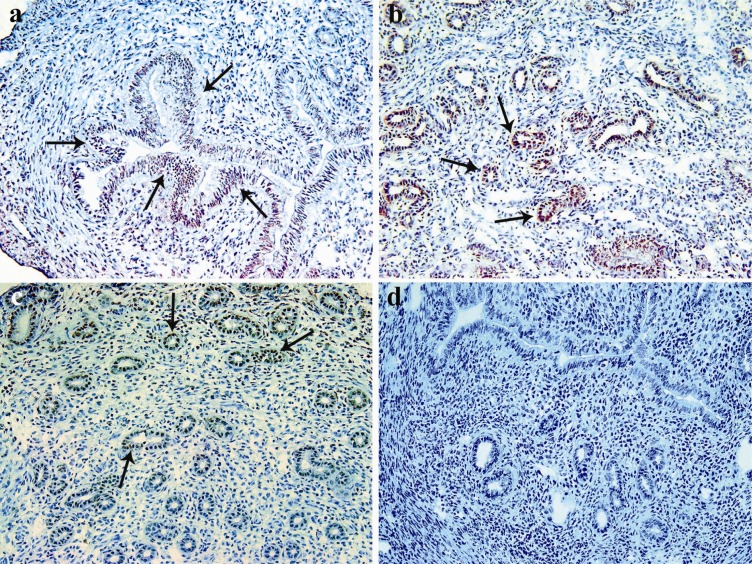
In this study, IDO was expressed both at the maternal (decidua) and fetal sides of placenta in all stages of murine pregnancy. Glandular and luminal epithelial cells were the prominent cell type in decidua basalis that expressed IDO during the gestational period (Figure 1). In addition, there were scattered populations of IDO positive cells in the endometrial stroma. IDO positive cells were also present in decidua capsularis. Beneath this layer, cells of chorionic membrane were positive for IDO as well (data not shown). Expression of IDO in the aforesaid cell population was continued until the end of pregnancy.
The study demonstrated strong anti-IDO antibody reactivity at the fetal side of placenta in both middle and late gestational periods (Figure 2). On the fetal face of the placenta, cells of both junctional and labyrinthine zones (syncytial cells) showed strong IDO expression. Trophoblast giant cells at the junctional zone were among the cells with strong IDO expression (Figure 2, black arrows).
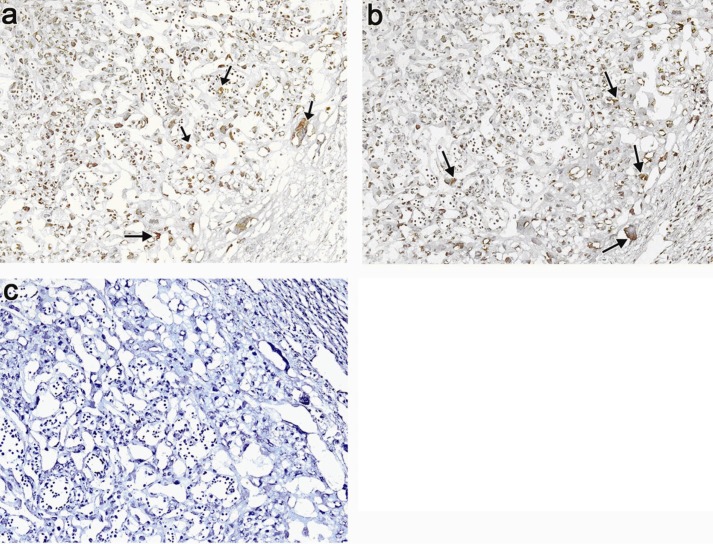
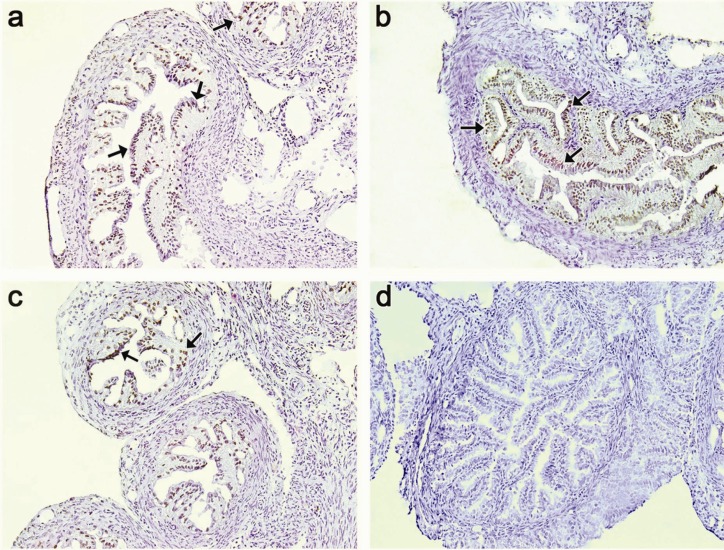
In all murine gestational stages, epithelial cells of the fallopian tubes were highly positive for IDO (Figure 3). Interestingly, the staining pattern of all cells was essentially perinuclear. When primary antibody was pre-adsorbed with immunizing peptide, no immunoreactivity was observed in negative reagent control slides confirming specificity of anti-IDO antibodies (Figures 1d, 2c and 3d).
Based on the results presented in this paper, IDO is expressed consistently at the maternal (decidua) and fetal side of placenta throughout murine gestational period. There are conflicting reports on the kinetic of IDO expression during pregnancy. Suzuki et al. showed that IDO protein and its mRNA were not expressed during early murine gestation, but they appeared 2-3 days afterwards, lasting for about three days and declining rapidly thereafter (26). According to von Rango's study (27), IDO expression starts at the mid-luteal phase in the menstrual cycle and remains high until the second trimester of pregnancy. However, glandular expression of IDO decreases during the second trimester, whereas its expression in villous tropho-blasts starts in the meantime. On the other hand, in an elegantly-designed study by Kudo et al., IDO was detectable immunohistochemically from day 6 of human blastocysts and thereafter throughout pregnancy in syncytiotrophoblasts, extravillous cytotrophoblasts and macrophages in the villous stroma and in the fetal membranes (28).
Recently, IDO localization in the reproductive tissues of rhesus monkeys was studied immuno-histochemically by Drenzek et al. (29). Likewise, IDO was expressed in all gestational periods of the monkeys. Although findings on kinetic expression of IDO at the feto-placental unit are largely inconsistent, but considering the protective role of this molecule, its steady expression is conceivable. Notably, in a very recent report by our group (25), we showed that expression of IDO is started very soon before the conception takes place in the endometrium of cycling mice which is in line with the findings of Drenzek et al. (29) and von Rango (27). Outstandingly, IDO expression was largely limited to epithelial cells of endometrium of non-pregnant mice (25), indicating contribution of these cell types in the regulation of local innate immune system as confirmed in the present study. The same finding was reported by Drenzek et al. showing localization of IDO in the epithelial cell of non-pregnant and pregnant endometrium. At the placental level, we showed that placental giant cells and spongio-throphoblasts express IDO steadily in all gestational periods, which is supported by Drenzek et al. (29).
IDO expression contributes to the suppression of potentially harmful maternal immune responses. IDO on the cells of syncytiotrophoblasts helps the survival of semi-allograft transplant of fetus by suppressive effects on T-cell proliferative responses (20, 21, 23, 24, 26).
Ligam P. et al. also proposed a physiological activity for this enzyme at the feto-maternal interface which may contribute to the regulation of blood flow or placental metabolism [30]. Indeed, induction of IDO by IFN-γ blocks growth of intracellular parasites (Toxoplasma gondii, Chlamydia psittaci, etc) by tryptophan depletion (31, 32). In addition, an extracellular antibacterial effect has been reported for IDO as inhibiting the growth of Enterococci by IFN-γ-activated human uroepithelial cells (33). IDO in epithelial cells of fallopian tubes, as reported in this study, may serve the same role in preventing ascending urinary tract infections during pregnancy.
Collectively, this study showed IDO expression at the protein level in endometrium, fallopian tubes and placenta of pregnant mice during the entire gestational period, reflecting its potential protective role in maintaining pregnancy. Quantitative analysis of IDO expression and functional study of its activity during different stages of pregnancy will increase the understanding of IDO-dependent immunoregulation at fetomaternal interface.
The authors are grateful to Razi Medical Scientific Festival for its financial support by Grant Number 3356/T/MM.
