
Spermatogenesis is a complex process of development that occurs in most mammals throughout adulthood period. This process happens in seminiferous tubules, lined with epithelial tissue that contains Sertoli cells. Sertoli cells are surrounded by a thin septum of peritubular cells that hold keep germ cells (1, 2).
The spermatogonia undergo mitotic divisions, meiotic alternations, and morphologically transform to highly developed cells, spermatozoa, with a unique function and structure (3). Such a complex process needs a unique program to control and regulate the involved genes. This gene regulation is accomplished by cell surface molecules which participate in cell to cell and cell to extracellular matrix interactions (4, 5). On the other hand, when sperm is passing through the male and female genital tracts, it gains fertilization ability (Capacitation) and adopts maturity characteristics. Maturity is initiated in the epididymis, where sperm communicates with the cell surface molecules of the pathway (6). Therefore, the investigation of stage and/or cell-specific molecular expression in testis or post-testicular maturation system can improve our understanding of germ cell differentiation and sperm formation (7).
Kurita et al. first identified a 38kDa protein (mTEX101) in adult mouse testis which is detectable on the surface of spermatocytes and spermatids in testis that it is absent on somatic cells, including Sertoli or interstitial cells, like Leydig cells (3). MTEX101 shows sexually dimorphic expression during gametogenesis. In the developing ovary, there is a temporary expression of mTEX101 on oogonia, but the molecule disappears in the mature ovary. In embryonic testis, mTEX101 is detected on the prosperm-atogonia (8). Upon puberty, mTEX101 mRNA is expressed in spermatocytes and in steps 1-9 spermatids during spermatogenesis, but not during spermatogonia. The TEX101 protein remains on the cell surfaces in steps 10-16 spermatids and testicular sperm, but hides from epididymal sperm after passing the caput epididymis (6).
MTEX101 homologues have been identified in rats and humans. Aside from testis, the expression of mTEX101 homologous protein has been reported in a leukemia cell line and lung cancer in rats and humans, respectively (9, 10).
The exact structure and function of mTEX101 is not completely understood yet, but it has been speculated that this protein is associated with several transmembrane proteins like Ly6k (11) and Cellubrevin (12) that transduce the extra-cellular signals to the intracellular molecules. The present study was undertaken to produce recombinant mTEX101, which might pave the way for the production of specific antibodies for further structural and functional characterization of the molecule.
Total RNA was isolated from male gonadal organs (four to 6 week-old mice from Pasteur Institute of Iran). RNA concentration was measured by a BioPhotometer (Eppendorf, Hamburg, Germany) at 260nm. One microgram of the total RNA was reversetranscribed to cDNA by using 200U of Molony Murine Leukemia Virus (RTM-MULV) reverse transcriptase enzyme (Fermentas, Vilnius, Lithuania), and 20pmol of random hexamer primers (Cybergene, Stockholm, Sweden). PCR amplifications for mTEX101 transcript was performed in a volume of 25µl using 10-20ng of testis cDNA, forward and reverse primers (10pmol each), specific for mTEX101 transcript, 10X PCR buffer (2.5µl), dNTP mixture (0.2mM each), 1mM MgCl2, and 1 unit of Taq DNA polymerase (Roche, Mannheim, Germany). PCR oligonucleotide primers were designed based on the mTEX101 ORF. Optimization of temperature and MgCl2 were performed to obtain a high quality PCR product. The best result was observed at 60°C with 1mM MgCl2. PCR reactions were carried out using a thermal cycler (Eppendorf Mastercycler Gradient) as indicated below: a preheating cycle at 95°C for 3min, 35 cycles of denaturation at 95°C for 30sec, annealing at 60°C for 30sec, extension at 72°C for 60sec, and finally a 7-min cycle at 72°C. The forward and reverse mTEX101 ORF primers used (Forward: 5′CCG AAT TCA TGG GAG CCT GCC GCA TCC AG 3′, Reverse: 5′ AGG GAA GTG GGT GAG GGG GGA GCA GAG CGG CCG C 3′.), contained EcoRI and NotI restriction enzyme (RE) sites, respectively.
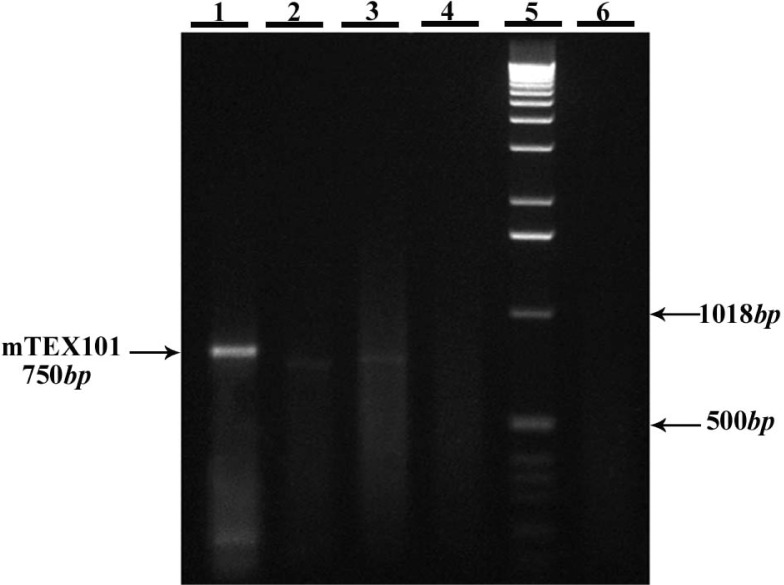
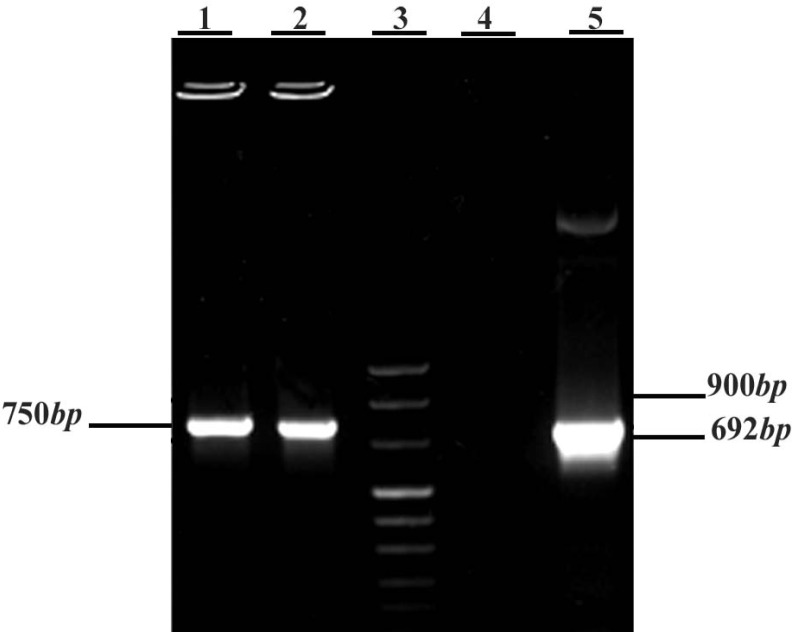
The PCR products were resolved by ethidium bromide-stained 1.5% agarose gel electrophoresis, which revealed a single distinct band at 750bp (Figure 1). The 750bp band was purified using QIA quick Gel Extraction Kit (QIAGEN, Germantown, MD, USA).
The pGEM-T Easy Vector (Promega, Madison, WI, USA) was used for the cloning of the purified PCR product. Ligation reac tion was set up by 50ng of pGEM-T Easy Vector (Promega), three units of T4 DNA ligase, 75ng of mTEX101 purified fragment, and 6µl of Rapid 2X Ligation Buffer (Promega). The mixture was incubated at 16°C for 16hrs. Competent cells of E. coli JM109 strain were used for transformation through heat shock method (17). The transformed bacteria were left for 1 hr in LB broth at 37°C for recovery, and later 100µl of the transformation culture was plated onto an ampicillin (100mg/ml) (Sigma, Louis, MO, USA), IPTG (Sigma) (0.5mM) and X-gal (Sigma), (80µg/ml) containing LB agar plate and was cultured for 16hrs at 37°C.
White colonies were screened by 25 cycles of colony PCR under the aforementioned conditions. The recombinant plasmids were isolated from confirmed colonies by miniperp kit (QIAGEN) and then digested by EcoRI and NotI restriction enzymes. Plasmid DNA (800ng) was used in 25µl of the total volume, including NotI (15units), (Invitrogen, Carlsbad, CA, USA), EcoRI (15 units), (Invitrogen), and 2.5µl of 10 X Reaction buffer 3 (Invitrogen) and incubated for 1.5 hr at 37°C. The mTEX101 fragment in pGEM-T Easy was extracted form agarose gel and then subcloned into a pET-28a (+) expression vector (Merck, Darmstadt, Germany) and was digested by the same restriction enzymes above. Ligation reaction was performed by 125ng of digested pET-28a (+), 0.5pmol of mTEX101 purified fragments, 2µl of Rapid 2X ligation buffer (Pro-mega), and 3 units of T4 DNA ligase (Promega) in 10µl of the total volume and it was incubated overnight at 4°C. Ligation products were used for transformation of E. coli JM109 strain by heat shock method (17). After a recovery time of 1 hour in LB broth, the transformed bacteria were cultured on LB agar and Kanamycin (50µg/ml) (Sigma, USA) containing plates for 16 hrs at 37°C. The obtained colonies were screened by colony PCR and one of them was confirmed by DNA sequencing. Recombinant plasmid was purified and was then used for transformation of BL21 (DE3), which is a protease deficient strain of E. coli.
A single transformed colony was inoculated into 50ml of LB broth, including Kanamycin (50µg/ml) (Sigma, USA) and untransformed BL21 (DE3) bacteria were cultured into 50 ml of LB medium. Incubation was performed under shaking at 37°C until the optical density (OD) at 600nm reached 0.6. Ten milliliters of each sample was removed as an uninduced control. IPTG (Sigma) was added to the remainder with the final concentration of 1mM and incubation continued for 2-3 more hours. The cells were harvested by centrifugation at 5000g for 5min at 4°C. Cell lysates were prepared by sonication of pellets in PBS buffer including 1% protease inhibitor (Roche).
Protein concentration of the cell lysates were determined by Bradford Protein Assay. Protein solutions were obtained from bacteria by boiling them in a sample buffer that contained Tris-HCl (pH=6.8, 0.5M), SDS (10% W/V), Glycerol (50% V/V), and Bromo Phenol Blue (0.5% W/V), for 5min. Samples (50µl of each) were separated by SDS-PAGE (8%) (Bio-Rad, Hercules, CA, USA) under non-reducing conditions. Untransformed and uninduced bacteria were used as negative controls.
The protein constituents were then electro-phoretically blotted onto a polyvinylidene difluoride (PVDF) membrane (Millipore, Billerica, MA, USA), as described by Towbin et al. (13). The membrane was blocked in 5% skim milk / 0.1% Tween 20 in PBS (pH 7.4), and then the reactivity of the transferred protein(s) with 1µg/ml of anti mTEX101 pAb (Avicenna Research Institute, Iran) was assessed using sheep anti rabbit Ig HRP (Avicenna Research Institute, Iran). Finally, the membranes were visualized using an ECL system (GE Healthcare, Biotech, Bucking-hamshire, UK).
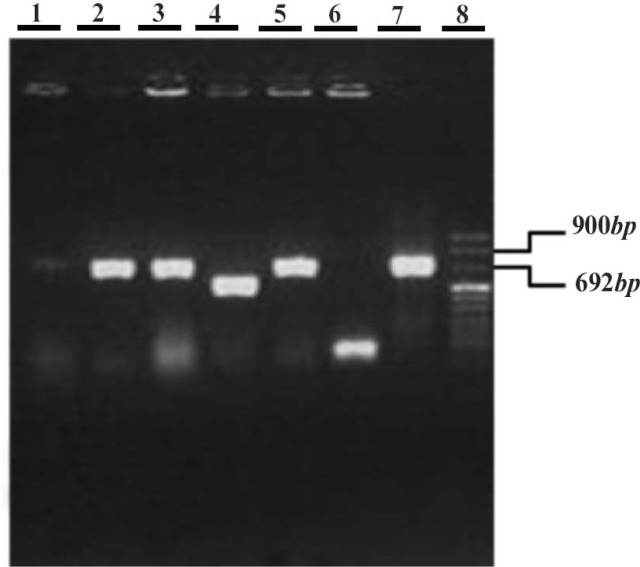
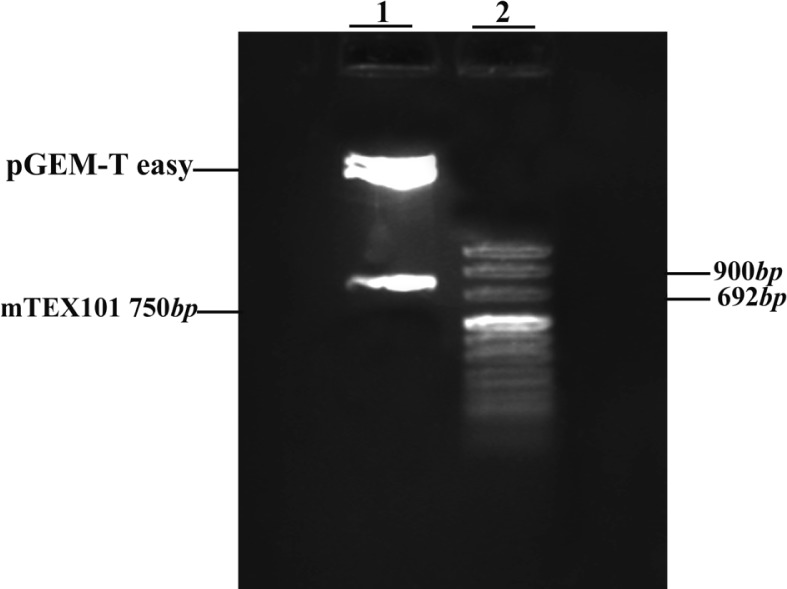
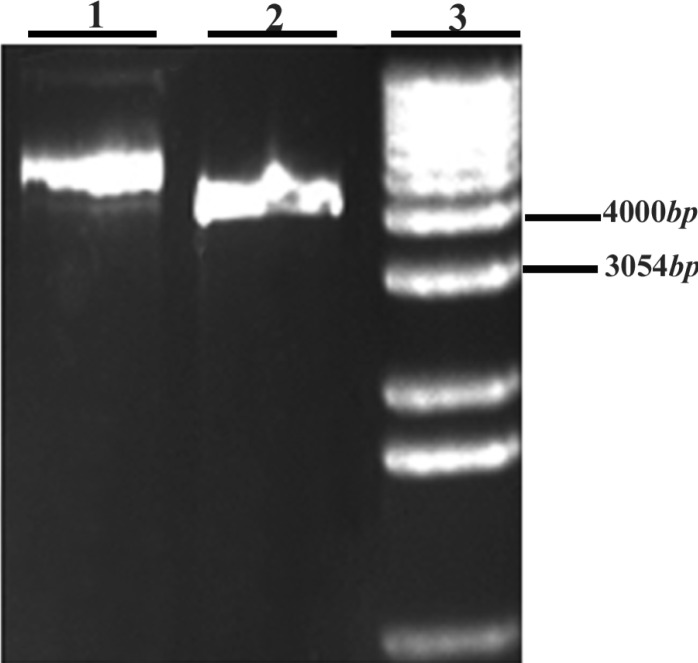
After cloning mTEX101 fragments in pGEM-T Easy Vector, several white colonies with probable target fragment inclusion were screened by colony PCR (Figure 2). A right-sized PCR product and a pET-28a(+) vector were cut by NotI and EcoRI restriction enzymes to obtain the required fragments for the next step (Figures 3 and 4).
E. coli J M109 strains were transformed using recombinant pET-28a(+) containing mTEX101 fragment and the undertaken transformation was verified by colony PCR (Figure 5). One of the confirmed colonies (clone 2 in Figure 5) was picked for detailed analysis by DNA sequencing. Alignment of DNA sequencing results with mTEX101 ORF by Genbee site (14) confirmed the cloned sequence. The verified fragment was used for the next round of transformation using E-coli BL21 (DE3) strain.
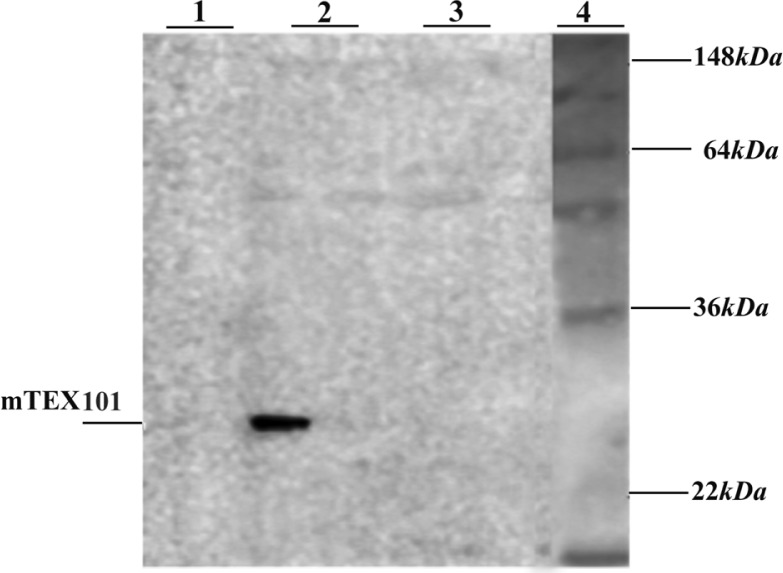
Western blot analysis using anti-mTE X 101 peptide polyclonal antibody revealed the correct size of mTEX101 recombinant protein production (27kDa) in BL-21 (DE3) bacteria (Figure 6).
MTEX101 was first reported and characterized by Kurita et al. in 2001 (3). The researchers immunized female mice with 8-week old testis lysates and obtained 12 monoclonal antibody producing clones (TES101-112). Immunohisto-chemistry analyses revealed that only TES101 was able to recognize a novel testicular protein as determined by searching the Expressed Sequence Tag (EST) database (3). All studies on mTEX101 protein are performed solely by TES101 antibody and presently, no commercial antibodies are available to carry out research on this protein. In this study, we produced mTEX101 recombinant protein that is useful for antibody development for further investigations.
MTEX101 mRNA contains 750 bases, which encodes 250 amino acids. After the removal of the putative 25-amino acid signal peptide at N-terminus, the molecular mass of the remaining protein is expected to be about 24kDa. Kurita et al. reported a 38kDa band by Western blot analysis under non-reducing conditions and no 24 kDa band was observed (3). This large difference in the molecular mass was speculated to be due to glycosylation of the peptide and it was proved to be true by Jin et al. observations (15).
Glycosylation is known as the prime cause of post-translational modifications (PTM) in proteins (16). The Asn-X-Ser/Thr is the basic sequence for N-linked glycosylation, however, the secondary structure of the protein can affect the final addition. No consensus sequence has been established for O-linked glycosylation yet (17).
Jin et al, found four putative sites for N-glyco-sylation and several possible sites for O-glyco-sylation in mTEX101 amino acid sequence (15). In fact, mTEX101 is a highly glycosylated protein and it has been clarified that most of the oligosaccharide chains on this peptide are N-linked carbohydrates (12). De-N-glycosylation of mTEX101 created an ∼20kDa band which is close to or even smaller than estimated molecular weight of mTEX101 amino acid backbone (15), confirming glycosylation as the cause for the higher mass of native mTEX101.
The cellular role of glycoprotein sugar components can be investigated via several methods, like protein production in a host lacking oligo-saccharide addition system, such as prokaryotes (18). We succeeded to produce mTEX101 recombinant protein in a prokaryotic system, which may be useful in clarifying the role of sugar components in protein structures. However, proteins which are produced by this method may vary in their structures and functions (19). Western blot analysis showed that this protein had a molecular mass of approximately 27kDa under non-reducing conditions that is concordant with the various post-translational modification processes in prokaryotic systems as compared to those in eukaryotes. The size of the recombinant protein (27kDa) is in conformity with the backbone protein (24kDa) and a 3kDa peptide derived from the digested vector by NotI and EcoRI restriction enzymes.
In this study, we successfully cloned mTEX101 into a His-tagged expression vector (pET-28a(+)), followed by an efficient production of the relevant recombinant protein. This protein can be used in antibody production to find out the role of mTEX101 in spermatogenesis, egg fertilization and further investigation about the critical role of glycosylation in the function of this protein.
We are deeply grateful to Mrs. R. Ghods, from Avicenna Research Institute, for her encouragements throughout the course of this study. This work was supported by a grant (number:957-33) from Avicenna Research Institute.
