
Endometriosis is defined as the growth of endometrial tissue including endometrial glands and stroma outside the uterine cavity, causing diverse diseases and signs such as infertility, pelvic pain, and dysmenorrhea (1, 2). Depending on the diagnostic method, the prevalence of this disease during reproductive period is reported to be 5 - 10% in the general population. The frequency of this disease among women who visit gynecologists for fallopian tube obstruction varies between 1 - 7% and in infertile women it varies between 9 - 50% (3, 4).
Although, this disease has been described and diagnosed for more than 100 years now, the mechanisms underlying the development of the disease are still unclear. While the transplantation of endometrial tissue into the pelvic peritoneum via retrograde menstruation is considered as one of the most widely accepted explanation for the pathogenesis of the disease, this physiological process does not lead to the onset of the disease in the majority of cases. Therefore, diverse factors are thought to be involved in the development of the disease, such as environmental, immunological, endocrine and genetic predispositions (5).
Angiogenesis is known to play a key role in the implantation and growth of the endometrial tissue displaced by retrograde menstruation (6, 7). Endo-metriotic lesions with high proliferative activity have a higher microvessel density compared to lesions with low proliferative activity (8).
Vascular Endothelial Growth Factor (VEGF) is a heparin-binding glycoprotein which is known as one of the strongest factors with angiogenesis properties (6). This glycoprotein plays a fundamental role in regulating angiogenesis and vascular permeability in both physiological and pathological states (9). There are many reasons indicating the role of VEGF in the development of endometriosis, such as expression of VEGF in stromal and epithelial cells and its regulation by estrogen (10, 11). Comparison of endometrial epithelial cells in patients suffering from endo-metriosis with healthy subjects shows higher levels of VEGF, specifically at the end of the secretory phase of menstrual cycle, and these cells are found more in red than black endometriotic lesions (12, 13). Furthermore, peritoneal cavity fluid in patients with endometriosis shows significantly elevated levels of VEGF compared to that of controls (6, 14, 15). VEGF is also considered as a diagnostic tool and candidate gene for the diagnosis of endometriosis. Based on genetic association studies, a few mutations and single nucleotide polymorphisms (SNPs) found in VEGF gene are regarded functionally important. For example, +405 G>C polymorphism in 5’ untranslated region affects the level of VEGF protein expression (16, 17).
Numerous studies have reported that VEGF gene polymorphisms are associated with prostate cancer, development of proliferative diabetic retinopathy and decreased risk of breast cancer (18–20).
Recently, the association of -460 C>T VEGF gene polymorphism with endometriosis was demonstrated (21). Furthermore, three research groups which have investigated the existence of any association between endometriosis and +405 G>C polymorphism in Chinese (21), South Indians (5) and Korean women (2), have reported positive findings, but to date, these results have not been confirmed in other populations.
In the present study, the correlation of VEGF gene +405 G>C polymorphism with endo-metriosis in an Iranian population was assessed.
To assess +405 G>C VEGF gene polymorphism, blood samples were collected from 20 – 50-year old women, who had been referred to Avicenna Infertility Clinic and Tehran Clinic Hospital in Tehran, Iran. One-hundred and five patients with endometriosis and 150 women with no gynecological problems were selected as cases and controls, respectively. The diagnosis of endometriosis was confirmed by laparoscopy.
Women having rheumatoid arthritis, giant cell arthritis, diabetic retinopathy, psoriasis and Behçet's disease were excluded from the study. The protocol of the study was also approved by the Ethics Committee of Avicenna Research Institute. A written informed consent was obtained from all the participants.
Five milliliters of peripheral blood samples were collected in tubes containing 200 µl of 0.5 M EDTA. Genomic DNA was extracted from the obtained blood samples using the salting-out method.
Genotyping of the 405 G>C polymorphisms in VEGF gene was determined by employing PCR / RFLP method. One pair of primers (Forward: 5' CCACTTGAATCGGGCCGACG 3', Reverse: 5' GTCTGTCTGTCTGTCCGTCA 3') was used to amplify the relevant fragment and analyze the +405 C>G variation. Each PCR reaction with a total volume of 25 µl, contained 50 ng of genomic DNA, 5 pmol of each primer, 1.5 mM of MgCl2 (Roche, Germany) and one unit of DNA polymerase (Roche, Germany). Amplification was performed in a programmable thermal cycler gradient PCR system (Eppendorf, Germany). DNA was denatured at 94° C for 5 minutes. The PCR amplification was carried out for 30 cycles (denaturation at 94° C for 30 sec, annealing at 61° C for 30 sec, extension at 72° C for 30 sec and final extension for 7 min at 72° C).
The PCR products, harboring the polymorphism at 5’ UTR of VEGF gene were analyzed using 1.5% agarose gel electrophoresis followed by ethidium bromide staining and ultraviolet visualization. The PCR products were digested with restriction enzyme BsmFI (New England Biolabs, UK) at 65° C overnight for +405 C>G Polymorphism, separated by polyacrylamide gel electrophoresis, and identified using silver nitrate staining. The +405 G allele was cut into two fragments of 101 and 181 bp, while the +405 C allele remained uncut (282 bp) (Figure 1).
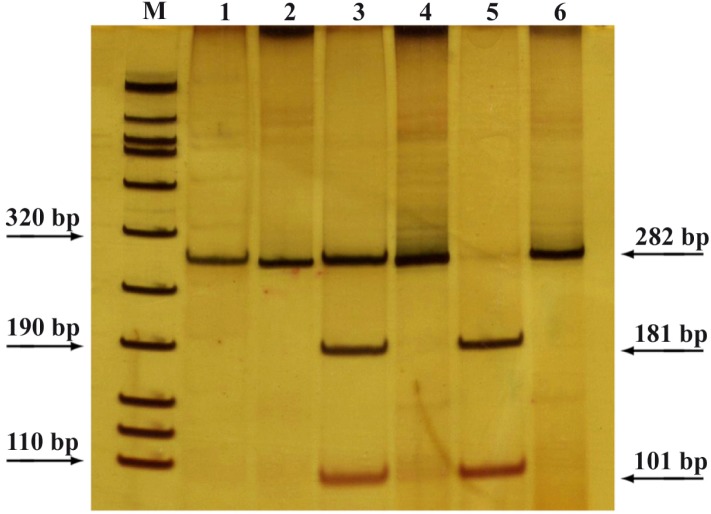
According to the restriction digestion pattern and gel staining analysis, genotypes of the participants were divided into three groups based on the presence or absence of polymorphism: wild-type homozygote, variant homozygote and heterozygote DNAs.
Statistical analysis was performed using SPSS statistical package (V. 13.0). Allele ratios and genotype distributions in the cases and controls were analyzed by logistic regression. GG genotype and G alleles were assumed as reference group in the analysis using Pearson's Chi-square exact test. Odds ratios were calculated with 95% confidence intervals (CIs). P-values less than 0.05 were considered statistically significant.
The +405 VEGF genotype frequencies in the case group were as follows: 41.3% G/G, 46.2% C/G and %12.5 C/C representing 43, 48 and 13 patients respectively. The genotype frequencies in the control group were 32% GG, %53.3 GC and 14.7% CC in 48, 80 and 22 patients, respectively. There were no statistically significant differences between the cases and controls in terms of 405 G/C genotype distributions and allele frequencies (p = 0.267), Table 1.
Table 1 The distribution of genotype and allele frequencies in the studied groups
| Genotype/Allele | Study Group | P-value | OR | ||
|---|---|---|---|---|---|
|
| |||||
| Patients (Number) | Controls (Number) | ||||
| Genotype | |||||
| GG | 48 | 83 | Reference Group | ||
| GC | 80 | 48 | 0.150 | 0.67 (0.39 - 1.15) | |
| CC | 22 | 13 | 0.308 | 0.66 (0.3 - 1.47) | |
| Allele | |||||
| G | 133 | 176 | Reference Group | ||
| C | 75 | 124 | 0.267 | 0.8 (0.55 - 1.17) | |
A key mediator in angiogenesis is vascular endothelial growth factor, as it stimulates endothelial cell proliferation and migration and increases vascular permeability. Recent studies have shown the association of VEGF gene polymorphisms with the development of diseases in which angiogenesis plays an important role. In the present study, the possible correlation between endometriosis and +405 G>C VEGF gene Polymorphism was studied in an Iranian population.
Awata et al. showed that +405 C/C VEGF gene polymorphism versus G/G genotype in type II diabetes mellitus increases the possibility of retinopathy of about three folds (22). Patients with psoriasis showed a significant increase in the frequency of C allele and +405 C/C genotype of VEGF gene compared to healthy controls (23).
VEGF gene is located on chromosome 6p21.3. This gene consists of 8 exons and the gene transcript undergoes alternative splicing processes to produce a protein family (24). There are a few transcription factor binding sites in 5’ untranslated region in VEGF gene (25). Hence, polymorphisms in this region result in different levels of gene expression in people, causing various ranges of diseases.
Three separate research groups carried out case-control studies on various populations to determine the association between endometriosis and +405 G>C VEGF gene polymorphism. Watson et al showed that the G allele at +405 possibly resided within a potential myeloid zinc finger protein (MZF1) binding site and had direct effects on the level of gene transcription and ultimately on LPS-stimulated VEGF protein expression in peripheral blood mononuclear cells (PBMCs) (17).
Bhanoori et al. evaluated 215 women with endometriosis and 210 with no evidence of the disease and reported significant difference between the prevalence of endometriosis and +405 G>C polymorphism (p = 0.002) in a way that the G allele frequency was 81.7% in rAFS stage III – IV endometriosis while it was 72.7% in the controls (5). In contrast, Kim et al. selected 215 women with an advanced stage of endometriosis as the case group, 219 women without endometriosis and 70 fertile women as the control group and showed that the frequency of +405 C/C genotype in patients with severe endometriosis was more than that of the control group (2). Similarly, Gentilini et al. examined 203 Italian women affected by endometriosis and 140 women without laparoscopic evidence of the disease and confirmed the possibility of endometriosis to be almost two times higher in patients carrying the C allele. Moreover, they showed that the existence of this allele could be a risk factor for the implantation of endometrial fragments which are refluxed into the peritoneal cavity (26). On the other hand, Awata et al. showed a high serum VEGF levels in healthy Japanese population with +405 C/C genotype distribution.
Our findings were not in lines with previously stated studies perhaps due to difference in geographical location or the genetic basis of the studied population, as the possibility of a disease occurrence depends on both its prevalence in the population and environmental factors (27). Race difference and genetic backgrounds are important factors in genetic association studies. Therefore selection of different control groups might lead to dissimilar results (27). For example, in the present study, the control group was comprised of women without the disease as confirmed by laparoscopy, while in a study on the Japanese population female neonates were selected as the control group (9). On the other hand, in a study carried out on the Korean population, the control group was made up of women who had either benign ovarian cysts, infertility, pelvic pain or dysmenorrhea (2).
In the present study, the genotype and allele distribution of the +405 C>G VEGF gene Polymorphism was not significantly different between the cases and the controls. However, further studies on larger Iranian populations may be necessary to confirm these observations.
The authors would like to thank Avicenna Research Institute for supporting this study, Mrs. Jamshidi and other operating room personnel of the Gynecological Surgery Ward at Tehran Clinic Hospital and also Mrs. Elham Savad Shirazi, Mrs. Bahareh Beik at Avicenna Infertility Clinic for help in collecting the study subjects.
