
Around 15 to 20% of all pregnancies in humans end in spontaneous abortions. The prevalence of chromosomal abnormalities in those abortions is as high as 50%. Although the cause is unknown in many instances, but parental chromosomal abnormality is one of the possible causes for recurrence of miscarriages in the first three months of pregnancy (1).
Robertsonian translocations (RTs) are recognized to be the most common structural chromosomal abnormalities in the population with an incidence of 1.23/1000 live births (2).
Translocations are of two main types: reciprocal and Robertsonian. Reciprocal translocations represent the exchange of chromatin blocks between two non-homologous chromosomes. The process requires breakage of the involved chromosomes within an abnormal arrangement. Its incidence in neonates is estimated to be at about 1/1000 to 2/1000 live births (3). Robertsonian translocation involves two acrocentric chromosomes, which fuse at the centromeric region and lose their short arms.
These chromosomal translocations are mainly observed in group D including 13, 14, 15 and group G including 21 and 22 chromosomes. The most frequent type of D/D translocation includes 13; 14 translocation, whereas translocation rob (13; 15) and rob (14; 15) are rare structural rearrangements among Robertsonian translocations (4). In Robertsonian translocation, the pericentric regions of two acrocentric chromosomes fuse to form a single centromere or two. The resulting balanced karyotype has only 45 chromosomes including the translocated one, which is the result of a fusion of the long arms of two acrocentric chromosomes (5). In the present study, we report a Robertsonian translocation rob (14; 15) in a female patient with a history of repeated abortions.
A non-consanguineous couple (a 27-year old male and a 25-year old female) with the complaint of repeated abortions attended the aforementioned Institute for cytogenetic evaluation. They had a history of three repeated abortions in the past two years of their married life. The first abortion was four months from pregnancy resulting in a fetus with anencephaly, kyphosis and cephalocele and the second was a blighted ovum at 3rd month of pregnancy. The third was a missed abortion from a of 2-month pregnancy. There were no such histories of repeated abortions in any other family member.
Two milliliters of peripheral blood was obtained from both partners in heparinised tubes to harvest white blood cells for karyotyping (6, 7). Twenty-five metaphases were analyzed and the karyotype was interpreted using the Applied Imaging Software. The chromosomes were identified and classified according to the guidelines by the International System for human Cytogenetic Nomenclature (ISCN, 1995) (8).
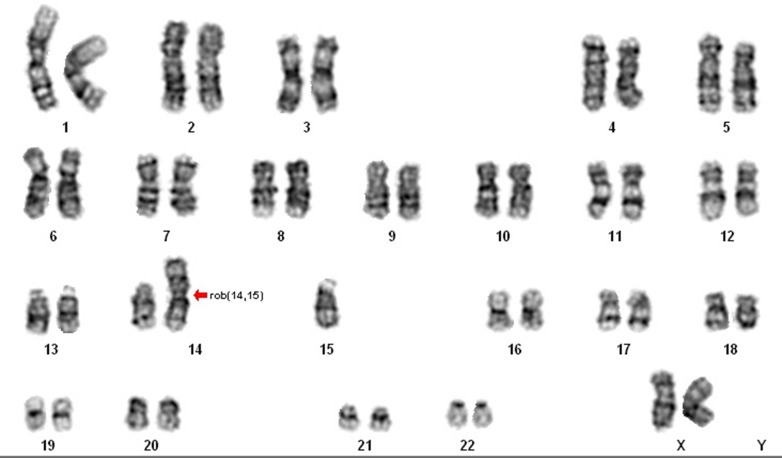
Chromosomal analysis revealed an abnormality in the female partner with 45, XX, rob (14; 15) (q10; q10) chromosomal constitution. The female karyotype revealed 45 chromosomes with missing chromosomes of 14 and 15, along with an additional chromosome which did not fit into any group of the chromosomes in the karyotype. The banding pattern of the short and long arms of the additional chromosome was similar to chromosome 14 and 15, thereby indicating the presence of a non-homologous RT. Thus, karyotype was confirmed as 45, XX, rob (14;15) (q10:q10) as depicted in Fig 1. Chromosomal analysis of the male partner showed normal 46, XY karyotype.
Chromosomal aberrations lead to reduced fertility in both men and women. About 15 to 20% of pregnancies end in spontaneous abortion, mostly in the first trimester, the most frequent cause being chromosomal abnormalities, with a prevalence of approximately 50% in spontaneous abortions. The majority of chromosomal anomalies (95%) are numerical, about 60% are trisomies, 20% are represented by X monosomy and another 15% by polyploidy, especially triploidy (9). In the case of a numerical chromosomal aberration in the fetus, parental chromosomes are usually normal; therefore, cytogenetic analysis of the parents is not indicated. Apart from numerical aberrations, structural aberrations (5%) of the chromosomes can also be the cause of pregnancy loss and subsequent infertility (10). The presence of a balanced chromosomal rearrangement in a parent results in an increased risk for structural chromosomal defects in future pregnancies. It is estimated that in about 70% of couples with at least two spontaneous abortions, one parent carries a balanced chromosomal rearrangement such as inversions, translocation, etc (11).
In the present study, the female partner exhibited a balanced Robertsonian translocation, with 45 chromosomes. The observed translocation could be due to either mutation or segregation in the offspring of a balanced carrier. The carrier of a Robertsonian translocation has a normal phenotype but is at risk of producing unbalanced gametes and, therefore, unbalanced offspring. In general, the prevalence of chromosomal abnormalities is higher in females than in males.
Subfertility in translocation carriers can be brought about in two ways. First, it can result from the production of genetically unbalanced gametes, which lead to spontaneous abortions of unbalanced zygotes. Second, it can be the consequence of the oogenic disturbances resulting in unviable zygotes (12).
In the present case, a trivalent configuration in metaphase I of meiosis could have resulted in a monosomic or trisomic condition. During pachytene stage in meiosis I, homologous pairing of Robertsonian translocation is achieved by the formation of a trivalent structure. If an alternate segregation occurs, then all gametes are potentially viable with balanced chromosomes. Nevertheless, adjacent segregations result in gametes, which are nullisomic or disomic for one of the chromosomes involved in the rearrangement and consequently a zygote with trisomy or monosomy for one of the involved chromosomes. Zygotes with monosomy are not compatible with life and most translocated trisomy concepti are expected to result in early or first trimester losses. However, some survive beyond the second trimester or up to the term (13).
Cytogenetic analysis of couples with recurrent abortions is mandatory to evaluate the probable presence of any chromosomal aberrations. This will offer valuable data for the appropriate genetic counseling strategies. Physicians should be aware of the condition as at least 5% of these couples with repeated abortions exhibit chromosomal abnormalities as the cause. Such cases have to be analysed as early as possible to arrange for adequate genetic counseling and to allow couples to make an informed reproductive decision regarding subsequent pregnancies. Prenatal diagnosis should be offered to these couples in the case of future pregnancies.
Authors thank Mrs. K. Veena and Mr. M. Panduranga Chary for the technical assistance.
