
Intrauterine insemination (IUI) is the first therapeutic step in assisted reproductive techniques, and is especially appropriate for cases with mild male factor infertility, anovulation, endometriosis with at least one patent tube, and unexplained infertility (1). Among the assisted reproductive techniques, IUI is considered a first-line procedure due to its simplicity, easy management, low cost, and absence of potentially serious complications. Although the literature reports several factors affecting the likelihood of pregnancy after IUI, among them, age, body mass index (BMI), female etiology, and semen quality, there is little consensus regarding the extent to which these factors affect the likelihood of pregnancy (2–4).
Epidemiological studies report varying rates of infertility in developed countries, ranging between 8% and 32% of couples of reproductive age (5–10). Recent data for Spain indicate that approximately 15% of couples of childbearing age have problems conceiving (11).
The objective of this study was to identify factors that predict pregnancy in terms of 3 categories: female infertility factors (duration of infertility, age, weight, hormones on the 3rd day of the cycle, and etiology), male infertility factors (semen analysis according to the strict morphology criteria), and technique-dependent factors (type of insemination, number of cycles, number of inseminations per cycle, follicle development, type of stimulation received, and total dose administered).
This is a retrospective study performed between 2002 and 2009 on 1201 couples with infertility problems, who consulted the reproduction department of Virgen de la Arrixaca University Hospital in Murcia, Spain. Overall, we analyzed 3012 IUI cycles. A basic infertility study was performed before starting controlled ovarian hyperstimulation (COH). The study consisted of medical history, physical examination, transvaginal ultra-sonography, hormone study, hysterosalpingogram, and semen analysis. The hormones studied were follicle stimulating hormone (FSH), luteinizing hormone (LH), prolactin (PRL), and estradiol on the third day and estradiol, progesterone, and PRL on the 22nd day of menstrual cycle. PRL was analyzed twice in the same cycle, since the value of this hormone can be affected by punction stress.
The swim-up technique was used to prepare the semen and the total motile spermatozoa (TMS) count was done by multiplying the total sperm count by the prewash percentage of motile sperm. Based on semen analysis, oligo/astheno/ teratospermia (OAT) were classified: mild OAT (TMS >5 million); moderate OAT (TMS 3–5 million); and severe OAT (<3 million sperm). Sperm morphology was rated according to Kruger cri-teria (teratospermia < 5% normal sperm shapes).
All IUI cycles were stimulated by gonadotropins. Treatment was started between the second and fifth day of the cycle, using pure urinary FSH (pFSH; Fostipur), recombinant FSH (rFSH; Gonal-F or Puregon), or human menopausal gonadotropin (hMG; Menopur). The most frequent starting dose of gonadotropins was 75–150 IU/24 hr. Hormone administration was adjusted accord-ing to each patient's characteristics, especially age, hormones on the third day of the cycle, and BMI. The first ultrasound scan to assess the number and size of follicles and endometrial thickness was performed five days after starting the treatment, and subsequent scans were performed on individual patients depending on ovarian response. Ovulation was induced by 250 µg of sub-cutaneously administered recombinant human chorionic gonadotropin (hCG; Ovitrelle), and insemination was performed 36 hr later. The criterion used to trigger ovulation was to obtain at least a single 18 mm follicle.
Following 48–72 hr of abstinence, semen was collected three hours before insemination for laboratory processing. After determining motility (TMS), sperm were washed free of seminal fluid and prepared for insemination. A soft catheter (Laboratoire CCD, Paris, France) was used for insemination. The proximal end of the catheter was located in the center of the uterine cavity, and 0.5 ml of sperm preparation was slowly injected over about 15 s. A hard catheter (Laboratoire CCD) was used if it was not possible to pass the soft catheter through the cervix. Luteal phase support was provided by 200 mg/24 hr of natural micronized progesterone (Utrogestan), administered vaginally starting on the night of insemination and continuing until the pregnancy test; if pregnancy occurred, administration continued until the 12th week of gestation.
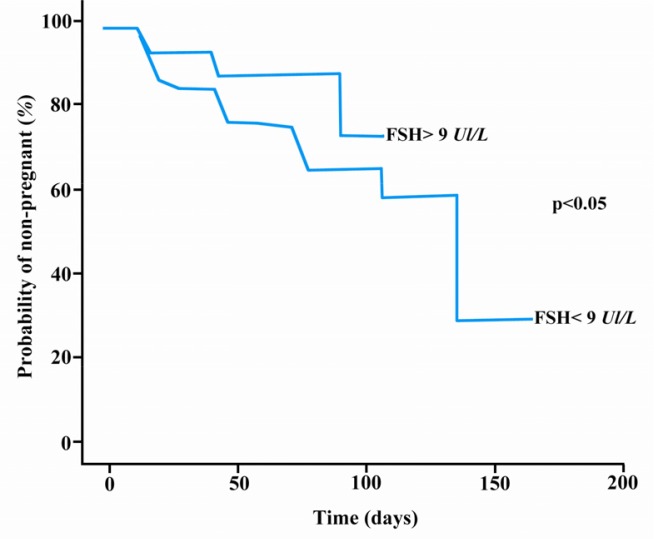
Statistical analysis was carried out using SPSS version 15. Results were expressed as means. Categorical variables were compared using the chi-square test (χ 2) and quantitative variables were analyzed using the Student's t-test. A value of p < 0.05 was considered statistically significant. The Kaplan-Meier method was used to measure the time elapsing until pregnancy as a function of baseline FSH levels. Multivariate logistic regression analysis was performed to identify correlations between the study variables and pregnancy. Only statistically significant co-variables were selected.
We studied a total of 3012 IUI cycles corresponding to 1201 couples between 2002 and 2009, for which the outcome was 306 pregnancies (10.2% per cycle), representing a pregnancy rate per couple of 25.5%. Infertility was primary and secondary in 87.8% and 12.2% of the cases, respectively. Female and male infertility factors were detected in 21.9% and 26.3% of the cases, respectively. Infertility was due to combined factors in 35.3% of the cases, and was unexplained in the remaining 16.5%. The mean duration of infertility was 3.04 years (range, 1 to 10). The pregnancy rate decreased significantly (p< 0.05), in line with years of infertility: 1 year (12.3%), 2 years (10.3%), 3 years (9.8%), and 4 or more years (8.9%).
The mean age of the participants was 32.2 years (range, 23 to 41 years), and mean BMI was 26 (range, 18 to 38). Age was not a strong predictor of success: the pregnancy rates per cycle for age brackets below 30 years, 30 to 35 years, and 35 to 40 years, were 11.4%, 10.6%, and 9.6%, respectively. Women older than 40 years only underwent 20 cycles, and none became pregnant. The participant's weight, however, did affect the pregnancy rate. The proportion of pregnancies increased with BMI, with a significant difference between a BMI (kg/m 2) under 25 (18.5 to <25), and a BMI of 25 or more (≥25 to 35.0) (8.9% vs. 12.1%; p < 0.05).
Ovarian function was calculated in terms of serum concentrations of FSH and estradiol before cycle commencement. A strongly significant relationship was observed between the FSH value on the third day of the cycle and the probability of pregnancy (p < 0.01), (Table 1).
Table 1 Results for female- and male-dependent factors
| Pregnancy predictors | Rate/Cycle (%) |
|---|---|
| Female factors | |
| Irregular ovulation | 8.9 |
| Occult ovarian failure | 7.7 |
| Anovulation (PCOS) | 13.3 |
| Tuboperitoneal | 7.7 |
| Endometriosis | |
| I-II | 7.0 |
| III-IV | 6.4 |
| Male factors | |
| Asthenospermia | 8.1 |
| OAT | 9.4 |
| Mild | 8.5 |
| Moderate | 6.4 |
| Severe | |
| Teratospermia | 10.8 |
| Azoospermia | 16.7 |
In terms of baseline FSH, we observed that the probability of pregnancy during IUI cycles fell significantly for baseline FSH values of 9 IU/L or more (p < 0.05) (Figure 1).
The estradiol value on the third day of the cycle (over 80 pg/ml) was not a relevant pregnancy predictor.
Female infertility factors were classified as follows, in order of frequency: irregular ovulation due to short or unsuitable luteal phases (41.2%); tuboperitoneal factors (16.5%); anovulation associated with polycystic ovary syndrome (PCOS) (10.4%); occult ovarian failure (10.2%); stage I-II endometriosis (7.8%); stage III-IV endometriosis (2.8%); uterine factors (2.6%); cervical factors (1.7%); and other causes (6.8%).
Female etiology was a powerful predictor of success in achieving pregnancy. Couples treated for anovulation associated with PCOS had the highest pregnancy rate per cycle (13.3%; p < 0.05). The lowest pregnancy rates were obtained for moderate to severe cases of endometriosis (6.4%), (Table 1).
Based on semen analysis, male infertility factors were classified as follows, in order of frequency: asthenospermia (29.4%); mild oligo/astheno/teratospermia (OAT) (24%); moderate OAT (18.9%); severe OAT (6%); oligospermia (0.7%); teratospermia (4.1%); azoospermia (12.5%); and causes unrelated to semen quality, such as erectile dysfunction, positive serology results, etc (4.4%).
Male factor etiology was a powerful predictor of success in achieving pregnancy when donor sperm was used due to azoospermia in the partner. Couples treated for azoospermia had the highest pregnancy rates per cycle (16.7%; p < 0.01), (Table 1).
Multivariate analysis was used to determine whether there was an association between pregnancy and the predictors that were found to be significant. The results are shown in Table 2.
Table 2 Factors associated with the probability of pregnancy (Multivariate analysis)
| Factors | Odds Ratio | 95% Confidence Interval | p-value |
|---|---|---|---|
| Anovulation (due to PCOS) | 1.47 | 0.93-2.31 | 0.09 |
| Infertility duration (less than 4 years) | 0.56 | 0.26-1.18 | 0.13 |
| BMI (25 and over) | 0.82 | 0.54-1.25 | 0.35 |
| FSH (below 9 IU/L ) | 3.17 | 1.36-7.41 | 0.008 |
Women with a baseline FSH below 9 IU/L were 3.17 times more likely to become pregnant than women with a baseline FSH of 9 IU/L or more (95% CI: 1.3–;7.4 times).
The type of semen used (partner or donor) was a strong predictor of success, with a pregnancy rate per cycle of 18.1% for donor sperm (p < 0.01) Results for the technique-dependent factors are summarized in Table 3.
Table 3 Results for technique-dependent factors
| Cycles (n) | Pregnancies | Rate/Cycle (%) | ||
|---|---|---|---|---|
| Insemination type | ||||
| IUI–Partner | 2708 | 251 | 9.3 | |
| IUI–Donor | 304 | 55 | 18.1 | |
| Cycle | ||||
| 1st | 1202 | 129 | 10.7 | |
| 2nd | 884 | 94 | 10.6 | |
| 3rd | 571 | 59 | 10.3 | |
| 4th | 300 | 22 | 7.3 | |
| ≥5th | 55 | 2 | 3.6 | |
| Follicles ( n ) | ||||
| 1 | 1535 | 124 | 8.1 | |
| ≥2 | 1477 | 182 | 12.3 | |
| Stimulation | ||||
| rFSH | 2549 | 259 | 10.2 | |
| hMG | 347 | 33 | 9.5 | |
| pFSH | 67 | 7 | 10.4 | |
| Total dose | ||||
| <300 IU/L | 152 | 14 | 9.2 | |
| 300-499 IU/L | 1139 | 104 | 9.1 | |
| 500-699 IU/L | 1294 | 121 | 9.4 | |
| 700-899 IU/L | 320 | 53 | 12.6 | |
| 900-1100 IU/L | 107 | 14 | 13.1 |
In terms of the number of IUI cycles performed, the couples underwent an average 2.1 cycles each (range, 1 to 6). In 98.2% of the cases, between one to four inseminations were performed. A maintained pregnancy rate was observed until the third cycle, after which the pregnancy rate decreased noticeably (p < 0.01), (Table 3).
In terms of the number of inseminations per cycle, in 95.6% of the cases a single insemination was performed. The pregnancy rate was not found to increase when two inseminations were performed in the same cycle.
The number of pre-ovulatory follicles recruited was observed to be a significant factor (p < 0.01). Recruitment of at least two follicles increased the pregnancy rate in cases of COH combined with IUI (Table 3).
Regarding the type of gonadotropin used, rFSH was administered in most cycles (86.3%), followed by hMG (11.5%), and pFSH (2.2%). The type of stimulation used did not affect the probability of pregnancy (Table 3). The mean dose of administered gonadotropin was 600 IU/L. The units of FSH used for COH were a marker of success (p< 0.05).
IUI is frequently offered to couples with problems conceiving, provided the woman has at least one patent ovarian tube and her partner has only mildly altered semen quality. An important factor to assess as a predictor of pregnancy in response to IUI is the duration of infertility. A number of studies have reported higher pregnancy rates corresponding to shorter periods of infertility (12, 13) but our study revealed significant differences (p < 0.05) in this regard. Nuojua-Huttunen et al. (14), unlike Goverde et al. (15), reported significant differences that depended on whether the infertility period was more or less than six years (14.2% vs. 6.1%). We observed that pregnancy rate fell as the duration of infertility increased, suggesting that other more complex assisted reproduction techniques should be used after four years of infertility.
In our study, the woman's age did not significantly affect the pregnancy rate. Nuojua-Huttunen et al. (14) reported a pregnancy rate of 13.7% per cycle for a total of 811 IUI cycles in women up to the age of 40, and a rate of 4.1% thereafter. Like Brzechffa et al. (15), we found that, after COH, age did not affect the pregnancy rate provided the woman was under 40 years. Other researchers, however, such as Goverde et al. (16), and Bronte et al. (17) consider age to be an important factor in achieving pregnancy.
Souter et al. (10) described the impact of BMI on IUI cycles. In our analysis, BMI significantly affected the pregnancy rate; however, women with a BMI of 25 or more achieved a higher pregnancy rate (12.1% per cycle) than women with a BMI below 25 (8.9%). Our results would indicate that in women with overweight that undergo treatment for anovulation, the likelihood of achieving pregnancy increases significantly. Dodson and Legros (18) found no differences for weight, although they did observe that higher gonadotropin doses were necessary for ovarian stimulation in obese women. Another study (19) pointed to the impact of lifestyle factors such as excess weight on the time elapsing before becoming pregnant; the annual probability of pregnancy for couples not exposed to risk factors was 83%, compared to 38% when they were present. Undoubtedly, lifestyle changes, exercise and weight loss are key factors in successfully treating infertility in such patients (20, 21).
A hormone analysis (estradiol and FSH) on the third day of the cycle is the main method for evaluating ovarian reserve. In our study we found a significant difference in pregnancy rates according to FSH levels, with values above 9 IU/L reducing the probability of pregnancy. In contrast, there was no clear difference regarding estradiol concentrations. A number of authors agree that higher FSH concentrations reduce the overall number of follicles produced, affect oocyte quality, and indicate a less favorable prognosis for treatment (22, 23), even though the cycle may appear to be regular (24). However, Mullin et al. (25), who evaluated threshold FSH and estradiol values of 15 IU/L and 80 pg/ml, respectively, found no significant differences in the pregnancy rate per couple. We agree with the opinion that women for whom ovulation induction prior to IUI is likely to be effective–that is, those with functioning ovaries–should be selected for this procedure (26).
In our study, the pregnancy rate per cycle for patients with anovulation due to PCOS was 13.3%, confirming the significant relationship between this etiology and IUI outcomes. It seems clear that COH corrects ovulation and, therefore, results in a high IUI success rate. Endometriosis, on the other hand, which is among the disorders that are the most difficult to treat (27), decreased the IUI success rate in our study to 7% per cycle for mild cases and to 6.4% for severe ones. Similar results were obtained by Vlahos et al. (28), who reported a pregnancy rate per cycle of 19.1% for cases with anovulation, compared to 9.1% for cases with endometriosis, and by Dickey et al. (29), who also reported better results for cases with anovulation. Toma and Hammond (30) reported a pregnancy rate of 6.5% per IUI cycle for donor sperm in women with stage I-II endometriosis compared to 14% in the control group. Some other authors (14) reported similar results.
Dorjpurev et al. (31) described the influence of semen characteristics on the pregnancy rate following IUI. In our case, using donor sperm for cases of azoospermia resulted in a pregnancy rate per cycle of 16.7%. When only mobility and altered morphology were considered, our study showed no significant differences; however, when OAT was included, the pregnancy rate decreased in line with severity (9.4%, 8.5%, and 6.4% for mild, moderate, and severe OAT, respectively). Sakhel et al. (32) reported a direct relationship between sperm count and poor sperm mobility with the pregnancy rate.
We were unable to determine the cause of infertility in 16.5% of the couples. In these cases, the pregnancy rate per couple was 10.5%. Hughes (33) achieved a pregnancy rate of 15% for this indication after stimulition by gonadotropins. This author strongly recommends IUI as a first-line treatment for such couples, provided the woman's age and the duration of infertility are acceptably low. Aboulghar et al. (34) proposed performing three cycles of IUI, and if pregnancy did not result, using a more complex assisted reproduction technique.
Most studies are based on artificial insemination using partner sperm. When we compared our study with studies that also included donor sperm insemination, we found that the proportion of cycles in which donor sperm was used were similar (35, 36). The fact that donor sperm is of higher quality explains why the percentage of pregnancies per cycle was significantly higher (18.1%) than when partner sperm was used (9.3%).
In our study, the mean number of IUIs per couple was 2.1. Over 90% of pregnancies occurred in the initial three cycles, with the pregnancy rate dropping noticeably from the fourth cycle (p <0.01). Plosker and Amato (37) advise considering in vitro fertilization after three failed inseminations. For 811 cycles, Nuoja-Huttunen et al. (14) observed that the highest pregnancy rate occurred in the first cycle, and that 97% of all pregnancies occurred within four cycles.
The number of inseminations per cycle did not affect the pregnancy rate. In a prospective study of 226 cycles in 169 patients, Ransom et al. (38) found no difference in results for one or two inseminations per cycle. In contrast, for 449 cycles in 273 patients, Ragni et al. (39) concluded that results improved in response to two inseminations per cycle. From the literature, we could not conclude which approach was more appropriate. With ultrasound-controlled ovulation, a single insemination per cycle is probably sufficient and is certainly less costly (40).
In our study, the number of pre-ovulatory follicles recruited was a significant predictor of pregnancy (p < 0.01). Plosker and Amato (37) showed that recruitment of at least two follicles increased success rates in COH in combination with IUI-by 2% for one follicle, and by 15% for two or more follicles (p < 0.01). In their study of 9963 cycles, Bronte et al. (17) reported similar results, with pregnancy rates of 7.6% for one follicle, 10.1% for two follicles, 8.6% for three follicles, and 14% for four follicles (p < 0.01). Similar analyses by some other authors (14) confirm these results.
It is not clear which of the drugs available on the market is preferably used for COH (41–45). It seems that higher pregnancy rates result when gonadotropins are primarily used (46, 47). Several studies have compared different types of gonadotropins (48–50), with some authors pointing to the greater potency of rFSH (51, 52). However, recent studies have reported higher pregnancy rates for the ‘older’ hMG, rather than the more recent FSH and rFSH products (53, 54). In our hospital we mainly use rFSH, as it has been reported to reduce the possibility of developing ovarian cysts associated with LH contamination, and also to increase the probability of a more consistent, effective, and efficient response (51, 52). In our study, no differences in pregnancy rates were found for the different protocols used.
The probability of success increases with higher total gonadotropin doses. This occurs in cases of PCOS, where ovarian stimulation represents a real challenge, first, because of the range of endocrine factors to consider, including chronic anovulation and obesity, and second, because of the variability in ovarian response (55, 56). To obtain a single mature follicle, FSH should reach but not exceed the threshold FSH, as otherwise the response will be multifollicular, resulting in a higher rate of cycle cancellation, an increased risk of multiple pregnancy, and ovarian hyperstimulation (57). In our setting, we applied a protocol based on low doses administered over time, sometimes over 10 to 15 days. This induction protocol, although lengthy and expensive for the amount of gonadotropin administered, aimed to avoid excessive recruitment of follicles.
In this study aimed at identifying factors that predict pregnancy following IUI, we found that the probability was greatest for couples composed as follows: men with mildly altered semen quality, and women aged less than 40 years, with a BMI of 25 or more, with an infertility duration of less than four years, with an FSH value on day three of the cycle below 9 IU/L, who undergo COH, and in whom anovulation due to PCOS can be corrected. According to our results, the ‘ideal’ stimulation is to administer the amount of gonadotropin necessary to induce ovarian response and recruit at least two follicles in a maximum of three cycles.
