
Large deletions of the AZF regions on the Y-chromosome (AZFa, AZFb and AZFc) were shown to result in fertility problems in males as long ago as 1976 (1). However, it is only recently that molecular techniques have advanced to the stage where partial AZF region microdeletions can be detected. The detection of partial AZFc deletions in infertile males has led to a lot of debate as to their causality (2). Various studies have described partial AZF deletions as either causative of infertility (3), not causative (4, 5) or potentially causative with variable expressivity and/or penetrance (6, 7). The variability in the conclusions of all of these reports was based not just on the differences between the types of microdeletions that were detected, but also on the high phenotypic variation between patients with the same microdeletion.
The standard Y-microdeletion assay recommended by the European (EAA/EMQN) best practice guidelines (8) does not detect the most commonly-reported partial deletion of AZFc. If further studies into the genotype/phenotype correlations of partial AZF deletions are to be carried out, an effective and easy method of detection is essential. The method must be able to accurately detect microdeletions of various sizes, preferably in a single reaction in order to minimize experimental time and cost.
We tested the Multiplex Ligation-dependent Probe Amplification (MLPA) assay (9) to ascertain if this would be a good method for the detection of partial AZF deletions.
The MLPA method lends itself to the simultaneous analysis of multiple chromosomal regions, offering an easy way to screen the three AZF regions. The new P360 Y microdeletion MLPA probemix contains multiple MLPA probes for all three AZF regions–15 probes that bind within AZFa, 19 in AZFb and 23 in AZFc. The MLPA probe design for this probemix was complicated by the presence of an inverted tandem duplication in AZFc which contains many of the important spermatogenesis genes. As both of the repeat segments have identical DNA, all probes that hybridize within these repeat regions will bind to a minimum of two sites. If one copy of this repeat is lost, it will not be possible to determine which copy is missing. However, studies suggest that it is the reduction in copy number of these genes, rather than the loss of a particular copy, that is thought to be important (10); therefore, as long as the copy number can be accurately determined then the data will have diagnostic value.
A cohort of 50 unrelated infertile men was collected at the Wessex Regional Genetics Laboratory (WRGL) following referrals from local and national clinicians. All patients had previously been tested for the presence of Y-chromosome microdeletions using the multiplex PCR method of Simoni et al. (8). None of the patients had been found to have a detectable deletion. Other common causes of infertility (CFTR gene mutations and karyotype abnormalities) had also been excluded.
In order to provide a matched control cohort, 50 healthy males (who were originally referred to the WRGL for linkage analysis) were chosen and anonymized. All individuals within this group had fathered at least two children and were, therefore, assumed not to have any significant fertility problems.
MLPA was carried out according to the manufacturer's instructions with the P360 (version A1) Y microdeletion probemix (MRC-Holland, the Netherlands) on both the infertility patient cohort and the fertile control individuals. MLPA PCR products (0.5 µl) were added to 0.2 µl of Genescan™ – 500 ROX™ Size Standard (Applied Biosystems, USA) and 9 µl of Hi-Di Formamide (Applied Biosystems, USA) and separated on an ABI 3130xl Genetic Analyzer (Applied Biosystems, USA) using a 36 cm long array and 3130 POP-7™ array polymer (Applied Bio-systems, USA). The run conditions were as follows: injection voltage = 1.2 kVolt, injection time= 5 s, oven temperature = 60 °C, run voltage = 15 kVolt, and run time = 20 min. Subsequent data was analyzed using the MLPA analysis function of the GeneMarker (version 1.85) software (SoftGenetics, USA).
The P360 MLPA kit was initially validated on a cohort of infertile patients with a known Y microdeletion, previously detected by multiplex PCR analysis. All of these deletions were detected by the MLPA kit (data not shown).
Any deletions identified at the WRGL in the test cohort were subsequently confirmed at the MRC-Holland testing laboratory. There was 100% concordance between the results from the two laboratories (data not shown).
Of the 50 infertile men that were analyzed, four (8%) were found to have a microdeletion of some part of the AZFc region (see tables 1 and 2) whilst one individual (2%) had a microduplication of AZFc. No microdeletions were seen in the fertile control cohort, although two individuals within this group (4%) had an AZFc microduplication.
Table 1 The AZFc MLPA probes in Y-chromosome order and the results of seven positive cases from the infertility (Inf) or control (Con) cohorts
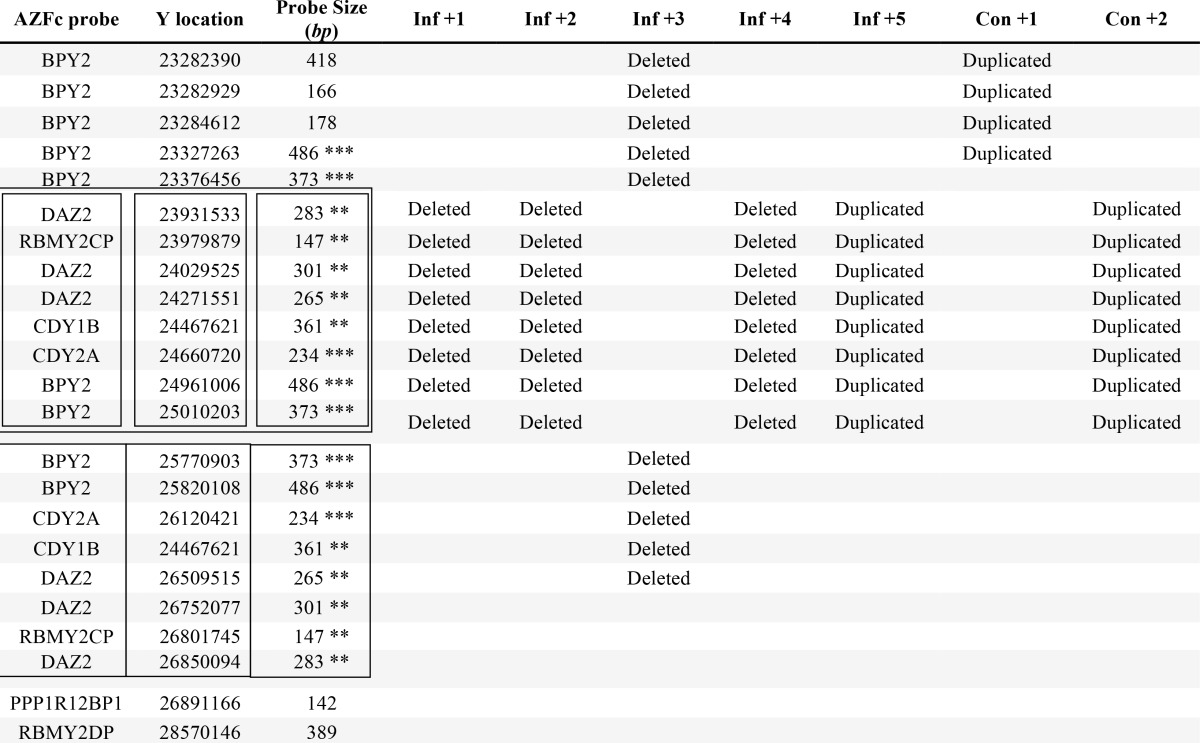 |
Some of the MLPA probes bind to more than one site on the Y-chromosome – those binding in two places are marked with**
those binding in three places are marked with***.
The tandem inverted repeat (DAZ2 to BPY2) is shown within the boxes. The Y chromosome location is given as the first base of the MLPA probe binding site, according to the HG19 human genome reference sequence
Table 2 An example of the typical MLPA ratios seen (in deletion-positive infertility patient 3) and the possible deletion combinations (Del 1-4)
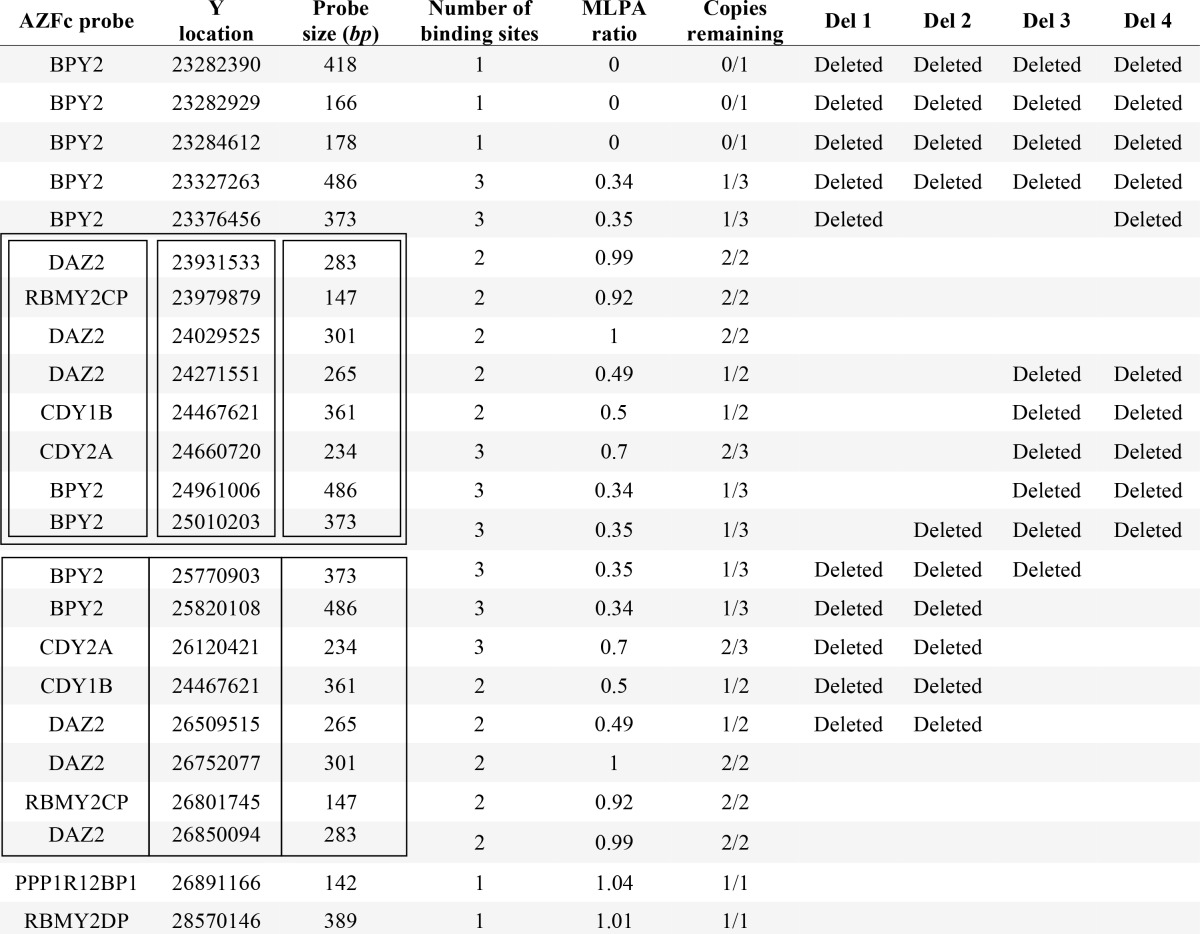 |
The tandem inverted repeat (DAZ2 to BPY2) is shown within the boxes. The Y-chromosome location is given as the first base of the MLPA probe binding site, according to the HG19 human genome reference sequence
As some of the MLPA probes bind to multiple sites (due to the presence of a large inverted repeat on the Y-chromosome) the deletions shown in table 1 are just one of the several possibilities in each case. An example of the typical MLPA dosage ratios for one of the deletion-positive cases is shown in table 2. This table shows all of the possible deletions that can be interpreted from the data for that particular patient.
The review by Navarro-Costa et al. (2) gives a thorough summary of the recent studies of partial AZFc deletions and their possible clinical effects. Most of the early publications were contradictory or equivocal, a fact highlighted by simultaneous studies of the Han Chinese population by two research groups who came to opposing conclusions (11, 12). However, other studies since then have provided more evidence that such deletions do affect the total motile sperm count (10). Although our study cohort was small in comparison to other published results, the presence of partial AZFc deletions in 4/50 infertile men (8%) compared to 0/50 fertile controls adds further weight to this argument. Our figure of 8% for partial AZFc deletions is similar to other larger studies, with most published microdeletion rates being approximately 5% (10, 13). Partial duplications were seen in both test groups (1/50 infertile males and 2/50 fertile controls) which agrees with the conclusion of Giachini et al. (13); namely, these small duplications do not have a significant effect on spermatogenesis.
The main problem with comparing data from different published studies is the variability in the size of the AZFc microdeletions in individual patients. In some cases the size is known, but in other individuals the deletion size has not been fully characterized. The selection criteria for the study populations is also likely to influence the outcome of the results.
In order to accurately ascertain genotype/phenotype correlations, it is essential to know which genes are missing. PCR-based deletion detection methods often need a separate test for each of the common Y microdeletions, such as the gr/gr deletion (14) or the b2/b3 deletion (15), and very few of these studies look at all possible deletions.
The MLPA technique has many advantages over PCR-based methods as it allows the detection of almost all of the potential Y-chromosome microdeletions or microduplications in a single reaction. The MLPA technique has previously been shown to be an ideal dosage detection technique in a large number of publications, ranging from the detection of single copy deletions or duplications of autosomal or sex chromosome genes (16–25) to the dosage analysis of genomic regions with variable copy number (26–28). The MLPA results obtained in this study were highly reproducible, the data obtained at the WRGL laboratory being concordant with the results from the MRC-Holland testing laboratory.
In order to know if partial AZFc deletions have an effect on fertility, an easy detection method for such deletions is required. Our results show that the P360 MLPA probemix provides a quick and simple method of detecting these deletions which would otherwise have been missed by conventional multiplex PCR. As the MLPA probemix covers all three AZF regions, the detection of partial AZFc deletions is performed simultaneously with the detection of larger AZF region deletions, meaning that the entire range of Y-chromosome deletions can be identified in a single reaction. The use of such methodology will allow the collection of accurate, fully-characterised microdeletion data. Once this is obtained, detailed genotype/ phenotype correlations may provide a definitive answer to the question of causality of AZFc partial microdeletions.
