
Methylphenidate (MPH), commonly known as Ritalin, is the most prescribed medication to treat behavioral disorders in children and adults (1). MPH is one of the isomers of Amphetamine (2). It is a white, odorless, and fine crystalline powder which is soluble in water. MPH is manufactured as oral tablets of 10 and 20 mg in Iran (3). Some researchers have shown that MPH could induce encephalic maintenance. So, it could be used to control unfavorable signs, such as absence of concentration, attentiondeficiency, and hyperactivity. Moreover, its using in children can be continued during adulthood, too (4). Due to the extensive use of this medication to treat Attention Deficit Hyperactivity Disorder (ADHD) symptoms, many investigations have been performed to evaluate its effects on the body organs (5).
It has been shown that chronic use of MPH in female mice could cause vaginal stenosis, changes in hormone secretion, and development of ovarian follicles (6). Another study has indicated that the body weights of the male mice were significantly decreased upon MPH use in comparison to the control group. Besides, the weight of the testes and seminal vesicles decreased significantly in these mice (7, 8). In another report, disorders in the growth of the animals have been observed following long-term use of MPH (9). Also, changes in the weight of brain, heart, ovaries, spleen and prostate indicate its effects on different body organs (2).
A chemical substance similar to Amphetamine group causes reductions in body weight and testosterone concentration in rats (10, 11). Cocaine, which is structurally similar to MPH, can cause body weight reduction and harmful effects on fertility (12).
Regarding the highly frequent prescription of MPH in children and adults, the importance of the gamete producing gonads, and insufficient awareness of chronic administration of MPH with its probable effects on fertility, this study evaluates the chronic use of this medication on fertility rate in male mice.
In this study, Twenty-seven healthy adult male Balb/C mice, each varying between 25−30 g (eight weeks old) were examined. The mice were kept in standard conditions, like proper temperature (21−23 °C), humidity (45%−55%), and free access to water and food in the animal lab. The male mice were initially weighed and divided into two treated and one control groups. The animals in the two treated groups were treated with doses of 2 mg/kg or 10 mg/kg of hydrochloride-MPH (produced in Novartis company). Forty days after treatment and repeated weight measurements, six male mice from each group were anesthetized and blood samples were drawn from their hearts. Serum testosterone concentrations were determined by chemo- luminescence immunoassay method. In order to determine morphometric changes of the testes, digital calipers were used to measure the length, width, and thickness of testes after opening the abdominal cavity. The same testes were later removed, washed in physiological serum, and weighed before being fixed in 10% formalin. Followed by 5-micron sectioning of the tissue blocks, the specimens were stained using hema-toxylin and eosin. For histological study of the testes, eight sections from each testis were randomly selected and photomicrographs were captured by using a calibrated photomicroscope connected to a computer equipped with Axiovision 4.8 software. In each section, the number of Leydig cells was morphologically analyzed by the Vidas Image Processing System connected to a microscope (13, 14).
In order to assess the effects of MPH on fertility, from each group, 3 male mice were chosen and each of them was kept with 3 female mice in a separate cage. After 10 days, the female mice were taken out, anesthetized and the embryos in their uterus were counted. The ovaries were then removed and washed in normal saline (sodium chloride solution 0.9%). The number of corpus luteum was counted and the fertility rate was determined by dividing the number of embryos to the corpus luteum. In the cases that no embryos were found, the above experiment was repeated for three times (15).
The data were statistically analyzed by one-way ANOVA and Tukey's Post Hoc Test, and a value of p<0.01 was considered significant.
The results of the present study in Balb/C mice showed that chronic administration of MPH can induce histological changes in testes depicted by diminishing the number of interstitial cells, declining serum testosterone levels, reduction in body weight, and also fertility rate. The assessment of weighting of the mice, before and after treatment, showed that the treated groups had a significant diminution in weight in comparison with the control group (Table 1; p<0.01).
Table 1 Comparing the mean (Mean±SEM) of testicular dimenstions, body weight, serum testosterone concentrations, Leydig cell number, and fertility rates in different experimental groups following chronic administration of MPH
| Parameters | Groups | ||
|---|---|---|---|
|
| |||
| Control group | Experimental group I 2 mg/kg/day (MPH) | Experimental group II 10 mg/kg/day (MPH) | |
| Body weight differences ( g ) (before and after treatment) | 12.21±1.82a | 0.46±0.60b | 3.73±1.41b |
| Length of testis ( cm ) | 0.66±0.04a | 0.67±0.05a | 0.73±0.04a |
| Width of testis ( cm ) | 0.39±0.02a | 0.43±0.07a | 0.46±0.03a |
| Thickness of testis ( cm ) | 0.45±0.06a | 0.049±0.03a | 0.47±0.03a |
| Testis weight ( g ) | 0.1150±0.0088a | 0.1189±0.0082a | 0.1144±0.0085a |
| Testosterone level ( ng/dl ) | 67.72±8.24a | 0.302±0.416b | 14.583±0.4167b |
| Leydig cell count ( n ) | 34.41±3.23a | 9.81±0.60b | 8.44±0.48b |
| Fertility rate (%) | 95.42±4.68a | 64.96±18.51b | 18.53±16.72c |
Numbers with different superscript letters in each row differ significantly (p<0.01)
Regarding the dimensional characteristics of the testes, it was observed that testicular weight; width; length; and thickness were not significantly different between the control and treatment groups (Table 1). The results of total counting of leydig cells, showed a significant decrease (p<0.01) in number, in treated groups compared with the control group (Table 1, Figures 1 and 2).
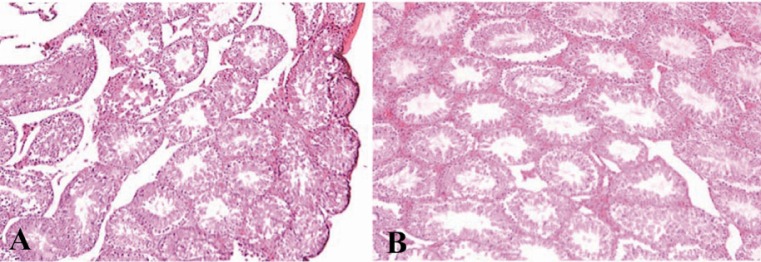
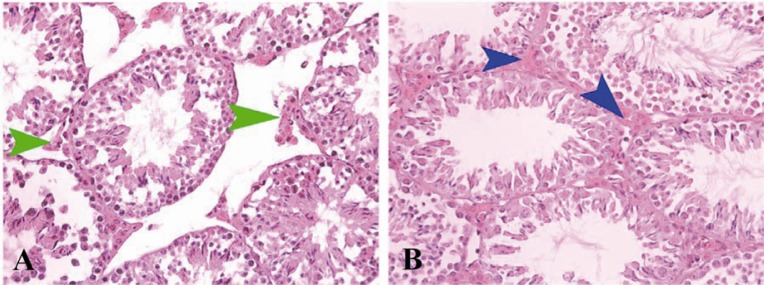
In another assessment the results revealed that the serum testosterone concentration in treatment groups had a significant diminution in comparison with the control group (Table 1; p<0.01).
The results indicated a significant abatement in fertility rate in comparison with the control group (Table 1; p<0.01).
MPH is a medication prescribed for treatment of ADHD in children and adults with behavioral symptoms not treated in childhood (16). Considering the possible effects of MPH on body organs, the study of its effects on body weight, testes, and fertility seems necessary. In the present study, the weights of mice in the treatment groups showed significant reduction in comparison with those in control groups. In another study, the mice receiving hydrochloride -MPH similarly showed a significant reduction in body weight (17). In fact, body weight reduction could be due to decrease of appetite. Some other chemicals, such as amphetamine could also cause body weight reduction. Weight loss after MPH treatment could be due to several factors, such as anorexia, stomach cramps, or insomnia, that reduce food intake. Weight loss caused by reduced food intake can severely affect growth and pubertal development by perturbing the maturation of not only the hypothalamo –pituitary– gonadal axis but also the axes of the hypothalamus and pituitary with the adrenals, thyroid, and growth hormone. Other nonspecific effects of weight loss that might indirectly affect growth and pubertal development include the following: gastrointestinal complications of reduced taste, delayed gastric emptying, or malabsorption (6). Therefore, the same reasons might be responsible for body weight reduction following MPH administration. It was observed that chronic oral use of MPH did not bring about any changes in weight or size of testes. However, a study on rats has shown that gavages of hydrochloride cocaine (15 mg/kg), which is structurally similar to MPH, prescribed for 100 days, resulted in testicular weight reduction (12). This study showed the significant reduction of the number of leydig cells in the treatment groups compared with the control group. Some other reports, confirming this finding, have indicated that intraperitoneal injection of hydrochloride cocaine at a dose of 30 mg/kg could cause necrosis and also decrease in the number of interstitial cells of the testes (18).
Serum Testosterone secretion showed a significant reduction in the treatment groups of this study. A similar study on the short term effects of MPH on the production of sex-hormone in male mice showed that exposure of mice to MPH causes considerable reduction in testosterone production: Reduction in testosterone serum concentration in treatment groups compared with the control group might be due to a variety of reasons including:
The testosterone might be naturally produced in the treated groups, but MPH through hepatic enzyme induction leads to testosterone destruction and subsequent decrease in serum testosterone concentration.
Therefore, the negative effect of MPH on the metabolism of testosterone could be concluded (19).
The results of this study revealed that the long-term administration of MPH can affect fertility rates in male mice. Although this study has been performed on animals, it is not ethically possible to be done on human beings. MPH is being widely abused without prescription by the youth in recent years. As the result, restrict measures to limit its consumption needs to be taken.
