
Human sexuality has been considered as one of the most important aspects of reproductive health and quality of life (1). Until recently, almost all research on sexual behavior was largely focused on vaginal intercourse. Because of cultural limitations, health care providers cannot discuss oral and anal sex and their consequences explicitly with women (2-4). Oral and anal sex are important, due to their association with negative sexual health outcomes, such as gonorrhea, chlamydia, syphilis, HPV or HIV in fections (5-8), abnormal anal cytology and anal cancer (9, 10).
Despite the commonality of oral and anal sexual behaviors in some countries (11), these behaviors are considered unnatural, immoral and a taboo in some other countries including Iran (12). Whestheimer and Lopater believe that people who participate in abnormal sexual behavior mostly suffer from feelings of inefficiency and low self-esteem (12-14). A study on the sexual perception of young females in Iran demonstrated that there were misperceptions sex and oral and anal sex was considered less risky compared to vaginal sex (15).
Previous studies conducted among adult populations have reported controversial findings regarding the prevalence of sexual behaviors. The national survey of family growth conducted in the USA found that 88% of people, aged 15-44 years had never experienced oral sex and 35% had never experienced anal sex (11). In Britain the prevalence of anal and oral sex among adult population was around 25% and 75%, respectively (16, 17).
Considering the increasing rate of oral and anal sex (18) and their negative physical and psychological impacts, estimating the prevalence of various sexual behaviors can increase awareness and help health policy makers and providers to enhance sexual health. In the present study, we aimed to determine the prevalence of some forms of sexual behavior (vaginal, oral and anal), the feelings of women practicing them and some factors related to these behaviors among 200 married Iranian women, aged 19 to 45 years.
This cross-sectional study was conducted on 200 married Iranian women aged 19-45 years in 2008 to 2009. Participants were selected, using convenient sampling, among women referring Taleghani Health Center for annual gynecologic examination. All the participants were informed comprehensively about the study and written informed consent was obtained prior to their participation.
All participants were interviewed by trained staff. Of 223 eligible women, 20 women cancelled before the interview and 3 others withdrew during the interview; complete data were obtained for 200 women. Since there seemed to be no valid or reliable questionnaire on women's sexual behavior in Iran, researchers developed a questionnaire based on instruments used for other populations, adopted form books and jri_articles and concepts of sexual specialists. The questionnaire contained 64 items in three sections: 1- Sociodemographic, 2- History of reproductive health and 3- History of sexual behavior.
The content validity of the questionnaire was assessed by 15 gynecologists, psychologists and sexologists. The internal reliability of the questionnaire was confirmed using test-retest and measuring the Chronbach's alpha, which showed an acceptable correlation of 0.86 and a Cronbach's alpha of 0.84 for all sections of the questionnaire. In this study, vaginal sex was defined as a penilevaginal penetration. Given oral sex was classified as any contact between the mouth, including lips and tongue of a woman and the penis of a man. Receiving oral sex was defined as any contact between the mouth, including lips and tongue of a man and genital of a woman. Anal sex was penileanal penetration.
Data were analyzed using SPSS, Version 15, statistical software (SPSS Inc., Chicago, IL). This study was approved by the Infertility and Reproductive Health Center of Shahid Beheshti University of Medical Science.
Data indicated that majority of the participants (88%) had satisfactory marriages and 77% of women mentioned satisfaction in their first intercourse. Only 2% of women had sexual relations before marriage, and a large percentage of women (93.5%) reported that their spouses did not have sexual relation outside their marital life. The demographic and reproductive characteristics of the women are presented in Table 1.
Table 1 Demographic and reproductive characteristics of the participants
| Variables | Mean±SD |
|---|---|
| Age | 34.08±7.04 |
| Age at marriage | 20.73±3.96 |
| Age at menarche | 13.09±1.5 |
| Parity | 1.99±0.93 |
| Categories of variables | Percentage ( n ) |
|
| |
| Education (%) | |
| High school | 34.2 (69) |
| Above high school | 65.8 (131) |
| Job (%) | |
| Housewife | 80.7 (161) |
| Employed | 19.3 (39) |
In answer to the question “Who is usually the initiator of sexual relations?”, 41.5% identified their husbands as initiators for sex at all times; however 24.5% reported that their husbands were often initiators and others noted that sometimes they themselves initiated sexual intercourse. In the response to the question “Has your husband ever had sex with you when you were asleep?” in 25% of women the answer was positive.
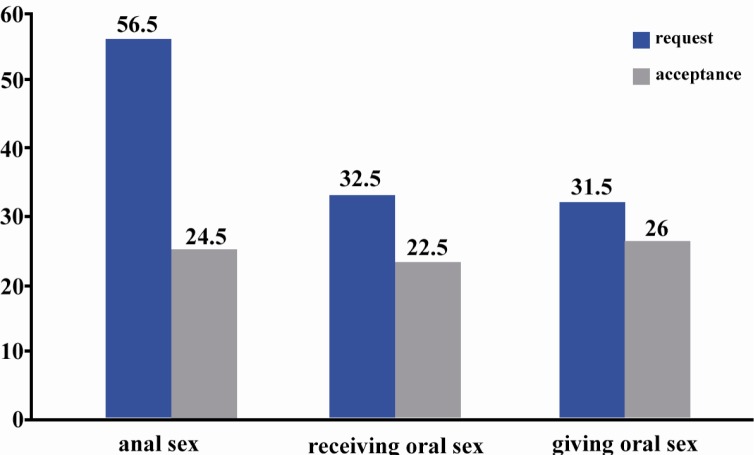
Generally, 100% of women had had vaginal sex; and oral sex was ranked as the second most common sexual behavior among participants. As presented in Diagram 1, although 56.5% of men request anal sex, only 24.5% of women accepted. There was a significant association between requests and acceptances agreeing to various types of sexual behaviors (Diagram 1).
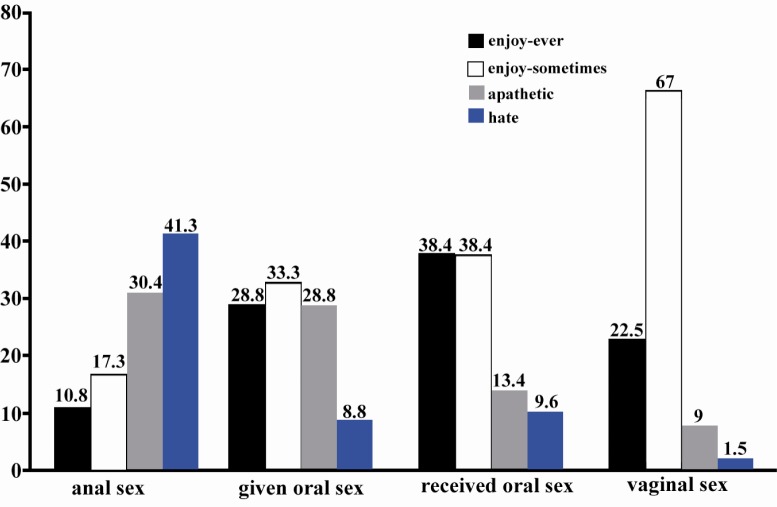
Feelings of women regarding practicing vaginal or non-vaginal sex are presented in Diagram 2. Accordingly, 67% of women sometimes enjoyed vaginal sex, while the rate for anal, receiving oral and giving oral sex were17.3% 38.4% and 33%, respectively. As shown in Diagram 2, most women (41%) hated anal sex.
Statistical analysis showed that women's educational attainment had a significant association with doing various types of sex. As presented in Table 2, receiving and giving oral sex were more common in women with higher education. Receiving oral sex was more common among men who had higher levels of education.
Table 2 Association between demographic variables and different types of sex among married women
| Variables | Types of sex | p-value | |||
|---|---|---|---|---|---|
|
| |||||
| Vaginal (n = 200) | Received oral (n = 45) | Given oral (n = 52) | Anal (n = 49) | ||
| Age (Mean±SD) | 35 | 34.9 | 33.8 | 34.05 | 0.17 |
| Duration of marriage (Mean±SD) | 14.2 | 13.8 | 14.06 | 13.5 | 0.09 |
| Age at marriage (Mean±SD) | 21.6 | 19.9 | 22.01 | 20.8 | 0.44 |
| No. of pregnancy (Mean±SD) | 2.03 | 1.8 | 1.8 | 1.9 | 0.19 |
|
| |||||
| Women's Education ( % ) | |||||
| High-school | 34.2 | 32.4 | 19.8 | 30.5 | 0.026* |
| Above high-school | 65.8 | 73.6 | 80.2 | 69.5 | |
p-value <0.05 shows a statistically significant difference
This study was conducted to examine the patterns of sexual behavior and feelings toward them in married women attending a health care center. The findings showed that most women (79.5%) reported having sexual relations of about 1-3 times during the week before the interview.
According to this study, only 2% of women had experienced premarital sexual relations compared with 36% for men. Due to the importance of being a virgin before marriage in Iranian women the rate of premarital sexual relations seems to be under reported in the participating women (19). Moreover, it seems that women are scared of disclosing their premarital sexual experiences and prefer not discuss it, especially after marriage.
Of all participants, 41.5% expressed that their husbands always initiated sexual relations, and they never did so. In the study by Shirpsk et al., although most women believed that sex was a bilateral relation and a woman could ask her husband for sexual relations, yet they did not even consider to do so, believing that they might face unexpected reactions from their husbands (12). According to Hawkes, social and cultural milieu reported sex as being central to marital relationship; however, men have been allocated the role of initiator of sex and women the role of preserver of sexual relationships traditionally. Women are also expected to maintain harmonious relations as part of their obligations (20). Culturally, exploring men's and women's roles in relation to negotiating sexual relations, Horvath and Brown argued that “there are cultural rules that attribute undesirable qualities to women if they attempt to renegotiate sex and saying no once they consent to having sex, they are cast as being a tease, flirt or tart” (21). It seems that notions and cultural beliefs in our society prevent women from expressing their sexual preferences in marital relations.
Overall, 22.5% of the participants said that they had never received oral sex, while 26% of them had performed oral sex for their husbands and 24.5% had experienced anal sex. While Henzel et al. indicated the prevalence of anal sex to be 65% and oral sex 13% among 387 adolescence women in Indiana, USA (22), Mosher reported the prevalence of for anal and oral sex to be 35% and 88%, respectively in a study conducted among 12571 men and women, aged 15-44 years, in the United State (11). Gindi et al. also reported that the prevalence of oral sex among girls, aged 12-25 years, in Baltimore, USA, rose from 16% in 1994 to 37% in 2004 and that the prevalence of anal sex increased from 2% to 6% during the same periods (18). Differences in the percentages reported in various studies may be explained by differences in cultures and traditions regarding sexual behavior and difference in the study age groups. Reports on the above-mentioned prevalence of non-vaginal sexual behaviors also show that among non-vaginal sex, oral sex is more common than anal sex and also indicate a considerable percentage of women and men practice non-vaginal sex in different cultures, although it is strongly believed to be a taboo in some of these societies.
Based on the results of the present study, about half of the women accepted to have oral sex upon their husbands’ request; however, approximately 41% of them hated anal sex and 31% were apathetic. Most of the women agreed to have oral sex, although they did not enjoy it all. Shirpak et al. found that oral and anal sex were the main sexual activities that women dislike, and that many of them considered oral and anal sex relations to be “abnormal sex”, taboo or unacceptable (12). However, it appears that some cultural and social conditions, along with religious beliefs among Iranian women force them to accept to do non vaginal sex. If they refuse without any apparent reason, their husbands would have the right to deprive them of financial support (14).
The present study had some limitations. The findings were based on a convenience sample of married women. Thus, the results could not be generalized to all married women in Iran. The sample size was relatively small and the study did not evaluate the association between sexual behavior with demographic or reproductive factors. In this study, we did not ask either about the first experience of oral or anal sex or about its duration and prevalence of condom use. However, the importance of our results, as the first report on the sexual behavior of a number of Iranian married women seems to be valuable. More in-depth studies with larger sample sizes, such as population-based studies, are needed to further understand patterns of sexual behavior in Iran. Similar studies on married men are also suggested to be considered as well.
The results demonstrated that the prevalence of oral and anal sexual behavior was considerable among married women, although they have long been culturally identified as unacceptable and taboo among Iranian women and they have many psychological impacts on their lives (12, 13). Hence, to promote sexual health, it seems that addressing different types of sex, and providing educational programs designated for married men and women through marital counseling programs by the Ministry of Health and Medical Education seems to be cruicially important.
The authors are grateful to the research staff of Taleghani Health Care Center. Special thanks are due to Mrs. N. Shiva for editing the manuscript. The authors also thank the Infertility and Reproductive Health Research Center of Shahid Beheshti University of Medical Science for the approving and funding this project.
