
The mammalian female reproductive tract provides the appropriate microenvironment for important reproductive processes such as gamete and embryo transport, capacitation, fertilization and early embryonic development (1–6). In this sense, the inner surface of the oviduct, as well as the oviductal fluid have drastic effects on the aforesaid biological processes. The various kinds of growth factors secreted by the oviductal cells and receptor mediated interaction between gametes and embryos with oviductal cells can efficiently support a better maturation of gametes, as well as growth, and development of early embryos (2, 7–9). In in vivo condition, the secretion of oviductal cells is augmented during the follicular phase under the influence of oestrogen and LH (10, 11).
Study on oviductal cells can be used both to investigate sperm–oviduct interactions and to simulate the appropriate conditions for a normal fertilization, approximating the IVF process to in vivo conditions. In this context, these kinds of cells have been employed both before and after in vitro fertilization in many studies (12–14) and under different conditions such as monolayers cells from different parts of the oviduct, from different stages of the cycle, and oviductal cell-conditioned medium (4, 15–17).
In humans, gametes and early embryos benefit from the secretions of the ampullary cells in vitro, which is manifested by higher fertilization rates and embryonic viability. In animal models, preincubation of oocytes with porcine oviductal epithelial cells (POEC) before and after fertilization showed some effects on some fertilization variables. The presence of POEC during IVF increased penetrability of oocytes when surrounded by cumulus cells. However, preincubation of denuded oocytes with POEC before fertilization resulted in lower blastocyst rate (5). Under in vivo condition, polyspermy is controlled in part by the regulatory role of the oviduct (18).
In pigs, high sperm concentration and POEC increase oocyte penetrability and decrease monospermy rates when sperm pre-culture with POEC is limited to 2 hr; the presence of POEC during IVF increased the rate of monospermy. By doing so, the presence of POEC in porcine IVF, offers the possibility of working with low sperm concentrations. Moreover, exposure of oocytes to POEC for 4 hr before IVF, facilitated monospermic penetration to over 70%. On subsequent embryo culture, however, a lower cleavage and blastocyst formation rates were recorded when the oocyte had been preincubated with POEC prior to IVF (5).
Contact between sperm and the oviductal cells is known to be beneficial for in vitro sperm capacitation and survival in different species (16, 19–22). Moreover, POEC and its conditioned medium efficiently increased the in vitro acrosome reaction of frozen-thawed bovine spermatozoa (23).
Apart from the beneficial effects of oviductal cell monolayer and its conditioned medium on in vitro fertilization and embryonic development (24–27), the accumulated maternal mRNAs in oocytes have a crucial role in the success of normal fertilization and early embryo development, allowing the first cleavages to occur, before the activation of embryonic genome (28). Amongst the mRNA stored in the growing oocyte, there are some oocyte-specific genes called maternal effect genes which may account for the early cleavage regulation (29–32). Zygote arrest 1 (Zar1) is one of the few known oocyte-specific maternal effect genes essential for transition from oocyte to embryo in many mammalian species (33, 34). This gene is evolutionarily conserved in vertebrates and its product is characterized by the presence of atypical plant homeobox zing finger domain, suggesting its role in transcription regulation (35).
The identification of Zar1 transcript at the 4-cell stage cattle embryos represents the characterization of one of the genes expressed in embryos before the major onset of embryonic transcription (32).
Considering the drastic effects of oviductal cells on numerous biological processes, such as sperm capacitation, fertilization and early embryonic development, and the importance of adequate storage and expression of oocyte-specific maternal effect genes, we designed the present study was to evaluate the effects of oviductal cell monolayer and its conditioned medium during IVF on subsequent embryonic development and the relative abundance of Zar1 transcript in ovine zygote.
Sheep ovaries were collected from a local slaughterhouse and transported to the laboratory in saline (30 to 35°C) within 1 to 3 hr from collection. Ovaries were washed 3 times with pre-warmed fresh saline (37°C), and all visible follicles with a diameter of 2 to 6 mm were aspirated using gentle vacuum (30 mm Hg) via a 20 gauge short-beveled needle. Prior to aspiration, the collecting tube was filled with 2 ml preincubated HEPES-modified TCM, supplemented with 50 IU/ml heparin.
After aspiration, only oocytes surrounded by more than 3 layers of unexpanded cumulus cells (cumulus oocyte complexes or COCs) were recovered and selected for in vitro maturation (IVM). Before culture, oocytes were washed in HEPES-buffered TCM199 (H-TCM199) supplemented with 10% fetal bovine serum (FBS) (Gibco 10270), and 2 mM glutamine.
The oocyte culture medium (OECs) consisted of bicarbonate-buffered TCM199 with 2 mM L-glutamine supplemented with 0.1 IU/ml FSH, 100 µl/ ml penicillin, 100 µg/ml streptomycin, 10% FBS (Gibco, USA), and 0.2 mM Na-pyruvate. The medium osmolarity was adjusted to 280 mOsm. The COCs were randomly distributed in maturation droplets (10 to 15 oocytes in 50 µl) and covered by sterile paraffin oil in a 60 mm Petri dish (Falcon 1008; Becton Dickinson, USA) and were then incubated under a 5% CO2, 95% air atmosphere with 100% humidity at 39°C for 22 hr.
The procedure for the culture of oviductal cell monolayer (OEC) was basically that described by Ouhibi et al. (36) with minor modifications. Ewe oviducts were recovered from the slaughterhouse and transported to the laboratory in saline at 30 to 35°C. They were then rinsed several times with antibiotic containing PBS and finally with 70% ethanol before being transferred to a Petri dish within a laminar flow hood. Fat pads and connective tissues were removed with sterile forceps and fine scissors. The oviducts were closed at isthmus end with a clip, filled with a trypsin-EDTA solution (0.5 ml), closed at the other end, and incubated at room temperature for 2 to 3 min.
After incubation, the oviduct wall was mechanically squeezed with sterile forceps and its contents were flushed into a Petri dish.
The epithelial cell clusters were dissociated by gentle, repeated pipetting using an insulin syringe. Five min after the addition of 0.5 ml trypsin- EDTA solution into a Petri dish, 1 ml FCS was then added to the plate in order to inactivate the trypsin. The cell suspension was then introduced into 14 ml graduate conical tubes containing 5 ml TCM199 medium followed by centrifugation at 700×g for 5 min (twice). The supernatant was then discarded and the pellet resuspended in fresh culture medium (TCM 199). Subsequently, 10 µl of this solution (containing nearly 6000 cells) was introduced into culture drop previously equilibrated for 2 hr at 39°C under 5% CO2, containing either 40 µl or 90 µl of fresh culture medium. The culture medium was replaced after 48 hr with IVF medium (IVF-SOF+20% sheep serum) and incubated at the same condition for at least 2 hr before introducing the gametes for IVF.
The procedure was the same as OECs monolayer preparation. After a 48-hour primary culture of OECs at 60% to 70% confluency, the culture medium was replaced by fresh IVF medium (IVF-SOF+20% sheep serum) followed by a 24-hour culture at the same condition (39°C under 5% CO2). After incubation, the medium was collected from IVF drops and stored at 2 to 8°C until use.
To evaluate any possible effects exerted by the presence of oviductal cells during IVF (as a monolayer or conditioned medium), on subsequent embryo development, the IVF procedure was carried out in the following culture conditions: I) in IVF-SOF+20% sheep serum (IVF medium), II) in the presence of OECs in 50 µl IVF medium, III) in the presence of OECs in 100 µl IVF medium, and IV) in the presence of OECs conditioned medium.
Group I served as the control group and groups II and III were considered to evaluate the effect of IVF drop volume in a co-culture system on IVF outcome.
Before transfer to fertilization drops, the oocytes were washed four times in HEPES synthetic oviduct fluid (HSOF) and once in fertilization medium. The HSOF and fertilization medium were the same as used by Tervit et al. (37) with some modification as such for preparing HSOF, 20 mM of NaHCO3 was substituted with 20 mM HEPES (10 mM free acid plus 10 mM Na salt). Both media were supplemented with antibiotics.
Fresh semen was collected from a Lori-Bakhtiari ram of proven fertility. For swim up, 80 to 100 µl of semen was kept under 1 ml of BSA-HSOF in a 15 ml conical Falcon tube at 39°C for up to 45min. After swim up, the 700 to 800 µl of the supernatant was added to 3 ml of BSA-HSOF, centrifuged twice at 200×g for 3 min and the final pellet was resuspended with BSA-HSOF.
Insemination was carried out by adding 1.0×10⁶ sperm/ml to the fertilization medium. The fertilization medium was SOF enriched with 20% heat-inactivated estrous sheep serum. A 5 µl aliquot of sperm suspension, containing 1×10⁶ sperm/ml, was added into the fertilization drop (10 to 15 oocytes per 45 µl fertilization drop). Fertilization was carried out by co-incubation of sperm and oocytes in an atmosphere of 5% CO2 in humidified air at 39°C for 22 hr.
After IVF, presumptive zygotes were vortexed for 2 to 3 min to remove the cumulus cells and then washed in HSOF to remove spermatozoa and cellular debris. They were then transferred to 20 µl culture drops (five to six embryos/drop) consisting of SOF supplemented with 2% (v/v) BME-essential amino acids, 1% (v/v) MEM-nonessential amino acids, 1 mM glutamine and 8 mg/ml fatty acid free BSA. The incubation condition was humidified 7% O2, 5% CO2, and 88% N2 at 39°C. On the third and fifth day of culture (Day 0 was defined as the day of fertilization) 10% charcoal stripped FBS was added to the medium. The culture was continued for 8 days post- fertilization. The osmolarity was maintained at 270 mOsmol.
Twenty-two hr after the onset of IVF, the presumptive zygotes were freed from adherent cumulus cells and adherent sperm by treatment with 0.3% hyaluronidase, followed by 3 min of constant gentle vortexing at room temperature. Denuded zygotes were rinsed 3 times in PBS and transferred in batch of 10 to a nuclease free microcentrifuge tube with minimum amount of PBS and were then snap-frozen in liquid nitrogen and stored until RNA extraction.
The zygotes were pelleted by centrifugation for 1 min and then the supernatant was removed by aspiration to ensure the maximum removal of PBS without disturbing the pellet. The zygotes were lysed in 22.5 µl lysis solution with DNAse (1:100 µl). The lysis reaction was mixed by pipetting up and down 5 times followed by mixing with gentle vortexing to ensure complete lysis of the cells. The reaction was incubated at room temperature (24°C) for 5 min. Stop solution, 2.5 µl, was pipetted into the lysis reaction and was mixed thoroughly by pipetting up and down 5 times, followed by gentle vortexing. The reaction was incubated for 2 min at room temperature. The lysate was then stored at -20°C for 1 week.
The RNA extraction was performed using the RNA-Plus Solution (Cat No. RN7713C, Cinna- Gen Co., Iran) as per the manufacturer's instructions. Briefly, 1 ml of RNA-Plus Solution was added to 2 ml tube containing the cell lysate. The tube was vortexed for 10 s and incubated at room temperature for 5 min. After addition of 200 µl chloroform, the tube was shaken for 15 s and then incubated on ice for 5 min. The tube was centrifuged at 12,000 RPM at 4°C for 15 min. The aqueous phase was transferred to a new RNase free tube and after addition of an equal volume of isopropanol, the tube was gently mixed and incubated on ice for 15 min. The supernatant was discarded and following the addition of 1 ml 75% ethanol, the tube was shortly vortexed to dislodge the pellet and centrifuged at 4°C at 7500 RPM for 8 min. The supernatant was then discarded and let the pellet to relatively dry at room temperature for a few min. The pellet was dissolved in 50 µl DEPC-treated water.
Before RT, the extracted RNA samples were treated by RNase-free DNase I (EN0521; Fermentas, Opelstrasse 9, Germany) to ensure that the extracted RNA used for the synthesis of cDNA are free of DNA contamination. The extracted RNA was reverse-transcribed to cDNA using RevertAid™ First Strand cDNA Synthesis Kit (Fermentas), 1 mg of extracted RNA, random hexamer primers for ovine genes. The thermal cycler conditions set up for the lysate for reverse transcription were as follows: 37°C for 90 min, then at 65°C for 5 min to inactivate the reverse transcriptase enzyme in the RT mix, followed by cooling to 4°C.
The quantification of Zar1 and G6PD (as a reference gene) transcripts in zygotes was carried out in different experimental groups by real time PCR in an Rotorgene 2000 Real Time Cycler (Corbett Research, Australia).
The PCRs were performed in 25 µl reaction volume containing 20 µl MasterMix, 2 µl primers (Table 1), 2 µl cDNA, 0.3 µl Taq polymerase, and 1 µl CYBR Green. The PCR protocol involved an initial incubation of 95°C for 5 min followed by 45 cycles of amplification program (94°C for 20 s, 55°C for 30 s, 72°C for 20 s), a melting curve program (65 to 95°C, starting the fluorescence acquisition at 65°C and taking measurements every 10 s interval, until the temperature reached 95°C) and finally a cooling step to 4°C. The expression value of each gene was normalized to the amount of a reference gene (G6PD) in cDNA to calculate a relative amount of RNA in each sample. For each treatment, real-time PCR assays were carried out in duplicate for each replicate. For each treatment, a relative quantitative fold change was determined using the 2-ddCt method (38). The sizes of the PCR products were further confirmed by gel electrophoresis on a standard ethidium bromide stained 2% agarose gel and visualized by exposure to ultraviolet light.
Table 1 Details of primers used for RT-PCR
| Gene | Sequence (sense/antisense) | Annealing temp.(°C) × cycle number | Fragment size (bp) | Accession number |
|---|---|---|---|---|
| Zar1 | F:5′-CACTGCAAGGACTGCAATATC-3′ | 55 × 45 | 137 | XM_591835 |
| R:5′-AGGTGATATCCTCCACTC-3′ | ||||
| G6PD | F:5′AAGATGATGACCAAGAAGC-3′ | 55 × 45 | 200 | NM000402 |
| R:5′-AGCAGTGGTGTGAAGATACG-3′ |
The data was collected over at least five replicates. All proportional data were subjected to an arcsine transformation. The development potential of oocytes fertilized in different culture conditions was analyzed using one-way analysis of variance (ANOVA). When ANOVA revealed a significant effect, the experimental groups were compared by Tukey's method. When equal variance test failed the treatments were compared by Student-Newman-Keuls Method. When normality test failed the Kruskal-Wallis one-way ANOVA on ranks was applied. A p<0.05 was considered statistically significant. All the calculations were performed by sigma stat (Version 2.0) software.
Neither the presence of oviductal cells nor their conditioned medium during IVF had a positive effect on subsequent embryo development. The cleavage, total blastocyst and hatching rates were significantly higher in the control group compared with other groups (p<0.01). With regard to the application of two different volumes of IVF medium in co-culture groups, no significant changes were observed in embryo developmental indices (Table 2).
Table 2 Post fertilization development of sheep oocytes fertilized in the presence of oviductal epithelial cells (OECs) or OEC-conditioned medium
| Experimental group | 0ocytes (n) | Cleavage n (%±SEM) | Expanded Blast n (%±SEM) | Total Blast.n (%±SEM) | Hatched Blast.n (%±SEM) |
|---|---|---|---|---|---|
| IVF (control) | 300 | 250 (84.1±1.9) a | 40 (36.6±5.3) | 99 (32.8±1.4) a | 37 (38.4±3.7)a |
| IVF-OECs (50 µl) | 236 | 176 (74.1±2.1) b | 14 (36.6±6.4) | 40 (16.9±0.8) b | 5 (12.6±3.6)b |
| IVF-OECs (100 µl) | 202 | 128 (63.1±3.3) b | 10 (39.7±9.3) | 26 (12.8±0.9) b | 4 (13.7±6.7)b |
| IVF- conditioned | 399 | 291 (72.6±3.5) b | 23 (32.3±6.1) | 71 (17.9±1.3) b | 10 (13.5±5.3)b |
Numbers with different superscript in the same column differ significantly (p<0.01).
The percentages of expanded and hatched blastocysts are proportional to the number of total blastocysts
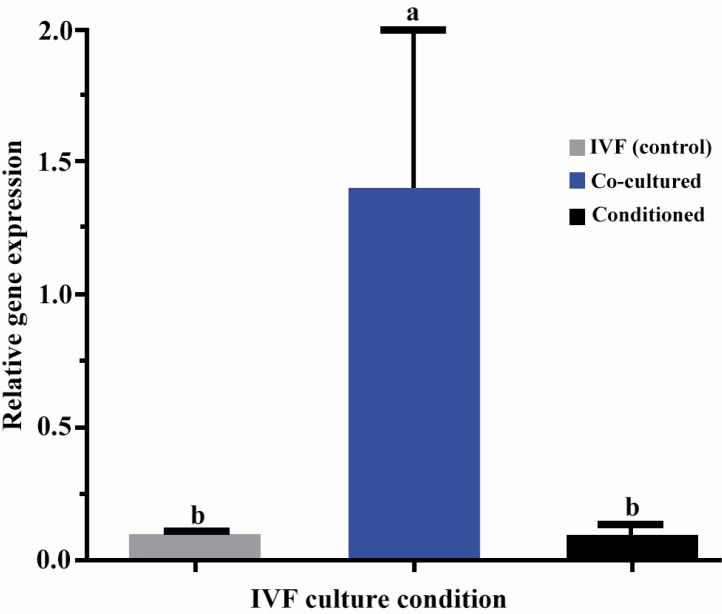
Concerning the expression of Zar1 gene in ovine zygotes produced in different culture systems, the ones produced in the presence of OECs showed a higher expression (p<0.05) compared to the control and conditioned groups (Figure 1).
The interaction between sperm and the oviductal cells is known to be beneficial for in vitro sperm capacitation and survival in different species (16, 19–22). In some species, such as pigs, the sperm– oviductal cell contact constitutes a final phase of maturation that gives spermatozoa the ability to penetrate the egg investments (39). It has also been pointed out that oocyte maturation is completed in the oviduct (21), where it could be influenced by oviductal factors. In this way, oocytes would be more competent to the fertilization process.
In the current study, the results were in contrast to what had been previously reported, indicating the improvement of fertilization rates by in vitro exposure of human and some other mammalian gametes to oviductal cells or their conditioned medium (40). In fact, not only the oviductal epithelial cells and their conditioned medium were unable to improve the determined embryonic variable but also the developmental indices were negatively influenced by them. Apart from the probable species-specific differences between oviductal epithelial cells and gametes interaction, the main question raised is why the developmental indices have been negatively influenced by this exposure.
Presently, little is yet known about the factors and mechanisms that regulate the inhibiting and activating effects of the oviduct on inseminated sperm. Nonetheless, to find reasonable answers to the above question we should consider all present components during in vitro fertilization such as spermatozoa and oocyte, culture condition, the IVF medium, as well as the presence of oviductal epithelial cells and their secretions. One issue is that to what extent the composition of Zona plusida is changed during exposure to the OECs and its CM. It has been shown that the Zona pellucida in oocytes exposed to oviductal secretions need more time to dissolve (41). In porcine, the oviduct-specific glycoprotein (OVGP1) increases the rate of monospermy in in vitro fertilized oocytes through induction of zona hardening and interaction with spermatozoa (42). In our study, however, we did not directly evaluate the percentage of fertilized oocytes; the lower cleavage rate might be related to the zona hardening. This concept is contrasted; however, with the report indicating that the presence of cumulus and oviductal cells at the time of IVF increases the penetrability of oocytes (5).
It has also been shown that the interaction of oviductal proteins with gametes can improve the efficiency of in vitro fertilization (IVF) in porcine (9), bovine (40) and human (43). Although, in an attempt to simulate the oviductal conditions, when the bovine oviductal fluid (bOF) treatment for 30 min on in vitro matured bovine oocytes, was applied prior to IVF the bOF treatment had no effect either on fertilization parameters, cleavage, or blastocyst rates, nor on the morphological quality of resulting blastocysts (44).
Another possibility for the lower cleavage and embryo development in our study might be related to the sperm capacitation changes during sperm binding to OECs and its exposure to the CM.
Numerous studies in in vitro models have demonstrated that sperm can survive longer when in contact with the oviductal epithelium and that capacitational changes are modulated by the oviduct in the human, canine, porcine, equine, and bovine species (45–50). In equine species, the co- culture with OEC-improves the capacitation of spermatozoa and in porcine the OECs conditioned medium can efficiently increase the in vitro acrosome reaction (AR) of frozen-thawed bovine spermatozoa (40, 51). Since the capacitation is considered to be a controlled destabilization process, which reduces the lifespan of sperm (52), maintenance of sperm viability within a certain window of time and control of capacitation are mutually associated events. Though, in the current study we did not evaluate the acrosome reaction, whether in ovine species the sperm exposure to OECs or CM could destabilize the acrosome in a way that AR could take place in an improper time, might be another possibility for the lower cleavage rate in OECs and CM groups compared to the controls.
The other possibility for the lower cleavage and subsequent embryo development in OECs and CM groups might be related to the incompatibility of medium used during IVF in support of both gametes and OECs. In other words, it seems that working with a single culture medium (SOFaa BSA) to address the different requirements of both somatic cells and gametes is infeasible. Under this condition, somatic cells and gametes will compete for nutrient resources and somatic cells cannot retain their proper morphological or functional properties. As a consequence, instead of the provision of required metabolites and specific growth stimulators, the accumulation of embryotoxic compounds (e.g ammonium and ROS), as well as medium acidification, probably due to improper metabolism and cell death, make the condition worse for normal fertilization (53).
Concerning the relative expression of Zar1 in zygotes produced in different culture conditions, the results showed the highest expression in the presence of OECs compared to the CM and control groups. In fact, the direct contact between zygotes and oviductal cells was positively influenced the gene expression of Zar1 in OEC group. Though, no relationship was observed between embryo development and the relative expression of Zar1 in zygotes produced in different culture conditions. Therefore, it can be inferred that the lower developmental competence of embryos fertilized in OEC and CM groups compared to the controls is not related to the relative abundance of Zar1.
As known, Zar1 is an ovary-specific maternal factor that plays an essential role during the oocyte-to-embryo transition in mouse and its expression is strictly limited to the oocyte, zygote and, at a lower level, the 2-cell embryo (32). In Zar1 knock-out mouse, the embryos are incapable to develop beyond the first cleavages stage (34). In another study, fewer than 20% of the mouse embryos derived from Zar1 (-/-) females progressed to the two-cell stage and showed marked reduction in the synthesis of the transcription-requiring complex, and no embryos developed to the four- cell stage (33).
In the current study, the higher expression of Zar1 in co-cultured groups had no beneficial effect on subsequent embryonic developmental indices. On the other hand, it seems that the relative abundance of Zar1 in ovine species is not meaningfully related to the subsequent embryo development.
It is concluded that under the conditions employed, neither the presence of oviductal epithelial cells nor their conditioned medium during IVF, could improve the developmental potential of ovine embryos. Moreover, no relationship was found between Zar1 relative expression in zygotes, produced in different conditions, and the subsequent embryo development.
The authors would like to thank the Research Institute of Animal Embryo Technology affiliated to Shahrekord University and Young Researchers Club for their financial supports, and Dr. A. Doosti for his assistance with molecular equipments.
