
Endometriosis is characterized by the presence of endometrial stromal and glandular cells outside the uterine cavity, mainly in the pelvis (1). The exact etiology and pathophysiology of the disease is still not clear. The widely accepted theory is retrograde menstruation and implantation of endometrial cells on peritoneal surface (2–4). Endometriotic cells are capable of attaching to the peritoneal mesothelium, break the peritoneal lining, and destroy the extracellular matrix (ECM); thereby, they invade the surrounding tissue (5). ECM is involved in the regulation of these cellular events, and ECM invasion may be on the critical point of endometriosis development.
Apelin is a new investigated member of adipose tissue peptide (6) and apelin expression has been shown in different tissues and in the uterus (7–9). Apelin and its receptor, also known as APJ receptor, make function in vessel formation and cell proliferation (10, 11). Being regarded as a new mitogenic peptide for endothelial cells (12), apelin can promote cells from G0/G1 to S phase and stimulate epithelial proliferation. Apelin and APJ have been reported to be expressed in vascular muscle (13–16).
It has been suggested that the apelin/APJ system might be involved in the size-sensing mechanism of blood vessels which is an important event for supplying oxygen and nutrients in smaller vessels (17). Contribution of the apelin/APJ system to portosystemic collateralization and splanchnic neovascularization in portal hypertensive rats has been also reported (18).
Heinonen et al. reported significant correlation between apelin and TNF-alpha that apelin might play a role in inflammation (19). It was reported that apelin-APJ signaling was essential for embryonic angiogenesis and it was upregulated during tumor angiogenesis. Ectopic expression of apelin was sufficient to trigger premature angiogenesis. Apelin was non-mitogenic for in vitro culture of primary human endothelial cells but it promoted chemotaxis (20). The function of endometrial apelin is not known yet but, apelin may play a role in endometrial regeneration and endometriotic implantation via angiogenesis.
We aimed to investigate the expression pattern of apelin in eutopic and ectopic endometrial tissues according to possible angiogenic function of apelin.
Tissue samples were collected in accordance with the requirements of the Firat University Hospital Ethics Committee between November 2008 and September 2009. Eutopic and ectopic endometrial samples were obtained from 45 women aged 18 to 40 years, and a BMI of 18.5 to 24.9 kg/m 2 who were undergoing laparoscopy for benign indications. The participants had a regular 26 to 33 day menstrual cycle and had received no hormonal medication in the preceding 3 months. The women were classified into two groups; Group I: women who did not have any pelvic pathology confirmed by ultrasonography and laparoscopy (n=15), and Group II: women with endometriosis (ASRM-stage II and III; n=30).
Samples of endometriotic implants and endometriomas were obtained at laparoscopy, and the disease was confirmed by histological examination of the biopsies. Eutopic endometrium was obtained from endometrial biopsies during surgery. We histologically examined the sections of endometrium and endometriotic tissues taken from these samples and assessed them for proliferative or secretory endometrial morphological features, using the criteria proposed by Noyes et al. (21). Fortyfive endometrial samples (22 proliferative, 23 secretory) from 15 women with a normal pelvis and 30 women with endometriosis were used for immunohistochemical and enzyme immunoassay analysis. Samples of endometriosis (16 from women in the proliferative stage and 14 from women in the secretory stage of the menstrual cycle) were obtained from 15 ovarian endometriomas and 15 peritoneal implants. Semi-quantitative estimation of apelin staining was evaluated as an index of staining intensity and distribution. Moreover, peripheral venous blood samples (5 ml) were also collected for serum enzyme immunoassay. A written informed consent was obtained from each patient using consent forms.
Peripheral venous blood samples (5 ml) were collected after overnight fasting. After centrifugation of blood samples at 4000 rpm at room temperature for 10 min, 20–30 μl/ml aprotinin (400 kallikrein inactivator units, KIU) and 1/10 volume 1 N HCl were supplemented into serum samples. Samples were then stored at -20°C until analysis. Eutopic and ectopic endometrial tissue samples were divided into two parts: formaldehyde embedded tissues for immunohistochemical analysis and the remaining tissues for ELISA. Approximately, 15 mg tissue samples were boiled at 100°C for 5 min, then were squashed on iron mold and were homogenised in phosphate-buffered saline (PBS) containing 5% (w/v) dry milk. The homogenised samples were later centrifugated at 4000 rpm at room temperature for 10 min. For accurate quantification of apelin levels in tissue samples, 20–30 μl/ml aprotinin (400 kallikrein inactivator units, KIU) and 1/10 volume 1 N HCl were supplemented into tissue samples. Samples were then stored at -20°C until analysis. The extracted plasma and tissue samples were assayed for apelin concentration by Human Apelin kit (Active; Phoneix Pharmaceuticals, Germany).
Paraffin-embedded tissue samples were cut into 5 μm sections and mounted on Poly-L-Lysine slides (Lab Vision Corporation, USA). Slides were deparaffinized in xylene and rehydrated in a graded series of alcohol. Endogenous peroxidase activity was quenched by incubation in 3% H2O2 for 10 min and followed by a rinse with PBS. For antigen retrieval, slides were placed in 10 mmol/L citrate buffer (pH=6.0) and were microwaved twice for 5 min. Non-specific binding of the primary antibody was prevented by incubation in Ultra V Block (Lab Vision Corporation, USA). Sections were then incubated with rabbit polyclonal apelin antibody (ab59469, Abcam Inc., USA) as primary antibody for 30 min at 38°C. Thereafter, sections were washed with PBS and incubated in biotinylated goat antiserum (Lab Vision Corporation) for 10 min at 38°C. After rinsing in PBS again, the slides were incubated in streptavidin-biotin-peroxidase (SBP) (HistoMark, USA) for 10 min. As negative control, primary antibody was omitted. The slides were washed with PBS twice for 5 min, and then amino-ethylcarbazole (AEC) was used as chromogene for 10 minutes. Mayer's hematoxylin was used for counter staining.
We semiquantitatively evaluated the cytoplasmic intensity for apelin immunoreactivity in eutopic and ectopic endometrial tissues. The stromal and glandular cells positively stained using the following intensity categories: 0 (no staining), 1+ (weak but detectable staining), 2+ (moderate or distinct staining), and 3+ (intense staining). In each slide, five different areas were evaluated under ×60 magnification for each intensity within these areas were determined by two investigators blind to the type and source of the tissues. The average intensity of the two investigators was considered for each slide.
Power calculation was performed based on previous studies that involved semiquantification of tenascin expression by immunohistochemistry. A sample size of 15 in each group has a power of 80% to detect a difference between means of 22.07 with a significance level (alpha) of 0.05. The statistical power analysis was performed using G power 3 program. Statistical analysis was performed by Statistical Package for Social Sciences (SPSS), version 12.0 (SPSS, Chicago, Illinois, USA). Results were expressed as means and standard deviation. Differences between two groups for continuous variables were analyzed using Student's t-test. Differences in two groups for ordinal variables were analyzed using Mann-Whitney U test. The p-values smaller than 0.05 were considered as statistically significant.
The age, BMI and waist/hip ratio of the participants, respectively, were as follows: 30.2±5.5 years, 22.1±1.8 kg/m 2, and 0.72±0.06 with no significant differences between two groups. The serum and tissue concentrations of apelin in both groups are presented in Table 1. There were no significant differences between serum and eutopic tissue levels of apelin in both groups. Serum apelin concentrations did not show cyclic changes, but both eutopic and ectopic endometrial tissue apelin concentrations increased during secretory, and decreased during proliferative phases. Concentrations of apelin were higher in tissue than serum (p=0.03). Eutopic endometrial tissue concentration of apelin did not differ between the two groups (p=0.43).
Table 1 Serum and tissue concentrations of apelin
| Group 1 (controls, n=15) | Group 2 (Endometriosis, n=30) | p-value | |
|---|---|---|---|
| Serum apelin ( pg/ml ) | |||
| proliferative phase | 711±122 | 731±124 | 0.97 |
| secretory phase | 703±124 | 735±114 | 0.86 |
| p-value | NS | NS | |
|
| |||
| Eutopic endometrial apelin ( pg/mg ) | |||
| proliferative phase | 1317±299 | 1094±287 | 0.08 |
| secretory phase | 2499±208 | 2418±191 | 0.51 |
| p-value | |||
| SPP vs. EuPP | <0.05 | <0.05 | -- |
| SSP vs. EuSP | <0.05 | <0.05 | -- |
|
| |||
| Ectopic endometrial apelin ( pg/mg ) | |||
| proliferative phase | -- | 1189±134 | -- |
| secretory phase | -- | 2639±342 | -- |
| p-value | -- | -- | -- |
| EuPP vs. EcPP | -- | NS | -- |
| EuSP vs. EcSP | -- | NS | -- |
Note: The results were presented as mean±SD. SPP=serum proliferative phase; SSP=serum secretory phase;
EuPP=eutopic proliferative phase; EcPP=ectopic proliferative phase; EuSP=Eutopic secretory phase;
EcSP=ectopic secretory phase.
NS=Not significant
Immunohistochemical staining of apelin in eutopic endometrium of both groups were dominant in secretory phase (p<0.01), but comparison of eutopic endometrial tissue apelin staining did not show a significant difference between two groups (p=0.71).
Upon immunohistochemical staining, intense immunoreactivity of apelin was observed in glandular cells of eutopic endometrial tissue of both groups during secretory phase (Figure 1). Moreover, endometriotic tissue showed intense apelin immunoreactivity in glandular cells during secretory phase (p<0.01). Stromal cells of ectopic and eutopic endometrial tissues showed weak staining for apelin; therefore, cyclic variation could not be analyzed in their expression levels. During secretory phase of menstrual cycle, apelin staining was intense in eutopic and ectopic endometrial tissue of women with endometriosis and in endometrium of non-endometriosis participants.
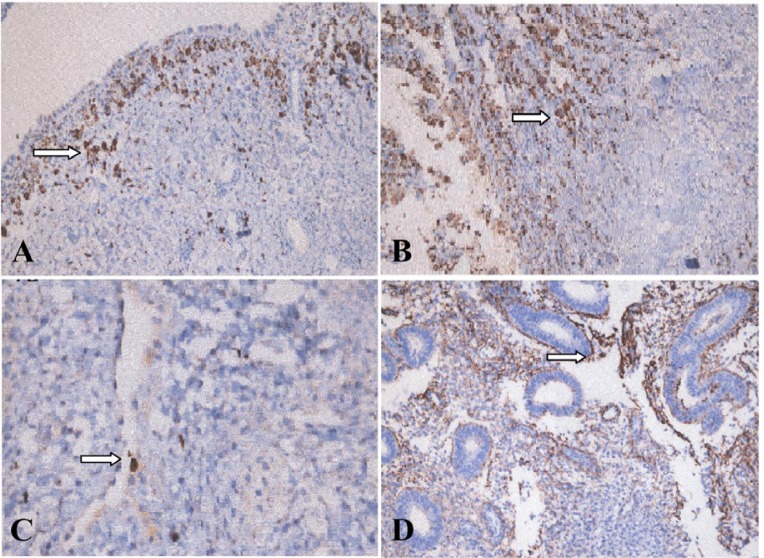
The present study most probably was the first to evaluate the expression of apelin in eutopic and ectopic endometrial tissues. Immunohistochemical and immunoassay results showed increased apelin expression during the secretory phase in glandular cells of eutopic and ectopic endometrium. However, the changes in stromal cells were less dynamic than those in glandular cells of both eutopic and ectopic endometrium. Increased local apelin concentration may indicate a paracrine function on endometrium.
The limitations of our study were as follows: Our small study population limited the statistical power of the analysis and immunohistochemical analysis of apelin could have been supported with APJ.
New vessel formation is involved in the pathogenesis of endometriosis (22), and it is thought that epithelial-mesenchymal interaction with the influence of sex steroids play a critical role in endometriosis (23–26). It is likely that the growth regulation of endometriotic cells is controlled by a complex interaction of ECM proteins and paracrine factors.
We hypothesized that apelin might play a role in the endometrial regeneration via angiogenesis process. Apelin mRNA and immunoreactive apelin were detected in various tissues and organs such as epithelial cells of the gastric mucosa, myocardium and endocardial endothelium, lungs, kidneys, adrenals, and the endothelium of large and small blood vessels (9, 27–29). Apelin has also been shown to be involved in the regulation of vessel formation and cell proliferation (11). Apelin causes endothelium dependent vasorelaxation by triggering the release of nitric oxide (30–32). Moreover, there are reports that apelin is a potent angiogenic factor inducing endothelial cell (EC) proliferation, EC migration, and the development of blood vessels in vivo (7, 33). Apelin was detected in the smooth muscle cells of intraluteal arterioles (8). Schilffarth et al. suggested that apelin might act as a chemo-attractant for sprouting endothelial cells (34). Apelin and APJ in the granulosa cells of bovine ovary may be involved in induction of cell apoptosis (35). Apelin has an important effect on activated T lymphocytes by supressing IFN-γ, IL-2 and IL-4 production (27).
Our study is most probably the first for describing apelin expression in ectopic and eutopic endometrium. Expression level of apelin was higher in secretory than proliferative endometrium and glandular cells more evidently showed intense expression than stromal cells. Similar expression patterns of apelin in eutopic and ectopic endometrium shows that endometriotic lesions share some of the characteristics of the cellular processes involved in the regeneration of endometrium. We observed that expression of apelin was similar in the eutopic endometrium of women with or without endometriosis. Presence of apelin in the ectopic endometrium may point to the expression of apelin by ectopic epithelium in the peritoneal environment of women susceptible to the disease.
Apelin may also play a spatio-temporal role for the maturation of blood vessels by transient expression in ectopic endometrium where angiogenesis is taking place. In addition, genetically engineered mouse models indicate that apelin/APJ regulates vascular stabilization and maturation in physiological and pathological angiogenesis (36). Thus, it is difficult to merely explain the proliferative potential of endometriotic epithelia in terms of quality or quantity of apelin.
In conclusion, our results point out secretory phase glandular cell dominancy of apelin expression in both of the eutopic and ectopic endometrium. Further studies are needed to investigate the possible effects of apelin on the formation of endometriotic lesions via their paracrine effects on vessel formation and ECM invasion.
We thank medical doctors in the Department of Gynecology of Firat University Hospital for their help during our study. This study was supported by Firat University Scientific Research Foundation.
