
Infertility is a common and worrisome problem for couples. About 30% to 50% of cases of infertility are due to male factors including sperm motility disorder (1). Physiological maturation of sperm and acquisition of motility are done during passage through epididymis; thus, immature sperm such as those from testicular sperm extraction (TESE) possess a little motility and fertilization capacity. Therefore, finding a way to increase sperm motility is essential for patients’ TESE samples (2).
Studies have shown that sperm motility is dependent on the amount of its energy production. Under various conditions, mammalian sperm provide their energy requirements by anaerobic glycolysis, aerobic glycolysis and beta oxidation of endogenous substrates (including fatty acids). In the presence of oxygen, the end product of glycolysis is pyruvate and the lactic acid present in the female genital tract can be used as substrate by the sperm lactate dehydrogenase C4 (LDH-C4) to produce pyruvate for the mitochondrial consumption. In anaerobic glycolysis, environmental glucose or fructose are used by sperm as a source of energy to release lactic acid by the LDH-C4 activity (3-4). In aerobic conditions and lack of substrates for glycolysis, sperm gain the energy from the beta-oxidation of fatty acids in the context in which L-carnitine acts as a cofactor (5).
It has been shown that LDH-C4 is a testis-specific isoenzyme (6) and it is present during spermatogenesis. LDH-C4 appears in the cytosol of testicular cells, from spermatocytes to spermatids. Finally, LDH-C4 will be placed in the middle and principal parts of mature spermatozoa (7) and also in the inner mitochondrial and plasma membrane of mature and developing spermatogenic cells in testis (8, 9). This isoenzyme plays an important role in the process of glycolysis and ATP production in sperm flagellum and, sperm motility. In addition, a disorder in LDH-C4 gene has been reported to cause impaired sperm motility, followed by infertility in male mice (10).
Production of excessive free radicals due to laboratory manipulations, cellular waste products, presence of large numbers of leukocytes and immature germ cells is one of the most important issues to be considered in assisted reproductive technique (ART) procedures. Therefore, sperm samples prepared for ART cycles are susceptible to oxidative damage, especially when the samples are free of seminal plasma and exposed to low levels of protective antioxidants (11). Reactive oxygen species (ROS) have been shown to have an impact on cellular components such as the lipid, protein and carbohydrate components of the cell membrane (12). There are reports that ROS can damage sperm motility by interruption of ATP production or flagellar axonome phosphorylation (13). Immature sperm, such as those from testicular sperm extraction (TESE), produce much greater ROS than mature sperm (14).
Sperm stimulators, such as pentoxifylline (PTX) and L-carnitine (LC), are antioxidants and ROS scavengers (11). Extensive studies have been done in vivo and in vitro on different compounds, including LC and PTX, affecting sperm motility in ART (15–18). LC has a key role in sperm metabolism by supplying the required energy and has a positive effect on sperm production, maturation and motility (19). It has been suggested that high concentrations of L-carnitine in the epididymal fluid serves to stabilize the sperm plasma membrane (20). According to existing theories since 1994, PTX acts as a phosphodiesterase enzyme inhibitor and causes an increase in cellular cAMP concentration (21). In later stages, this increase could cause increased cellular glycolysis and ATP production which can promote sperm motility and lead to increased fertility rates (18). Other studies suggest that PTX can protect the sperm plasma membrane integrity (22). Despite widespread use of PTX in the culture media in IVF laboratories throughout the world, PTX is a toxic agent and can lead to a decrease in sperm survival if it is prescribed for longer than 90 min (23).
Considering the harmful effects of free radicals in the structural integrity of sperm membrane, ATP production, and ultimately sperm function, we used antioxidants to reduce oxidative stress. PTX, an anti-oxidant with toxic effects and LC, a non-toxic antioxidant, can prevent LDHC4 damage in sperm. We subsequently evaluated mouse sperm motility and LDHC4 enzyme activity after LC and PTX administrations.
The animal experiments were approved by the Ethics Committee of Shiraz University of Medical Sciences. Fortyeight male balb/C mice weighing 25 to 30 g were acclimated to the laboratory condition (12 hr light, 12 hr darkness and a temperature of 22 to 24°C). We removed the testes of the animals and washed them by saline and Ham's F10 medium (Sigma, USA). The tunica albuginea was separated from the testes and seminiferous tubules were gently removed by two syringes. Red blood cells were separated by the addition of Ham's F10 to the samples and centrifugation at 500 rpm for 10 min. The palette was cut into pieces in Ham's F10 medium, and vortexed for 1 min to extract the sperm from the tubules (24). The sample was then incubated at room temperature for 1 hr (23), and centrifuged at 500 rpm for 10 min to precipitate the Leydig and Sertoli cells. The supernatant was centrifuged at 1200 rpm for 10 min and the palette which contained sperm was resuspended in 1 ml of Ham's F10 (24). Sperm count was done using a hemocytometer.
The sperm samples were pooled and aliquoted into three parts. Ham's F10 (0.2 ml), used as the control solution containing 3.6 mM of LC (Sigma, USA) or PTX (Sigma, USA), was added to the equal volume of aliquoted sperm samples. The final concentration of 1.76 mM of LC or PTX was obtained in the samples (17).
Sperm motility assay: Sperm motility was assessed 30 min after incubation at room temperature. All motility evaluations were performed according to the World Health Organization (WHO) guidelines (25). To evaluate sperm motility, sperm were classified as immotile (IM, no movement), non-progressive motile (NP, all other patterns of motility with an absence of forward progression, e.g. swimming in small circles, the flagella force hardly displacing the head, or when only a flagella beat can be observed) and progressively motile (PR, spermatozoa moves actively, either linearly or in a large circle, regardless of the speed) (25). The percentage of the motile sperm was calculated according to study done by Moreira et al. (26).
LDH-C4 enzyme activity was measured by spectrophotometry. Sperm samples (6×10⁶/ml) were sonicated in 500 µl Tris-HCl (0.1 M, pH=7) for 10 s, three times and centrifuged at 14,000 rpm at 4°C for 10 min. Ten µl of the extract was added to 1 ml of reaction buffer (0.05 M Na2HPO4 (Merck, Germany) pH=7, 0.1 mg/ml NADH (Sigma, USA), and 27.5 µg/ml pyruvate (Sigma, USA). LDH-C4 activity was calculated as the change in absorbance at 340 nm over a period of 1 min and expressed as U/ml.
All results were presented as mean±SE (standard error of mean). Statistical analyses were performed using one-way analysis of variance (ANOVA), followed by Fisher's LSD test using SPSS version 15 for windows. A pvalue less than 0.05 was considered as a statistically significant difference.
The findings showed a significant increase in the percentage of progressive sperm exposed to PTX compared to the control sperm (p<0.001) after 30 min of incubation. There was a significant decrease in the percentages of immotile sperm and a significant increase in the percentage of non-progressive sperm in the presence of LC and PTX compared with the control sample 30 min after incubation (p<0.001). The data for sperm motility has been summarized in Table 1.
Table 1 Mouse testicular sperm motility after 30 min of exposure to L-carnitine and Pentoxifylline (Mean±SE)
| Experimental groups | Sperm motility (%±SE) | ||
|---|---|---|---|
|
| |||
| Immotile | Non-progressive | Progressive | |
| Control | 71.80±1.5 | 27.70±1.4 | 0.16±0.16 |
| L-carnitine | 52.67±1.2* | 46.48±1.1* | 0.54± 0.18 |
| Pentoxifylline | 45.47±1.08* † | 52.86±1.09* † | 1.44±0.26* † |
Significant difference from the controls (p<0.001)
Significant difference from LC-treated group (p<0.01)
As shown Figure 1, LC-treated sperm had a significant increase (2.20±0.12 U/ml; p=0.04) in mean LDH-C4 enzyme activity compared with the controls (1.80±0.13 U/ml) 30 min after incubation. In addition, the results (Figure 1) demonstrated a significant increase in the LDH-C4 enzyme activity of PTX-treated sperm (2.27±0.14 U/ml; p=0.01) after 30 min of incubation in comparison to the controls (1.80±0.13 U/ml).
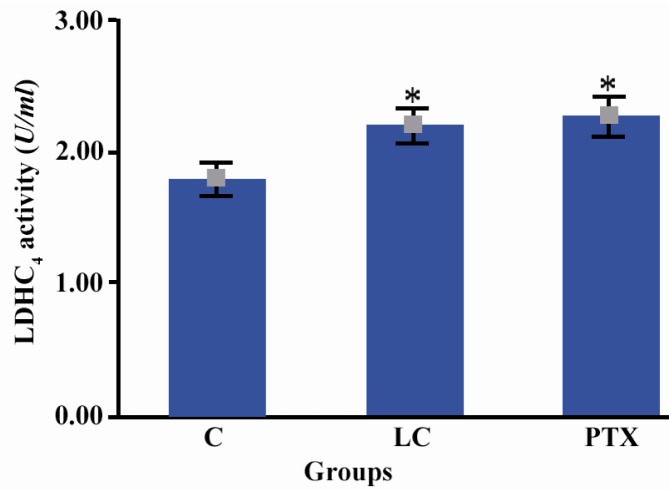
Improving the ability of sperm to fertilize the oocyte is the aim of many ART studies. In the testicular sperm extraction technique, it is important to have good quality, matured sperm for successful application of ART. Our findings showed that incubation of extracted sperm samples with LC or PTX led to both an increase in testicular sperm motility and LDH-C4 enzyme activity compared to the control group.
Wang showed that LC can increase ejaculatory sperm motility of men with asthenozoospermia (27). In another study, Shi et al. also demonstrated that testicular sperm motility improved after exposure to LC in vitro (28).
Similarly, PTX has been reported to increase testicular sperm motility (17). Aliabadi et al. showed that mice testicular sperm motility can be improved after exposure to LC and PTX in vitro (16). Our findings in this study are consistent with all the aforesaid results.
L-carnitine increases sperm motility by affecting the metabolism of fatty acids (29). Fatty acid metabolism occurs in the mitochondria of sperm middle-piece. It has been demonstrated that LC regulates the amount of acetyl coenzyme A (30). Acetyl-CoA is necessary for tricarboxylic acid cycle and energy production (31). Therefore, the increased motility of sperm by LC in this study might be due to the effects of LC on oxidative phosphorylation and energy production. We also indicated that a significant increase in LDH-C4 enzyme activity in LC- and PTX- treated sperm in comparison to the control group. LDH-C4 catalyzes a reversible reaction that produces lactate in sperm (32). It supplies the required NAD+ for glycolysis process and continuous production of ATP in anaerobic conditions. Immunohistochemical studies have shown that LDH-C4 protein is present in the cytosol of spermatocyte, spermatid and the principal piece of spermatozoa (8) and also in the inner mitochondrial and plasma membrane of mature and developing spermatogenic cells in the testis (8, 9). It has been observed that increased ROS causes damage to the sperm membrane and its mitochondrial membrane due to lipid peroxidation in lipopolysaccaride-treated rat testis. LPS also decreases the LDH-C4 enzyme activity. However, in this study treating sperm with LC inhibited the LPS-induced toxicity in the testis (9) and increased sperm motility and LDH-C4 activity.
Gil-Guzman showed that immature sperm such as TESE produce much more ROS than mature sperm (13).
Oxidiative stress can influence cell membrane structures such as proteins (12). Therefore, Reactive oxygen species scavengers such as LC and PF may affect sperm metabolism (11), motility (15, 28) and its plasma membrane (20, 22). Other researchers have reported that ROS by interruption of ATP production or flagellar axonome phosphorylation can damage sperm motility (13). Dokmeci's study showed that LC, as an antioxidant, can decrease oxidative products in infertile men (high volumes of ROS in their seminal fluid) and affect both sperm maturation and motility (5).
Our findings support similar previous studies. It is hypothesized that LC either through its role in the oxidative phosphorylation pathway in the aerobic condition or by antioxidant effects in protecting LDH-C4 from the damage by ROS production improves the capacity for energy production in sperm. Especially in anaerobic conditions which ATP is produced and supplied by glycolysis, the maintence ability of LDH-C4 enzyme for supporting glycolysis process is important to sperm motility.
Pentoxifylline also acts as an anti-oxidant agent (17) and can protect the fresh sperm plasma membrane (33). In our study, the PTX effects on LDHC4 activity and sperm motility were likely due to its antioxidant activity. It has been shown that PTX can increase testicular sperm motility when it is added to the medium (17). However, Tasdemir et al. showed that PTX can also increase sperm motility by inhibiting the activity of phosphodiasterase diesterase enzyme to increase the intracellular concentration of cAMP, glycolysis and production of energy (34). It is possible that PTX, through raising intracellular cAMP, increases the activity of cAMP/PKA pathway that requires ATP for its function. Therefore the increased need for ATP in this pathway in sperm can stimulate glycolysis and LDH-C4 enzyme activity to provide energy requirements of sperm.
In our study both LC and PTX increased the motility and LDH-C4 enzyme activity of sperm; however, LC is normally seen in epidydimis and testicular sperm is exposed to it (20). In addition, our previous work showed that LC administration could improve nuclear maturation more effectively than PTX (16).
In our study, in vitro administration of L-carnitin and pentoxifylline to extracted testicular sperm samples led to increased sperm motility and LDHC4 enzyme activity. Application of non-toxic antioxidant, L-carnitin is more suitable for ART protocol than PTX.
This study was supported by a grant, No. 5881, from Shiraz University of Medical Sciences in Shiraz, Iran for Ms Fatemeh Karimi's thesis in fulfilling her master's degree in anatomy.
