
Today, the world population is around 7.11 billion and that of India in particular is around 1.23. One of the major problems of the developing countries like India is its geometrical increase in the human population. This popu lation explosion will have negative impact on our economic policies and would simultaneously mis balance our socio-economic infrastructure. Thus, the control of human fertility in the sense of its limitation is the most important and urgent requirement (1). So, various scientists have started to solve this problem by developing the contraceptives. Basically contraceptives refer to those chemical agents that either inhibit the sperm motility and sperm production in males or prevent the generation of ovum and produce some structural changes within the endometrium, making it non-receptive to a fertilized ovum in the case of females (2). At recent, several potential approaches for induction of infertility have been investigated over a long period, including chemical, hormonal, and immunological approaches, recently. However, no suitable method has emerged that is effective and free from side-effect (3).
Infertility is defined as the state in which a couple wanting a child cannot conceive even after the 12 months of unprotected sexual intercourse (4). In men, the main causes of infertility are oligospermia, asthenospermia, teratozoospermia and azoospermia, which account for 20–25% of cases (5). There are a number of risk factors such as STD involving N. gonorrhoeae and C. trachomatis. It leads to changes in semen quality and chronic infection may lead to a block of the vas deferens or seminal vesicles (6). Besides these factors, many drugs may lead to infertility in male. The drugs causing infertility in males are alkylating agents, antibiotics such as ampicillin, dicloxacillin, calcium channel blockers, sulphasalazine, chloroquine and many more (7). The major target sites for fertility regulation in the male reproductive tract are testis, where spermatogenesis and sperm production occur. In epididymis, spermatozoa acquire progressive motility and fertilizing capacity or sperm maturation. This organ represents an ideal extragonadal site for fertility regulation and vas deferens is a passage for the transport of spermatozoa during ejaculation. Any intervention at this site would result in either azoospermia or inability of spermatozoa to initiate fertilization associated events (8).
Cytotoxic drugs cause oligospermia by directly affecting the germinal epithelium. Alkylating agents have a dose-related effect and may cause testicular atrophy, but the function may be regenerated many months after stopping the treatment. Methotrexate given for psoriasis produces oligospermia, though plasma hormone concentrations remain normal, the oligospermia improves within a few months of stopping the drug. Similarly, uses of various sulpha drugs like sulphasalazine were found to be producing varying degrees of infertility in males. The side effects produced in this way are not unexpected, but more surprising is the influence of SASP. The mechanism of the side effect of using SASP is not clear, but it seems that either SASP or a metabolite is toxic for developing spermatozoa (9). Psychotropic drugs, especially monoamine oxidase inhibitors, are thought to affect the sperm count adversely (7). Similarly, adverse effects of many antibiotics and chloroquine on male reproductive functions have been reported. Nitrofurantoins, macrolides such as erythromycin and tylosin, aminoglycosides such as gentamycin and neomycin (10), tetracyclines, ampicillin and sulfadrugs have all been reported to cause varying degrees of spermatogenic inhibition in men and various animal models (11).
Many researchers have reported the antifertility effect of AMP and SASP at a considerable higher dose (12, 13). Both drugs are used in combination for various pathological conditions like in diarrhoea (14). Therefore, this motivated researchers to use a combination of these drugs for evaluating their synergistic effect after repeated exposure in a mammalian test system.
Forty colony bred adult male wistar rats, 5–6 months old and weighing between 175 to 250 gr with proved fertility were used for the study. All the animal experiment protocols were approved by the Institutional Animal Ethics Committee (IAEC) and the experimentation on animals was done in accordance with the CPCSEA (Committee for the Purpose of Control and Supervision of Experimentation on Animals, Approval No.711/02/a/CPCSEA) guidelines. Experiments were performed on male wistar rats procured from the central animal facility of the institute. All the animals were kept under controlled environmental conditions at room temperature (22±2°C) with humidity (50±10%) and a 12 hr light and dark cycle. Standard laboratory animal feed (purchased from commercial supplier) and water were given ad libitum. Animals were acclimatized to experimental conditions prior to the start of dosing for a period of one week.
Sulphasalazine, Ampicillin, Hematoxylin and Eosin, were purchased from Sigma– Aldrich Chemicals, Saint Louis, MO, USA. Ethylenediamine- tetraacetic acid and Hank's balanced salt solution (HBSS) were obtained from HiMedia Laboratories Ltd, Mumbai. Testosterone estimation kit was purchased from Cayman Chemical, Michigan USA (Testosterone EIA Kit Item Number 582701).
It is reported that SASP at the doses of 300, 450 and 600 mg/kg induced significant decrease in fertility of male rats (13). Raji et al. (12) showed reduction in fertility of male when treated with AMP at the dose of 40 mg/kg. Based on the above studies, for evaluating the synergistic effects of SASP and AMP combination, they were used at the doses of 100 mg/kg and 10 mg/kg respectively. However, for studying their individual effect, 200 mg/kg SASP and 20 mg/kg AMP were used so as to evaluate their antifertility effect at a lower dose in comparison to the earlier studies. Apart from it, for studying the reversible effect of the combination, another group received the combination of both drugs for the full treatment period followed by a recovery period of 30 days. The suspension of both drugs was prepared in corn oil and administered through oral route up to a treatment period of 45 days. The volume of administration of drugs to each animal was 10 ml/kg of body weight. All the animals were divided into five groups (n=8). Spermatogenesis is a highly organized process and in rodents, sperm are produced from the progenitor spermatogonia after a series of meiotic and mitotic divisions, which takes approximately 42–56 days (15–17). This explains the basis of taking the sampling after 45 days of exposure. Group I served as the control, while Group II and III received AMP and SASP at the doses of 20 mg/kg and 200 mg/kg respectively. Moreover, group IV and V received the combination of both of them at the doses of 100 mg/kg (SASP) and 10 mg/kg (AMP). However, for evaluating the reversible effect of the combination, a washout period of 30 days was given in group V. Animals were sacrificed by cervical dislocation after the last treatment.
At the end of the treatment period, each rat was sacrificed by cervical dislocation. The testes, seminal vesicles and epididymis were dissected, freed from adherent tissue and weighed accurately up to milligram level.
Successful mating (male female ratio 1:2) was carried out with all the animals, five days prior to sacrifice period. The successful mating was confirmed in the following mornings by vaginal plug and spermatozoa in the vaginal smear. The inseminated females were separated and after gestation period, the number of females delivered, number of litter born and fertility percentage were recorded (8).
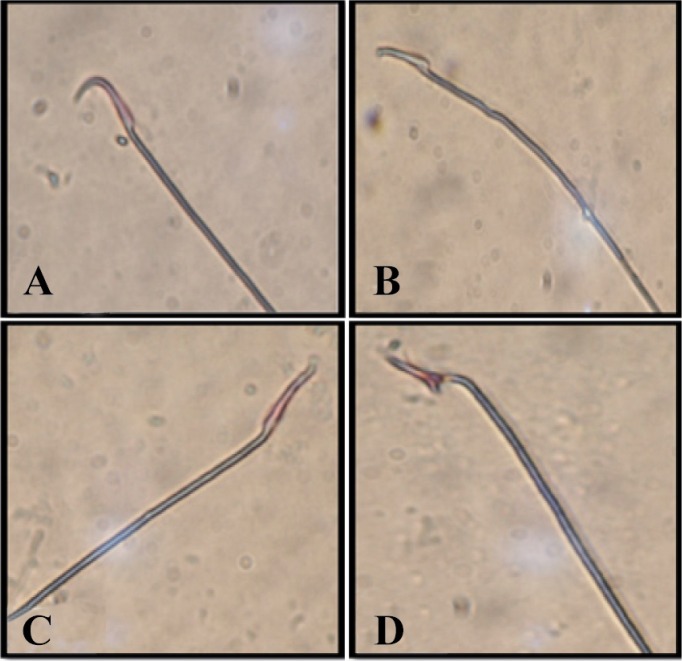
After sacrificing the animal, a 1 mm incision was made in the caudal epididymis and drops of sperm fluid were squeezed onto the microscope slide and 2 drops of normal saline were added to mobilize the sperm. Epididymal sperm motility was then assessed by calculating motile spermatozoa per unit area and was expressed in percentage. Epididymal sperm counts were also done by homogenizing the epididymis in HBSS. Counting was then done using the counting chamber in the haemocytometer (18). For sperm head morphology, the sperm suspension in HBSS was stained with 2% eosin solution and kept undisturbed for 1 hr. Smears were prepared using the above solution, air dried and fixed with absolute methanol for 5 min. Two hundred sperm per animal were examined to determine the morphological abnormalities. Sperm head morphology was scored under the category of normal, sperm without hook, amorphous head, banana head and triangular head.
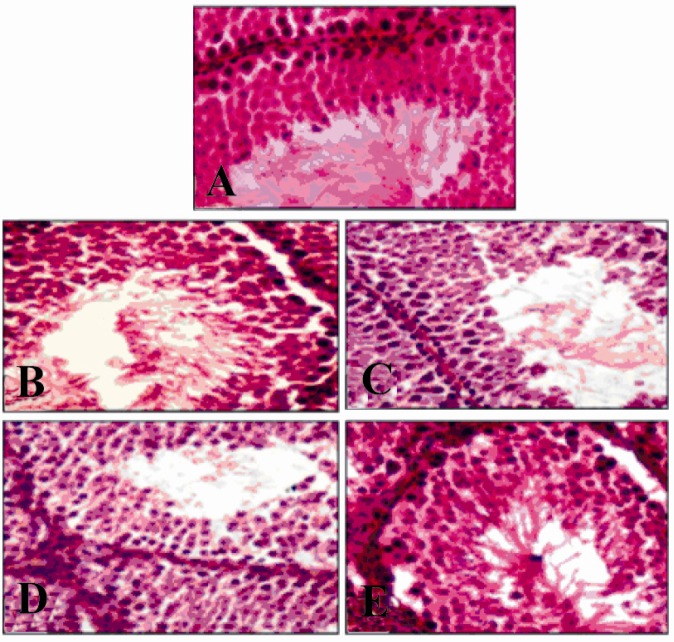
After sacrificing the rats, the testes were fixed in 10% formalin, dehydrated in increasing concentrations of ethanol and then embedded in paraffin. Tissue sections (5 μm) were mounted on glass slides which was already coated with Mayer's albumin and dried overnight. The sections were then de-paraffinized with xylene, rehydrated with alcohol and water. The rehydrated sections were stained, mounted with DPX mounting media and examined under the microscope (19).
Serum testosterone assay was carried out using the enzyme immunoassay (EIA) method. The within assay variation was 8.1 % and the sensitivity was 0.3 ng/mL. For the estimation of testosterone, blood samples were collected by retero-orbital plexus and serum samples were separated by standard procedures and stored at −20°C for subsequent analysis.
The testis and epididymis were dissected out, freed from adherent tissues and weight accurately. Protein (20) and glycogen (21) concentration were estimated in testis and other accessory reproductive organs.
Results were shown as Mean± standard error of mean (S.E.M.) for each group. Statistical analysis was performed using Jandel Sigma Stat (Version 2.03) statistical software. Fo r multiple comparisons, One-way analysis of variance (ANOVA) was used. In case ANOVA showed significant differences, post hoc analysis was performed with Tukey's test. The level of significance of the data was considered p<0.05.
Significant decrease in the final body weight (p<0.001) was observed after 45 days of treatment with the combination of SASP and AMP at the doses of 100 mg/kg and 10 mg/kg as compared with their initial weight (Table 1). The relative weights of different sexual organs were also determined. The weight of testis and seminal vesicle in all treatment groups showed significant difference (p< 0.001) after the treatment period of 45 days as compared to control group but in recovery group, no significant changes were observed after 30 days of withdrawing the treatment.
Table 1 Effects of drug treatments after 45 days on body, testicular, epididymal and seminal vesicle weights in wistar rats
| Treatment Group | Body weight (gr) | Testis (gr) | Epididymis (gr) | Seminal vesicle (gr) | |
|---|---|---|---|---|---|
|
| |||||
| Initial | Final | ||||
| Group I (Control) | 251±18.19 | 253±17.12 | 1.98±0.05 | 0.43±0.03 | 0.41±0.02 |
| Group II (AMP 20 mg/kg) | 231±16.12 | 236±16.12 | 0.91±0.07 | 0.33±0.05 | 0.26±0.06* |
| Group III(SASP 200 mg/kg) | 245±17.51 | 250±12.12 | 0.79±0.11 | 0.29±0.04 | 0.25±0.01* |
| Group IV(Combination) | 255±18.78 | 196±21.12 | 0.54±0.08 | 0.21±0.06 | 0.19±0.05* |
| Group V (Recovery) | 260±12.19 | 265±16.22 | 1.88±0.06 | 0.33±0.03 | 0.43±0.09 |
Values are expressed as Mean±SEM (n=8)
p≤0.01 when compared with control group
The ratio between delivered and inseminated females (09/16, 03/16, 01/16 and 15/16 animals versus 16/16 animals in group I) and the number of pups dropped after treatments are shown in Table 2. Although there was a decrease in ratio between delivered and inseminated females in all the groups except for the recovery group but this ratio was found to be least in the group which was treated with the combination of the drugs. However, all the delivered pups were normal and healthy.
Table 2 Effects of drug treatments on number of females delivered/ number of inseminated females, total number of pups, litter weight and mean percentage fertility (Male: female ratio, 1:2)
| Treatment groups | Mean percentage fertility (%) | Total N of pups | Litter weight (gr) |
|---|---|---|---|
| Group I (Control) | 100.00 | 97 | 9.3±0.91 |
| Group II (AMP 20 mg/kg) | 56.25 | 56 | 8.1±0.82 |
| Group III (SASP 200 mg/kg) | 37.50 | 51 | 6.1±1.21 |
| Group IV(Combination) | 6.25 | 04 | 7.0±1.31 |
| Group V (Recovery) | 93.75 | 94 | 8.6±1.19 |
The effects on sperm motility and counts were shown in Table 3.
Table 3 Effect of drug treatments after 45 days on sperm motility and sperm count in wistar rats
| Treatment Group | Sperm motility (% | Sperm counts (×106/ml) |
|---|---|---|
| Group I (Control) | 84.81±2.31 | 62.00±8.76 |
| Group II (AMP 20 mg/kg) | 74.62±1.31* | 50.67±9.82** |
| Group III (SASP 200 mg/kg) | 88.98±3.21 | 52.88±7.61** |
| Group IV (Combination) | 80.22±2.78 | 29.65±6.54*** |
| Group V (Recovery) | 83.21±1.93 | 61.00±7.67 |
Values are expressed as Mean±SEM (n=8)
p≤0.05
p≤0.01
p≤0.001 when compared with control group
Significant decrease in sperm motility was found in the group treated with AMP at the dose of 20 mg/kg (p<0.05) as compared with the control count. However, in all the other groups, there was not a significant decrease in sperm motility of the animals.
Decline in sperm count was observed in all the groups. A significant decrease in sperm count was observed (p<0.01) in the groups which were treated with AMP and SASP at the doses of 20 mg/kg and 200 mg/kg respectively as compared to the control group. Furthermore, a significant decrease in sperm count of the animals treated with the combination of AMP and SASP at the doses of 10 mg/kg and 100 mg/kg (p<0.001) was also observed as compared to the control group; however, no significant change in sperm count was seen in recovery group. Apart from this fact, abnormalities in sperm head were seen in all the groups as compared with the control group (Figure 1).
The mean serum testosterone level was found to be significantly (p<0.001) reduced in all the treatment groups as compared to the control group. However, in the recovery group there was not a significant change in the serum testosterone level (Table 4).
Table 4 Effects of drug treatments after 45 days on serum testosterone level in wistar rats
| Treatment Group | Serum testosterone level (ng/dL) |
|---|---|
| Group I (Control) | 256±1.9 |
| Group II (AMP 20 mg/kg) | 90.87±1.2 * |
| Group III (SASP 200 mg/kg) | 69.23±2.1 * |
| Group IV (Combination) | 70.12±1.9 * |
| Group V (Recovery) | 254±2.1 |
Values are expressed as Mean±SEM (n=8)
p≤0.001 when compared with control group
The group treated with AMP at the dose of 20 mg/kg showed significant (p<0.01) reduction in glycogen content of both testis and epididymis as compared to the control group. Similarly, group IV which was treated with the combination of both AMP and SASP at the doses of 10 mg/kg and 100 mg/kg showed significant (p<0.001) decrease in glycogen content of both testis and epididymis as compared to that of the control group. Furthermore, the protein levels in both testis and epididymis were significantly reduced in all the groups as compared to that of the control group. There was not a significant change in the recovery group (Table 5).
Table 5 Effects of drug treatments after 45 days of treatment on glycogen and protein level in reproductive organs of wistar rats
| Treatment Group | Glycogen Level (µg/mg tissue) | Protein level (µg/mg tissue) | ||
|---|---|---|---|---|
|
| ||||
| In testis | In epididymis | In testis | In epididymis | |
| Group I (Control) | 5.78±0.15 | 2.76±0.12 | 8.92±0.99 | 4.71±0.1 |
| Group II (AMP 20 mg/kg) | 4.01±0.74* | 1.91±0.22* | 6.65±0.65** | 2.43±0.2** |
| Group III (SASP 200 mg/kg) | 5.34±0.54 | 1.85±0.56* | 6.43±0.43** | 2.86±0.54** |
| Group IV (Combination) | 2.87±0.77** | 1.22±0.54** | 6.28±0.33** | 1.31±0.2** |
| Group V (Recovery) | 5.81±0.82 | 2.69±0.68 | 8.88±0.77 | 4.67±0.3 |
Values are expressed as Mean±SEM (n=8)
p≤0.01
p≤0.001 when compared with control group
The histology of both AMP and SASP treated rat testis showed maturation arrest of spermatozoa as compared to control group in which all the stages of spermatogenesis can be seen. But the effect produced by the AMP was patchy. However, in the group which was treated with the combination of both the drugs, the seminiferous tubules showed lack of spermatozoa along with the necrosis of the germ cells. Also, there was disorganization of plasmalemma in the basal portion of few seminiferous tubules. But the histological slide of the recovery group showed all the stages of spermatogenesis (Figure 2).
The results of this investigation reveal that the administration of SASP, AMP and their combination interfere with the structure and function of major elements of male fertility as reflected by the marked reduction in percentage fertility, serum testosterone level, sperm count and decrease in weight of major sex organs but a significant decrease in motility of sperm was not observed except for the group which was treated with AMP. Similar results were reported by Chumpol Pholpramool et al. (13) for SASP at the doses of 300, 450 and 600 mg/kg and by Y. Raji et al. (12) for AMP at the dose of 40 mg/kg in male rats.
The decreased fructose and protein level may affect glycoproteins secreted by the epididymis and coated on the sperm to stimulate motility (22). The reduced protein content may be another reason for the reduction in the weight of reproductive organs, because the growth rate of organ is proportional to its protein content (23). The depletion in the glycogen content due to treatment hampers the glycolytic metabolism of spermatozoa. A decrease in the glycogen content of the testis reduces the energy source for spermatogenic activity (24). The present study reveals reduction in the level of glycogen and protein of testes and epididymis, and it affects spermatogenesis and sperm maturation.
However, in this investigation, AMP and SASP either separately or in combination were producing decline in the reproductive capacity of male rats but the combination of both SASP and AMP was found to be impairing the reproductive activity at a considerably lower dose. Apart from it, overall decrease in the fertility, sperm count and serum testosterone level was very higher in comparison to other groups. So, it can be predicted that they have synergistic antifertility effect in male rats. Till now, the exact mode of action of both SASP and AMP as antifertility agents is not well elucidated yet. But according to Marmor et al. (6), SASP produces antifertility action due to inhibition of dietary folic acid absorption, while AMP produces this effect due to inhibition of sperm motility (12).
Thus, our results clearly demonstrate the treatment by AMP and SASP combination in male rats induced synergistic germ cell toxicity in rats as is evident from the decrease in sperm count, serum testosterone level and decline in percentage fertility but the effect was reversible as is evident from the recovery group. Furthermore, this was confirmed by histopathological analysis and sperm head morphology but the cause of this infertility at genetic level is not evaluated in the research paper. As they are both used in combination for treatment of various pathological conditions, it warrants further attention for complete elucidation of the reasons behind this toxic effect so as to reduce the potential risk in the patients, who are particularly in the reproductive ages.
The financial assistance received from department of pharmaceutical technology, MIET Meerut to carry out this particular study is duly acknowledged.
