
Arecurrent miscarriage (RM) is defined as a condition of three or more consecutive pregnancy losses before 24 weeks of gestation (1). The etiology is unknown in 50% of the cases. The causes of RM are parental chromosomal abnormalities, uterine anomalies, endocrine dysfunction, autoimmune disorders, maternal and paternal age, infectious diseases, environmental toxins, etc. Among the various etiologies, genetic factors appear to be highly associated with reproductive loss (2).
Balanced chromosomal rearrangements are the most frequent genetic abnormalities in humans; an estimated 0.5% of the population carries a balanced translocation or inversion (3). These balanced rearrangements are common in couples with reproductive disorders (4). There is a 15-20% chance of all pregnancies ending up in RM and 70% of them represent the chromosomal abnormalities. Parental chromosomal abnormalities also represent an important etiology of RM with a prevalence of 2-8% (5). Due to malsegregation during meiosis, unbalanced gametes can be produced. The unbalanced distribution of the chromosomes involved in the translocation, leads to partial trisomy for one chromosome and partial monosomy for the other chromosome (6). The severity of the phenotype depends on the chromosomes involved and the position of the breakpoint regions. The clinical consequences of such imbalances are usually lethal to the developing embryo leading to spontaneous miscarriages or early neonatal deaths (7). Since there is the prevalence of chromosomal abnormalities in couples with recurrent miscarriages, it is important for the clinicians to suggest cytogenetic analysis in such couples. This eventually helps to know the existence of any rearrangements as well as also increase the know-ledge of the recurrent chromosomal rearrangements in a given population.
Although there are few reports in literature involving translocation (18;22), they are mostly associated with lymphomas. For example, B-cell lymphomas with a t(18;22)(q21;q11) (8) and a t(18;22) in a case of lymphocytic lymphoma are the typical ones (9). But to our knowledge, there are no reports showing t(18;22) associated with RM.
We report here on the clinical cytogenetic and Molecular cytogenetic finding in a patient with t(18;22). To the best of our knowledge, this is the first report with t(18;22) showing the unique breakpoints associated with RM.
A non-consanguineous couple, wife (29 years) and husband (33 years), were referred to our genetic clinic with poor reproductive history evaluation. The wife had three miscarriages, all in her first trimester and one neonatal death. The detailed family history and written consent were taken from the couple. Both the partners were physically and intellectually normal. There was no family history of any other disorders and miscarriages. Other possible factors like infectious diseases, immunological incompetence and anatomical defects in the female reproductive tract were ruled out.
Chromosomal analysis was carried out on peripheral blood lymphocytes in both the partners by standard methods. Metaphases were analyzed by G-banding using Trypsin and Giemsa in the couple.
SKY was performed using SKY Paint kit-Human (Applied Spectral Imaging). The denaturation and hybridization of the probe and the target DNA with recommended parameters of time and temperature, final post-hybridization washes and counterstaining with 4′-6-diamidino 2-phenylindole hydrochloride (DAPI) were carried out as per manufacturer's protocol on the patient slide.
FISH was performed according to the manufacturer's instructions on the metaphase spreads of the patient by standard procedures. Commercially available whole chromosome paint probes of chromosomes 18 and 22 were used (Kreatech, Netherlands).
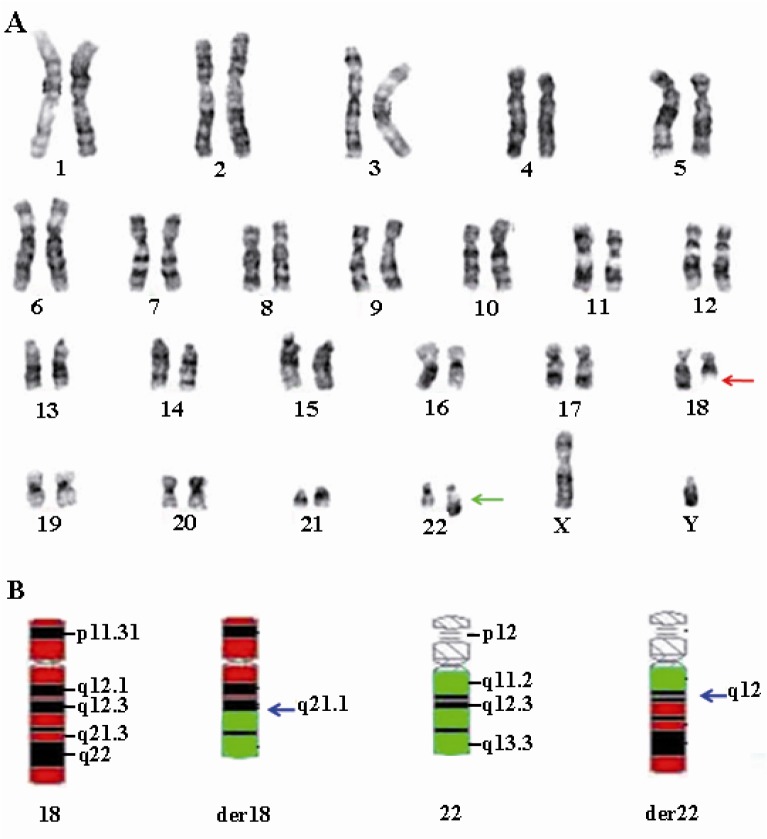
Cytogenetic analysis of the GTG banded chromosomes of the husband revealed a karyotype of t(18;22)(q21.1;q12) (Figure 1) whereas wife had a normal female karyotype of 46,XX.
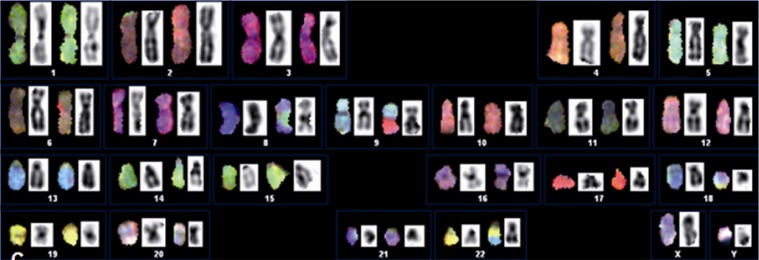
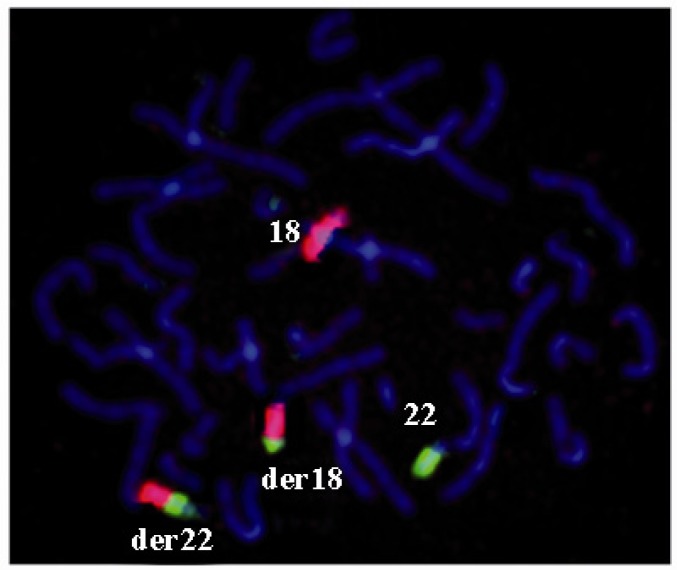
Spectral karyotyping (SKY) was performed which showed the balanced reciprocal translocation (BRT) involving only chromosomes 18 and 22. SKY also ruled out the involvement of other chromosomal aberrations present in the genome (Figure 2). Apparently, the balanced translocation was further confirmed by FISH. FISH with whole chromosome paint 18 (red) and paint 22(green) showed normal 18 and 22 chromosomes in red and green colors and both the derivatives 18 and 22 in both red and green (Figure 3). Hence, the refined karyotype according to ISCN 2013 is 46,XY.ish t(18;22)(q21.1;q12)(wcp18+,wcp22 + ; wcp22+,wcp18 + ) (10).
Reciprocal translocation is the most common chromosomal abnormality found in 1 in 500 people (11). These translocations do not show any phenotypic effect in most carriers, but can give rise to reproductive problems, usually RM, chromosomally abnormal offspring or in some cases infertility (12). In this study, a couple with RM was studied. The husband revealed a BRT and the molecular cytogenetic technique like FISH confirmed the translocation and SKY ruled out the involvement of other chromosomal rearrangements.
BRT is ascertained in 68% of phenotypically normal couples because of their reproductive problems (13). They can cause pregnancy loss be-cause segregation during meiosis results in gametes with duplication or deficiency of chromosome segments (14). The severity depends on the chromosomes involved and also the breakpoint regions. When one member of a couple carries a BRT, the risk of having a miscarriage is approximately doubled (15).
In BRT, the translocated chromosomes and their homologues align in a cross shaped structures called quadrivalent during meiosis (16). These quadrivalents segregate with or without recombination, to give gametes with different balanced or unbalanced chromosome complements (17). Likely, there are 32 possible types of meiotic outcomes, out of which only two are genetically balanced; one having normal chromosomes and the other carrying the balanced form of the translocation (12).
Also, in the present study, it was probable that the proper alignment of the homologous chromosomes was not possible due to the reciprocal translocation, thereby resulting in unbalanced gametes. This could be the reason of the three RM in the wife and a neonatal death.
Most likely, pathogenic mechanism behind RM is a multifactorial mode of inheritance. Several causes such as skewed X-chromosome inactivation, genomic imprinting, single gene mutations, chromosomal instability and sperm chromosomal abnormalities have been suggested to explain the reproductive losses (13).
Identification of each case is important as it leads to insights into the mechanisms of the rearrangements and characterization of such rearrangements helps in the identification of the disease involved. In RM cases, the parental chromosomal analysis plays a significant role as the cause of the RM can be understood. When a BRT is identified, the future pregnancies can be monitored by offering prenatal diagnosis. This helps in confirming the balanced and unbalanced state of the offspring. Where available, the products of conception can also be analyzed to confirm the partial trisomy and monosomy of the fetus.
Apparently, precise molecular characterization of BRT could pave the way for the identification of new genes or genes involved in RM and also help in elucidating the molecular mechanism underlying the aberrations. It also establishes the cause of the miscarriage and helps in genetic counseling.
In summary, the problem of the reported case in this study can increase our knowledge about RM. Genetics of RM also helps especially in assisted reproductive procedures. Hence, cytogenetic studies leading to RM still remain an important tool. To the best of our knowledge, this is the first report of t(18;22) with the unique breakpoints in RM.
This study was supported by a core grant to the Centre for DNA Fingerprinting and Diagnostics, from the Department of Biotechnology, Government of India. URD is grateful to Prof Dr med Evelin Schrock from Medizinische Fakultat Carl Gustav Carus, Technische Universitat, Dresden, Germany for kindly providing the training in SKY.
