
Detection and treatment of RTI/STIs is of particular concern in India due to the dual problems of underdetection and their chronic complications besides the recent association of RTI/ STIs with the global epidemic of HIV/AIDS. RTI/ STIs remain under-diagnosed due to being asymptomatic and even when symptomatic, women may not seek treatment. Among the symptomatics and those seeking care, many women remain inadequately treated (1). Previous community based studies show that half the symptomatic of RTI/ STI do not seek treatment in India (2). This is due to a variety of factors ranging from inadequate or inaccessible health-care coverage and particular cultural factors in India relating to stigma, lack of knowledge and vulnerability in women.
RTI/STIs, in addition to causing long term complications in women such as pelvic inflammatory disease, infertility and propensity towards neo-plasia, are also a significant source of morbidity which affect quality of life and cause a large burden on the healthcare system. In addition, they may cause fetal anomalies. QOL is a composite index of health, disease and treatment seeking. Impairment of QOL in RTI/STIs is well recognized and several hospital based studies evaluating QOL in patients suffering from RTI/STIs have showed uniform impairment affecting productivity and quality of life (3–6).
World Health Organization (WHO) recommends a syndromic approach in the community which uses flowcharts to guide diagnosis and treatment is more accurate than diagnosis based on clinical tests alone. It follows a scientific approach and offers accessible and immediate treatment that is effective. In countries like India, the syndromic approach is cost effective and amenable to use in the community. In large scale Indian studies, the syndromic approach has shown adequate sensitivity and specificity (7).
RTI/STIs are a public health concern universally regardless of the development status of the country unlike the differential occurrence of infectious and noncommunicable diseases. The prevailing trend is a growth of viral RTI/STIs like human papilloma virus and herpes and with an emergence of bacterial resistance due to partial clearance of bacterial agents with incomplete or improper treatment (8, 9). The estimates of the burden of disease in India vary to a large extent due to an improper reporting system, varying methodologies of study conduct including hospital based studies which predominate and regional differences. Studies have obtained a one year prevalence rate ranging from 3.4% to 13.7% (2).
The present study was conducted to determine the burden of the disease using syndromic approach in the rural community and to evaluate the impact on QOL.
A community based cross sectional study was conducted in the field practice area of a rural health center of a teaching hospital which covers 6 villages with a population of 20,756. Married women in the reproductive age were included in the study with the age range between 18 years to 49 years through systematic random sampling over a period of 3 months to achieve a sample size of 500. Excluding incomplete responses and missing responses, a total of 464 valid cases were included in the study. Pretesting and validation of the questionnaire were performed via a pilot study. The purpose of the study was explained, and informed consent was obtained from all respondents. Privacy and confidentiality were ensured during the whole process. Female house surgeons previously trained regarding interviewing the respondents explained the questionnaire in lay language and recorded the responses.
A semi-structured questionnaire consisting of 5 parts was administered through a face to face interview. Data was obtained regarding 1) Socio-demographic characteristics such as age, education, occupation, number of children and total family monthly income. Socio-economic status was obtained using the Kuppuswamy classification and respondents were divided into 5 socio-economic classes (10). 2) Data regarding symptoms of RTI/STI during the previous year were obtained including abnormal or foul smelling vaginal discharge, genital or vaginal pruritus, dysuria, dyspareunia, genital ulcer and infertility. Infertility was defined as inability to conceive in spite of unprotected sexual intercourse for over a year (11). Women exhibiting symptoms were considered to be suffering from RTI/STI as per the syndromic approach (2). 3) Risk factors for RTI/STI were evaluated including current method of use of contraception, history of similar previous infections, menstrual and perineal hygiene and use of reusable cloth or disposable napkins, presence of RTI/STI symptoms in the spouse, consumption of alcohol by either partner during intercourse and multiple sexual partners. 4) Knowledge regarding RTI/STI was evaluated; women were evaluated on the ability to name at least 2 symptoms of RTI/ STI, mode of spread of infection, prevention through barrier method of contraception, importance of perineal hygiene in prevention and possibility of maternal to child transmission. 5) QOL was evaluated using a standardized instrument, the WHO-BREF, which is applicable cross culturally, is validated in the Indian context and has been previously used to evaluate perception of life and health in RTI/STI. (4, 12) WHO-BREF consists of a 26 item questionnaire evaluating QOL on 4 domains namely, physical, psychological, social relationship and environmental. Responses were obtained on a 5 point Likert scale ranging from 1-5, appropriately coded and reverse coded and domain totals were calculated as per the prescribed analysis. Transformed scores were obtained using the formula (Actual raw domain score-lowest possible raw domain score)/Possible raw domain score range x 100 for cross domain comparison. Overall scores could range from a 28 (minimum) to 140 (maximum) on the raw scale and 0-100 on the transformed scale, with higher scores indicating better QOL.
Statistical measures obtained included percentages, proportions and tests of significance namely chi square test and unpaired t test.
A total of 464 women consented to participate in the study. Most women with symptoms were in the age group of 18-25 years and in women without symptoms, the age group with the largest number was 26-33 years followed by 34-41 years. Age was significant for an outcome of RTI/STI (p = 0.0006). Most women had 2 children and statistical test measuring the association between the number of children and outcome of RTI/STI was not significant (p = 0.99). The predominant distribution of the sample was in the lower middle and upper lower socio-economic classes as per the Kuppuswamy scale and socio-economic status was a significant factor for outcome of RTI/STI (p = 0.0004). Socio-demographic characteristics are depicted in Table 1.
Table 1 Socio-demographic characteristics of the women with symptomatic RTI/STI
| Characteristic | RTI/STI present (%) | RTI/STI absent (%) | Total | Significance |
|---|---|---|---|---|
| Age in years | ||||
| 18-25 | 22 (26.8) | 60 (73.2) | 82 (100) | X2=17.34 p = 0.0006 |
| 26-33 | 14 (9.6) | 132 (90.4) | 146 (100) | |
| 34-41 | 12 (9.2) | 118 (90.8) | 130 (100) | |
| >41 | 12 (11.3) | 94 (88.7) | 106 (100) | |
| Number of children | ||||
| ≤ 1 | 6 (13) | 40 (87) | 46 (100) | X2=0.006 p = 0.99 |
| 2 | 44 (13) | 295 (87) | 339 (100) | |
| >2 | 10 (12.7) | 69 (87.3) | 79 (100) | |
| SES | ||||
| Upper middle | 10 (35.7) | 18 (64.3) | 28 (100) | X2=17.59 p = 0.0004 |
| Lower middle | 14 (7.9) | 164 (92.1) | 178 (100) | |
| Upper lower | 30 (13.3) | 196 (86.7) | 226 (100) | |
| Lower | 6 (18.7) | 26 (81.3) | 32 (100) | |
| Total | 60 (13) | 404 (87) | 464 (100) | |
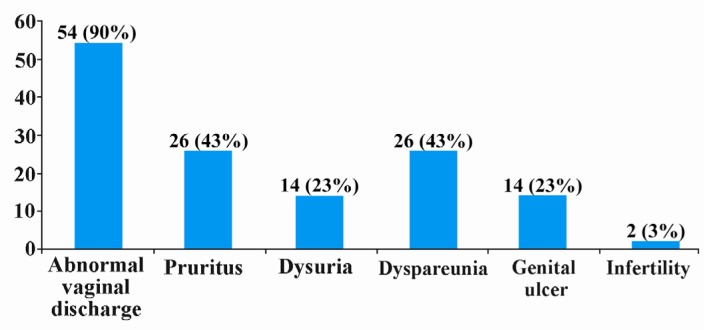
In the sample, 60 (13%) women responded with having at least 1 symptom characteristic of RTI/ STI. The most common symptom in the group was abnormally profuse or colored vaginal discharge with 54 (90%) of the women suffering from it followed by dyspareunia and pruritus in 26 (43.3%) women. The symptom distribution of the affected women is depicted in Figure 1. Of the 60 women, 24 (40%) had sought treatment for the condition. 22 of the remaining 36 felt that “the symptoms will go away on their own”, while 14 complained of lack of accessibility to a lady medical officer.
Risk factors for RTI/STI were evaluated and nonuse of barrier contraceptives was significant on a proportions test (p < 0.001). An incidence of similar infection in the past was also significant for an outcome of RTI/STI with p < 0.001. Menstrual hygiene and presence of RTI/STI symptoms in the spouse were also significant for an outcome with X2=16.41, p < 0.001 and X2=193.6, p < 0.001, respectively. Consumption of alcohol during intercourse and multiple sexual partners were not included in analysis due to a high non response rate. The distribution of risk factors is presented in Table 2.
Table 2 Risk factors in symptomatic RTI/STI
| Characteristic | RTI/STI present (%) | RTI/STI absent (%) | Total | Significance |
|---|---|---|---|---|
| Method of contraception | ||||
| Barrier | 12 (37.5) | 20 (62.5) | 32 (100) | X2=18.43 |
| Other/none | 48 (11.1) | 384 (88.9) | 432 (100) | p < 0.001 |
| Past history of infection | ||||
| Present | 22 (39.3) | 34 (60.7) | 56 (100) | X2=39.29 |
| Absent | 38 (9.3) | 370 (90.7) | 408 (100) | p < 0.001 |
| Menstrual hygiene | ||||
| Reusable cloth | 34 (21.8) | 122 (78.2) | 156 (100) | X2=16.41 |
| Disposable napkins | 26 (8.4) | 282 (91.6) | 308 (100) | p < 0.001 |
| Spousal symptoms | ||||
| Present | 36 (78.3) | 10 (21.7) | 46 (100) | X2=193.6 |
| Absent | 24 (5.7) | 394 (94.3) | 418 (100) | p < 0.001 |
| Total | 60 (13) | 404 (87) | 464 (100) | |
Knowledge regarding symptoms, mode of spread, prevention, importance of personal hygiene and mother to child transmission was evaluated in both groups. The largest difference in knowledge was related to method of prevention with 5% in RTI/STI group and 20.04% in non RTI/STI group being aware about the importance of barrier methods to prevent infection. Overall knowledge and specifically, knowledge regarding mother to child transmission was poor in both groups. Knowledge levels for both groups are presented in Table 3.
Table 3 Knowledge of women regarding RTI/STI
| RTI/STI present (%) | RTI/STI absent (%) | Total | Significance | |
|---|---|---|---|---|
| Awareness regarding symptoms | ||||
| Aware | 13 (8.6) | 139 (91.4) | 152 (100) | X2=3.85 |
| Not aware | 47 (15.1) | 265 (84.9) | 312 (100) | p = 0.049 |
| Mode of spread | ||||
| Aware | 9 (7.3) | 114 (92.7) | 123 (100) | X2=4.68 |
| Not aware | 51 (15.0) | 290 (85.0) | 341 (100) | p = 0.03 |
| Prevention through barrier methods | ||||
| Aware | 3 (3.6) | 81 (96.4) | 84 (100) | X2=7.98 |
| Not aware | 57 (15.0) | 323 (85.0) | 380 (100) | p = 0.004 |
| Importance of personal hygiene | ||||
| Aware | 13 (7.1) | 170 (92.9) | 183 (100) | X2=9.11 |
| Not aware | 47 (16.7) | 234 (83.3) | 281 (100) | p = 0.002 |
| Mother to child transmission | ||||
| Aware | 2 (4.8) | 40 (95.2) | 42 (100) | X2=2.73 |
| Not aware | 58 (13.7) | 364 (86.3) | 422 (100) | p = 0.09 |
| Total | 60 (13) | 404 (87) | 464 (100) | |
QOL was measured on the 4 domains of WHO-BREF including physical, psychological, social and environment domains. The possible range of raw scores for each domain were 7-35 for the physical domain, 6-30 for the psychological domain, 3-15 for the social domain and 8-40 for the environmental domain. Transformed scores range from 0-100 with 0 representing poor QOL and 100 representing optimal QOL. The largest mean difference was in the social relations and sexual activity domain with the raw score in RTI/STI group being 17.5±8.22 and in the non RTI/STI group being 49.8±6.9, respectively. The mean raw and transformed scores are depicted in Table 4.
Table 4 Quality of life scores in women with symptomatic RTI/STI
| Domains | RTI/STI present | RTI/STI absent | Significance | ||
|---|---|---|---|---|---|
| Raw score | Transformed score | Raw score | Transformed score | ||
| Physical (7-35) | 17.23±0.767 | 36.54±2.74 | 22.79±1.402 | 56.38±5 | t = 30.013 p < 0.001 |
| Psychological (6-30) | 12.87±1.127 | 28.61±4.69 | 17.57±1.74 | 48.20±7.25 | t = 20.31 p < 0.001 |
| Social (3-15) | 5.10±0.99 | 17.5±8.22 | 8.99±0.82 | 49.8±6.9 | t = 33.16 p < 0.001 |
| Environment (8-40) | 17.73±1.56 | 30.41±4.87 | 24.14±2.2 | 50.41±6.88 | t = 21.715 p < 0.001 |
| Total | 33.4±3.45 | 56.07±3.31 | 57.07±3.65 | 78.79±3.5 | t = 49.194 p < 0.001 |
An unpaired t test was performed among the QOL domains and total QOL score among the RTI/STI and the non RTI/STI group and significant differences were obtained between the domains as well as the total score.
QOL measures how a debilitating illness that is not life-threatening affects living negatively. WHO defines quality of life as “individual′s perception of their position in life in the context of the culture and value systems in which they live and in relation to their goals, expectations, standards and concerns”. QOL refers to how the individual's wellbeing may be impacted over time by a disease and is thereby a measure of the persons own perception of the impact of the disease. QOL hence represents an index of the burden of the disease with respect to the patients’ physical, psychological, and social relations in the environment. This measure is particularly relevant in diseases such as RTI/STI wherein disclosure is associated with stigma and health seeking is impaired by embarrassment and hesitation, particularly in women where accessibility to an empathic female health worker may not be available given the state of primary health-care.
In the current study, the percentage of affected symptomatics was 13% which correlates with other community based studies such as the study conducted by Samanta et al. (2) and Madhivanan et al. (13) also in a rural community. Hospital based studies such as the ones by Devi et al. (9) and Setia et al. (14) have obtained higher prevalence in women attending STI clinics and tertiary hospitals; however, the rates are not comparable due to differences in the study setting. More than 1 in 10 women suffer from symptoms of RTI/STI and this represents a large proportion of women who require essential health-care in an optimal manner in keeping with the cultural drawbacks and hesitancy in seeking help for these conditions. Only 40% of the women in this study had sought health-care and this is a gap in provision of universal health-care that needs to be bridged. The pressing complications leading to chronic disease, sterility and possible risk of cancer beget immediate intervention.
Age and socio-economic significance was similar to the study by Madhivanan et al. (13), but while the study by Setia et al. (14) obtained a decreasing occurrence of infection in younger women, this study had a higher proportion of infection in younger women. Women with early exposure to sexual intercourse and early age at marriage are at higher risk and physiologically, the cervical mucosa is thinner making them prone to infections. Symptom wise, they may report later to the hospital due to lack of knowledge and delayed appearance of complications, but the trend represents a lacuna in health delivery systems as permanent disabling complications including sterility may occur with infections at an early age.
The risk factors for RTI/STI examined have been reiterated time and again in several epidemiological studies; however, combating them has proven difficult due to the social issues surrounding the practices and precluding intervention because of the hesitancy in approach of these topics in a conservative society such as India. These however need to be addressed immediately as these risk factors are also a marker for the risk of acquiring HIV infections which is a current global epidemic. Simple measures such as educating women about the mode of spread, making them aware of the symptoms of the condition and promoting the use of barrier methods of contraception would be effective as evidenced by the significant association between these factors and outcome of RTI/STI in this study. Due to vulnerable state of women in India, encouraging concurrent treatment of the spouse requires special effort
Knowledge regarding RTI/STI was measured by Cabada et al. (15) and McManus et al. (16) in India. More than 30% of the adolescent girls in the study were unaware about the symptoms of RTI/ STI and they recognized the immediate need for gender based sex education. In this study, the knowledge was significantly lower in the RTI/STI group regarding the importance of barrier method of contraception and the lack of awareness regarding mother to child transmission was prevalent in both groups. Impetus through reproductive and child health national health programs is required to address these issues.
All domains of QOL were impacted in the RTI/ STI group in this study with the largest impact on the social and sexual domain. While RTI/STIs appear innocuous, the burden of disease in society is large as evidenced by the significant differences between the mean QOL of both the groups. QOL is impaired in RTI/STIs and this impairment has been replicated in numerous studies in all subtypes of infections (3–6). While a measure of prevalence gives an estimate of the disease occurrence, QOL measures give a more direct measure of the impact of the disease on daily life and this is more relevant in RTI/STIs where the condition is distressing physically, psychologically and treatment seeking is hindered by numerous factors which are predominantly social even if logistic measures of health care delivery are achieved. This significant difference in QOL is more relevant when obtained in the community as it may be incompletely uncovered in hospital studies. A renewed effort in context of the existing health-care programs with emphasis on health education are simple techniques that can improve knowledge and practices and combat these largely preventable infections.
In the current study, the obtained data was a 13% prevalence of RTI/STI symptoms with a significant lack of awareness regarding occurrence and prevention among women and significant impairment on all QOL domains.
Data was obtained solely on verbal response and perception of QOL was subjective. Further analysis and study is required to determine the correlation between individual infections and QOL.
