
Fibroblast growth factors (FGFs) are a large family of structurally-related, widely expressed, multifunctional heparin-binding poly-peptides, which contain 23 members in vertebrates. The biological processes of FGFs are mediated by binding to and activating a group of high-affinity FGF receptors (FGFRs), which are encoded by five distinct genes. Differential splicing of Fgfr mRNA also gives rise to several receptor isoforms that are expressed in a tissue-specific fashion (1). Overwhelming data demonstrate that FGF/FGFR signaling cascades play an important role in many cellular processes including mitogenesis, differentiation, migration, survival and polarity (1–4).
FGFRs are evolutionarily conserved transmembrane proteins that are composed of an extracellular ligand-binding domain, a transmembrane region and a cytoplasmic portion containing the catalytic protein tyrosine kinase domain (1, 2, 5). Studies have demonstrated that FGFRs possess broad ligand binding affinity and specificity that can interact with multiple FGFs for signal transduction. FGFR1 to FGFR4 are known to propagate the highest level of FGF signals in a wide range of tissues. The binding of FGFs to these receptors activates multiple signaling cascades, which include STAT, MAPK and PI3K pathways (6). The role of FGFR5 (also known as FGFR like-1), which is a short form of FGFR lacking the catalytic protein tyrosine kinase domain, is currently less understood (7, 8).
A number of FGFs and FGFRs are detected in the male reproductive system of different mammalian species including mouse, rat, bovine and human (1, 9–16). The most characterized gonads are the rat testes. Previous studies have demonstrated that the transcript variants of Fgfr1 IIIb and IIIc, Fgfr2 IIIc, Fgfr3 IIIc and Fgfr4 are expressed in fetal, immature and adult rat testes (10). However, only FGFR1 and FGFR3 but not FGFR2 and FGFR4 proteins are detected in the fetal rat testes (10). In immature testes, all four FGFRs are present in the germ and Leydig cells but not in Sertoli cells. FGFR1 to FGFR4 are found in the seminiferous epithelium and interstitium of adult rat testes (11, 17). It is reported that all four FGFRs are immunolocalized in germ cells including elongated spermatids, while only FGFR4 is present in Sertoli cells (10). Furthermore, the expression pattern of each Fgfr in the germ cells during spermatogenesis exhibits a stage-specific change (10–12).
The presence of multiple FGFs and FGFRs in multiple cell types of pre- and post-natal testes implies that these factors are important in regulation of the fetal testicular development, maturation of sperm, inducing the capability of male to produce functional gametes and affecting male fertility (1). To investigate the function of FGFs/ FGFRs signaling in vivo, several mutant mice have been created. Conventional gene knockout of either Fgfr1 or Fgfr2 results in an early death in utero, suggesting the vital role of these receptors during embryonic development (18, 19). Fgfr3 and Fgfr4 null mutant mice, on the other hand, are viable with no reproductive phenotype reported (20–22). Conditional gene knockout of Fgfrs in specific organs or cells in mice (16, 19, 21, 23–29) have been generated to circumvent the embryonic lethality. The crucial role of FGFR2 during testicular development has been elegantly demonstrated by Kim et al. Using two different transgenic Cre mouse lines that induce either a temporal or a cell-specific ablation of this receptor reveal that FGFR2 mediated FGF9 signaling is essential for proliferation and Sertoli differentiation during testis determination (16).
Despite extensive studies in the last decades, the temporal and spatial expression of Fgfr1 and Fgfr2 in mouse testes during the postnatal development is not well defined and their exact roles in spermatogenesis and male fertility are not unequivocally demonstrated. The aim of this study was to determine the localization of FGFR1 and FGFR2 in the mouse testes during postnatal development, and to elucidate the effect of each Fgfr1 and Fgfr2 on spermatogenesis and fertility using mouse models with postnatal germ cell-specific deletion.
All animals were housed under 12 hr light-dark cycles with food and water provided ad libitum. All mice were maintained as required under the National Institutes of Health guidelines for the Care and Use of Laboratory Animals. All studies have been approved by the Animal Care and Use Committee of the University of Louisville. All the mice were sacrificed under ketamine anesthesia and all efforts were made to minimize their suffering.
To specifically investigate the role of each Fgfr1 and Fgfr2 in germ cells, a transgenic Cre mouse line expressing an improved Cre (iCre) recombinase driven by the mouse Tex101 promoter (Tex101-iCre) was used. This transgenic line was previously generated in our laboratory (30). The expression of iCre was specifically detected in the prespermtogonia within seminiferous tubules of postnatal eight-day-old testes. In adult mice, there were robust iCre activities in spermatocytes and spermatids and a weak activity in spermatogonia. For germ cell selective deletion of Fgfr1 or Fgfr2, Tex101-iCre female mice were first bred with Fgfr1flox/flox or Fgfr2flox/flox males to obtain bigenic heterozygous females (i.e.,Tex101-iCre;Fgfr1flox/+ and Tex101-iCre;Fgfr2flox/+). Then, these heterozygous females were bred with Fgfr1flox/flox or Fgfr2 flox/flox to generate male germ cell-specific Fgfr1 or Fgfr2 mutant mice (male Tex101-iCre;Fgfr1flox/flox or Tex101-iCre;Fgfr2flox/flox). Floxed Fgfr1 and Fgfr2 mice were kindly provided by Dr. Juha Partanen (floxed Fgfr1 mice, University of Helsinki, Finland) and Dr. David M. Ornitz (floxed Fgfr2 mice, Washington University in St Louis) and details were described elsewhere (23–25). To determine the efficiency of Tex101-iCre in excision of floxed Fgfr1 and Fgfr2 alleles, Tex101-iCre;Fgfr1flox/flox and Tex101-iCre;Fgfrflox/flox male mice were mated with wild-type females.
Genomic DNA was isolated from mouse tails using proteinase K and phenol chloroform extraction method as described previously (30). The presence of iCre or LacZ was determined by PCR using the primer pairs listed in Table 1. The primer sets Fgfr1Δ and Fgfr2Δ were used to determine the deletion of floxed Fgfr1 and Fgfr2 alleles.
Table 1 Oligonucleotide primers for genotyping and semiquantitative RT-PCR (F, forward; R, reverse)
| Genes | Primer sequences (5‘-3‘) | PCR cycles |
|---|---|---|
| RT-PCR primers | ||
| Fgfr1 | F: AAGAGAGACCAGCTGTGATG | 31 |
| R: ATATTCGGAGACTCCAGCCA | ||
| Fgfr2 | F: AGAAGGAGATCACGGCTTCC | 31 |
| R: TACTCGGAGACCCCTGCTAG | ||
| Fgfr3 | F: CTGTGCCAGCCGCAAACACT | 31 |
| R: AGAATGGCTGTCTGGTTGGC | ||
| Fgfr4 | F: TCCCAGCCAACACCACAGCT | 31 |
| R: TCTTCCTCTGGCAGCACCGT | ||
| Fgfrl1 | F: GGACGCCACAACTCCACCAT | 31 |
| R: GAAGACAGCACCAGCTGGGA | ||
| Rpl19 | F: GAGTATGCTCAGGCTTCAGA | Co-amplified with target genes |
| R: TTCCTTGGTCTTAGACCTGC | ||
| Genotyping primers | ||
| Fgfr1 | F: TTGACCGGATCTACACACACC | 32 |
| R: AACCACCCCCACACCAAA | ||
| Fgfr2 | F: GTCAATTCTAAGCCACTGTCTGCC | 32 |
| R: CTCCACTGATTACATCTAAAGAGC | ||
| Fgfr1 ▵ | F: GGACCTCTGGAAGAGCAGTG | 32 |
| R: AGGTTCCCTCCTCTTGGATGA | ||
| Fgfr2 ▵ | F: ATAGGAGCAACAGGCGG | 32 |
| R: CATAGCACAGGCCAGGTTG | ||
| iCre | F: TCTGATGAAGTCAGGAAGAACC | 33 |
| R: GAGATGTCCTTCACTCTGATTC |
Testicular cells were isolated from three 2-month-old mice using the procedure described previously (31) with a little modification. Briefly, the testes were decapsulated and incubated with a collagenase type II solution (0.5 mg/ml, Sigma, St. Louis, MO) to separate interstitial cells and seminiferous tubules. The interstitial cells were pelleted by centrifugation. To obtain the germ cells and Sertoli cells, the dispersed seminiferous tubules were cut into small pieces and digested with a solution containing 1 mg/ml trypsin (Sigma) and 10 μg/ml DNase I (Sigma) at 32oC for 30 min. The reaction was stopped by adding trypsin inhibitor (Sigma) and Hank's Balanced Salt Solution (HBSS, Invitrogen, Carlsbad, CA). The supernatant that contained germ cells was collected after precipitation by unit gravity. The pellet was incubated with a collagenase type II solution at 32oC for 15 min and settled down by unit gravity. The cell pellet that contained Sertoli cells was rinsed with HBSS three times and cultured with Dulbecco's Modified Eagle's Nutrient Mixture/F12 Ham Medium supplemented with 10% fetal bovine serum (Invitrogen) overnight. Sertoli cells were harvested the next day after residual germ cells were hypotonically removed. The purity of isolated interstitial, Sertoli and germ cells was evaluated by performing RT-PCR using several putative marker genes, which included cholesterol side-chain cleavage enzyme and 17α-hydroxylase (interstitial cells), follicle stimulating hormone receptor and Pem homeobox gene (Sertoli cells), alkaline phosphatase and fibronectin (myoid cells) and protamine 2 and stimulated by retinoic acid gene 8 homolog (germ cells) (32, 33). The results showed that the contamination of each cell type by the others was minimal (data not shown).
Total RNA was extracted from the testes and the isolated testicular cells using Trizol Reagent (Invitrogen) according to manufacturer's instructions. Total RNA was adjusted to a concentration of approximately 1.0 μg/μl. Two microgram of total RNA was reverse transcribed into cDNA with random primers (Invitrogen) and avian myeloblastosis virus (AMV) reverse transcriptase (Promega Corporation, Madison, WI). The cDNA was amplified by PCR with the primer sets of the target gene and a housekeeping gene, ribosomal protein large subunit 19 (Rpl19). PCR primers, as listed in Table 1, were designed according to the sequences obtained from GenBank using the Vector NTI 12.0 program (Invitrogen) and synthesized by Operon Technologies (Alameda, CA). All primers were designed to amplify all variants of Fgfr1 and Fgfr2 and the products covered one or more exons. The amplified products were separated by electrophoresis and the intensity of specific bands was scanned and semi-quantified using the image analysis software, TotalLab (Nonlinear USA Inc, Durham, NC). The results were presented as the ratio of target gene over Rpl19.
The testes were homogenized by sonication in an ice-cold lysis buffer. The protein concentrations were measured by the Bradford method (Bio-Rad laboratories, Hercules, CA). Protein aliquots were separated on SDS-PAGE gels, transferred to PVDF membranes, blocked with 3% non-fat milk, and then incubated overnight with rabbit polyclonal antibodies against FGFR1 (sc-121, 1:400) and FGFR2 (sc-122, 1:600) (Santa Cruz Biotechnology, Santa Cruz, CA), respectively. Peroxidase-conjugated anti-rabbit IgG (1:2000, Vector Laboratories, Burlingame, CA) was used as the secondary antibody. Immunoblotting signals were detected by Amersham ECL plus Western blotting detection system (GE healthcare Biosciences, Pittsburgh, PA). All membranes were re-blotted with β-actin or β-tubulin antibodies (Sigma) as the loading control. The intensity of specific bands was scanned using image analysis software, TotalLab (Nonlinear USA Inc). The results were presented as the ratio of target protein over β-actin or β-tubulin.
Tissues were fixed in 10% formalin and embedded in paraffin. The procedure was performed by an avidin-biotin immunoperoxidase method as described previously (34). Briefly, sections were de-waxed, rehydrated and then incubated with 1% H2O2 for 30 min. After rinsing with phosphate buffered saline (PBS), sections were treated with 0.025% trypsin (Sigma) for 30 min at room temperature and incubated with rabbit polyclonal antibodies against FGFR1 (1:50) and FGFR2 (1:200) (Santa Cruz Biotechnology) overnight at 4°C, respectively. Sections were then incubated with biotinylated goat anti-rabbit IgG (Vector Laboratories, Burlingame, CA) for 1 hr. After rinsing with PBS, sections were incubated with avidin-biotin-horseradish peroxidase complex using a Vectastain ABC kit (PK-4000, Vector Laboratories) for 1 hr and rinsed with PBS. Immunostaining was detected by incubation of the sections with the substrate 3'3-diaminobenzidine. All sections were counterstained with hematoxylin. Replacement of the primary antibody with PBS was performed at the same time as a procedure control. We also used irrelevant rabbit IgG instead of the primary antibody later to check the specificity of the immuno-staining. Immunostained sections were evaluated by two researchers independently. The stage of the seminiferous epithelium cycle was determined by the morphology and localization of spermatocytes and spermatids within the seminiferous tubule as described by Hess and Renato de Franca (35).
Four Tex101-iCre;Fgfr1flox/flox and four Tex101-iCre;Fgfr2flox/flox male mice at age of 3 months were housed individually with proven female breeders. The females were separated from males once they were pregnant. The breeding test for males continued for a period of 4 months. The resultant pregnancies were noted and the number of pups for each litter was recorded.
The data presented are the means±SEM. All results were analyzed by Kruskal-Wallis test and Dunn's post-test using a version 3.06 Instat program (Graphpad Software, San Diego, CA). A p-value <0.05 was considered statistically significant.
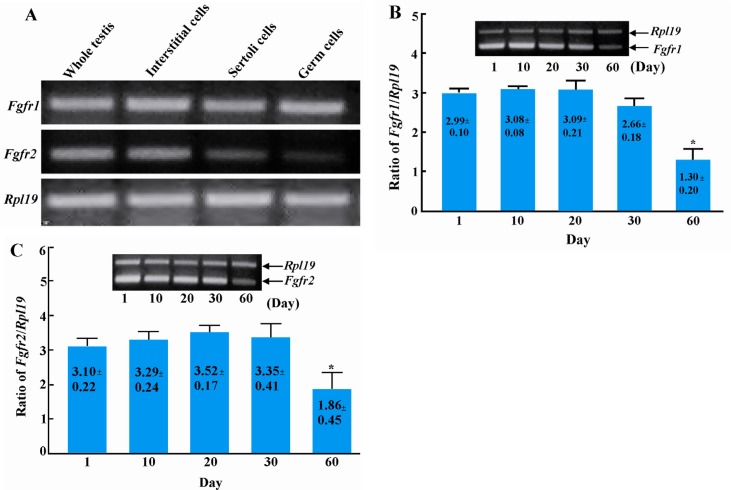
To identify which cell types expressed Fgfr1 and Fgfr2 in adult mouse testes and whether the expression of these two receptors changed during postnatal development, RT-PCR was performed. The results indicated that the transcripts of Fgfr1and Fgfr1 were present in germ cells, Sertoli cells and interstitial cells in adult mouse testes (Figure 1A). The mRNAs of these two receptors were readily detected in the testes during the entire postnatal development period examined ranging from neonatal (day-1), immature (day-10), peripubertal (day-20), pubertal (day-30) to adulthood (day-60) (Figures 1B and C). The testicular mRNA levels of both Fgfr1 (Figure 1B) and Fgfr2 (Figure 1C) remained constant from neonatal to pubertal period and then significantly decreased in adult testes (n=3, p<0.05 compared to day-1 to -30).
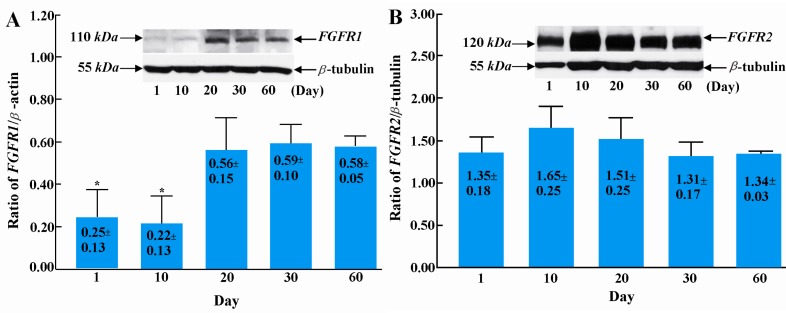
To determine whether the levels of FGFR1 and FGFR2 proteins were also postnatally regulated in the testes, Western blot analyses were carried out. In contrast to their mRNA profiles, immuno-blotting demonstrated that the protein levels of FGFR1 were low during the neonatal and immature stage, increased in the peripubertal period and then maintained a steady level to adulthood (n=3, p<0.05 compared to day-20 to-60, Figure 2A). The protein levels of FGFR2, on the other hand, showed no apparent changes from the neonatal period to adulthood (n=3, p>0.05, Figure 2B). The mechanism by which the mRNA and protein levels of Fgfr1 and Fgfr2 in sexually mature animals is differentially regulated is currently unknown.
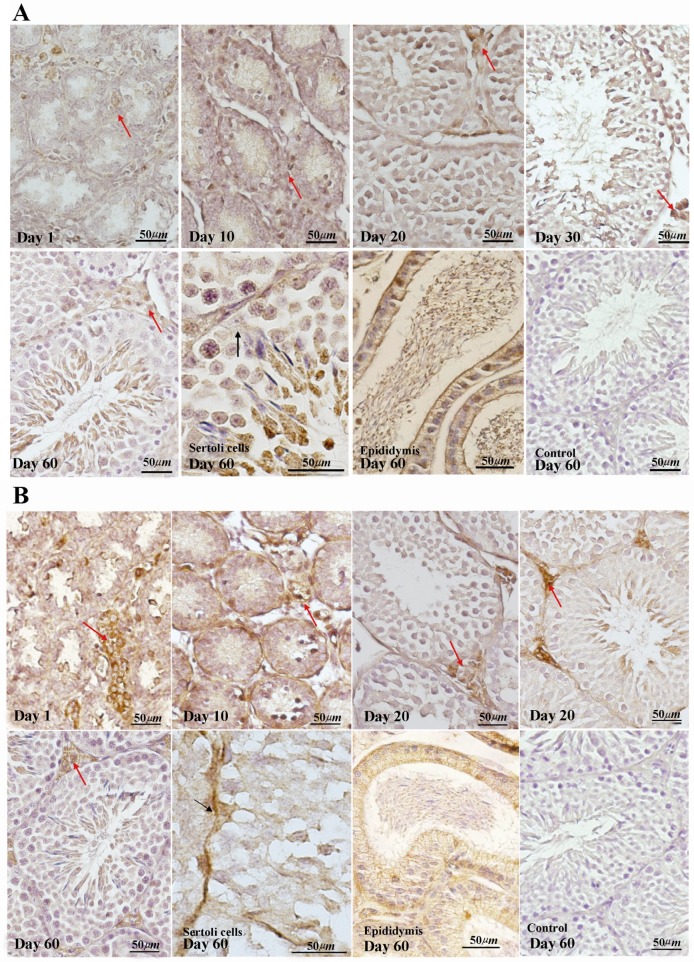
Immunohistochemical staining of testicular sections revealed that FGFR1 (Figure 3A) and FGFR2 (Figure 3B) were detected in both the interstitial and seminiferous tubular compartments from neonatal to adulthood. The most prominent immunostaining of FGFR1 and FGFR2 was observed in interstitial and peritubular cells with little or no changes in all phases of postnatal development. In the seminiferous tubular compartment, weak immunostaining of both receptors was present in spermatogonia, spermatocytes and Sertoli cells throughout all phases of postnatal development. The immuno-staining for FGFR1 and FGFR2 was also evident in elongated spermatid, spermatozoa, the seminiferous tubules and sperm in the epididymis but weak immunostaining was seen in round spermatid in adult testes (Figures 3A and B). Differential immunostaining intensity of FGFR1 and FGFR2 was observed in seminiferous epithelial cycle. It appeared to be lower in stages IX and X and higher in stages I-VIII.
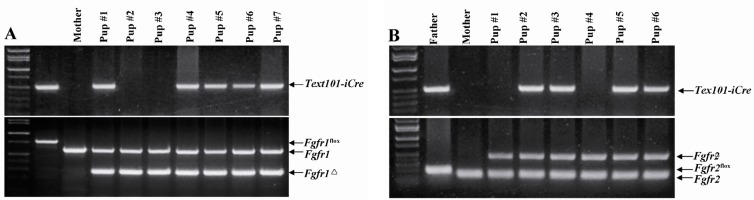
First, the efficiency of Tex101-iCre in deletion of floxed Fgfr1 and Fgfr2 was evaluated by breeding Tex101-iCre;Fgfr1flox/flox and Tex101-iCre;Fgfr2flox/flox males with wild-type females, respectively, and genotyping analysis of the progenies was performed. If iCre recombinase is active in the spermatogenic cells, the floxed Fgfr1 and Fgfr2 alleles will be converted to the recombined Fgfr1Δ and Fgfr2Δ allele regardless of the presence or absence of Tex101-iCre transgene in the progenies. The results showed that lack of Fgfr1flox (Figure 4A) and Fgfr2flox (Figure 4B) alleles and presence of Fgfr1Δ and Fgfr2Δ alleles in all pups indicated complete deletion of the floxed Fgfr1 or Fgfr2 alleles in the male germline.
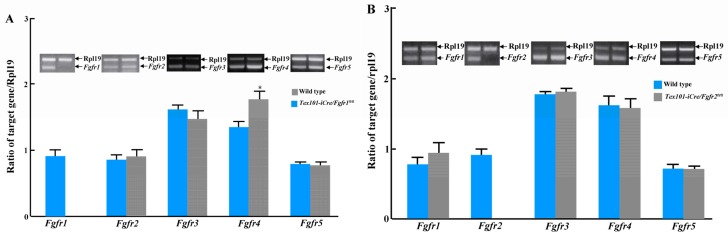
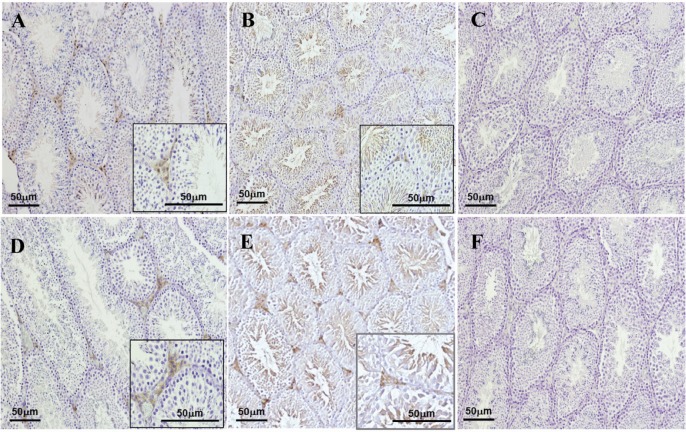
Complete deletion of Fgfr1 and Fgfr2 in the germ cells of Tex101-iCre;Fgfr1flox/flox and Tex 101-iCre;Fgfr2flox/flox males was further confirmed by performing RT-PCR and immunohistochemistry. RT-PCR showed that the transcripts of testicular germ cells of Fgfr1 in Tex101-iCre; Fgfrflox/flox (Figure 5A) and Fgfr2 in Tex101-iCre; Fgfr2flox/flox (Figure 5B) animals were not detectable. Immunohistochemistry demonstrated the absence of immunostaining of Tex101-iCre; Fgfr1flox/flox (Figure 6A) and FGFR2 in Tex101-iCre;Fgfr2flox/flox (Figure 6D) mice, while the immunostaining of these two proteins in testicular somatic cells for either genotype animal was comparable to wild-type siblings (Figures 6B and E).
Both Tex101-iCre;Fgfr1flox/flox and Tex101-iCre; Fgfr2flox/flox mice were viable with no apparent developmental defects. To test the fertility of Fgfr1 and Fgfr2 mutant male mice, sexually mature Tex101-iCre;Fgfr1flox/flox and Tex101-iCre; Fgfr2flox/flox male mice were mated with wild-type female mice, respectively. All of the wild-type mice tested delivered pups with normal litter sizes. Average litters sired by Tex101-iCre; Fgfr1flox/flox and Tex101-iCre;Fgfr2 flox/flox male mice during four months of fertility tests did not significantly differ from wild-type siblings (n=4, p>0.05, Table 2), indicating that germ cell-selective ablation of individual Fgfr1 or Fgfr2 in mice does not affect male fertility.
Table 2 Breeding performance of mature male mice
| Male×Female | n | Litter size |
|---|---|---|
| Wild type×wild type | 4 | 9.0±2.2 |
| Tex101-iCre/Fgfr1 fl/fl ×wild type | 4 | 8.6±1.7 |
| Tex101-iCre Fgfr2 fl/fl ×wild type | 4 | 8.8±1.5 |
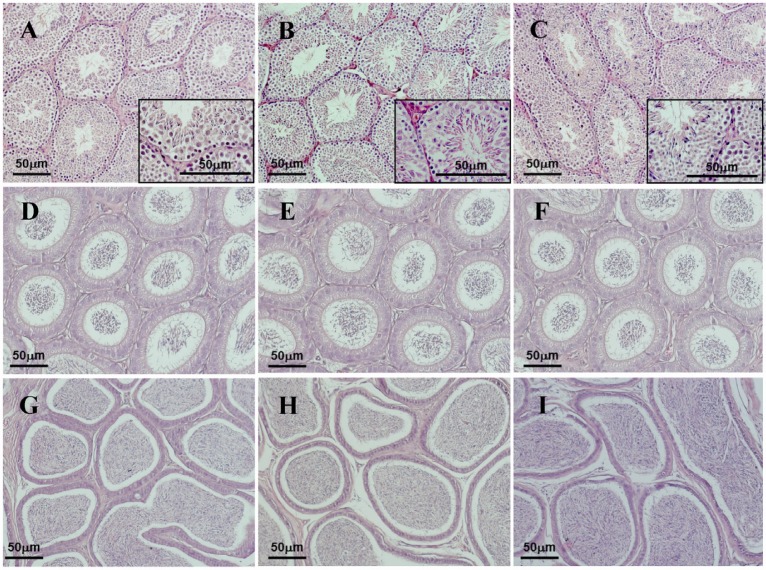
There were no gross abnormalities and size difference in the testes and accessary sex organs in either Fgfr1 or Fgfr2 mutant mice. Light microscopy revealed that in wild-type and mutant mice, all stages of spermatogenesis were present. The size of the seminiferous tubules, the histological structures of the testes and epididymides of wild-type (Figures 7C, F, I), Tex101-iCre;Fgfr1flox/flox (Figures 7A, D, G) and Tex101-iCre;Fgfr2flox/flox (Figures 7B, E, H) were essentially indistinguishable.
To explore possible effects of germ cell-selective deletion of Fgfr1 and Fgfr2 on the expression of other Fgfrs, RT-PCR was carried out to determine their mRNA levels in adult testes. The results showed that Fgfr1 to Fgfr5 were expressed in the germ cells of adult testes. Deletion of Fgfr1 in germ cells led to a moderate elevation of Fgfr4 mRNA levels, while the expression of Fgfr3 and Fgfr5 was not affected (Figure 5A). Semiquantitative RT-PCR also showed that deletion of Fgfr2 in germ cells did not significantly influence the expression of Fgfr1, Fgfr3, Fgfr4 and Fgfr5 in the adult testes (Figure 5B).
More than seven FGFs including FGF1 to FGF5, FGF8 and FGF9 are known to be expressed in the fetal and adult testes (1, 29, 36–38). It is well established that the signals evoked by FGF family members are converted by four major FGFRs, namely FGFR1 to FGFR4, to exert myriad biological effects on embryonic development and homeostasis in the adult for a wide range of tissues (1–4). In this study, it was reported that in the neonatal (day-1), immature (day-10), peripubertal (day-20), pubertal (day-30) and sexually mature (day-60) mouse testes, both FGFR1 and FGFR2 were present within the seminiferous tubules and the interstitial compartment, and the expression patterns changed based on the stages of spermatogenesis in sexually mature animals. The present study demonstrated that prominent immunostaining of FGFR1 and FGFR2 was observed in interstitial and peritubular cells in all phases during postnatal development. In the seminiferous tubular compartment, weak immunostaining for FGFR1 and FGFR2 was found in spermatogonia, spermatocytes and Sertoli cells throughout all phases during postnatal development. The immunostaining of these two receptors was also observed in sperm in the epididymis. The findings are essentially consistent with previous studies (1, 9–11, 16). However, the current report did not specify what FGFR1 and FGFR2 variant proteins were present in germ cells, Sertoli cells and interstitial cells due to lack of proper antibodies to detect these variants. The broad expression of Fgfr1 and Fgfr2 in the testes throughout the entire postnatal development implies that these two major receptors may transduce diverse signals of FGFs in modulation of postnatal testis development and spermatogenesis. For example, FGFR1 in mouse sperm has been reported to mediate FGF signal for modulating sperm capacitation by differentially influencing the downstream PI3K and MAPK activity (39).
Although Fgfr1 to Fgfr4 are expressed in the fetal as well as adult testes, Fgfr3 or Fgfr4 is neither essential for prenatal testis development nor crucial for spermatogenesis in the adult (20–22). Both Fgfr1 and Fgfr2 are critical for embryonic development. Fgfr1 null mutant embryos die during gastrulation and segmentation, while homozygous embryos of Fgfr2 knockout die before gonad formation (18, 19). The postnatal roles of Fgfr1 and Fgfr2 in regulation of male reproductive functions remain obscure due to lack of viable Fgfr1 or Fgfr2 null mutant animal models. To bypass the early lethal phenotype of Fgfr1 null mutation, embryonic stem (ES) cells with Fgfr1 null mutant have been used to generate chimeric mice that develop to adulthood. Despite the fact that these chimeric mice exhibit various defects in neural tube and limb development, no morphological abnormalities of the testes and functional defects of male fertility are detected in these animals with varying contributions of Fgfr1 null mutant ES cells (Embryonic Stem cells) (27). However, another study reported that transgenic mice overexpressing a truncated Fgfr1 that lacks a signal transduction domain in elongated spermatids displayed a reduction of daily sperm production and capacitation (39). As such, the function of Fgfr1 in adult testes is still contentious. More recent studies, in which the loxp-Cre system is adapted to conditional knockout of Fgfr2 in somatic progenitor cells of embryonic gonads, reveal that Fgfr2 is crucial for male sex determination (16, 29). However, whether Fgfr2 plays a role in postnatal testes remains to be established.
To elucidate the contribution of each Fgfr1 and Fgfr2 in testicular germ cells to spermatogenesis, floxed Fgfr1 and floxed Fgfr2 and Tex101-iCre transgenic mice were used in this study (24, 25, 30) to overcome embryonic lethality and to achieve selective deletion of Fgfr1 and Fgfr2 in postnatal testicular germ cells. The data clearly demonstrated that Tex101-iCre mediated ablation of floxed Fgfr1 and floxed Fgfr2 in testicular germ cells was specific and complete, which excised regions including the transmembrane and most of the intracellular portions of Fgfr1 and the ligand binding and transmembrane domains of Fgfr2 and produced functional inactive Fgfr1 and Fgfr2 alleles, respectively (24, 25). However, spermatogenesis and fertility of mature males were well preserved. No morphological changes in the testes and epididymis were observed. These findings indicate that each germ cell Fgfr1 or Fgfr2 is postnatally dispensable. The current study and published data convincingly demonstrate the presence of all five Fgfrs in the postnatal testes. Moreover, almost all testicular cell types express multiple Fgfrs. The results of this study do not rule out the possibility that Fgfrs expressing in the testicular cell types other than germ cells convert the FGF signals which indirectly influence spermatogenesis. Using the loxp-Cre system to selectively delete either Fgfr1 or Fgfr2 in other testicular cell types will help to verify this speculation.
Given the facts that numerous FGF ligands are present in the germ cells of adult testes and that each FGF can interact with multiple FGFRs for signal activation (9–16), it is plausible that the lack of individual Fgfr1 or Fgfr2 in testicular germ cells is compensated by the presence of other Fgfrs in these cells. These results show that the transcripts of the other four Fgfrs in germ cells of both genotype testes were not significantly altered except that the mRNA levels of Fgfr4 were moderately elevated in these cells of Tex101-iCre;Fgfr1flox/flox testes. Indeed, a compensatory function between Fgfr3 and Fgfr4 in modulating postnatal lung development has been demonstrated. Although Fgfr3/Fgfr4 double null mutant mice were viable, only a few animals sired and the growth of these animals was severely retarded (21), which were not observed in individual Fgfr3 or Fgfr4 null mutant animals (20, 21). In future studies, creating compound mutations of Fgfr1 and Fgfr2 in the germ cells will allow us to address this issue.
In summary, this study demonstrated that (1) Fgfr1 and Fgfr2 in mouse testes were present in germ, Sertoli and interstitial cells throughout entire postnatal development; (2) male germ cell-selective individual ablation of Fgfr1 or Fgfr2 did not affect mouse reproductive capability and suggested possible presence of redundant FGF/FGFR signal pathways in adult male germ cells.
We are grateful to Drs. Juha Partanen and David M. Ornitz for providing floxed Fgfr1 and Fgfr2 mice, respectively.
This work was supported by Grant R01-HD 057501 from the National Institutes of Health.
