
Human endometrium undergoes regular cycles of growth and breakdown and has long been recognized as one of a few tissues where significant angiogenesis occurs on a physiological basis (1). Angiogenesis is fundamental for human endometrial development and differentiation which are necessary for implantation. These vascular changes are thought to be mediated by the vascular endothelial growth factor (VEGF) and its specific receptors (2, 3). Six members of the VEGF family, VEGF-A, VEGF-B, VEGF-C, VEGF-D, VEGF-E and placental growth factor (PlGF) have been identified to date. These growth factors exert their activity through activation of three types of receptors: VEGFR-1 (flt-1), VEGFR-2 (flk-1/KDR), and VEGFR-3 (flt-4) (1, 4, 5). Of those, VEGFR-2 (flk-1) seems to be mainly involved in the formation of primitive endothelial tubular structures after binding with VEGF-A and VEGF-C (6).
Human endometrium expresses all of the splice variants of VEGF (7). As an estrogen-responsive angiogenic factor that varies throughout the menstrual cycle, VEGF may be important in both physiological and pathological angiogenesis of human endometrium (8).
VEGF is involved in several functions of the female reproductive system, such as ovulation, periodical changes of the endometrium, embryo implantation and development. In addition, dysregulation of VEGF seems to play a key role in conditions such as preeclampsia and fetal intrauterine growth restriction (9). Previous studies have shown that VEGF and its receptors are expressed in the mouse and rabbit endometrium and probably participate in the increased angiogenesis and vascular permeability necessary for implantation (10, 11). Deficient expression of VEGF and its receptors in mice result in poor development of vascular network in the endometrium leading to implantation failures and abortions (12). Expression of VEGF and its receptors is significantly increased during the post-ovulation and around the peri-implantation period. It appears that the expression of VEGF is highly regulated in a temporal and spatial manner at the early stage of implantation (1).
Knowledge on the expression and regulation of VEGF and its receptors in human endometrium during menstrual cycle is still limited and the results are controversial. A previous study reported that the expression of VEGF receptors (Flt-1 and Flk-1/KDR) is temporarily regulated according to the phase of the cycle and these changes are responsible for VEGF actions on endometrial vascular growth and permeability (2). Sugino et al. reported that VEGF, Flk-1 and Flt-1 were differentially expressed in the endometrial epithelium and stroma during the proliferative and secretory phases (3). VEGF receptors exhibited the strongest expression during the beginning of the secretory phase, coinciding with the developing endometrial edema and formation of a complex subepithelial capillary plexus (13, 14).
The aim of this study was to investigate the expression pattern of VEGF and flk-1 in three components (luminal epithelium, glandular epithelium and stroma) of human endometrium during different phases of menstrual cycle using tissue microarray (TMA) analysis. To date, the expression pattern of VEGF and Flk-1 during the menstrual cycle has not been investigated thoroughly in such a manner.
The study was performed at the Johns Hopkins University School of Medicine and the Institutional Review Board of Johns Hopkins Hospital approved this study.
Archived paraffin-embedded endometrial samples from 60 normally cycling women (age 23-39) were obtained from the Department of Pathology of the Johns Hopkins Hospital from July 2001 to June 2003. All patients had regular menstrual cycles ranging in length from 28 to 30 days and had not received exogenous hormonal therapy for at least 2 months before the procedure. Women with sexually transmitted diseases, pelvic inflammation diseases, systemic diseases, and any reproductive tract pathology were excluded from the study as well as those with BMI greater than 28. Samples with evidence of endometritis, endometrial polyp, endometrial hyperplasia, or other pathologies were also excluded. The same pathologist examined all of the endometrial samples. The samples were classified histologically according to the criteria of Noyes (15).
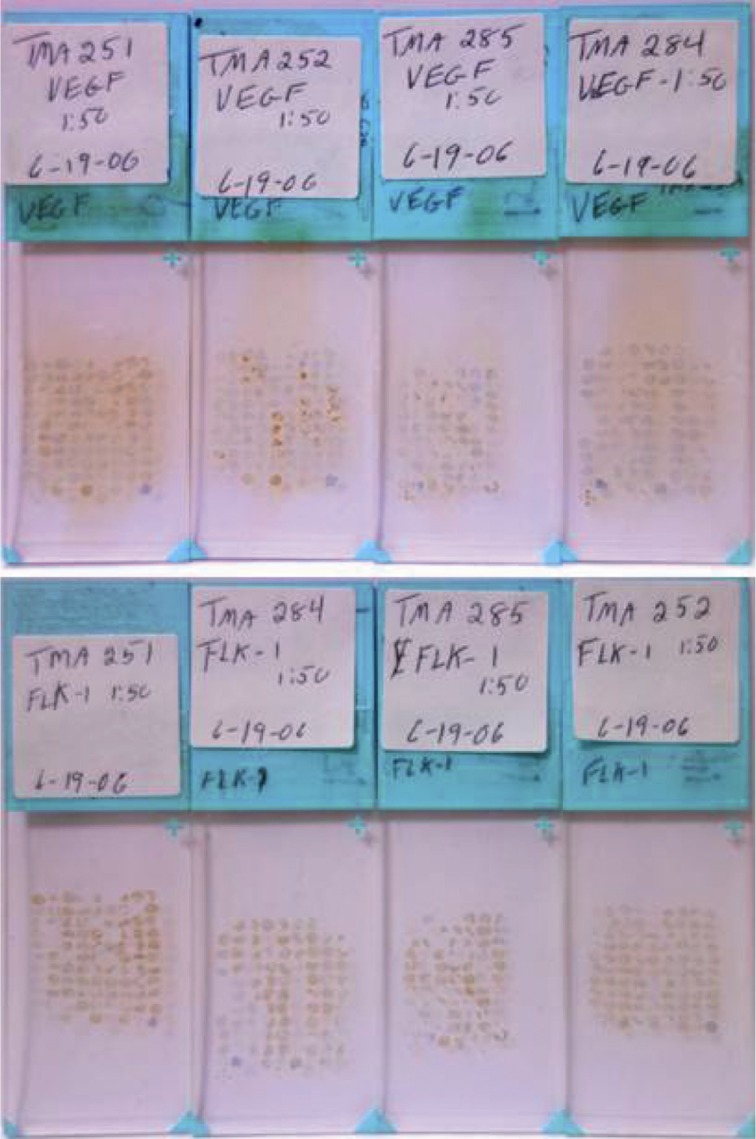
To allow for a high throughput tissue analysis on paraffin-embedded samples, “tissue chip” approach was used. Tissue microarray (TMA) is a method of harvesting small-core biopsies from a range of standard histological sections and placing them in an array on a recipient paraffin block in such a manner that hundreds of specimens can be analyzed simultaneously. This technique provides a highly efficient, reliable, and high-throughput mechanism for evaluation of protein expression in large cohorts. Therefore, TMA allows a rapid and comprehensive characterization of biomarkers of interest (16). In this study, TMA slides were assembled from formalin-fixed, paraffin-embedded endometrial samples at cores of 1.5 mm in diameter for each core and three representative punches from each specimen. The arrays encompassed 180 tissue cores derived from samples of 60 patients. Each tissue core was sectioned in 5 µm thickness and affixed to the glass slides. Examples of TMA slides are shown in Figure 1.
Tissue sections were dewaxed through descending grades of ethanol to distilled water, and pretreated with citra buffer (Vector H3300, Vector Laboratories, Burlingame, CA) in a steamer (HA900; Black & Decker, Hampstead, MD) at 90°C for 20 min. Immunohisto-chemical staining was then performed using monoclonal antibodies of anti mouse VEGF (sc-7269) and anti-human Flk-1(sc-6251) (Santa Cruz Biotechnology Inc, CA). Binding of VEGF or Flk-1 was detected by a biotinylated rabbit antimouse secondary antibody, followed by HRP conjugated avidin-biotin perioxidase. For the negative control, additional sections were stained with an antihuman microthalmia transcription factor (MiTF) antibody (clone D5; Department of Pathology, Johns Hopkins Medical Institutes, Baltimore, MD). The primary antibody was detected by using a Ventana DAB Detection Kit (Ventana-Biotek Solutions, Tucson, AZ). The stained TMA slides were evaluated using a light microscope (Olympus, CH-2, Hitech Instruments, Inc. Edgement, PA). The intensity of staining of the antibody was then analyzed by HSCORE, a semi-quantitative method, which has been shown to have a low intra-observer and inter-observer variability. The HSCORE was calculated using the following equation: HSCORE = S Pi (i + 1), where i is the intensity of the stained epithelium (1 = weak, 2= moderate and 3 = strong), and Pi is the percentage of stained epithelial cells for each intensity varying from 0 to 100%.
A commercially available statistical package (SPSS13.0, SPSS Inc., Chicago, IL, USA) was used for statistical analysis. Non-parametric Kruskal-Wallis test and one-way analysis of variance (ANOVA) were used to compare differences in the HSCOREs between five phases of the menstrual cycle. When there was a significant difference in the main effect, Scheff's posthoc test was performed to identify the significant differences between the phases. A p-value of less than 0.05 was considered statistically significant.
Out of the 60 samples selected in the study, 23 were obtained from patients who had undergone hysterectomy for uterine leiomyoma and the remaining 37 were biopsies as a part of infertility evaluation. The samples were divided into five groups according to the day of sampling: proliferative (days 7-12, n = 14), peri-ovulatory (days 13-15, n = 9), early-secretory (days 16-18, n = 12), mid-secretory (days 19-21, n = 11) and late-secretory (days 24-26, n = 14) phases. Demographic data of the patients is shown in Table 1. Mean age and BMI of the patients among groups were similar (p > 0.05).
Table 1 The demographic variables of the patients (Mean±SE)
| Parameters | Proliferative | Peri-ovulatory | Early-secretory | Mid-secretory | Late-secretory | p-value |
|---|---|---|---|---|---|---|
| No. of subjects | 14 | 9 | 12 | 11 | 14 | -- |
| Age (year) | 34.0±1.0 | 34.7±1.3 | 34.4±1.2 | 31.1±1.2 | 33.2±1.0 | 0.731 |
| BMI ( kg/m 2 ) | 26.6±1.8 | 23.8±1.9 | 23.5±1.2 | 24.8±1.8 | 24.7±1.3 | 0.218 |
VEGF and Flk-1 were immunolocalized in the luminal epithelium, glandular epithelium and stroma of the endometrium at various phases of the menstrual cycle (Figures 2 and 3, A-E). No immunoreactivity was detected when a monoclonal antibody MiTF was used as the primary antibody in the negative control staining (Figures 2 and 3, F).
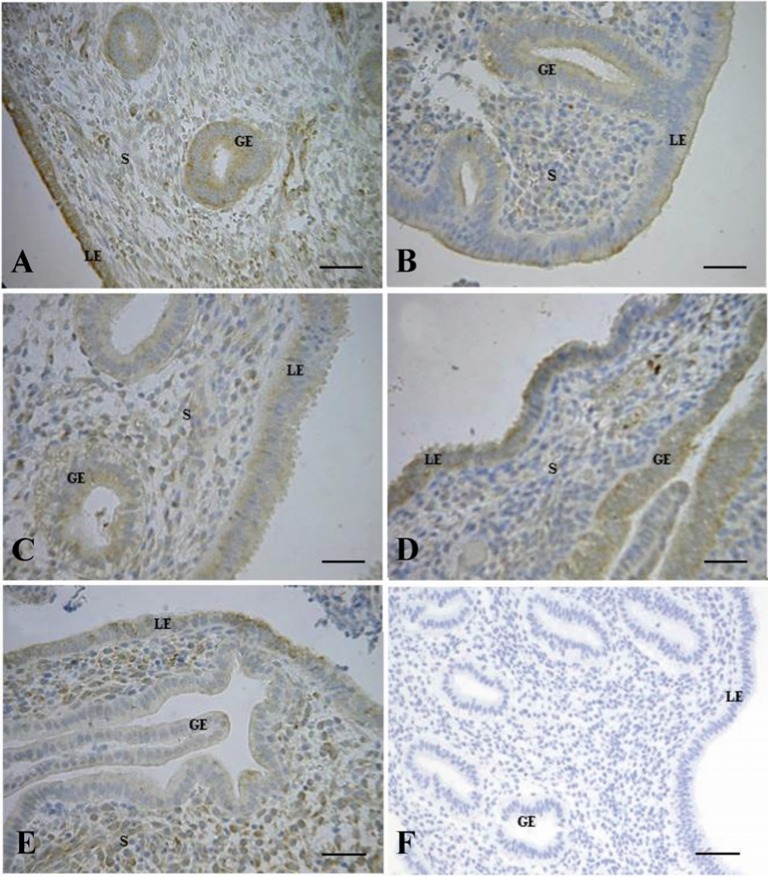
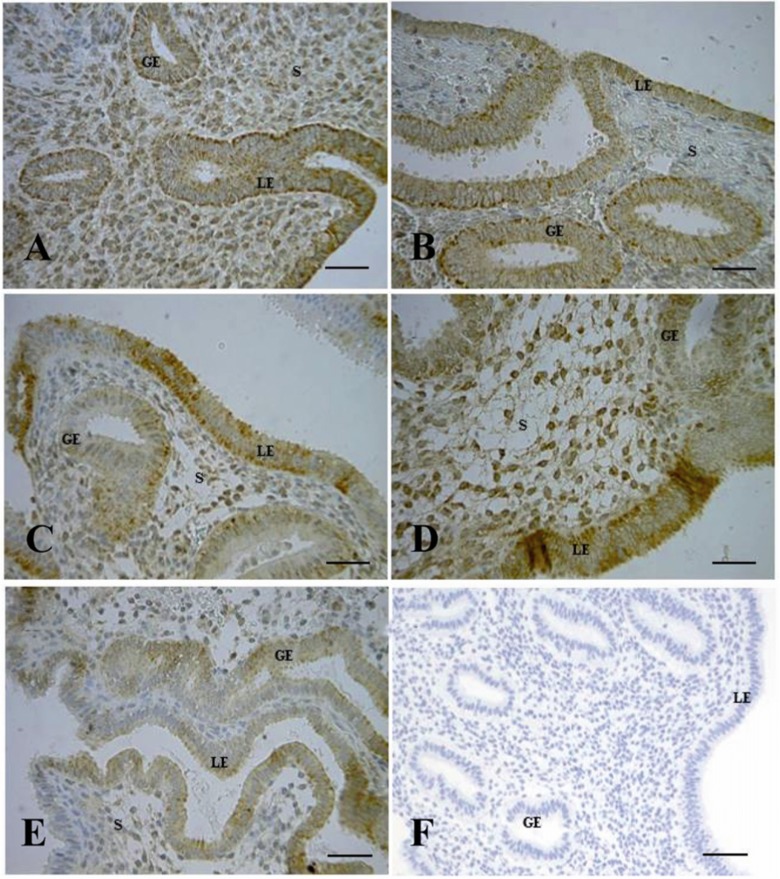
Table 2 summarizes the HSCOREs of VEGF and Flk-1 in the endometrium during the menstrual cycle. For different locations but the same phase of the cycle, the expression of VEGF showed no statistically significant difference among the different compartments although the immunoreactivity was overall stronger in the luminal and glandular epithelium than that in the stroma (Figures 1A-E, Table 2). Within the luminal epithelium, the expression of VEGF showed a trend of down regulation from the proliferative phase to late-secretory phase. In the glandular epithelium, a stronger staining intensity was observed at the early-secretory phase, and then it trended down towards late-secretory phase. Reactivity of VEGF varied significantly in the stroma between the phases of the cycle (p < 0.05), as tested by one-way ANOVA.
Table 2 The expression and distribution of VEGF and Flk-1 at the various phases of the normal cycle
| HSCORE (Mean±SE) | Proliferative | Peri-ovulatory | Early-secretory | Mid-secretory | Late-secretory | p-value | |
|---|---|---|---|---|---|---|---|
| VEGF | |||||||
| Luminal epithelium | 0.45±0.21 | 0.34±0.26 | 0.33±0.27 | 0.31±0.26 | 0.32±0.10 | 0.430 | |
| Glandular epithelium | 0.31±0.12 | 0.30±0.23 | 0.41±0.30 | 0.34±0.32 | 0.33±0.17 | 0.665 | |
| Stroma | 0.25±0.0 | 0.16±0.08 | 0.23±0.07 | 0.26±0.12 | 0.31±0.10 | 0.047 (p < 0.05) a | |
| Flk-1 | |||||||
| Luminal epithelium | 1.99±0.79 | 1.83±0.54 b | 1.88±0.46 c | 1.71±0.65 | 2.27±0.58 d | 0.121 | |
| Glandular epithelium | 1.74±0.74 | 1.79±0.51 b | 2.13±0.32 c | 1.83±0.63 | 2.24±0.53 d | 0.043 (p< 0.05) a | |
| Stroma | 1.29±0.67 | 1.20±0.42 b | 1.27±0.42 c | 1.36±0.51 | 1.59±0.53 d | 0.363 | |
Significant differences were observed in the stroma among the phases (p < 0.05)
Significant differences at the peri-ovulatory phase were observed between luminal epithelium and stroma and between glandular epithelium and stroma (p < 0.05)
Significant differences at the early-secretory phase were observed between luminal epithelium and stroma and between glandular epithelium and stroma (p < 0.05)
Significant differences at the latesecretory phase were observed between luminal epithelium and stroma and between glandular epithelium and stroma (p < 0.05)
Expression of Flk-1 showed distinct patterns and changes during the menstrual cycle (Figures 2A-E, Table 2). A stronger staining intensity was detected in the luminal and glandular epitheliums in all phases of the menstrual cycle, while the greatest intensity was seen during late-secretory phase in the three components of the endometrium. The expression of Flk-1 was weaker in the stroma as compared to the luminal and glandular epithelium at the peri-ovulatory, early-secretory and late-secretory phases (p < 0.05) (Table 2).
The human endometrium is a dynamic tissue that undergoes cyclic proliferation and differentiation controlled by a sequential and carefully timed interplay of various hormonal and environmental changes. The physiological changes in the endometrium during the menstrual cycle are associated with profound angiogenesis. Vascular endothelial growth factor is a key regulator of angiogenesis and vascular function. Studies have demonstrated VEGF expression in the human endometrium. VEGF stimulates endothelial cell proliferation, permeability, migration and assembly into capillary tubes (17).
In a previous study on expression of VEGF and its receptors in human endometrium during menstrual cycle and in early pregnancy, Sugino et al. reported that VEGF and its receptor Flk-1 (KDR) were expressed in both glandular epithelial and stoma cells during the mid-secretory phase as well as in decidual cells of early pregnancy (3). With a limited number of cases, the study failed to show the expression of VEGF and its receptors in luminal epithelium. In the present study, an attempt was made to investigate the temporal and spatial distribution of VEGF and its receptor Flk-1 in the luminal epithelium, the glandular epithelium and the stroma of the endometrium throughout the menstrual cycle using a high throughput tissue microarray analysis, which can efficiently investigate the gene expression patterns in a sizable number of samples simultaneously. The expression of VEGF and Flk-1 were identified in all of the three components of the endometrium. The immunoreactivity of VEGF in the luminal and glandular layers of the endometrium was overall stronger than that in the stroma where the VEGF expression differed significantly between the phases of the cycle. While the expression of VEGF in the luminal epithelium showed a trend of down regulation from the proliferative phase to late-secretory phase, stronger intensity of Flk-1 was detected in the luminal and glandular epitheliums in all phases of the menstrual cycle with greatest intensity during late-secretory phase. Our findings are similar to previous reports (18, 19). Torry et al. (18) detected strong vascular endothelial growth factor immunoreactivity in the glandular epithelial cells of the secretory endometrium with no discernible immunoreactivity in stroma cells. Observation by Naresh's group (19) showed that glandular expression of VEGF was higher as compared to stromal compartment. Meduri et al., using immunocytochemistry and computerized image analysis of the endometrial functionalis, showed that the number of capillaries immunostained for Flk-1/KDR was maximal during the proliferative phase, while co-expression of Flk-1/KDR and Flt-1 peaked during the mid-secretory period, in synchrony with the characteristic increase of endometrial microvascular density and permeability (2). Recent studies have reported that the role of VEGF in the early angiogenic processes is associated with postmenstrual regeneration of the endometrium (20). VEGF is essential for the rapid burst of angiogenesis that occurs during postmenstrual repair and in the early proliferative phases in the primate endometrium, and further plays a role in re-epithelialization of the endometrium. The temporal and spatial distribution of VEGF and its receptor would thus appear to be related to the process of menstruation.
The expression of VEGF in the human endometrium is reportedly regulated by ovarian steroid hormones. Estrogen has been found to induce VEGF expression in the stromal layer of the uterus in rodents, as well as in cultured human uterine stromal cells (21). Ovarian sex hormones may also regulate VEGF activities through modulating the expression and function of the VEGF receptors. Administration of estrogen plus progesterone enhanced the levels of expression for VEGF and its receptors (3). In isolated endometrial stromal cells from proliferative phase endometrium, incubated with estrogen and medroxyprogesterone acetate for 18 days, expression of VEGF and KDR mRNAs was significantly increased, whereas flt-1 mRNA expression was not affected (3). In the present study, Flk-1 expression showed distinct patterns and changes during the phases of the cycle. The expression of Flk-1 predominantly increased at the peri-ovulatory and early-secretory phases in the glandular epithelium of the endometrium, when estradiol levels reached their peak during the natural cycle, suggesting that Flk-1 expression was closely associated with cycling steroid hormone changes. A recent study by Herve et al. showed that 17 beta-estradiol up-regulates Flk-1/KDR expression in vivo in endothelial cells mainly through the modulation of VEGF by a paracrine mechanism (22). The findings of the present study on a high level of Flk-1 expression in the luminal and glandular epithelium (Table 2) may suggest the role of Flk-1 in the preparation of the endometrium for vascularization and implantation.
A recent review by Okada et al. summarized regulations of decidualization and angiogenesis in the human endometrium (17). Following treatment with estrogen, increase in VEGF and decrease in sVEGFR-1 production, and consequential increase in VEGF/sVEGFR-1 ratio appears to be a sustained and ongoing process designed to promote growth and development of the endometrium during the advancing stages of the menstrual cycle at the local level. In addition, co-treatment with the progesterone receptor antagonist RU-486 reverses this inhibition of estrogen-stimulated VEGF, suggesting a pathway by which progestins may reduce the production of these factors through the progesterone receptor (23). Progestins are known to initiate down regulation of the estrogen receptor in the human endometrium in vivo as well as in vitro, and therefore the inhibition of VEGF may be caused by the decrease in estrogen receptor levels (23). In our study, variation in the expression of VEGF in stroma and differential expression of Flk-1 in different compartments during menstrual cycle may reflect the balance of steroid hormone's effect in the dynamic changes of the cycle. The significance of differential expression of VEGF and its receptor at given phases and locations of the endometrium remain to be further studied and elucidated. It was recognized that one of the limitations of this study is lacking the data of measurement for hormones which affect the menstrual cycle. Nevertheless, the strengths of this study include its relatively large sample size, physiological status of the specimens, reliable high throughput semi-quantitative technology, and thorough measurements on the levels of VEGF and Flk-1 expression in the human endometrial tissue in a temporal and spatial manner, which has not been completely investigated in the previous studies. The results reported here may reflect the aspects of endometrial process of angiogenesis during menstrual cycle. Documentation of this study would be a valuable addition to our current understanding and to the bank of literature for the expression and distribution of VEGF and its receptors in human endometrium in physiological conditions.
In summary, it was demonstrated that VEGF and Flk-1 underwent differential expression in the three components of human endometrium at various phases throughout the normal menstrual cycle. The results suggest functional role(s) of these factors in the cycling changes and remodeling process of the endometrium. The molecular mechanisms concerning their regulations require further investigation.
