
Primary amenorrhea is the complete absence of menstruation. Amenorrhea is a normal clinical feature in pre-pubertal, pregnant, and postmenopausal women. It has a strong correlation with the expression of X chromosome. It has been reported that the percentage of chromosomal abnormalities varies from 15.9% to 63.3% in patients with primary amenorrhea (1, 2). It also accounts for 20% cases of patients with infertility. X; autosome translocations are uncommon and are associated with a variable phenotype with an incidence of approximately 1:30,000 live births. Due to non-random X-inactivation, the majority of X; autosome carriers that present with abnormal phenotypes include multiple congenital abnormalities, developmental delay, a recognizable X-linked syndrome or gonadal dysgenesis (3). In this report, the clinical, biochemical and cytogenetic aspects of a healthy, non dysmorphic 24 years old female with the complaint of primary amenorrhea was presented.
The proposita, 24 year-old female with the complaint of primary amenorrhea, was referred to Institute of Genetics and Hospital for Genetic Diseases, Osmania University for cytogenetic evaluation in the year 2013. She was born to a nonconsanguineous parent and her siblings were healthy. Her physical examination revealed normal height and weight of 168 cm and 73.5 kg, respectively. She showed fairly normal intelligence. Her biochemical laboratory investigations were found to be normal with a hormonal profile of 6.8 ng/ml of prolactin (normal range 3–25 ng/ml), 13.9 mIU/ml of follicle stimulating hormone (FSH ref range. 10–15 mIU/ml) and 11.2 mIU/ml of luteinizing hormone (LH ref range. 10–15 mIU/ml). Thyroid profile was also found to be normal with TSH=0.66 mIU/ml (0.4–4.2 mIU/ml) T3=1.08 ng/ml (0.8–1.9 ng/ml) and T4=110 ng/ml (50–130 ng/ml). Ultrasound examination of the pelvis revealed bilateral streak gonads (right ovary: 2.1× 1.9 cm and left ovary: 2.7×2.1 cm) and a markedly hypoplastic uterus measuring 4.9×2.7 cm. Normal vagina and cervix were present and there was no abnormality of the external genitalia. The female had been on low level of contraceptive pills for several years for cyclic estrogen and progesterone replacement and to induce menses, but had never menstruated spontaneously.
Cytogenetic analysis of the peripheral blood lymphocytes of the proband was carried out according to the modified method of Moorhead et al. (4). Peripheral blood lymphocytes were stimulated with phytohemagglutinin and harvested at 68th hr with colchicine. Hypotonic treatment was given to the cells and then they were fixed with Carnoy's fixative. Standard GTG banding was done according to the method of Seabright (5). Karyotype analysis of 50 metaphases revealed a pattern of 46, X, t(X;1)(q21; p32), suggestive of a balanced sex autosome translocation involving the long arm of chromosome X and short arm of chromosome 1 (Figure 1). ISCN guidelines for the chromosomal nomenclature (2013) were followed for the karyotype analysis (6). The translocation was found to be de novo as the parental karyotypes were normal.
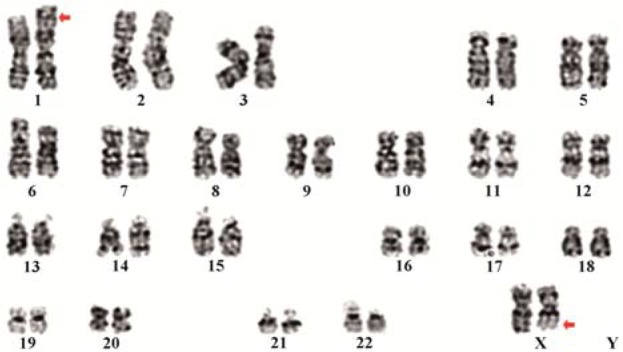
Genes essential for normal ovarian development are located on both arms of the X chromosome (7). An abnormality in the number or the structure of the X chromosome results in the disturbance in the normal process of translation of genetic sex and final determination of the phenotypic sex (8). Thus, the abnormal phenotypes are the consequences of the gene disruption, position effect or deletion at one of the break points resulting in haploinsufficiency of critical X linked genes.
The present study revealed a rare de novo sex autosome translocation in a female with primary amenorrhea. Cytogenetic analysis revealed 46,X,t (X;1) (q21; p32) karyotype indicating its possible association with amenorrhea. As there is no published data on X and 1 translocation with these break points, this case can be considered as a novel X, autosome translocation in primary amenorrhea. However, Waters et al. published a report on X autosome translocations from UK population with 104 cases from different laboratories in UK. Among them, 5 cases were found with X; 1 translocation with different clinical manifestations (Table 1) (9).
Table 1. Cases of balanced X; 1 translocations reported in literature
| Sl. No | Reason for referral | Karyotype |
|---|---|---|
| 1 | Recurrent miscarriages | 46,X,t(X;1)(p22.1;p31) de novo |
| 2 | Development delay | 46,X,t(X;1)(p22.1:p32) de novo |
| 3 | Learning difficulties? Norrie fetus | 46,X,t(X;1)(p11.4;p36.3) de novo |
| 4 | Multiple congenital anomalies/ Developmental delay | 46,X,t(X;1)(q26;p22)mat |
| 5 | Mother: abnormal scan | 46,X,t(X;1)(q26;p22) de novo |
Vidhya et al. (2009) reported X; 7 translocation in a female with hypergonadotropic amenorrhea (10). Omrani et al. (2012) reported X; 9 translocation in a female with premature ovarian failure (11). Chen et al. (2014) reported an association of primary amenorrhea and mental retardation with concomitant unbalanced X; 6 translocation and X chromosome rearrangements (12). Additional studies showed that Xq13–q26 was particularly a crucial section of chromosome X, since loss or disruption of this region results in severe impairment in ovarian function (13). Our study is in agreement with the hypothesis supported by a review of balanced X autosome translocations where 23 of 36 phenotypic females had POF (premature ovarian failure) with a break point between Xq13 and Xq26. The genes DIAPH2, XPNEP2, DACH2, POF1B, CHM and NXF5, are some of the candidates that are present on X chromosome which are interrupted by the Autosome and X translocations (14).
Our case report is believed to be the first description of a balanced X; 1 translocation with break points (Xq21 and 1p32) in a female with primary amenorrhea. As the proband manifested non dysmorphic features or developmental delay with normal hormonal profile, the impact of X; 1 translocation appears to be limited to ovarian structure and function. Since the break point was in the critical region of the X chromosome, therefore, it is probable that her chromosomal abnormality was responsible for her critical state. Thus, the reported de novo translocation in a phenotypically normal female with primary amennorhea could be due to the deleterious effects related to disruption of essential genes on X chromosome.
The X autosome translocations advance the understanding of clinical and cytogenetic basis for amenorrhea. Thus, the precise diagnosis and evaluation of patients with sex chromosome abnormality with conventional cytogenetic analysis is essential for the evaluation of phenotype and karyotype correlations, followed by genetic counseling.
Authors thank Mr. B. Kishore and Mr. M. Panduranga Chary for their technical assistance and Department of Biotechnology, New Delhi for the financial assistance.
