
The altered activity of eNOS gene, in the form of polymorphism, may lead to NO deficiency and may result in cardiovascular complications like, hypertension, myocardial infarction, coronary artery disease and heart failure (1). Several polymorphisms have been identified in the eNOS gene. Among them, the Glu298Asp (G894T), −786T>C and the 27 bp VNTR, located in the exon 7, the promoter (regulatory region) and intron 4, respectively are of prime and functional importance. Besides, they are also most widely studied owing to the reason of being associated with the increased risk of cardiovascular complications.
Given the high incidence of cardiovascular complications world-wide, another key regulator of blood pressure, the renin angiotensin aldosterone system (RAAS), also imparts a noteworthy role in maintaining the water-electrolyte balance through the aldosterone hormone, secreted by the adrenal cortex of the adrenal gland (2). Numerous polymorphisms have been identified in the CYP11B2 gene (3). Among them, the promoter region polymorphism, viz., C-344T is most widely studied and is of paramount importance owing to its regulatory activity in inducing the production of steroidogenic factor-1, the transcriptional regulatory protein (4). Apart from its function in the regulation of aldosterone activity, this gene has a direct effect on the cardiovascular system as well. In much the same way, another key player, angiotensin converting enzyme (ACE) mediates the constriction of blood vessels thereby increasing blood pressure. ACE is a zinc metallopeptidase which helps in the conversion of angiotensin I to angiotensin II and is a part of the rennin angiotensin system (RAS).
The ACE gene located on chromosome 17q23 has an I/D polymorphism that comprises an insertion (I)- which represents the presence of 287 bp Alu and deletion (D) -which denotes the absence of the same 287 bp Alu repeat in the intron 16 of the ACE gene (5).
TheI/D polymorphism has been linked to cardiovascular (6) and chronic renal diseases (7). The I/D and D/D genotypes are determined by the insertion or absence of 287 bp Alu sequence in the intron 16. The DD genotype has been found to be a risk factor in cardiovascular diseases like hypertrophic cardiomyopathy, myocardial infarction and ventricular hypertrophy.
The products of nitric oxide synthase (NOS), angiotensin converting enzyme (ACE) and renin angiotensin system (RAS) play a significant role in determining the structure and function of the blood vessel wall. Polymorphisms in eNOS, ACE and RAS are independently associated with the propensity to cardiovascular events (8). Normal pregnancy is accompanied by intense haemodynamic fluctuations that chiefly comprise and mediate improved vasodilation (9). Increased endothelium-dependent flow-mediated vasodilation is a typical characteristic feature during normal pregnancy. This in turn is portrayed by the reduced systemic vascular resistance, which may be triggered by nitric oxide (NO) (10).
With ample evidence provided world-wide with respect to the polymorphisms of eNOS, ACE and aldosterone synthase genes shown to be associated with the hypertensive disorders of pregnancy, especially preeclampsia, population-based polymorphism studies clearly set out to overcome other associated complications of the same owing to the heritable nature of the allelic variations (11, 12). In spite of straightforward clinical diagnosis in most cases and the availability of effective drugs and therapeutic regime for preeclampsia, various factors contribute to a delay in diagnosis which lead to an increased maternal-foetal morbidity and mortality globally and result in 40% of births to be delivered before 35 weeks of gestation (13). Given the high incidence reported even among the developed nations globally, the foetal-maternal mortality rate is still very high, and no wonder preeclampsia continues to be the leading cause of complications during pregnancy, vulnerable both to the mother and the growing foetus.
From an epidemiological standpoint, numerous studies have also revealed that preeclampsia is an ailment with a strong familial predisposition, which in turn differs as per geographical location, socioeconomic status and racial ethnicity. The data thus generated among normal pregnant women in turn could be used for extrapolating and estimating the anticipatory outcome as a result in the due course (13). Furthermore, the earlier pharmacogenetic data on clinically significant genes encoding the drug metabolizing enzymes (Phase I and II) and drug transporters from our team, executed among the south Indian population, provides possible evidence and exceptionally supports the phenomenal inter-ethnic variability existing among the south Indian population with that of the other global population (14–16). However, given this circumstance, studies on the effect of eNOS, ACE and CYP11B2 polymorphisms on preeclampsia or any other hypertensive disorders of pregnancy have not been done so far in south Indian or in any of the native Indian population.
Hence, the current study intended to assess and estimate the frequency of eNOS (−786T>C, Glu 298Asp, Intron 4 VNTR), ACE (Intron 16 Ins/Del) and CYP11C2 (−344C>T) genotypes, alleles and haplotypes among normal pregnant women in a population of south India. Furthermore, the purpose of the study was to determine the inter-ethnic variability of allele frequencies of the above genes among the south Indians with the HapMap and other populations from previously published reports. In delivering this information, the current study in turn offers a primary understanding for a prospective and an additional pharmacogenetic examination of the candidate gene polymorphisms. This in turn would further augment preceding molecular epidemiological investigation, for a better and a clear-cut understanding on the influence of these variants on the incidence and progression of preeclampsia or any other hypertensive disorders of pregnancy.
Unrelated healthy women of Tamilian origin who underwent uncomplicated term pregnancies (n=303), between the age of 18 and 32 years were included in the study. The study was approved by the Institute Ethics Committee, JIPMER of Pondicherry. The subjects, taking into account their family history for the past three generations and staying in Tamil Nadu and speaking the local language, confirmed their Tamilian status. Besides, subjects who used medications which were known to significantly interact with the normotensive effect of the candidate genes were excluded from the study. In addition, subjects with significant liver and kidney dysfunctions and chronic tobacco chewers were also excluded from the study. After explaining the purpose and details of the study protocol, written informed consent was obtained from all the participants.
Five milliliters of the umbilical cord blood was drawn from the vein of the umbilical cord at the time of labor and collected into the tubes containing 100 μl of 10% ethylenediaminetetraacetic acid (EDTA). After centrifugation for 10 min at 1500 g, the plasma was separated and discarded, and the remaining red blood corpuscles with the buffy coat were stored at −20°C until DNA extraction. Thereafter, genomic DNA was extracted from the umbilical cord blood samples by the standard phenol-chloroform extraction procedure. The extracted DNA was analyzed quantitatively and qualitatively by biophotometer plus (Eppendorf AG 22331, Hamburg Germany). Each DNA sample was diluted to an optimal concentration of 50 ng/μl, and further stored in aliquots at 4°C, suitable for downstream analysis.
The eNOS Glu298Asp (G894T) and −786 T>C alleles were identified and analyzed by polymerase chain reaction -restriction fragment length polymorphism (PCR-RFLP). On the other hand, the 27 bp direct repeat in intron 4 VNTR region was determined by polymerase chain reaction (PCR) alone as described elsewhere (17) with minor modifications. The details of the primers used for amplification, with the annealing temperature and cyclic conditions and the enzymes used for the RFLP analysis are summarized in table 1. The amplified PCR products for eNOS Glu298Asp and −786T>C were checked for amplification on 1% agarose gel and the restriction enzyme digested products were electrophoresed and visualized on 8% and 12% polyacrylamide gels, respectively. The amplified PCR product for eNOS Glu 298Asp (894G>T) polymorphism resulted in a 206 bp amplicon and the same was checked with agarose gel electrophoresis. After restriction digestion with MboI (New England Biolabs), bands were observed at 119 and 87 bp for homozygous variant type, 206, 119 and 87 bp for heterozygous variant type and a single band at 206 bp for normal type on 8% polyacrylamide gel. Similarly, the amplified PCR product of eNOS −786T>C polymorphism resulted in a 223 bp amplicon and after restriction digestion with NgoMIV (New England Biolabs), bands were observed at 115 and 108 bp for homozygous variant, 223, 115 and 108 bp for heterozygous variant type and a single band at 223 bp for normal type on 12% polyacrylamide gel. On the other hand, the amplified PCR products of the eNOS 27 bp direct repeat on intron 4 VNTR region were directly resolved on 7% low melting agarose, and the fragments were visualized by ethidium bromide staining and ultraviolet transillumination. The intron 4 VNTR genotypes were observed as 4a homozygous (4a/4a) type with 393 bp, heterozygous type (4a/4b) with 393 and 420 bp and 4b homozygous type (4b/4b) with 420 bp.
Table 1. Details of primers, PCR conditions and restriction digestion used for genotyping eNOS, CYP11B2 and ACE gene polymorphisms
| Genes/SNPs | Primers | PCR conditions | Size of the PCR products (bp) | Enzymes | Size of the digested products (bp) | |
|---|---|---|---|---|---|---|
| eNOSGlu298Asp | ||||||
|
F: 5′-CATGAGGCTCAGCCCCAGAAC-3′ R:5′- AGTCAATCCCTT TGGTGCTCAC-3′ | 95°C – 15 min | 206 bp | MboI | 206 (Glu/Glu) 206, 119, 87 (Glu/Asp) 119, 87 (Asp/Asp) | ||
| 95°C – 1 min | ) 30 cycles | |||||
| 60°C – 1 min | ||||||
| 70°C – 1 min | ||||||
| 70°C – 5 min | ||||||
| 4°C – 1 min | ||||||
| eNOS-786T>C | ||||||
| F:5′- GCATGCACTCTGGCCTGAAGT-3′ R: 5′- CAGGAAGCTGCCTTCCAGTGC-3′ | 95°C – 7 min | 223 bp | NgoMIV | 223 (TT) 223, 115, 108 (TC) 115, 108 (CC) | ||
| 94°C – 30 s | ) 35 cycles | |||||
| 61°C – 45 s | ||||||
| 72°C – 1 min | ||||||
| 72°C – 5 min | ||||||
| 22°C – 10 s | ||||||
| eNOSIntron 4VNTR | ||||||
|
F: 5′ - AGGCCCTATGGTAGTGCCTTT-3′ R: 5′ - TCTCTTAGTGCTGTGGTCAC-3′ | 94°C – 4 min | 393 bp (4a/4a) 420 bp, 393 bp (4a/4b) 420 bp (4b/4b) | -- | -- | ||
| 94°C – 1 min | ) 35 cycles | |||||
| 56°C – 1 min | ||||||
| 72°C – 2 min | ||||||
| 74°C – 7 min | ||||||
| CYP11B2-344C>T | ||||||
| F: 5′- CAGGAGGAGACCCCATGTGAC-3′ R:5′- CCTCCACCCTGTTCAGCCC-3′ | 94°C – 5 min | 538 bp | HaeIII | 203,138,126,71 (CC) 274,203,138,126,71 (CT) 274,138, 126 (TT) | ||
| 94°C – 1 min | ) 35 cycles | |||||
| 67°C – 1 min | ||||||
| 72°C – 1 min | ||||||
| 72°C – 5 min | ||||||
| ACEIntron 16Ins/Del | ||||||
| F:5′- CTGGAGACCACTCCCATCCTTTCT-3′ R:5′- GATGTGGCCATCACATTCGTCAGAT3′ | 94°C – 4 min | 30 cycles | 190 bp (Del/Del) 190 bp, 490 bp (Ins/Del) 490 bp (Ins/Ins) | -- | -- | |
| 94°C – 1 min | ||||||
| 58°C – 1 min | ||||||
| 72°C – 2 min | ||||||
| ACE Insertion specific primer | ||||||
| R:5′-TTTGAGACGGAGTCTCGCTC-3′ | ||||||
The CYP11B2 promoter polymorphism (−344C>T) was detected by PCR-RFLP method as described elsewhere (16). The details of the primers used for amplification, with the annealing temperature and cyclic conditions and the enzymes used for the RFLP analysis are summarized in table 1. The amplified PCR product was checked for amplification on 1% agarose gel and the restriction enzyme (HaeIII, New England Biolabs) digested products were electrophoresed and visualized on 8% polyacrylamide gel. After restriction digestion, bands were observed at 274, 138 and 126 bp for homozygous variant type, 274, 203, 138, 126 and 71 bp for heterozygous variant type and 203, 138, 126 and 71 bp for normal type.
The presence or absence of 287 bp fragment in intron 16 of ACE gene was determined by allele specific PCR method (5). The details of the primers used for amplification, with the annealing temperature and cyclic conditions are summarized in table 1. Amplification was done using forward and reverse primer which binds to the ACE gene sequence and the amplified PCR products were analyzed by 2% agarose gel electrophoresis. The sizes of the different fragments obtained were 490 bp (II), 190 bp (DD), and 490 and 190 bp (ID). The samples reported as homozygous deletion (DD) in this assay were retyped using a third insertion specific primer. This was especially done to rule out the possibility of mistyping individuals due to preferential amplification of the deletion fragment over the longer insertion fragment (18).
The data analysis was executed using GRAPHPAD Instat 3 statistical software (GraphPad Software Inc., San Diego, CA, USA). Genotype frequencies in the study population were checked for Hardy-Weinberg equilibrium (HWE) scopes by comparing the observed and expected frequencies by using HWE calculator. The deviation of the genotype distribution from HWE was measured by chi-square test. Differences in allele frequencies between Tamilian and other ethnic populations were assessed by Fisher’s exact and chi-square tests. The 95% confidence intervals were calculated using Confidence Interval Analysis software version 1.0. The level of statistical significance was set at p<0.05. Linkage disequilibrium among pairwise eNOS SNPs was measured using D0 value, and frequency of haplotypes consisting of multiple SNPs found in the same gene (eNOS) was estimated with Expectation-Maximization algorithm using Haploview software version 4.2.
The current study was ethically approved and executed in accordance with the Institute Ethics and Research Committee guidelines of JIPMER, Pondicherry, India.
The studied allele and genotype frequencies of eNOS, CYP11B2 and ACE gene polymorphisms among the Tamilian population are summarized in tables 2 and 3, respectively. The observed frequencies of the studied polymor phisms did not diverge from the HWE (p>0.05). As shown in table 2, the minor allele frequencies of the eNOS gene polymorphisms viz., Asp (rs1799983), C (rs2070744) and 4a (rs3138808) were found to be 12%, 21.6% and 21.1%, respectively. On the other hand, the minor allele frequencies of the CYP11B2, (T, rs1799998) and ACE, (Del, rs4646994) gene polymorphisms as demonstrated in tables 3 and 4 were found to be 43.8% and 42.7%, respectively. Of the studied SNPs, CYP11B2 (rs1799998) and eNOS Glu298 Asp (rs1799983) were the highest and lowest with the frequencies of 43.8% and 12%, respectively.
Table 2. The allele and genotype frequencies of eNOS gene variants in Tamilian population
| Gene & SNP | Locus/position | N | Genotype frequency, N (%) | 95% Confidence interval | |
|---|---|---|---|---|---|
| eNOS Glu298Asp (rs1799983) | |||||
| 7q36.1/Exon 7 | 303 | Glu/Glu | 232 (76.5) | 71.0 to 81.9 | |
| Glu/Asp | 69 (22.7) | 12.8 to 32.5 | |||
| Asp/Asp | 2 (0.6) | −10.1 to 11.3 | |||
| N | Allele frequency, N (%) | 95% Confidence interval | |||
| 606 | Glu | 533 (86.2) | 83.2 to 89.1 | ||
| Asp | 73 (12.0) | 4.5 to 19.5 | |||
| eNOS -786T>C (rs2070744) | |||||
| 7q36.1/Promoter | 303 | TT | 181 (59.7) | 52.5 to 66.8 | |
| TC | 113 (37.2) | 28.3 to 46.21 | |||
| CC | 9 (2.9) | −8.12 to 14.06 | |||
| N | Allele frequency, n (%) | 95% Confidence interval | |||
| 606 | T | 475 (78.3) | 74.6 to 82.0 | ||
| C | 131 (21.6) | 14.5 to 28.6 | |||
| eNOS 27 bp VNTR (rs3138808) | |||||
| 7q36.1/Intron 4 VNTR | 303 | 4b/4b | 190 (62.7) | 55.8 to 69.6 | |
| 4a/4b | 98 (32.3) | 23.0 to 41.6 | |||
| 4a/4a | 15 (4.9) | −6.03to 15.9 | |||
| N | Allele frequency, n (%) | 95% Confidence interval | |||
| 606 | 4b | 478 (78.8) | 75.2 to 82.5 | ||
| 4a | 128 (21.1) | 14.0 to 28.1 | |||
Table 3. The allele and genotype frequencies of CYP11B2 and ACE 287 bp Alu I/D gene variant in Tamilian population
| Gene & SNP | Locus/Position | N | Genotype frequency, N (%) | 95% Confidence interval | |
|---|---|---|---|---|---|
| CYP11B2 -344C>T (rs1799998) | |||||
| 8q22/Promoter | 303 | CC | 96 (31.6) | 22.3 to 40.9 | |
| CT | 148 (48.8) | 40.7 to 56.8 | |||
| TT | 59 (19.47) | 9.3 to 29.5 | |||
| N | Allele frequency, N (%) | 95% Confidence interval | |||
| 606 | C | 340 (56.1) | 50.8 to 61.3 | ||
| T | 266 (43.8) | 37.9 to 49.8 | |||
| ACE 287 bp Alu I/D Intron 16 (rs4646994) | |||||
| 17q23/Intron 16 | 303 | I/I | 98 (32.3) | 23.0 to 41.6 | |
| I/D | 151 (49.8) | 41.8 to 57.8 | |||
| D/D | 54 (7.8) | 7.6 to 28.0 | |||
| N | Allele frequency, N (%) | 95% Confidence interval | |||
| 606 | I | 347 (57.2) | 52.0 to 62.4 | ||
| D | 259 (42.7) | 36.7 to 48.7 | |||
Table 4. Genotype and allele frequencies of eNOS Glu298Asp (rs1799983) polymorphism observed in this study and compared with those reported in other ethnicities
| Ethnicity | ||||||||
|---|---|---|---|---|---|---|---|---|
| N | Genotype frequency (%) | Allele frequency (%) | P-value | Ref | ||||
| Glu/Glu | Glu/Asp | Asp/Asp | Glu | Asp | ||||
| Asians | ||||||||
| Tamilians | 303 | 76.5 | 22.7 | 0.66 | 87.9 | 12.0 | -- | Current study |
| North Indians | 50 | 82 | 18 | 0 | 91 | 9 | NS | [21] |
| Chinese | 78 | 82.05 | 17.9 | 0 | 91.03 | 8.97 | NS | [22] |
| Japanese | 51 | 84.3 | 11.8 | 3.9 | 90.2 | 9.8 | NS | [23] |
| Africans | ||||||||
| YRI | - | 100 | 0 | 0 | 100 | 0 | 0.0003 | [24] |
| Sub-Saharan Africans | - | 100 | 0 | 0 | 100 | 0 | 0.0003 | [24] |
| Caucasians | ||||||||
| Italians | 67 | 28 | 61 | 11 | 59 | 41 | 0.0001 | [17] |
| N. Americans | 90 | 22 | 61 | 17 | 53 | 47 | 0.0001 | [25] |
| Europeans | - | 0 | 100 | 0 | 50 | 50 | 0.0001 | [24] |
N= Total number of subjects, NS= No significant difference (p>0.05), CHB-Han Chinese in Beijing, China, JPT-Japanese in Tokyo, Japan
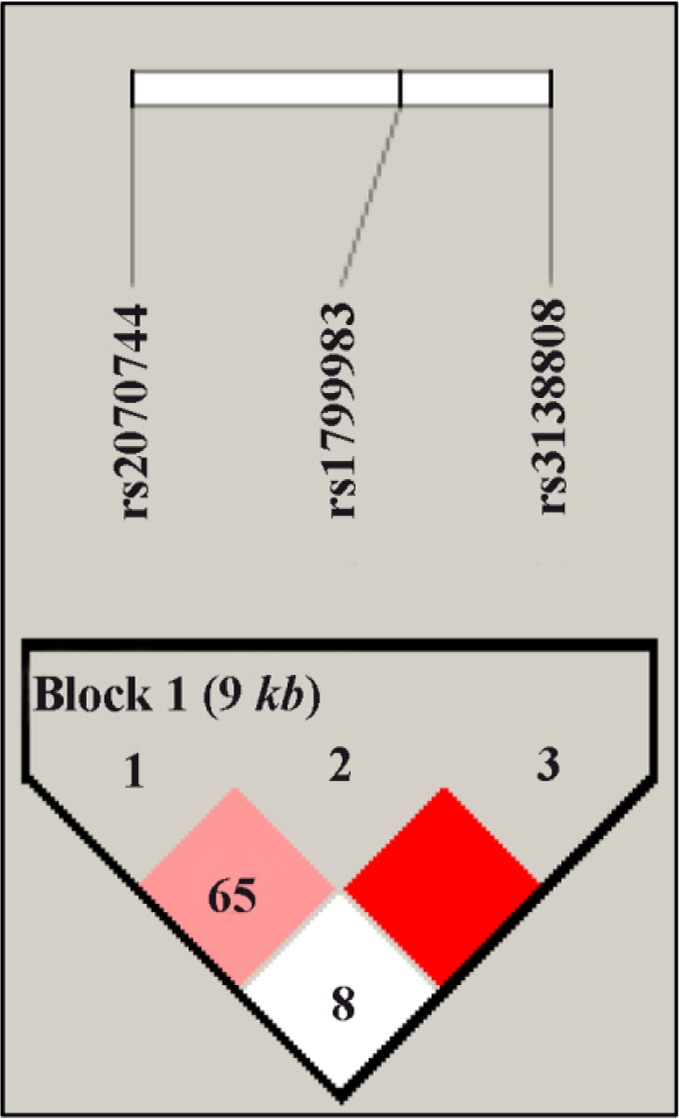
A total of six different haplotype structures with a frequency of >1% were generated from three eNOS (rs 2070744, rs3138808, rs1799983) gene polymorphisms. Among the haplotypes generated, the haplotype T-4b-G was the most common with the frequency of 64.4%. Ensuing haplotypes were C-4a-G, T-4b-T, T-4a-G, C-4b-T and C-4b-G with frequencies of 15.5%, 8.3%, 5.7%, 3.8% and 2.4%, respectively. Comparatively substantial LD pattern (D’=1) was observed between rs1799983 and rs3138808. Likewise, moderate LD (D’= 0.658) was detected between rs2070744 and rs1799983 (Figure 1).
Endothelial dysfunction is widely foreseen as a prognostic marker of futuristic cardiovascular complication. Endothelium maintains the vascular tone and plays a key role in regulation of blood flow and blood pressure. Nitric oxide is a major vasodilator substance released by the endothelium and is a chief regulator of endothelial function. Endothelial nitric oxide synthase (eNOS) helps in the formation of nitric oxide in the endothelial cells from its precursor, L-arginine (19). Abnormalities in eNOS enzyme that synthesizes nitric oxide in the endothelial cells can lead to the worst course of action and often result in cardiovascular diseases like hypertension, myocardial infarction, atherosclerosis, preeclampsia, etc. (20).
This study is the first of its kind to survey the distribution of numerous functionally important polymorphisms (eNOS Glu298Asp, 4b/4a and −786T>C, ACE I/D and CYP11B2 −344C>T) among healthy pregnant women. The population sample included in the study was a homogeneous collection of south Indian Tamilian women. Furthermore, in this study, for the first time, the presence of a novel allele, viz., the 27 bp intron 4 VNTR in the eNOS gene was reported which has not been studied till date among Tamilian population. On the whole, our conclusions displayed a substantial inter-ethnic inconsistency in the distribution of eNOS, ACE and CYP11B2 genes’ variants.
Taking into account the existing allele and genotype frequencies of eNOS, CYP11B2 and ACE genes of the current population, an extensive comparative analysis of the current data manifested a relatively higher frequency of Glu298Asp mutant allele when compared to the sub-Saharan African population. In just the same way, the current existing data for the same allele was relatively lower in comparison to that of the Caucasian race (Table 4). On the other hand, the promoter region polymorphism, viz., −786T>C, whose mutant allele was found to be comparatively higher than the Japanese and Afro-American populations was found to be reasonably lower than the sub-Saharan and Caucasian ethnics (Table 5). This aside, the 27 bp intron 4 VNTR polymorphism of the eNOS gene had a relatively higher frequency when compared to other populations of the world, although it appeared to be moderately lower than the Tunisians and the Germans (Table 6).
Table 5 Genotype and allele frequencies of eNOS −786T>C (rs2070744) polymorphism observed in this study and compared with those reported in other ethnicities
| Ethnicity | ||||||||
|---|---|---|---|---|---|---|---|---|
| N | Genotype frequency (%) | Allele frequency (%) | P-value | Ref | ||||
| TT | TC | CC | T | C | ||||
| Asians | ||||||||
| Tamilians | 303 | 59.7 | 37.2 | 2.9 | 78.3 | 21.6 | -- | Current study |
| South Indians | 224 | 60.7 | 36.2 | 3.1 | 78.8 | 21.2 | NS | [26] |
| JPT | -- | -- | -- | -- | 91.7 | 8.3 | 0.0092 | [27] |
| HapMap-CHB | -- | 100 | 0 | 0 | 100 | 0 | 0.0001 | [28] |
| HapMap-JPT | -- | 100 | 0 | 0 | 100 | 0 | 0.0001 | [28] |
| Africans | ||||||||
| YRI | -- | 100 | 0 | 0 | 100 | 0 | 0.0001 | [28] |
| Sub-Saharan Africans | -- | 0 | 100 | 0 | 50 | 50 | 0.0001 | [28] |
| Caucasians | ||||||||
| Italians | 38 | 21 | 50 | 29 | 46 | 54 | 0.0001 | [17] |
| CEU | -- | 100 | 0 | 0 | 100 | 0 | 0.0001 | [28] |
N= Total number of subjects, NS= No significant difference (p>0.05), CHB-Han Chinese in Beijing, China, JPT-Japanese in Tokyo, Japan, YRI-Yoruba in Ibadan, Nigeria, CEU, CEPH-Utah residents with ancestry from Northern and Western Europe
Table 6 Genotype and allele frequencies of eNOS intron 4 VNTR (rs3138808) polymorphism observed in this study and compared with those reported in other ethnicities
| Ethnicity | ||||||||
|---|---|---|---|---|---|---|---|---|
| N | Genotype frequency (%) | Allele frequency (%) | P-value | Ref | ||||
| 4b/4b | 4b/4a | 4a/4a | 4b | 4a | ||||
| Asians | ||||||||
| Tamilians | 303 | 62.7 | 32.3 | 4.9 | 78.8 | 21.1 | -- | Current study |
| South Indians | 100 | 69 | 16 | 15 | 77 | 23 | NS | [26] |
| Japanese | 203 | 76.85 | 21.67 | 1.48 | 87.68 | 12.32 | NS | [27] |
| CHB | 166 | 87.3 | 12.04 | 0.6 | 93.3 | 6.6 | 0.0072 | [29] |
| Africans | ||||||||
| Tunisians | 255 | 74.12 | 23.92 | 1.96 | 76.6 | 23.24 | NS | [30] |
| Caucasians | ||||||||
| Finnish | 356 | 67.98 | 27.81 | 4.21 | 81.88 | 18.12 | NS | [31] |
| Germans | 114 | 61.4 | 30.70 | 7.89 | 76.75 | 23.25 | NS | [32] |
N= Total number of subjects, NS= No significant difference (p>0.05), CHB-Han Chinese in Beijing, China, JPT-Japanese in Tokyo, Japan
Likewise, the mutant allele for the promoter region polymorphism of CYP11B2 gene, viz., −344C>T was found to be significantly higher among the African population, but moderately high within north Indians and other Asiatic ethnic groups. In the same manner, it was also found to be moderately high among the Caucasian ethnicity as well (Table 7).
Table 7 Genotype and allele frequencies of CYP11B2 -344C>T (rs1799998) polymorphism observed in this study and compared with those reported in other ethnicities
| Ethnicity | ||||||||
|---|---|---|---|---|---|---|---|---|
| N | Genotype frequency (%) | Allele frequency (%) | P-value | Ref | ||||
| CC | CT | TT | C | T | ||||
| Asians | ||||||||
| Tamilians | 127 | 31.6 | 48.8 | 19.4 | 56.1 | 43.8 | -- | Current study |
| North Indians | 48 | 8.33 | 45.83 | 45.83 | 31.25 | 68.75 | 0.0006 | [34] |
| Chinese | 503 | 10.5 | 42.5 | 47 | 32 | 68 | 0.0010 | [35] |
| Japanese | 221 | 9.1 | 34.8 | 56.1 | 26.5 | 73.5 | 0.0001 | [36] |
| CHB | 246 | 7.2 | 47.2 | 45.6 | 30.8 | 69.2 | 0.0006 | [37] |
| HapMap-CHB | -- | 0 | 46.3 | 53.7 | 23.2 | 76.8 | 0.0001 | [38] |
| HapMap-CHD | -- | 12.9 | 54.1 | 32.9 | 40 | 60 | 0.0335 | [38] |
| Africans | ||||||||
| People of African origin London | 441 | 3.9 | 34 | 62.1 | 21 | 79 | 0.0001 | [39] |
| Caucasians | ||||||||
| Europeans | -- | 17.9 | 50.9 | 31.2 | 43.3 | 56.7 | NS | [39] |
N= Total number of subjects, NS= No significant difference (p>0.05), CHB-Han Chinese in Beijing, China, JPT-Japanese in Tokyo, Japan, CHD-Chinese in Metropolitan Denver, Colorado, GIH-Gujarati Indians in Houston, Texas, ASW-African ancestry in Southwest USA, LWK-Luhyain Webuye, Kenya, MKK-Maasai in Kinyawa, Kenya, TSI-Toscani in Italia
Regarding the distribution of ACE intron 16 Alu (Ins/Del) polymorphism, in comparison with other racial groups of the world, it appears to be fairly alike with other world-wide ethnicities. However, there was a significantly higher frequency of the same among the Omani Arabs. Nonetheless, there was a slightly moderate significance for the same among the Caucasian population (Table 8). Among the variants of eNOS gene explored in this study, the minor allele frequency of rs1799983 (Asp) was similar to those previously reported in north Indian and other Asiatic population (21–28). However, it was found to be significantly higher among the Caucasian population (p=0.0001). On the other hand, the “C” allele frequency of rs2070744 was significantly higher than those displayed among Chinese, Japanese and other HapMap populations (for all comparisons, p=0.0001) (28). This aside, the intron 4 VNTR (rs3138808) polymorphism appeared to be considerably higher when compared to the Columbians (p=0.0004). Nevertheless, no such difference was detected with other major world populations (28, 29).
Table 8 Genotype and allele frequencies of ACE 287 bp Alu I/D polymorphism observed in this study and compared with those reported in other ethnicities
| Ethnicity | ||||||||
|---|---|---|---|---|---|---|---|---|
| N | Genotype frequency (%) | Allele frequency (%) | P-value | Ref | ||||
| I/I | I/D | D/D | I | D | ||||
| Asians | ||||||||
| Tamilians | 303 | 32.3 | 49.8 | 17.8 | 57.2 | 42.7 | -- | Current study |
| South Indian (Andhra Pradesh, Nellore Dist.) | 60 | 28.3 | 55 | 16.6 | 55.8 | 44.2 | NS | [39] |
| Tamilians | 444 | 34.5 | 42.8 | 22.7 | 56 | 44 | NS | [40] |
| Chinese | 668 | 45.5 | 44.8 | 9.7 | 67.9 | 32.1 | NS | [41] |
| Omani Arabs | 124 | 10.1 | 50.6 | 63.2 | 29 | 71 | 0.0001 | [42] |
| Africans | ||||||||
| African Americans | 88 | 10.2 | 51.1 | 38.6 | 35.7 | 64.2 | 0.0045 | [43] |
| Cubans | 182 | 14.8 | 56.5 | 28.5 | 43.1 | 56.8 | NS | [44] |
| Caucasians | ||||||||
| Italians | 92 | 26 | 52 | 22 | 52 | 48 | NS | [45] |
N= Total number of subjects, NS= No significant difference (p>0.05), HP= Himachal Pradesh
Studies have shown that SNPs occurring in the eNOS gene leads to variations in response to the vascular endothelium with increased oxidative stress (19). In addition, the Glu298Asp variant of the eNOS gene has been found to exhibit a significant role in coronary atherosclerosis (20). Besides, with the exponentially alarming increase in the incidence of preeclampsia, few reports have also substantiated the association of Glu298Asp variant polymorphism with a striking decrease in NO levels eventually leading to its altered expression among preeclamptic women (21). Also significant is the fact that the “C-Glu-b” haplotype may protect against the progression of PE by increasing the endogenous formation of NO.
This aside, the promoter region polymorphism of the eNOS gene, viz., −786T>C, involves the replacement of a thymidine by cytosine at nucleotide 786 position of the regulatory region. The overall effect of this variation is that it reduces the promoter activity of the eNOS gene, thereby leading to an alteration in the production of nitric oxide (46). Among the Japanese population, the homozygous subjects with −786T>C had a high risk of developing coronary spasm. Studies have also shown that this SNP was associated with the development of blood pressure among healthy adult males. Furthermore, in the case of homozygous −786T>C variants, the promoter activity was reduced by 50%. This in turn led to an improper functioning of the L-arginine-NO pathway causing endothelial dysfunction. These findings thus substantiate the significant role of eNOS gene in maintaining the structural integrity of the arterial wall (46).
In much the same way, the functional importance imparted by the 27 bp intron 4 VNTR polymorphism of the eNOS gene cannot be underestimated as well. It is located in the intron 4 region of the eNOS gene and consists of two alleles. Out of the two alleles, the larger allele has five tandem repeat units of 27 bps (first three has “A”s and the last two “G”s at the 19th position in the repeat unit). However, the smaller allele has only four repeats (first two “A”s and last two “G”s at the 19th position in the repeat unit). These alleles are known as eNOS 4a and eNOS 4b for shorter and larger alleles, respectively. This polymorphism, however, is directly related to the change in the plasma NOx levels (47, 48).
This aside, also significant is the fact that cardiovascular complications are generally depicted as a multifactorial and polygenic disorder, predisposed by genetic and environmental factors (2). Another interesting counterpart, viz., the rennin angiotensin aldosterone system (RAAS), plays a crucial role in the production of the aldosterone hormone, which is chiefly associated with water-electrolyte balance.
In the current study population, the minor allele frequency of −344C>T (rs1799998) polymorphism in the CYP11B2 gene was found to be significantly lower than the Japanese and African population (p=0.0001). However, it appeared to be reasonably somewhat significant among the north Indians and Chinese (p≤0.001). Apart from its function in the regulation of the aldosterone activity, this gene may have direct effect on the cardiovascular system as well. The expression of this gene is regulated by the angiotensin II and potassium (5). Three main polymorphisms have been detected in this gene. Of the three, the mutation C-344T which occurs in the promoter region of the gene is known to be associated with high blood pressure and ischemic stroke among Chinese population (49). Another report from our laboratory has also validated the notion that essential hypertension was associated with the CYP11B2 polymorphism (C-344T) in a study conducted among south Indian Tamilian population (16). In addition, it has also substantiated the fact that environmental and other risk factors must be taken into account while predicting the influence of genes on multifactorial diseases like arterial hypertension (49).
This apart, one cannot ignore the fact about the substantial role rendered by genetic polymorphisms in RAAS for the progression of preeclampsia. Also significant is the fact that at post-transcriptional level, miRNA interacts with the targeted site within the 3′-UTR of the RAAS gene which in turn triggers the regulation of RAAS and the pathology of preeclampsia. Although the results generated by several studies are controversial, it is nonetheless interesting in terms of prospective analytical implication (50).
Likewise, the minor allele frequency of the 287 bp Alu I/D polymorphism of the ACE gene (rs 4646994) as seen in the current study, was significantly higher among the Omani Arabs (p=0.0001) and fairly marginally significant when compared with the Caucasian groups (p≤0.5). Various studies have revealed that this polymorphism in ACE gene is responsible for different cardiovascular diseases like hypertension, myocardial infarction and renal diseases like nephropathy (51). A significant association between homozygotes DD and hypertension has been reported in Andhra population whereas no such association was reported in western Indians (52). This association is prominent and highly prevalent in men than in females according to the large number of studies conducted in Indian as well as foreign populations.
To further complicate the issue, ACE ID polymorphism was also reported to be associated with coronary artery disease in a meta-analysis of 118 studies consisting of 43,733 coronary artery patients and 82,606 controls (53). It was also reported that DD genotype and D allele result in an increased risk for hypertrophic cardiomyopathy and dilated cardiomyopathy (54). This polymorphism was also found to have association with lowering blood pressure response. The systolic blood pressure was reduced and the mean arterial blood pressure was greater in subjects with DD genotype when compared to other ACE I/D genotypes on treatment with hydrochlorothiazide among 829 patients (55). However, the effect of ACE I/D polymorphisms on the progression of preeclampsia is still ambiguous and yet needs to be explored in detail. Literature is inadequate in terms of the role of polymorphisms in this gene and their resultant risk to preeclampsia.
Although several studies have investigated the association of polymorphisms present in these genes (eNOS, CYP11B2 and ACE) with hypertension, and other cardiovascular parameters, there are few or no reports available documenting the allele, genotype and haplotype frequencies of the same in south Indian Tamilian population among healthy pregnant women. India has a polygenic population and possesses an amazing amalgamation of various cultures and races. In fact, it accounts for more than one sixth of the world’s population and holds more than two thousand ethnic groups of people. In other words, India constitutes a highly complex and colorful social mosaic. In spite of this broad range of cultural diversity and heterogeneity, this mosaic is not chaotic. It has a clearly distinguishable pattern, wherein sociocultural diversity is highly sustainable and strong (56). To validate this notion, significant inter-ethnic differences in the distribution of eNOS, CYP11B2 and ACE gene variants among various ethnic groups have been demonstrated by the current study.
Our study is the first epidemiological-based investigation to describe the distribution of three candidate genes like eNOS, YP11B2 and ACE with their genotypes and haplotypes in an Indian set-up among healthy pregnant women. Extensive inter-ethnic inconsistency detected in the current study specifies the discrete genetic makeup of the south Indian population. This in fact coincides with the Indian genome variation consortium evaluation on the Dravidian population (57).
New molecular conceptions propose newer possibilities of early diagnosis of elevated maternal and foetal risk during pregnancy. Genetic predispositions in the form of single nucleotide polymorphisms in candidate genes of cardiovascular risk offer an effective means of early risk calculation. The outcome of this study paves way for future therapeutic value of these variants to be studied in a preeclamptic patient set-up. This in turn would pose a credible diagnostic potential for primary risk assessment to detect women who are susceptible to preeclampsia or other pregnancy related complications. Moreover, this would further augment the potential remunerations for them, their offspring and the health care systems as a whole. In addition, even though ample studies substantiate the positive relationship in genetic mutations and increased risk for preeclampsia, additional large-scale examinations are required to evade the intervention from different variants.
The study was supported by Indian Council of Medical Research (ICMR), New Delhi (Grant Order No. 53/17/2003-BMS dt.12.03.2007).
