
Uterine synechiae or Asherman's syndrome is a condition which can cause infertility, menstrual abnormalities, and recurrent pregnancy losses that occurs due to a partial or complete closure of the uterine cavity and/or the cervical canal (1). Moreover, this obliteration may be a direct outcome of surgical endometrial lesions of a gravid uterus such as uterine curettage, placental products depletion in the postpartum period, cesarean section or uterine devascularization in cases of severe postpartum hemorrhage (2–4). Asherman's syndrome may be induced due to a trauma of nongravid uterine cavity such as diagnostic curettage, hysteroscopic surgery, including mymectomy, polypectomy and endometrial ablation (5, 6). The true prevalence of Asherman's syndrome is unclear due to underdiagnosis. It is estimated to affect 1.5% of women undergoing a hysterosal-pingogram; between 5% and 39% of women with recurrent miscarriage; and up to 40% of patients who have undergone repeat dilation and curettage for retained products of conception following pregnancy (7). The exact mechanism of synechiae formation, high interindividual variability for the onset of intrauterine adhesions, unknown influence of gravidity on synechiae formation and effective preventive treatments for the problem are the issues that highlight the need for having experimental animal models to explain synechiae pathogenesis, its prevention and treatment.
Presence of two completely separate uterine horns with two cervices and the largest bicornuate uterus among laboratory animals made the rabbit an appropriate model for simultaneous evaluation of control and treatment group in an individual case. However, in human and most domestic mammals, ovulation takes place at regular intervals; the female rabbit ovulation will occur non-spontaneously, therefore, they do not have an estrous cycle with regular periods of heat. Rabbits are considered to be in estrus more or less permanently and their ovulation occurs only after mating. Therefore, the poly-estrous characteristic of rabbits probably allows the uterine endometrium to be restored shortly after the traumatic curettage of the uterus. However, removing this effect may allow the rabbit uterine endometrium to grow. In addition, pseudo-pregnancy which is caused by liberation of unfertilized ova is another physiologic trait of rabbit lasting 15 to 18 days. During pseudopregnancy period, corpus luteum and uterus develop as in an ordinary pregnancy (8). The human uterus displays some idiosyncrasies compared to other mammals: 1) a uterine muscle with an apparent thickness can only be observed in some of higher order primates; 2) the high-regeneration frequency of the endometrium, due to monthly menstrual menses, is also quite specific to human species. In theory, the macaque would be an ideal model, but it would raise ethical concerns and also the considerable additional cost is not negligible. Based on these characteristics, Khrouf et al.'s (9) model was modified in this study to create a rabbit model of intrauterine adhesions.
Eighteen female adult healthy New Zealand white rabbits (Oryctolagus cuniculus) weighing 3500–4000 g were randomly selected and kept in the Center of Comparative and Experimental Medicine, Shiraz University of Medical Sciences, Shiraz, Iran. They were housed in the condition of 20±2°C temperature, humidity 60%, and 12 hr light/dark cycle. They had free access to food and water. Carrot and parsley were added to their food for better supplementation. Rabbits were randomly divided into intact and ovariectomized groups.
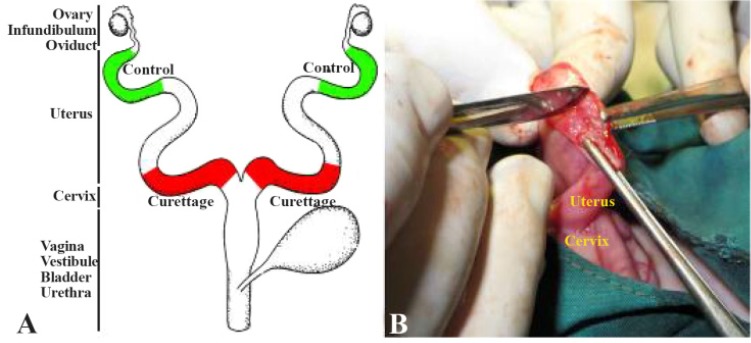
One third of caudal part of both uteri of all rabbits was submitted to traumatic endometrial curettage. Briefly, they were anesthetized and sedated with a single intramuscular (IM) dose of a combination of ketamine 10% (35–40 mg/kg, Alfasan™, Netherlands), and xylazine (3–5 mg/kg, Merk™, Germany) after pre-operative overnight fasting. Following laparotomy, the pelvic region was examined in order to exclude any animal with macroscopic abnormality which may interfere with fertility. Five-mm long incisions were performed on the right and left uteri. Incisions were located beyond the cervix (Figure 1A). Four-cm curettage of the endometrium was performed with a scalpel through these incisions on the half part of endometrium which was in front of the incision (Figure 1B). Whole thickness of endometrium was removed and it was continued until observation of bleeding as an indicator of completion of curettage. Then, uteri were repaired with 4-0 vicryl sutures, abdominal muscles were sutured using 3-0 vicryl and the skin was closed with 2-0 silk sutures. At the end of the operation, rabbits received flunixin meglumine (0.2 mg/kg, IM, Caspian-Tamin™, Iran) immediately and then every 24 hr at 3 doses. Penstrep-400 (Nasr™, Iran, IM) was injected as an antimicrobial, just after the operation and continued for 3 days.
Grouping of the rabbits is summarized in table 1). Nine rabbits (18 uteri) were simultaneously ovariectomized. The intact rabbits of the second group (n=9) were artificially induced ovulation with vaginal stimulation using a plastic rod during 10 days after surgery. Rabbits were sacrificed with a high dose of pentobarbitone (1 g, Specia™, France) at various times following surgery (days 15, 30 and 45). One third of caudal part of both uteri as curetted and one third of cranial part of both uteri as control and ovaries of intact rabbits were immersion fixed for two weeks in 10% formalin buffer.
Table 1. Groups of the present study for induction of human Asherman's syndrome in rabbit model
| Days of sampling | Number of rabbits (uterus) | Uterus of intact group | Uterus of ovariectomized group | ||
|---|---|---|---|---|---|
| Cranial part (Control) | Caudal part (Curetted) | Cranial part (Control) | Caudal part (Curetted) | ||
| 15 | 6 (12) | 6 samples | 6 samples | 6 samples | 6 samples |
| 30 | 6 (12) | 6 samples | 6 samples | 6 samples | 6 samples |
| 45 | 6 (12) | 6 samples | 6 samples | 6 samples | 6 samples |
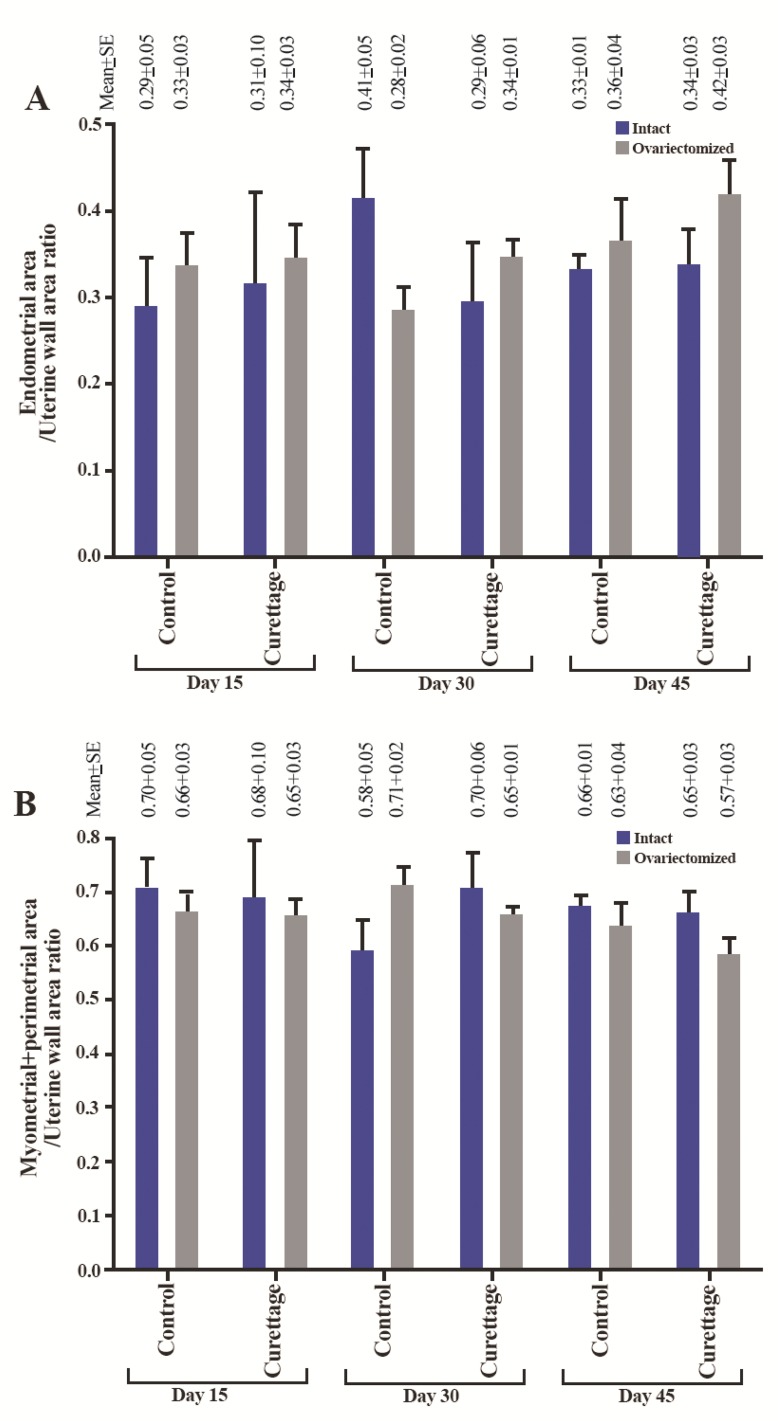
The segments of uteri were embedded in paraffin after fixation and histopathologic sections were made from each block. The 5 μm thickness sections were stained with hematoxylin and eosin and green Masson's trichrome to analyze histopathologic damages following curettage and the evolution of the regeneration process with passage of time. Hematoxylin and eosin stain slides were visualized and photographed on light microscope (Olympus, Japan) equipped with an adjusted digital camera (Dino-Eye, Taiwan). Lumen area, endometrial area and total area of the uterus were measured using Dinocapture 2.0 software (Dino-Eye, Taiwan; Figure 2). The proportion of damaged endometrial luminal epithelium were estimated by calculation of different indices (Table 2) of both uteri in six subdivided groups (n=6). Synechiae occurring, inflammatory elements and histopathologic changes in time were evaluated in curettage and intact control parts by evaluation of Masson's trichrome slides.
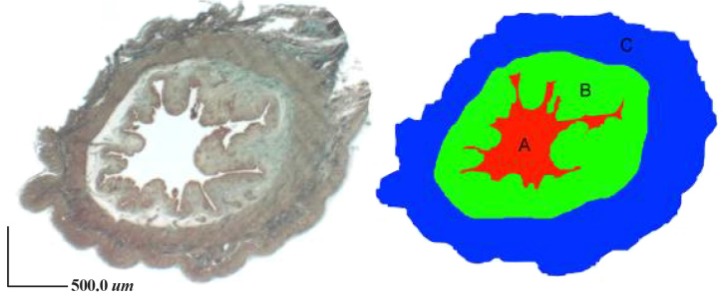
Table 2. Histopathologic indices for evaluation of curetted and control uterus in intact and ovariectomized groups for induction of human Asherman's syndrome in rabbit model
| Indices | Abbreviations |
|---|---|
| Lumen area/total horn area ratio | LA/THA |
| Endometrial area/total horn area ratio | EA/THA |
| Myometrial and perimetrial area/total horn area ratio | MPA/THA |
| Endometrial area/uterine wall area ratio | EA/UWA |
| Myometrial and perimetrial area/uterine wall area ratio | MPA/UWA |
This experimental prospective study was approved by the Ethics Committee for Animal Experiments in Shiraz University of Medical Sciences, Shiraz, Iran code number # 92-01-85-6951.
The means and standard error (SE) of ratio of LA/THA, EA/THA, MPA/THA, EA/UWA and MPA/THA were subjected to Kolmogorov-Smirnov test of normality and at each date (day 15, 30 and 45) were analyzed by two-way ANOVA (SPSS for Windows, version 11.5, SPSS Inc, Chicago, Illinois), and post-hoc test was performed by LSD test. The p-value of less than 0.05 was considered statistically significant. Group means and their SE are reported in the graphs (GraphPad Prism version 5.01 for Windows, GraphPad software Inc., San Diego, CA, USA).
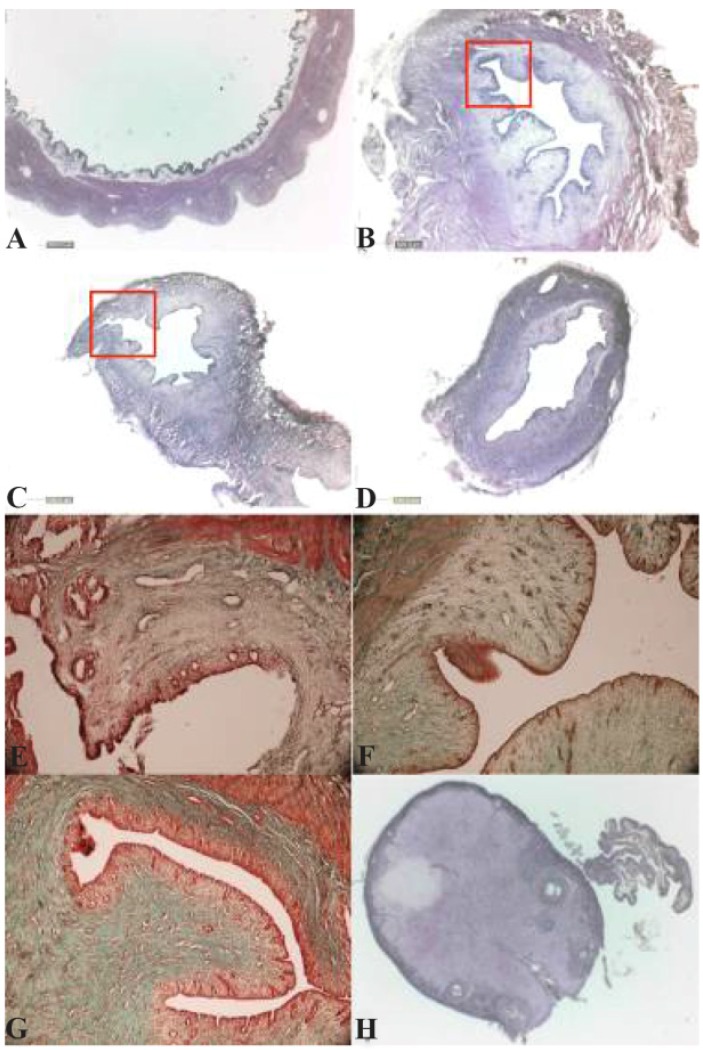
All rabbits had no postoperative complications. After autopsy, complete lumen obstruction of curettage site of two uterine horns was induced hydrometra (Figure 3A). Histopathologic findings showed significant epithelial damage together with significant inflammatory reaction in the intact and ovariectomized curettage groups (Figures 3B, 3C, 3E, and 3F) in comparison with the control groups (Figures 3D and 3G). Furthermore, ovarian sections in the intact groups with corpus lutea did not have secondary or tertiary follicles which confirmed pseudo-pregnancy induction (Figure 3H).
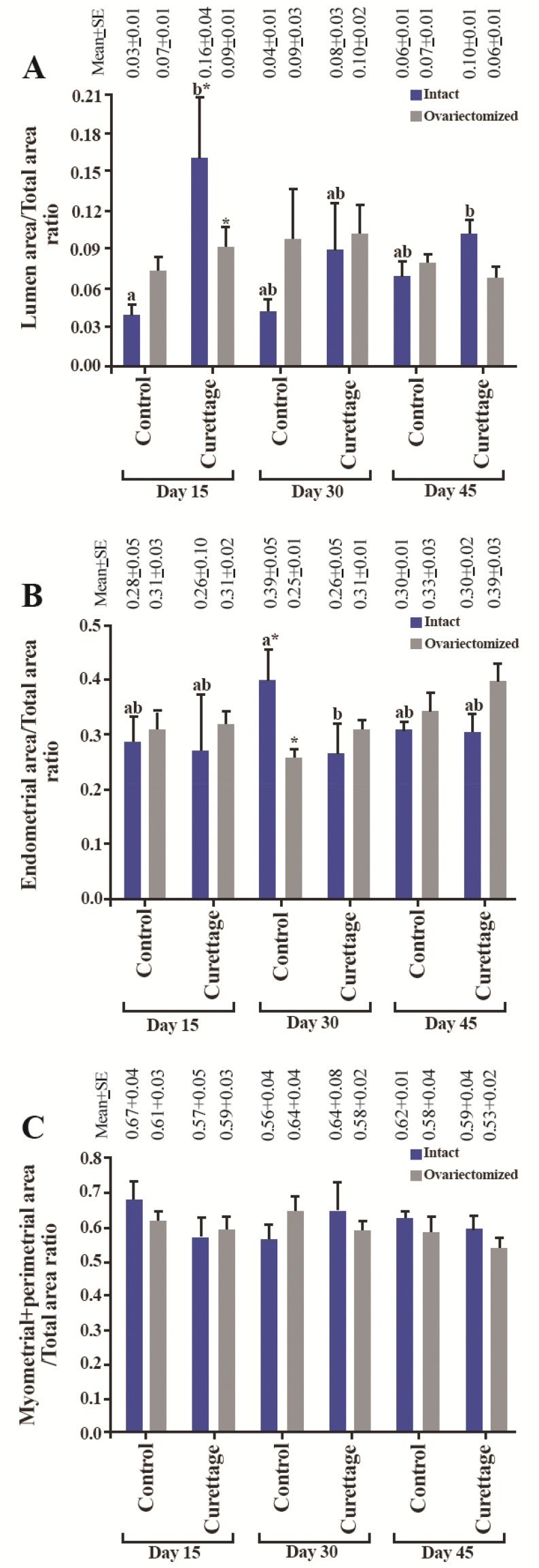
Uterine LA/THA ratios of intact curettage group on days 15 and 45 were more than the intact control group on day 15 (p=0.002 and p=0.049, respectively, Figure 4A). Furthermore, uterine LA/THA ratios of intact curettage group was more than the ovariectomized curettage group on day 15 (p<0.05, Figure 4A). Moreover, EA/THA ratio of the intact curettage group on day 30 was less than the intact control group on day 30 (p=0.036, Figure 4B). EA/THA ratio of the intact control group was more than the ovariectomized control group on day 30 (p=0.034, Figure 4B). In addition, MPA/THA ratio did not change during the period of study in both groups of intact and ovariectomized (Figure 4C). EA/UWA ratio and MPA/UWA ratio did not change during the period of study in the both groups of intact and ovariectomized (Figures 5A and 5B).
The present study was performed to create an animal model of postoperative synechiae based on the endometrial curettage, a true clinical situation in rabbits. The examination of the uterine sections in the intact and ovariectomized rabbits showed that curettage was effective for endometrial destruction during 15 and 30 days after induction. However, histopathologic examination on day 45 demonstrated a partial regeneration of endometrium especially in the ovariectomized group. In addition, a significant increase in lumen surface on day 15 in the intact group with a lower simple columnar epithelium compared to the control was observed. Ovariectomy interrupts the effect of ovarian cycle on healing and regeneration of endometrium and therefore, fibroblasts gain enough time to proliferate in the curetted endometrium. However, with ovariectomy, the uterine size rapidly regressed and different ratios were used to evaluate the exact effect of curettage on synechiae induction. Moreover, the intact curetted rabbits were vaginally stimulated using a plastic rod to induce pseudo-pregnancy. Presence of corpus lutea on the ovaries of pseudo-pregnant intact curetted rabbits and ovariectomy of the ovariectomized group prevented the effect of estrous cyclic changes on endometrial decline and growth which may omit the curettage effect.
Preserving fertility after endouterine surgery is a great concern for clinicians and synechiae is considered as a postoperative complication which, in some cases, may be hard to treat (10). Although it usually occurs following curettage of the pregnant or recently pregnant uterus, any uterine surgery, trauma or infection, particularly after pregnancy when estradiol levels are low, can lead to synechiae (10, 11). In contrast with these great interests, little is currently known about the process of synechiae formation and its physiopathology, while this could help in developing effective preventive treatments. For these considerations, creating an animal model is essential because it represents a tool for the description of time-related histopathologic changes after endouterine trauma. Moreover, since causal relationship between endometrial surgery and infertility has been established based on retrospective studies (12–14), synechiae induction in an animal model may allow further investigations of this relationship.
In contrast with the high number of publications using animal models for intraperitoneal adhesions (15–17), intrauterine adhesions (IUAs) are rarely investigated or described in animals. Spontaneous IUAs were also reported with 9% frequency in a unique retrospective study of 87 hypofertile mares (18). However, to the best of our knowledge, there are four studies for induction of IUAs in experimental rabbit model (9, 19–21). In three of them, a traumatic curettage of the endometrium in rabbits were pretreated with estrogens (19) progesterone (20) or without pretreatment (21). None of these experimentations succeeded in creating IUAs and the authors report a complete regeneration of endometrium on day 7 of the surgery. Khrouf et al. (9) also evaluated the rabbit as an experimental model of Asherman's syndrome and tried to induce synechiae using traumatic curettage as a trigger mechanism. In their model as a first attempt in induction of this disease in animal model, no synechiae have been observed after traumatic endometrial curettage and examinations on days 7, 15 and 30 demonstrated a complete regeneration of endometrium (9). Despite the fact that those studies failed to create synechiae using curettage, the endometrial curettage was used in the present study as it is a frequent procedure in routine gynecological activity. The present study has two modifications compared to the previous ones in rabbit model: 1) reducing the endometrial proliferation by deletion or fixation of ovarian hormone effects (pseoudo-pregnancy or ovariectomy) and 2) the method of histopathology evaluation using uterine layers ratios which could demonstrate uterine defects. In contrast with previous findings, intrauterine fibrosis was revealed using curettage and the present study demonstrate an increased lumen surface probably due to a low endometrial thickness.
Other surgical approaches such as endometrial destruction by cryosurgery or chemical aggression had no success (22, 23). Finally, a two-step procedure including subcutaneous graft of sponge and its insertion into the uterine horn after three weeks was performed in rats, rabbits, monkeys and humans. With this model, total IUAs were obtained which showed that fibroblast has a major role in Asherman's syndrome pathology (24). However, this procedure is not comparable to clinical situations leading to Asherman's syndrome, because these “synechiae” are probably a simple immunological reaction against a foreign body and unhelpful for clinical purposes. Our results are in concordance with Schenker's experimentation using curettage (21) and despite significant endometrial destruction, a partial regeneration of endometrium especially in ovariectomized group was observed on day 45.
Existence of some correlation between histopathologic morphology of endomterium and its functional aspect as shown in this study suggests the benefit of histopathologic examination to predict IUAs. The idea that implantation and pregnancy is associated with immune suppression has created a myth of pregnancy as a state of immunological weakness (25). However, inflammation impact on implantation remains unclear; while some publications report negative impact of inflammation (26, 27), other authors have shown that a local injury of the endometrium induced an inflammatory response that promotes successful implantation (11, 28, 29). This model allowed an evaluation of histopathology for appreciation of endometrial function and also demonstrates the potential impact of curettage on endometrial structure, regeneration and fertility.
In conclusion, a model of Asherman's syndrome was proposed in the rabbit and uterine fibrosis was observed in the intact curettage group. Therefore, this modified model, psoudo-pregnant curetted uterus, represents a pathogenesis condition in the rabbit similar to IUAs observed in the human and will help in our understanding of the physiopathology of Asherman's syndrome.
This work was supported by Vice-Chancellor of Research and Technology, Shiraz University of Medical Sciences. Grant no. 92-01-85-6951.
