
Growth factors like platelet-derived growth factor (PDGF) and stem cell factor (SCF) are naturally occurring substances capable of stimulating cellular growth, proliferation and differentiation. Normal development and function of the testicular somatic cells (e.g. leydig cells) are controlled by growth factors like SCF, PDGF and their interaction with tyrosine kinase receptors (PDGFR and c-kit) (1–5).
Imatinib mesylate (Glivec®, STI 571; Novartis Pharma, Switzerland), an antitumor agent has been widely used to treat multiple cancers, most notably Philadelphia chromosome-positive (Ph+) chronic myelogenous leukemia and gastrointestinal stromal tumors. Like all tyrosine kinase inhibitors, imatinib works by preventing a tyrosine kinase enzyme and therefore inhibits growth factor induced receptor phosphorylation and blocks the PDGF/PDGFR and PI3-K/Akt pathway (6–9). Although such drugs could be targeted with a high degree of selectivity towards the tumor cells, mentioned signaling pathways perform critical functions in normal cells, especially during development. For instance, PDGF is a central mediator of leydig cells development and these cells supply supply the testosterone necessary for the completion of spermatogenesis and maintenance of male reproductive function (2, 10, 11).
To the best of our knowledge, there is no study showing the effect of imatinib on growth factor levels in normal leydig cells. However, Heim et al. demonstrated that germline stem cell grown in imatinib led to decreased numbers of differentiated spermatogonia and reduced culture growth consistent with the known requirement for c-kit in survival and proliferation of spermatogonia (12). Besides testosterone reduction has been reported by some investigators following imatinib therapy (13, 14).
On the other hand, some reports have documented findings contradictory to those previously described in the literature and the effect of imatinib on fertility potential is controversial. For instance, unaffected spermatogenesis in a leukemic mouse (15) and successful pregnancies involving men with chronic myeloid leukaemia and imatinib therapy have been reported (16). Therefore, in this study, an attempt was made to determine cellular viability, PDGF and SCF levels in normal mouse leydig cells exposed to imatinib to address this issue.
Imatinib mesylate was kindly gifted by Fararyand-shimi company, Iran; 1 mM stock solution was prepared in distilled water and stored at −20°C. In this study, imatinib was used at increasing concentrations from 0 (control), 2.5, 5, 10 and 20 μM for 2, 4 and 6 days. Each experiment was repeated three times (15 experiments in each day).
Imatinib concentrations were chosen according to previous studies. In the study of Soares et al., the decrease in cell viability was observed only with high concentrations of Imatinib mesylate (15–25 mM) (17). Besides, lower imatinib concentrations (lower than 1 μM) have been reported which led to an underestimation of imatinib anti-tyrosine kinas activity (18).
The mouse TM3 leydig cells line of Musmusculus normal testis were provided from the genetic Laboratory of Tehran University and cultured in 90% DMEM-F12 medium (PAA, UK), supplemented with 5% fetal bovine serum (PAA, UK), 5% horse serum (PAA, UK) and 100 unit/ml penicillin. Cells were incubated at 37°C in a 5% humidified CO2-enriched atmosphere. To determine the effect of imatinib, cells were treated with 0 (control), 2.5, 5, 10 and 20 μM imatinib for 2, 4 and 6 days. Each experiment was repeated three times.
Cellular viability in different groups was determined using MTT proliferation assay kit (Cayman chemical, USA). TM3 cells (5000 per well) were treated with 0 (control), 2.5, 5, 10 and 20 μM imatinib in 100 μl of cultured media for 2, 4 and 6 days. Each experiment was repeated three times. After treatments, 10 μl of MTT reagent was added per well and the plates were incubated at 37°C for 3 hr. MTT-containing media were then removed and the reduced formazan dye was solubilized by adding 100 μl of Crystal Dissolving Solution to each well. The absorbance was measured at 570 nm using ELISA microplate reader. Cell survival rate was calculated as follows: (OD values of the experimental samples/OD values of the control) ×100%.
The IC50 value was determined on the basis of dose-response curves from the MTT assay using the CompuSyn Software.
To determine the concentration of PDGF and SCF in different groups, 50 μl cultured media were assayed using a Human/Mouse PDGF-AA Immunoassay and Mouse SCF Immunoassay kits (R&D Systems, USA), respectively. Triplicate determinations were made at each dilution of the standard and samples.
Data were analyzed using SPSS 16.0 statistical package. Results are expressed as mean±SD. The normality of data distribution was checked with Kolmogorov-Smirnov test and homogeneity of variance was assessed by Levene’s test. Subgroup analyses were performed using one-way analysis of variance (ANOVA) and the Kruskal-Wallis test (ANOVA on ranks) for parametric and nonparametric data, respectively. Tukey’s post hoc test was used to analyze differences between parametric groups. A p-value less than 0.05 was considered statistically significant.
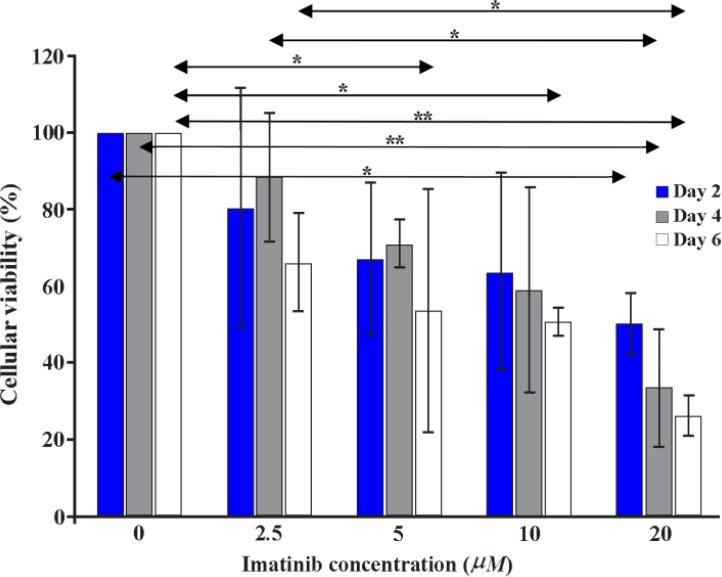
By increasing drug concentration in cultured media from 0 to 20 μM, cellular viability decreased significantly in each separate day. Differences in cellular viability between groups treated with 0 and 20 μM in all days and also 0 and 10 μM and 0 and 5 μM on day 6 were significant (p<0.05) as shown by Tukey’s post hoc tests (Figure 1). The effective concentration of imatinib to reduce cellular viability by 50% (IC50value) on day 4 calculated by CompuSyn Software was 6.42 μM.
Increasing drug concentration in cultured media from 0 to 20 μM increased PDGF level, which was statistically significant on days 4 and 6, and only between groups treated with 0 and 20 μM imatinib according to Tukey’s post hoc tests (Figure 2). However, SCF level did not change significantly following treatment with increasing drug concentration (Table 1).
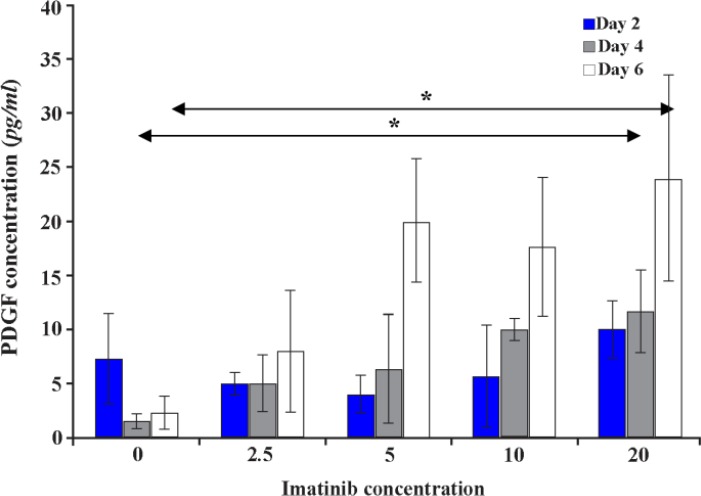
Table 1. SCF levels in leydig cells treated with increasing concentrations of imatinib on different days
| Drug concentration (μM) | SCF level pg/ml | ||
|---|---|---|---|
| 2 Days | 4 Days | 6 Days | |
| 0 | 6.37±0.59 | 17.18±1.76 | 20.31±1.76 |
| 2.5 | 6.87±0.66 | 17.81±2.65 | 20.00±2.20 |
| 5 | 10.93±1.76 | 16.25±1.32 | 15.62±1.32 |
| 10 | 10.93±0.88 | 12.81±0.00 | 15.62±6.1 |
| 20 | 12.1±0.88 | 9.37±5.74 | 8±0.61 |
| P-value | 0.63 | 0.14 | 0.05 |
Data represent mean values±SD of three replicates in each subgroup. Mean values were compared using Kruskal-Wallis test. SCF: stem cell factor
Increasing duration of treatment from 2 to 6 days had no obvious effect on cellular viability, PDGF and SCF levels. However, PDGF level from day 2 to 6 increased insignificantly.
The main finding of this study was that the imatinib mesylate, an anticancer drug and a selective tyrosine kinases inhibitor, decreased cellular viability of normal testicular leydig cells, which was associated with the stimulation of PDGF levels. However, SCF level was not affected by imatinib treatment. The effect of imatinib on cell viability and PDGF level was sustained and occurred in a concentration-but not a time-dependent manner.
Functional PDGFR-α, PDGFR-β, c-kit and their ligands, PDGF-AA, PDGF-BB and SCF are expressed in normal leydig cells and they play a crucial role in leydig cell development and function, including testosterone secretion (10, 19–22). PDGFs and PDGFRs mRNAs of leydig cells were readily detected by both northern analysis and RT-PCR and an identical pattern of protein expression was also confirmed by immunohistochemistry (19). Imatinib mesylate, as a signal transduction inhibitor, reduces tyrosine kinases activity in leydig cells by inhibition of c-kit, PDGFR-α and PDGFR-β receptors (23). According to our results, PDGF level in leydig cells increased in a concentration dependent manner. However, SCF level was unaffected by imatinib exposure. To the best of our knowledge, there has been no study concerning the effect of imatinib on PDGF and SCF levels in normal leydig cells. Testicular mRNA levels of PDGF and SCF showed no changes by the postnatal short term treatment with imatinib (2). The distinction in PDGF level is likely due to differences in the model of the study, the method, target site and concentration of drug application in the experimental conditions. The increase in PDGF level in our study might be due to feedback inhibition of growth factor downstream signaling pathways which have also been shown in our previous work (24). Inhibition of this path by decreasing PDGFR phosphorylation has been reported in tumor cells like mouse melanoma (25) and human neuroblastoma cells (26), with different effects on cellular growth and viability. The altered PDGF response to different concentrations of imatinib might be mediated by the extent of inhibition within the cell tyrosine kinas signaling pathways.
The reason for unaffected SCF levels by imatinib treatment in our study was probably due to higher and more constant imatinib concentrations which were required to suppress SCF/c-kit-dependent proliferation or survival, according to previously published data (18). Other studies in testes with disrupted spermatogenesis showed decreased levels of c-kit and the augmented expression of SCF as a protective mechanism of sertoli cells through a counteracting mechanism (22, 27).
Although the suppression of viability in our studies (IC50=6.42 μM, 4 days of imatinib treatment) occurred at concentrations nearly similar to the IC50 values reported for imatinib-mediated apoptosis induction and proliferation inhibition (IC50=5 μM) and in the approximately same order than the concentrations achieved for the inhibition of leydig cell tumor growth in vitro (IC50=5 μM) (23), it was higher than concentrations required in studies on chronic myeloid leukemia (IC50=1 μM) (28, 29) and lower than that required in studies on neuroblastoma (26). According to previous reports, the mean maximal plasma concentration of oral imatinib (400 mg/body) reached 4.6 μM in the patients of chronic myeloid leukemia. The mean concentration was kept at 1.46 μM even 24 hr after the administration (30, 31). It has also been reported that 1–10 μM of imatinib in cultured cells is almost equivalent to the clinical dose (31). These data indicate that the doses employed in our in vitro study, especially lower doses, are clinically relevant and suitable for in vitro imatinib tyrosine kinas inhibition.
According to our data, imatinib decreased cellular viability of normal testicular leydig cells in a concentration-but not a time-dependent manner. Consistent with this result, Basciani et al. reported that imatinib caused concentration-dependent decreases in the viability of leydig tumor cells, which of course have more tyrosine kinase pathways activity, comparing to normal cells (23, 32). Inhibition of cell growth and viability by imatinib are achieved through reduction of proliferation and induction of apoptosis (33). A further mechanism may include an antiangiogenic effect of imatinib observed in various cancers (34, 35) and the inhibition of vascular endothelial growth factor (26) through a PDGF inhibition-mediated mechanism. Although no study concerning the effect of imatinib on normal leydig cells viability was found, decreased testosterone production has been reported repeatedly as an adverse effect of imatinib therapy (13, 14, 36, 37). Moreover, loss of adult leydig cell population, reductions in testicular size and testosterone production, and the subsequent loss of spermatogenesis and fertility have been reported in PDGFA deficient mice (10). These data point to imatinib’s influence on leydig cells’ function including testosterone production, which might affect fertility potential. Decreased number of differentiated spermatogonia has also been reported in imatinib treated germline stem cells (12). Nonetheless, Schultheis et al. showed that imatinib at therapeutic doses has no impact on folliculogenesis or spermatogenesis in a leukaemia mouse model (15). The difference between this in vivo study and our study may be related to hormonal regulation of PDGF, SCF and c-kit in response to GnRH (22). Altogether, it appears that imatinib may cause reproductive impairment and might reduce fertility potential by decreasing cellular viability through PDGF signaling pathways.
In conclusion, this study shows that exposure of normal leydig cells to imatinib resulted in a sustained suppression of cellular viability and enhancement of PDGF levels of normal testicular leydig cells in a concentration- dependent manner. Whilst multiple cellular signaling pathways involving in imatinib-induced cellular toxicity could not be ruled out, it is hypothesized that PDGF mediated mechanisms may be involved in this phenomenon. Since PDGF and its receptors are important for the development and function of the leydig cells, which in turn are involved in regular spermatogenesis, their abnormal levels caused by some factors like imatinib seem to be associated with reproductive disorders and even infertility. Whilst it is hypothesized that imatinib may reduce fertility potential by decreasing cellular viability through PDGF signaling pathways, future studies focusing on the mechanism of imatinib action, especially PDGF signaling pathways and testosterone production are required to establish the precise nature of their interaction.
This study was supported by Urmia University of Medical Sciences and imatinib mesylate was provided by Mr Aziz-mohammadi (Farayand-shimi Co). Thanks them for co-operation.
