
During recent years, the use of cellular phone among adults, teenagers and children has been increased all over the world. The concern on the possible health hazards of radiofrequency electromagnetic fields (RF-EMF) emitted by mobile phones on human health has been growing in many societies (1). Recent studies have investigated a variety of biological effects of EMFs, on somatic cells, germinal tissues, the rates of cell proliferation and reproductive capacity of animals (2, 3). More specifically, the biological effects of EMF can be grouped into thermal and non-thermal. The thermal effects will ultimately lead to an increase in the local temperature, and the non-thermal type is indirectly associated with temperature changes, but includes some other changes in the tissue by the EMF (4). Up to now, numerous studies reported that the adverse effects of cell phone on reproductive system were due to non-thermal health effects (5–7). On the other hand, some scientists have reported that electromagnetic radiation generated by cell phone has no adverse effect on the fertility or reproduction of mammals, including humans (8, 9).
In general, the possibility of cell phone radiation affecting the cell proliferation has raised concerns of the effects on early embryo development in many species. Also, others reported reduction in the survival rate of murine early embryos in conditions of extremely low-frequency magnetic fields (50 Hz) (ELF-MF) exposure, while it was higher in embryos obtained by in vitro fertilization (IVF) compared with natural breeding (NB) derived embryos (10). Results indicated that the hazardous effect of EMF on living organisms is associated with frequency and intensity of the waves (11). However, the cell phone technology commonly has frequency radiation between 900–1800 MHz.
Up to now, several studies performed in different species provide contradictory information. A study of EMF in pregnant rats suggested that exposure to mobile phone for 30 min could alter the normal development and increase the risk of skeletal system abnormalities of rat fetuses (12). D’Silva et al. reported that exposure to cell phone radiation caused the damage in the developing lens of a chick embryo (13). In recent years, the animal and in vitro models are used mainly to provide useful information of the possible adverse effect of EMF on the living organism, which may complement the in vivo studies. In the present study, an in vitro model was used to assess the morphological parameters, survival rate and development of mouse early stage embryos obtained by NB as consequences of exposure to the cell phone radiation during incubation.
For the control and experimental groups, a total of 40 mice (20 females and 20 males), 6 week old and sexually mature (BALB/c), were obtained from animal house of Research and Clinical Center for Infertility, Yazd, Iran. The mice were housed on a 12 hr light and 12 hr dark cycle at 20–24°C and humidity- controlled (55%±15%) condition in animal room. Mice had access to a standard breeding granulated diet and water ad libidum.
Ovulation was induced in mice by intraperitoneal (i.p.) injection of 10 IU of Pregnant Mare’s Serum Gonadotropin Folligon (PMSG; Intervet, Holland) followed by 10 IU of human chorionic gonadotropin (HCG; Organon, Holland) after 48 hr. In this study, one female mouse was mated with a male mouse overnight. The following morning, the mating was confirmed by inspection of the vaginal plug. Mice with visible copulation plugs were sacrificed by cervical dislocation, and then ovary burses were surgically removed and collected in Hams’F10 medium. Under stereomicroscope (Olympus.SZX16, Japan), zygotes were dissected out from the swollen ampulla and treated with hyaluronidase (80 IU/ml, Irvine Scientific, USA). The collected zygotes were transferred into 100 μl of G1 medium (Vitrolife, Sweden) and incubated for 5 hr in standard incubator. Next, 2-cell embryos were divided into two groups of control (n=150) and experimental (n=150). The latter group was exposed to RF radiation (30 min/day). Also, the embryos were cultured for a maximum of 4 days up to the blastocyst stage under liquid paraffin at 37°C/5% CO 2 . For recording any delay or abnormality during incubation, the morphology of the developing embryos was monitored daily under an inverted microscope (TE300; Nikon, Tokyo, Japan) equipped with heating stage.
The experimental zygotes were exposed to EMF emitted from a commercially cellular phone (Huawei Ascend y300, China) with carrier frequency of 900–1800 MHz and specific absorption rate (SAR) ranged from 0.683 to 0.725 W/kg. The cell phone was held horizontally and parallel to the zygotes culture medium inside the CO 2 incubator (Memmert, Germany) while the bottom of the phone being placed 1 cm above the upper from the stage of incubator. For exposure, the cell phone was kept on talk mode and distance between the phone and embryos was >10 cm. The total duration of exposure was 30 min/day in one dose and exposures started on the second day of incubation for 4 days. The control zygotes were kept at the 5% CO 2 incubator for 4 days without exposure to cell phone radiation.
The cleaved embryos were evaluated according to our recent report (14). Briefly, embryos were graded as follows: Grade A: equal blastomeres without fragmentation, Grade B: slightly unequal blastomeres, up to 10% cytoplasm fragments, Grade C: unequal blastomeres up to 50% fragments and large granules, Grade D: unequal blastomeres with significant fragmentation and large black granules. Also, grades A and B were considered as high quality embryos, whereas grades C and D were low quality ones.
Blastocyst staining with PI and H33258 was performed for identification of viable cells described by Hosseini et al. (15). Briefly, the blastocysts were washed twice in phosphate buffer saline free of calcium (PBS) and magnesium. Then, they were incubated for 30 min in preequilibrated staining solution PI (Cat No: P4127; 300 μg/ml) and Hoechst (Cat No H33258: 5 μg/ml). For removing residual dyes, embryos were washed three times in warm PBS, and stained embryos were fixed in 2.5% glutaraldehyde for 5 min at room temperature, and washed again in PBS. Fixed embryos were mounted in a drop of glycerol between two lines of paraffin wax. Prepared samples were examined under epifluorescence microscope (Olympus BX51, Japan) to distinguish early to completely necrotic cells as red vs. live cells as dark blue.
Data were analyzed using SPSS software version 20 (SPSS, Chicago, IL, USA). The Shapiro-Wilk test was applied for evaluation of normal distribution of the data. Statistical significance was set at p<0.05. Student’s t-test and Mann-Whitney U test were used for statistical analysis. Data were presented as mean±SD, median (min-max).
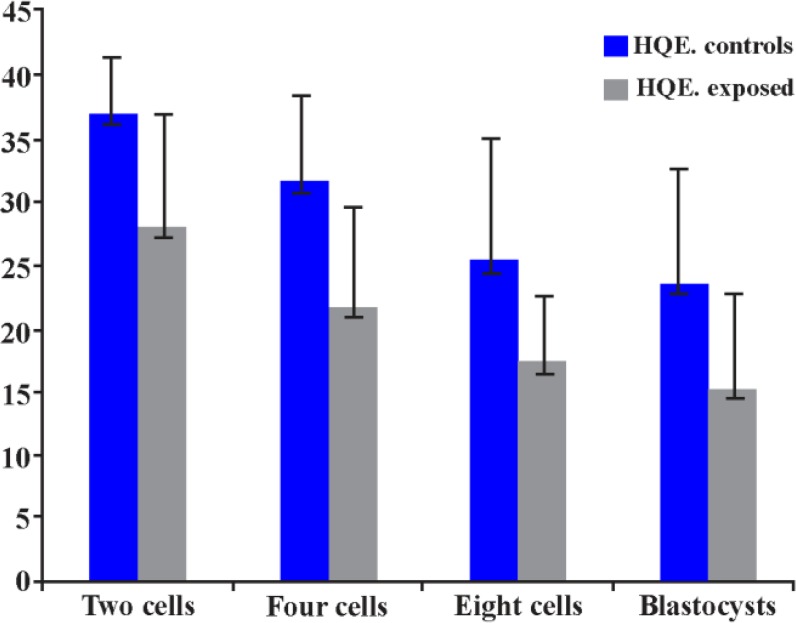
There were insignificant changes in the rate of embryo survival to the blastocyst stage in the experimental group after exposure to EMF emitted from cell phone, compared with control group ( Table 1). Analysis revealed that the percentage of necrotic embryos at the 2-cell stage was significantly higher in experimental group compared with controls (22.7% vs. 12.7%, respectively; p=0.03). In addition, there was insignificant change in the rate of embryo survival to the blastocyst stage in the experimental group (60.6%) after exposure to EMF emitted from cell phone, compared to controls (69.3%; p=0.1). Further analysis demonstrated that there were no differences between control and experimental groups in the percentages of high quality embryos ( Figure 1).
Table 1. Development of preimplantation embryos under exposure to EMF (900–1800 Hz)
| Embryos | Control group | Experimental group | P-value |
|---|---|---|---|
| Two cells (No.) | 150 | 150 | -- |
| Four cells (%) | 87.3 | 77.3 | 0.03 |
| Eight cells (%) | 70.6 | 67.3 | 0.6 |
| Blastocysts (%) | 69.0 | 60.6 | 0.1 |
The p-value between exposed and control samples was calculated using Student’s t-test for coupled data
The loss of cell viability was found by significant increase in the percentage of dead cells within experimental blastocysts (p=0.002, Figure 2). In general, it was found that EMF exposure caused changes in membrane permeability, late apoptotic, and early necrotic blastomeres. The data on early embryo development in two groups are presented in table 2.
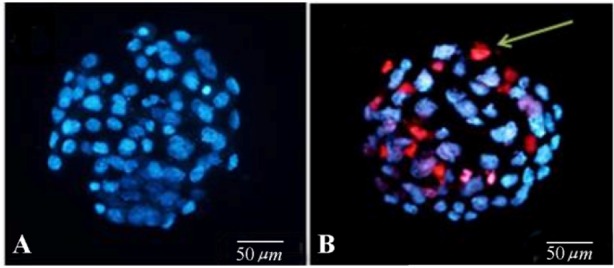
Table 2. Comparison of blastocysts live and dead cells counts in control and experimental groups
| Control | Experiment | P-value | |
|---|---|---|---|
| Live cell (M±SD) * | 52.51±21.95 | 40.36±16 | 0.005 |
| Dead cell (M±SD) | 2.38±2.12 | 3.58±2.39 | 0.019 |
| Median (Range) ** | 2(0–7) | 3(0–12) | |
| Viability rate (M±SD) | 94.81±5.89 | 90.56±7.82 | 0.002 |
| Median (Range) ** | 96.39(73–100) | 92.08(59–100) |
P-value according to independent samples t-test,
p-value according to Man-Whitney U test
This is the first study to specifically analyze the effects of exposure to 800–1900 MHz radiation from cell phone on the mouse preimplantation embryos. Since in IVF technology, the embryos are generated and cultured in in vitro condition, any environmental disruption, including EMF exposure may affect their survival and developmental abilities. However, EMF is a generic term and can be considered as radiation. These electromagnetic waves have periodically changed between positive and negative, and the speed or the number of changes per second, is called frequency with hertz as its unit. The concerns about risk of malformations from exposure to cell phone are increasing (10). Therefore, the consequences and effects of exposing the in vitro produced mouse embryos to a cell phone radiation (in talk mode) on subsequent embryo survival were assessed. The measurement of the RF energy absorbed to the person’s body during a call position is called SAR. Also, most phones have SAR range from 0.1 to 1.2 W/kg. The maximum SAR for the used cell phone in our study ranged from 0.683 to 0.725 W/kg.
Luo et al. (2006) evaluated the effects of extremely low frequency electromagnetic fields (ELFEMFs) exposure on mouse preimplantation embryos. Their results showed a significant delay in the cleavage rate of the exposed two and eight-cell compared to control embryos. They concluded that the delaying effects of EMFs are consistent with the DNA damaging effects of ELFEMFs on embryos (16). Then, subsequent DNA repair was noticed which was activated by cell-cycle checkpoints and this “time-out” response was called cell-cycle arrest (17, 18). Another study suggested that oxidative stress caused delay in the embryonic development (19). In addition, it was noticed that the majority of the embryos in EMF-exposed group died at the 2-cell stage compared with controls. Also, there were significant differences between control and experimental groups in embryos after exposure to EMF (p=0.03). Moreover, the survival of embryos to the blastocyst stage does not guarantee that the embryos are normal because, the most remarkable finding of this study was a progressive decrease of the live cells within exposed blastocysts compared with control group.
PI and Hoechst staining was applied in order to determine the viable cell numbers of blastocysts. However, this novel technique has a potency to enter into all cells but, the live cells with intact cell membrane appeared in blue and not permeable to PI, while dead cells appeared as red, because in the cells with altered cell membrane both PI and H33258 stain could enter the cells, staining the nuclear chromatin. The loss of cell viability observed by staining of Hoechst and PI is a plausible explanation in which EMF exposure caused changes in membrane permeability. Also, apoptosis is a physiologic process which could regulate the cell number of blastocysts, especially inner cell mass (ICM) which is formed during the blastocyst stage with elimination of injured cells. This phenomenon is seen among over 80% of in vivo produced mouse blastocysts that had one or more dead cells on days 4–5 of development (20). In this regard, Friedman et al. (2007) demonstrated that within minutes of exposure to radiation emitted from cell phone in mammalian cells, rapid production of reactive oxygen species (ROS) takes place which is mediated by activation of plasma membrane NADH oxidation (21). This may be attributed to an increase in the membrane permeability after EMF exposure. In fact, ROS are highly reactive molecules and damaging cell membranes and DNA (22).
However, Beraldi et al. were assessed a consequences of exposing the in vitro and in vivo produced murine embryos to extremely low-frequency electromagnetic fields (ELF-MF) on subsequent embryo survival rate and rate of embryo survival after exposure to ELF-MF was significantly decreased in vitro embryos that obtained by IVF compared with natural breeding group (p<0.01) (10). Conversely, in this study, there was insignificant change in the rate of embryo survival to the blastocyst stage in the experimental group (60.6%) compared to controls (69.3%; p=0.1).
In another study, Panagopoulos et al. showed that both types of radiation, GSM 900 MHz (Global System for Mobile telecommunications) or DCS 1800 MHz (Digital Cellular System) in Drosophila melanogaster induced cell death of ovarian egg chambers up to 55% compared to the control group. Although they could not extrapolate, the ovarian cell death could be due to apoptosis in response to the electromagnetic stress or necrosis by the electromagnetic radiation (23). Furthermore, it has been shown that subjecting the cells to environmental stress could be related to an increased synthesis of stress proteins including heat-shock proteins (Hsp), not obtained by heat only (24). In this regard, Weisbrot et al. (2003) examined the effects of a discontinuous mobile phone radiation (900/1900 MHz; SAR_1.4 W/kg) on reproduction and development in Drosophila. They reported that cell phone radiation increases levels of the Hsp70 and components of signal transduction pathways. Also, they showed both types of ELF and RF emitted from cell phone are capable of affecting the cell functions (25). These findings are similar to earlier studies, which suggested that an increase in Hsp70 as a result of RF field had progressive stimulatory effects on cell function, specifically the stimulation of cell (26–29). From these experiments, it can be concluded that the EMF can be considered as an environmental stress factor. In addition, Mezhevikina et al. showed that EMFs increase the resistance of embryos to undesirable environmental conditions and play stimulating role in the early development of embryos (30). On the contrary, Grigorev et al. investigated the influence of waves emitted by GSM phones on chicken embryos. They also confirmed an increase in mortality in the experimenttal group (31). On the other hand, our data showed that there were no differences between groups in the rates of embryo survival to the blastocyst stage. Furthermore, our results are in agreement with some studies that have revealed 50 Hz ELF-MF in in vitro condition does not directly perturb mouse embryo development to the blastocyst stage. However, some loss of cell viability was observed in exposed group compared with the control (32, 33). Since many factors could influence the outcome of experiments in EMF research, such as the exposure conditions, cell types, the frequency of mobile phone use, and duration period, so, there could be some inconsistency in the observations. Also, the average time of mobile phone use in a day as half an hour could be investigated for each individual. Since, digital telephones use frequencies between 1850 and 1990 MHz, mobile phone with radiofrequency radiation between 900–1800 MHz was used in this research. Our results imply a probable role of ROS in the adverse effects of EMF from a cell phone in subsequent embryo survival rates.
In conclusion, normal embryonic development up to the blastocysts indicates that EMF-exposure commonly did not have major adverse effects on the development of mouse preimplantation embryos, but it could increase the rates of dead cells in blastocysts. It was also found that EMF exposure caused loss of cell viability and changes in membrane permeability and apoptosis.
This study was supported by a grant from the Research and Clinical Center for Infertility, Shahid Sadoughi University of Medical Sciences, Yazd, Iran.
