
Spermatogenesis is influenced by several aspects, those including metabolic, genetic, environmental and physiological factors. Quantity or quality of sperm produced, or both can be influenced in this process (1). This is because many sperm are never produced because of cell death during meiosis, while many sperm released from the seminiferous tubules are abnormal. Evolutionary processes due to sperm competition in mammals and other species have resulted in increased daily spermatogenesis, greater epididymal sperm storage and more sperm in the ejaculate (2–4). Epididymal transit time of sperm has been estimated to range from 2 to 11 days (5). The variation is probably due to the rate of passage through the cauda which in turn can be influenced by ejaculatory frequency (6, 7).
Sexual abstinence, one of the several factors that influences semen parameters, is a clinical criteria included in the semen evaluation guidelines recommended by the World Health Organization (WHO) to provide maximum sperm quality (8). Traditionally, 2 to 7 days of sexual abstinence is recommended when evaluating semen parameters (8) as a strategy for interlaboratory homogenization of the results. Longer abstinence intervals reward men with poor sperm production, because sperm accumulate in the excurrent ducts for 7 days or more of sexual abstinence; and otherwise penalize men with good sperm production, because after 3 days or less of abstinence, their excurrent ducts are probably full (1). For normal ejaculates, when the male tract is unobstructed and the abstinence time short, the total number of spermatozoa in the ejaculate is correlated with testicular volume (9, 10). This can provide a measure of the capability of the testes to produce spermatozoa (11), as well as the patency of the male tract.
There is general agreement that semen volume and sperm concentration will increase with prolonged sexual abstinence, but simultaneously it can have a negative impact on motility, viability (12–14) and seminal plasma contribution (15). Recently, our group has reported that during a two week period of daily ejaculation, the sperm concentration or total count did not drop below the WHO reference values (16). During epididymal transit and storage, spermatozoa are greatly exposed to reactive oxygen species (ROS) (17). However, shorter abstinence period of one day was found to improve sperm quality by protecting from ROS damage (and higher seminal total antioxidant capacity), even though lower numbers of motile sperm were produced (18). A decrease in the levels of intracellular ROS in semen samples collected after only one day of abstinence was also demonstrated (16).
Sexual abstinence has also been associated with higher pregnancy rates forming a part of standard recommendation for couples in infertility treatments (12, 17, 19, 20). Short abstinence periods lead to reduction in the incidence of sperm DNA fragmentation and increase in pregnancy rates after assisted reproductive techniques (17, 21). This effect was marked after quick repetitive ejaculation with 3 hr of abstinence, and could be a strategy to improve the DNA quality for sperm selection in intra-cytoplasmic sperm injection (ICSI) (21). A second ejaculate within an hour after the first can yield a better sample quality (volume, count and motility) for assisted reproductive techniques in oligo-terato-asthenospermic men (22). In view of the paucity of currently available information on the semen quality of ejaculates after very short abstinence intervals, the effect of four repeated ejaculations was evaluated on the same day at two-hour interval each on conventional semen parameters according to WHO 2010 guidelines. Also, the functional sperm parameters such as intracellular ROS production, DNA fragmentation index (DFI), mitochondrial membrane potential (ΔΨm) and plasma membrane integrity were evaluated as well.
Ethical approval for this study was obtained from the Institutional Research Ethics Committee, and all men provided informed consent. This study used semen samples collected in August of 2014. Three healthy men (32±3.6 years) were recruited from men serving as quality controls for studies at the Reproduction Group at the Medical School of the University of Antioquia.
Exclusion criteria for study participation were any history of urogenital surgery, leukocytospermia (white blood cells >1×10⁶ cells/ml semen), and azoospermia. In addition, self-reported illnesses or use of medication in the three months immediately preceding the study were recorded.
Semen samples were produced by masturbation, collected into sterile sample containers and delivered to the laboratory within 30 min of ejaculation. For the first ejaculation, a 3–4 day period of sexual abstinence was required and all samples were classified as normozoospermic. Thereafter, three ejaculates from each participant at two-hour intervals on the same day were analyzed according to WHO 2010 guidelines (8) and functional parameters (23, 24). Concentration was determined using a Makler chamber (Sefi-Medical Instruments, Haifa) (25).
The intracellular sperm ROS (ROS: H2O2, HO−, and ONOO−) levels were evaluated by flow cytometry using 2′,7′-dichlorofluorescein diacetate (DCFH-DA; Sigma-Aldrich, St Louis, MO), a cell-permeable probe that is highly sensitive to cellular oxidation and fluoresces when oxidized to DCF. It is therefore useful for the detection of ROS and nitric oxide (NO) and for the determination of the degree of overall oxidative stress (16, 24). Propidium iodide (PI) (Molecular Probes Inc, The Netherlands) was used in conjunction with DCFH-DA as a vitality stain (final concentration 12 μM). DCFH-DA was diluted to a final concentration of 1 μM in Ham′s F12 medium containing 2×10⁶ spermatozoa in 300 μl. The cell suspensions were then incubated for 10 min at 37°C before being analyzed using a flow cytometer. Results are expressed as the mean fluorescence intensity (MFI) of live cells exhibiting a fluorescent response.
The Sperm Chromatin Structure Assay (SCSA) was used to measure the DFI, as previously described by Evenson et al. (26, 27), and further modified by us (24, 28–30). The sperm suspension (200 μl) was added to a cytometry tube containing 200 μl of acid detergent solution. After 30 s, the spermatozoa were stained with 600 μl of acridine orange staining solution to give a final concentration of 6 μg/ml. The ratio of single stranded (red) to single plus double stranded (green) fluorescence was expressed as %DFI.
ΔΨm was measured by flow cytometry using 3,3′-dihexyloxacar-bocyanine iodide (DIOC6; Molecular Probes Inc, The Netherlands) staining (16). DIOC6 is a cell-permeant, green-fluorescent cationic lipophilic dye that is selective for the mitochondria of live cells when used at low concentrations. PI was used as a vitality counter stain. Briefly, 2×10⁶ spermatozoa suspended in 300 μl of medium were incubated for 20 min at 37°C with DIOC6 (final concentration of 10 nM) and subsequently subjected to flow cytometry. Samples were scored as the percentage of cells in the population showing ΔΨm.
The integrity of the plasma membrane was assessed with the LIVE/DEAD® Sperm Viability Kit (Molecular Probes Inc, The Netherlands), as performed previously (16). Staining was carried out according to the manufacturer’s instructions. In brief, 300 μl of sperm suspension, containing 2×10⁶ spermatozoa was incubated with SYBR-14 and PI to final concentrations of 1 μM and 12 μM, respectively prior to flow cytometry analysis. Data are expressed as the percentage of viable sperm positive to SYBR-14 and negative to PI. All flow cytometry analyses reported in this study were conducted on an Epics XL flow cytometer (Becton Dickinson, CA, USA) with a 488 nm argon laser. Forward scatter and side scatter measurements were taken to generate a density plot, which was used to gate for sperm cells only. All data were acquired and analyzed using WinMDI 2.9 Software (Scripps Research Institute, La Jolla, CA) and a total of 10,000 events were collected per sample.
To compare the variables among time periods, Friedman test was used. Data were analyzed using Prism 5.0 (GraphPad Software, San Diego, CA) statistical software and a p-value of <0.05 was considered to be statistically significant. All data are expressed as median and range.
Table 1 shows that the conventional semen parameters corresponded to WHO 2010 minimum criteria at the first evaluation after 3–4 days of abstinence (volume: 1.4–1.7 ml, concentration: 12–16×106 sperm/ml, total sperm count: 33–46×106/ejaculate, total motility: 38–42%, progressive motility: 31–34%, vitality: 55–63%, and calculated total motile sperm count (TMSC): 6.38–11.42×10⁶), the values for the parameter of progressive motility being borderline (26.3±4.9%). At the second and third evaluations after 2 hr of abstinence each, these semen parameters were still in accordance with WHO 2010 minimum criteria except progressive motility whereas vitality value was borderline (Table 1). However, at the fourth evaluation after another 2 hr of abstinence, only the volume and concentration ranged within the WHO 2010 minimum criteria with total motility value as borderline, while total sperm count, progressive motility, vitality and TMSC were below the WHO recommended guidelines. Despite the small sample size, the statistical comparison of the conventional semen parameters at second, third and fourth evaluations after 2 hr of abstinence each with that of first evaluation after 3–4 days of abstinence revealed significant reduction (p<0.05) in the parameters of concentration, total sperm count and TMSC at fourth evaluation (Table 1). Overall, a decreasing trend was noted in the conventional semen parameters at second, third and fourth evaluations after two hours of abstinence in comparison to first evaluation after 3–4 days of abstinence (Figure 1).
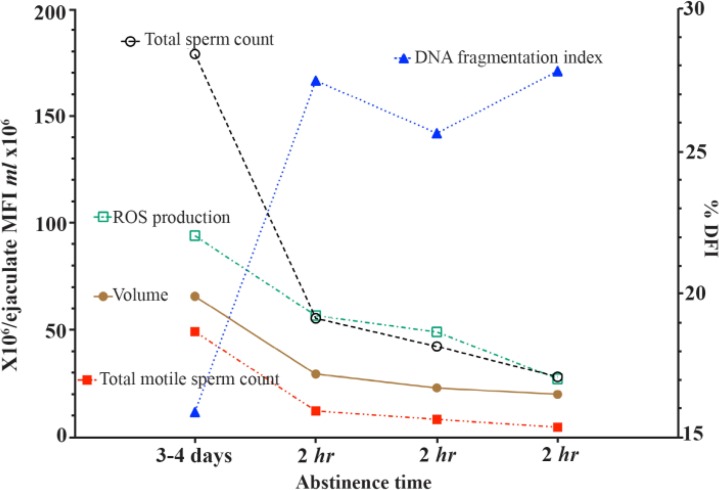
Table 1. Conventional semen parameters for four repeated ejaculations on the same day at two hour intervals (n=3)
| First evaluation (6 AM) | Second evaluation (8 AM) | Third evaluation (10 AM) | Fourth evaluation (12 noon) | |||||
|---|---|---|---|---|---|---|---|---|
| Abstinence time | 3–4 days | 2 hr | 2 hr | 2 hr | ||||
| Median (range) | M±SEM | Median (range) | M±SEM | Median (range) | M±SEM | Median (range) | M±SEM | |
| Volume (ml) | 2.4 (2.3–3.3) | 2.6±0.6 | 1.8 (1.7–2.3) | 1.9±0.3 | 1.9 (1.5–2.6) | 2±0.6 | 1.5 (1.0–2.3) | 1.6±0.7 |
| Concentration (106/ml) | 76 (42–79) | 65.7±20.6 | 23 (20–45) | 29.3±13.7 | 16 (15–38) | 23±13 | 17 (12–31) * | 20±9.8 |
| Total sperm count (×106/ejaculate) | 174.8 (100.8–260.7) | 178.8±80 | 46 (39.1–81) | 55.4±22.5 | 41.6 (28.5–57) | 42.4±14.3 | 27.6 (25.5–31) * | 28±2.8 |
| Total motility (%) | 38 (36–46) | 40±5.3 | 36 (35–44) | 38.3±4.9 | 41 (40–42) | 41±1 | 35 (34–40) | 36.3±3.2 |
| Progressive motility (%) | 24 (23–32) | 26.3±4.9 | 24 (17–24) | 21.7±4 | 20 (18–22) | 20±2 | 18 (15–18) | 17±1.7 |
| Vitality (%) | 61 (40–65) | 55.3±13.4 | 50 (42–60) | 50.7±9 | 55 (46–62) | 54.3±8 | 40 (40–45) | 41.7±2.9 |
| Total motile sperm count (×106) | 40.2 (24.2–83.4) | 49.3±30.6 | 9.4 (7.8–19.4) | 12.2±6.3 | 8.3 (6.3–10.3) | 8.2±2 | 4.6 (4.1–5.6) ** | 4.8±0.7 |
Significance differences with first evaluation at p<0.05;
Significance differences with first evaluation at p<0.01
The functional semen parameters for four repeated ejaculations on the same day at two hour intervals are presented in table 2. Statistical comparison of the functional semen parameters (intracellular ROS production, DFI, ΔΨm high spermatozoa and plasma membrane integrity) at second, third and fourth evaluations after 2 hr of abstinence each with that of first evaluation after 3–4 days of abstinence revealed significant reduction (p<0.05) only in the parameter of intracellular ROS production at fourth evaluation (Table 2). With each subsequent evaluation after the first one, a decreasing trend was noted in the parameter of ROS production and an increasing trend was found in the parameter of DFI, whereas ΔΨm high spermatozoa and the integrity of the plasma membrane remained stable throughout the evaluations. DFI remained within acceptable levels (<29%) (Figure 1).
Table 2. Functional semen parameters for four repeated ejaculations on the same day at two-hour intervals (n=3)
| First evaluation (6 AM) | Second evaluation (8 AM) | Third evaluation (10 AM) | Fourth evaluation (12 noon) | |||||
|---|---|---|---|---|---|---|---|---|
| Median (range) | M±SEM | Median (range) | M±SEM | Median (range) | M±SEM | Median (range) | M±SEM | |
| ROS production, MFI | 99.2 (81–101.7) | 94±11.3 | 40.7 (34.1–95.1) | 56.6±33.5 | 36.1 (19–92.1) | 49.1±38.2 | 26.9 (26.7–27.9) * | 27.2±0.6 |
| DNA fragmentation index (%) | 43.5 (34.3–52.5) | 15.9±7 | 51.5 (16.9–53.2) | 27.5±2.8 | 34 (29.8–37.8) | 25.6±9.8 | 16.6 (10.4–33–3) | 27.8±3.6 |
| ΔΨmhigh spermatozoa (%) | 13.46 (10.3–23.8) | 27±13.9 | 27.5 (24.7–30.3) | 26.4±20.6 | 28.9 (14.6–33.4) | 26.3±2.8 | 29.13 (23.7–30.6) | 21.9±14 |
| Plasma membrane integrity (%) | 51.2 (39.7–55.7) | 53±16.4 | 53.4 (43.5–58.4) | 46.7±6.5 | 50.2 (42.2–51.7) | 56.2±13 | 40.9 (35.3–41.5) | 39.4±3.5 |
Significance differences with first evaluation at p<0.05, MFI: Mean Fluorescence Intensity
In the present study, a decreasing trend was noted in the conventional semen parameters at second, third and fourth evaluations after two hours of abstinence in comparison to first evaluation after 3–4 days of abstinence. Given the limitation of small sample size, significant reductions (p<0.05) were noted only in the parameters of concentration, total sperm count and TMSC at fourth evaluation after 2 hr of abstinence in comparison to that of first evaluation after 3–4 days of abstinence. Previous study on ejaculation after 1 hr of abstinence reported lower volume and progressive motility, comparable total motility, and higher sperm density in oligospermic men (31). On the other hand, Gulmez et al. reported reduced semen volume and enhanced total motility in the ejaculate after 1 hr of abstinence, without any change in sperm density (32). Improved semen quality was also suggested by another group after a short-interval second ejaculation (33). Also, in men with severe oligoasthenoteratozoospermia (OAT), a second ejaculate after 1 hr of abstinence could improve the sperm concentration and motility (22). Another study showed that a second ejaculate obtained two hours after the first one had significantly higher TMSC in comparison to the first ejaculate although there was no difference in pregnancy rate after insemination (19). In our study with four repeated ejaculations on the same day at two-hour intervals, the values of most of the conventional semen parameters did not drop below the WHO 2010 minimum criteria until the third evaluation.
The results about the relation between abstinence and DNA fragmentation are controversial (16). In the present study, an increasing trend was noted for DFI with each subsequent evaluation after the first one although it remained within acceptable levels (<29%) at all the evaluations (27). Similar to our data, De Jonge reported that frequent ejaculation increased the percentage of sperm with immature chromatin within one day of ejaculatory abstinence (12). These findings can be supported by the observations of Kucuk et al. who reported an increase in the number of sperm but not the pregnancy rate after insemination with the second sample obtained after 2 hr of ejaculatory abstinence (19). In contrast, Gosalvez et al. demonstrated reduced sperm DNA fragmentation after short-term recurrent ejaculation (21). These differences can be attributed to the variability in the sample size used in respective studies.
There is general agreement that semen volume and sperm concentration will increase with prolonged sexual abstinence, but simultaneously it can have a negative impact on motility, viability (12–14) and seminal plasma contribution (15). Our group has recently reported that during a two week period of daily ejaculation, the concentration or total sperm count did not drop below the WHO reference values (16). With each subsequent evaluation after the first one, a decreasing trend was noted in the functional parameter of ROS production, the difference being significant (p<0.05) at fourth evaluation after 2 hr of abstinence in comparison to that of first evaluation after 3–4 days of abstinence. This is in accordance with our recent findings of decreased levels of intracellular ROS in semen samples collected after one day of abstinence. Notably, in the current study, two hours abstinence time with four repeated ejaculations on the same day was used. Such reduction in intracellular ROS production can be ascribed to the fact that those spermatozoa spent really short time in the epididymis and that their intracellular antioxidants had not been depleted. During epididymal transit and storage, spermatozoa are greatly exposed to ROS (17). Marsburn et al. also showed that shorter abstinence period of one day could improve sperm quality by protecting from ROS damage, even though lower numbers of motile sperm were produced (18).
In order to synthesize ATP, mitochondria continuously oxidize substrates and maintain a proton gradient across the lipid bilayer in the respiratory electron transport chain with a large ΔΨm. ΔΨm of mitochondria is an essential indicator for assessing the physiology, viability, and fertilization potential of a sperm, the germ cell of males (34–36). As the mitochondria provide energy for sperm movement, abnormal ΔΨm of sperm mitochondria may lead to mitochondria dysfunction and result in male infertility (37). For successful fertilization, a functionally constituted sperm plasma membrane is necessary, which is clearly dependent on the sperm maturation process (38). Results of this study also demonstrated that ΔΨm high spermatozoa and plasma membrane integrity values remained stable throughout the repeated ejaculations on the same day at two-hour intervals.
Potential clinical use of repeated ejaculations at shorter abstinence times in assisted reproduction has not been adequately explored. The present study for the first time demonstrates the conventional as well as functional semen parameters for four repeated ejaculations on the same day at two-hour intervals. Majority of conventional semen parameters did not drop below the WHO 2010 minimum criteria until the third evaluation, while the functional parameter of intracellular ROS production showed a decreasing trend with each subsequent evaluation. Even though an increasing trend was found in the parameter of DFI, it remained within acceptable levels (<29%). The ΔΨm high spermatozoa and the integrity of the plasma membrane remained stable throughout the evaluations, too. The findings of the present study indicate the potential use of additional semen samples with repeated ejaculations at short abstinence times in assisted reproduction procedures particularly from severe oligospermic men.
This study was supported by the grant of Estrategia de Sostenibilidad of the University of Antioquia. The stay of Dr. Shubhadeep Roychoudhury in Cleveland Clinic was supported by the Department of Biotechnology, Government of India.
