
Robertsonian translocations are structural chromosomal abnormalities caused by fusion of two acrocentric chromosomes. It has been estimated that 1/1000 healthy persons carry a Robertsonian translocation. Notably, there is an increased risk of infertility, spontaneous abortions, or chromosomally unbalanced offspring for carriers of Robertsonian translocation (1). t(13;14) and t(14;21) have been shown to be the most frequent Robertsonian translocations (2). Balanced translocations impede the normal chromosome pairing and segregation at meiosis phase I, leading to the formation of unbalanced gametes, consequently causing unbalanced abnormal children (2). In carriers of such translocations, different modes of segregations are expected at the end of meiosis I for the translocated and nontranslocated chromosomes which would result in the formation of either balanced (alternate segregation mode) or unbalanced (adjacent 1, adjacent 2, and 3:1 segregation modes) gametes. Only products of alternate segregation have normal/balanced karyotype (3). Although semen analyses in carriers of Robertsonian translocations have demonstrated that 76–89% of spermatozoa were normal or balanced, polar body analysis on der(13q;14q) and der(14q; 21q) carriers showed unbalanced forms in about 33% and 42%, respectively (4). Consequently, there are increased risks for miscarriage (27.6±4% for female carriers and 19.7±4.7 for male carriers) as well as stillbirths (3.3%±1.6% for female carriers and 1.4±1.4% for male carriers) (5). Furthermore, carriers of Robertsonian translocations are at increased risk of imprinting disorders in their offspring (4). Until now, there are few reports showing homozygosity for Robertsonian translocations which are summarized in table 1. Based on scarcity of such situation, no relevant statistical analyses have been performed. In homozygote carriers of Robertsonian translocations, all gametes are expected to carry a Robertsonian translocation leading to formation of offspring which are heterozygous for the translocation.
Table 1. Known cases of double Robertsonian translocations
| Case | Phenotype | Karyotype | Reference |
|---|---|---|---|
| 1 | Normal, a history of one spontaneous miscarriage and mother of phenotypically normal heterozygote | 44, XX, der (13;14)x2 | (6) |
| 2 | Normal | 44, XY, der(13;14)x2 | (6) |
| 3 | Normal | 44, XY, der(13;14)x2 | (6) |
| 4 | Normal, mother of six phenotypically normal heterozygotes | (7) | |
| 5 | Normal | 44, XX, der(13;14)x2 | (8) |
| 6 | Not known | 44, XY, der(13;14)x2 | (9) |
| 7 | Normal, a history of 3 second-trimester intrauterine fetal deaths (IUFDs) with multiple congenital anomalies in his spouse | 44, XY, der(13;14)(q10;q10)x2 | (2) |
| 8 | Normal phenotype at 18 weeks of gestation (the pregnancy was terminated electively) | 44, XX, der(14;21)(p11, q11)x2 | (10) |
| 9 | Normal | 44, XX, der(14;21)x2 | (10) |
| 10 | Down syndrome | 45, XY, der (14;21)x2+21mat | (11) |
| 11 | Normal | 44, XY, der (14;22)x2 | (12) |
| 12 | Normal, a history of infant death at 6 months (unknown cause) | 44, XY, der(14;15)(q10;q10)x2 | (13) |
| 13 | Normal, mother of two phenotypically normal heterozygotes | 44, XX, der(14;21) der(14;22) | (14) |
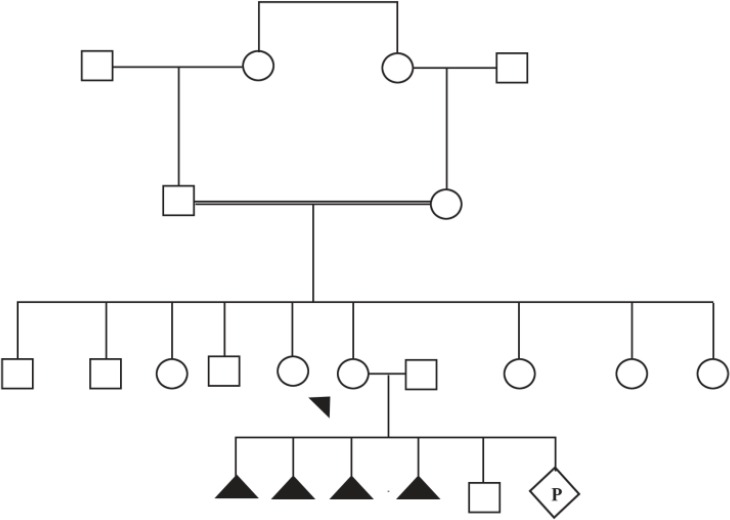
The probands are a phenotypically normal consanguineous couple who were referred to Center for Comprehensive Genetics Services in summer 2015 because of their history of 4 consecutive first trimester fetal loss. Both probands were in good health. The female proband was born to a consanguineous parent (Figure 1). At the time of referral, they had no living children. In past medical history, there was no evidence of drug or alcohol abuse or radiation or chemical exposure. No pregnancy losses were reported in relatives of probands. Afterwards, she experienced two consecutive pregnancies, one continued until term with a phenotypically normal male and the other was in 26 gestational weeks with normal first trimester screening results. No invasive prenatal test was performed because of the proband reluctance.
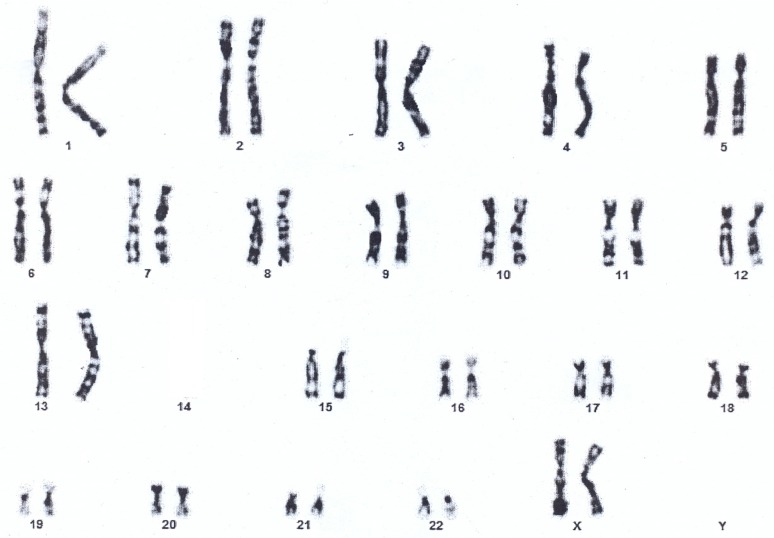
Chromosomal analysis was performed after 72 hr phytohemagglutinin (PHA) stimulation of peripheral blood lymphocytes culture based on standard methods. For each proband, 30 metaphases were counted and 5 metaphases were analyzed and karyograms were prepared using the Cytovision computer-assisted karyotyping system version 4.1 (Applied Imaging, NewCastle Upon Tyne, UK). The chromosomal abnormalities were described based on the International System for Human Cytogenetic Nomenclature (ISCN; 2013) (15). GTG banding of wife’s cells showed the presence of a double Robertsonian translocation involving the long arms of chromosome 13 and 14 (44, XX, der(13;14)(q10; q10)x2) in all analyzed metaphases. A metaphase for the wife is shown in figure 2. The husband had a normal male karyotype. The karyotype of infant was 45, XY, der (13;14)(q10;q10). Afterwards, to ascertain the origin of double Robertsonian translocations in the proband, cytogenetic analyses have been performed in her parents which showed 45, XY, der (13q;14q) and 45, XX, der(13q;14q), respectively.
A homozygote carrier of a Robertsonian translocation (13q;14q) was reported in this paper who was phenotypically normal. Previously, there were at least 12 reported cases with 2 translocations involving the same acrocentric chromosomes with most of them being phenotypically normal. In addition, most of these cases were shown to be caused by inbreeding within a family that carries a familial translocation, and were discovered following detection of an existing familial rearrangement rather than any specific characteristic for the homozygosity (16). Similar to these reports, our proband was born to consanguineous parents both being carriers of a Robertsonian translocation though no adverse pregnancy outcome was reported in the parents (Figure 1). This is in contrast to previous reports showing the increased risk for miscarriage and stillbirth in carriers of Robertsonian translocations. In some reported cases, only one parent is heterozygous, with the second rearrangement arising de novo (10). As inferred from table 1, although there were histories of spontaneous abortion or intrauterine fetal deaths (IUFDs) in some cases, there were three cases (case 1, 4 and 12) that had given birth to phenotypically normal children albeit heterozygous for the corresponding Robertsonian translocation. As there are few cases of homozygote Robertsonian translocations, it is not possible to make a statically relevant deduction about the pregnancy outcome of such persons. However, previous studies in carriers of one der(13;14)(q10; q10) have shown that detected miscarriage frequency of female carriers is about 27%. In addition, the frequency of stillbirths was 3.3±1.6% for female carriers and 1.4±1.4% for male carriers. However, the risk for the live birth of children with translocation trisomy 13 has been shown to be low in these patients (5). In addition, another study has indicated an increased risk for chromosomal imbalance in pregnancies of Robertsonian translocation carriers, so it has been suggested that the preimplantation genetic diagnosis (PGD) option should be explained for the couples (1). However, another study has indicated the presence of insufficient data regarding the PGD role in improvements of the live birth rate in carriers of structural chromosome abnormalities (17). However, according to the presence of imprinted genes on chromosomes 14 and 15, Robertsonian translocations involving these chromosomes are expected to have a relatively higher likelihood of resulting in uniparental disomy (UPD). Consequently, it is recommended to offer UPD analysis to couples in the prenatal diagnosis of Robertsonian translocations. UPD for chromosomes 13, 21 and 22 have no unfavorable clinical effect as these chromosomes are not subject to imprinting (4).
The results obtained from the present case were in concordance with those of previous reported cases in the literature that were healthy individuals with 44 chromosomes. Consequently, it is of practical significance in genetic counseling and particularly in prenatal diagnosis in which prediction of phenotypic consequences of a structural rearrangement plays an important role in decision making. However, the increased risk for imprinting disorders should be considered.
Furthermore, as presented above, consanguineous marriages within families that carry familial translocations can result in formation of homozygotes for Robertsonian translocations. These persons usually experience adverse pregnancy outcomes such as miscarriages (despite their normal phenotype). So this fact should be considered and clarified in preconception genetic counseling of consanguineous couples in addition to the established increased risk of autosomal recessive disorders.
