
Brachydactyly is a rare condition with a prevalence of 2% (1). It is commonly seen in patients with Albright’s hereditary osteodystrophy (AHO) which is a constellation of physical features that include short adult stature, obesity, brachydactyly, and ectopic ossifications. AHO patients who have normal end-organ responses to parathyroid hormone (PTH) constitute the rare disorder pseudopseudohypoparathyroidism (PPHP). A short fourth metacarpal is seen in approximately 65% of such patients (2). This is distinct from pseudopseudohypoparathyroidism (PPHP) which presents with hypocalcemia, hyperphosphatemia, and high levels of parathyroid hormone (PTH). It is associated with a possible resistance toward several hormones such as Thyroid stimulating hormone (TSH), Luteinizing hormone (LH), Follicle stimulating hormone (FSH), Growth hormone releasing hormone (GHRH) that mediate their action through the G-protein-coupled receptors (3).
An eighteen-year old female with height of 138 cm and weight of 66 kg was referred to the endocrine department of a multispecialty hospital of eastern India, in mid 2015. She reported menarche at eighteen years of age and a lack of menses thereafter. However, the reported menarche was actually an episode of induced bleeding due to an unknown medication provided by a local doctor.
Born to nonconsanguineous parents, the patient was an unmarried college student who reported to be apparently healthy with no significant past history. There was no complaint of symptoms such as cramping, tetany, twitching, or seizure. There was no history of thyroid or other surgery, radiation or any systemic illness.
Her blood pressure was 100/60 mmHg, temperature 37°C, pulse rate 78 min and respiratory rate 20 min. Physical examination revealed breast bud formation with a small area of surrounding glandular tissue and areola beginning to widen. There was lack of secondary sexual characters. The fourth and fifth metacarpals on both sides were short with the knuckles being depressed in the clenched fist position (Figure 1). The fourth metatarsal bone on the left was short. However, hand and feet movements were normal. The deep tendon reflexes and flexor plantar reflexes were normal. Chvostek’s sign, Trousseau’s sign, and signs of neuromuscular irritability were negative.
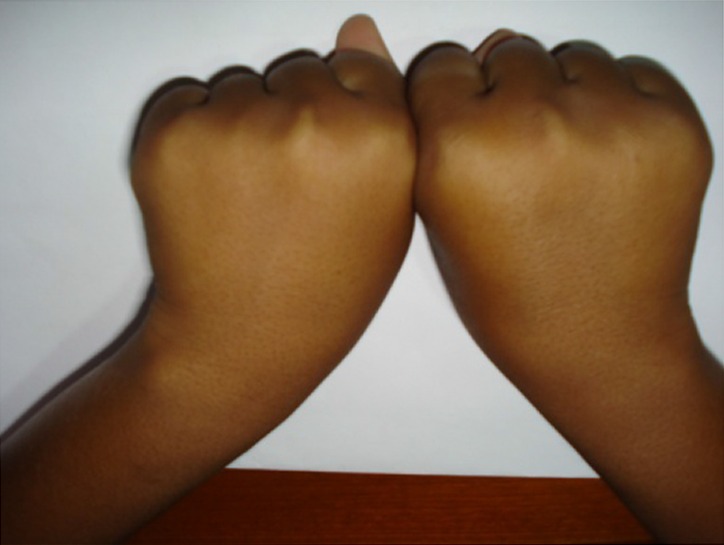
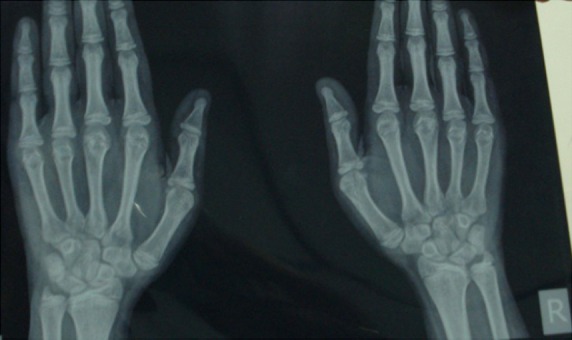
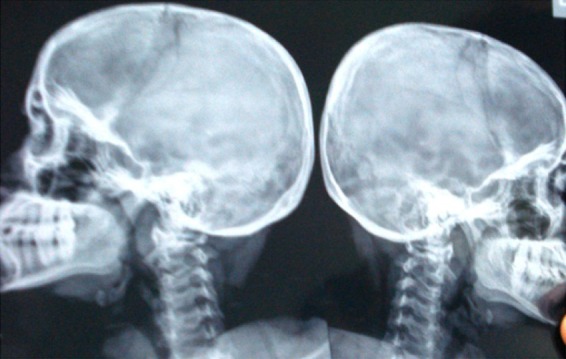
When a family history was sought, the patient revealed she felt that her grandmother had the same general physical features of short height, round face, thick neck and particularly the appearance of her hands and feet. Radiography of both hands showed shortened fourth and fifth metacarpals (Figure 2). X Ray of the skull (Figure 3) revealed normal appearance of the pituitary fossa.
Reports from tests done six months back in an outside laboratory revealed LH 0.8 mIU/ml (1.5–8), FSH 2 mIU/ml (3–12), prolactin 4.1 ng/ml (5–35), and dehydroepiandrosterone sulphate (DHEAS) 0.79 μg/dl (25.9–460.2). At presentation to our hospital, laboratory investigations were repeated. The fasting plasma glucose, serum calcium, phosphorus and alkaline phosphatase, blood urea, blood creatinine, serum 25 hydroxy vitamin D, serum magnesium, 24 hr urinary calcium, parathormone (PTH), TSH, growth hormone (GH), insulin- like growth factor 1 (IGF-1) levels and erythrocyte sedimentation rate (ESR) were within the reference ranges. Serum cortisol level at 8 A.M was 402.3 nmol/l (>300), estradiol <9 pg/ml (18–575), and FSH 1.63 mIU/ml (3–12). Chromosomal karyotyping revealed normal female karyotype (46XX) with no numerical or structural chromosomal anomalies at 450–550 banding resolution. Due to financial constraints of the patient, MRI of the hypophysis, though advised, could not be done. Molecular genetic testing done at another laboratory outside the hospital identified a mutation in the GNAS gene.
This case has the classic findings of Albright’s facies with short fourth metacarpals and metatarsals, normal serum calcium, phosphate and PTH levels diagnostic of pseudopseudohypoparathyroidism with an added unusual feature of hypogonadism.
Archibald et al. (4) described the metacarpal sign (shortening of the fourth and fifth digits, presenting as dimpling over the knuckles of a clenched fist) as a diagnostic marker of gonadal dysgenesis. In males, this metacarpal sign occurs much more frequently in the presence of some gonadal anomaly than when the gonads are normal. Patients showing the metacarpal sign usually have delayed skeletal development, reflected as short height and short fourth and fifth metacarpals. This deformity is seen more often in females and is hereditary in nature (5).
Short fourth and fifth metacarpals and metatarsals are seen in pseudo-pseudohypoparathyroidism, gonadal dysgenesis (Turner’s syndrome/chromosomal disorder 45XO), pseudohypoparathyroidism and familial brachydactylism, with hypogonadism being associated with the first two conditions (6). Normal female karyotype obtained in our patient excluded the diagnosis of Turner’s syndrome. Brachydactyly occurs due to premature closure of the epiphyses of the metacarpal bones. It has also been reported in idiopathic primary hypoparathyroidism (7). Trauma is the most common cause of this deformity but other causes include neurofibromatosis, congenital adrenal hyperplasia due to 11 beta hydroxylase deficiency, (5) familial short stature, hereditary multiple exostoses, patients with homocystinuria and other less common syndromes (8).
An alteration in the coding sequence of the GNAS gene leads to a haplo-insufficiency and a dysmorphic phenotype referred to as Albright’s syndrome or Albright’s hereditary osteodystrophy (AHO). It is a clinical syndrome defined by specific physical features that include short stature, obesity, round-shaped face, subcutaneous ossifications and brachytherapy mainly of the fourth and fifth metacarpals. Patients with mutations on their maternally derived allele are likely to have associated PHPIa, whereas mutations on the paternal allele usually cause PPHP. Isolated PTH resistance (PHPIb) can result from mutations within the GNAS1 gene but is more commonly caused by epigenetic imprinting abnormalities affecting the upstream exon 1A (9). In PHP, there is a hormonal resistance to PTH at the kidney level and to TSH at the thyroid level while in PPHP, there are few clinical signs with no hormonal resistance (10). However, according to a recent publication, PTH and other hormone resistance may be seen in both disorders (11).
The characteristic physical features of short stature, round face, brachydactyly of the fourth and fifth metacarpals and the biochemical findings of normal serum calcium, phosphorus and parathyroid hormone concentrations along with a very low level of gonadotropin hormones led us to the diagnosis of Albright’s syndrome in this patient who presented to us with primary amenorrhea and hypogonadism.
The authors would like to thank Dr Natasha Das of PFC Pharma Focus for assistance in editing the document.
