
The critical functions of the ovary are the regular release of mature oocytes and creating an optimal environment for both fertilization and early implantation. In order to provide a mature oocyte at regular intervals throughout an animal’s sexual lifetime, the development and the transition of each primordial follicle to a mature ovulatory oocyte is a finely controlled process (1, 2). In the human, the ovary needs to be able to selectively develop one primordial follicle without the neighboring follicles developing. The dormant primordial follicles (unselected) are critical to maintaining the follicular pool for future ovulation (3, 4). This process is poorly understood with numerous factors implied but still no satisfactory mechanism proposed. However, the latter stages of folliculogenesis (post-antral) are well understood and are primarily controlled by the gonadotropins; follicle stimulating hormone (FSH) and luteinizing hormone (LH) with FSH being responsible for the development of an antral follicle to a Graafian follicle and the LH surge causing follicular rupture and release of the oocyte for fertilization (5–7). Despite the hormonal control of follicle development being well understood, the pre-antral development still has many complexities which remain unresolved particularly the recruitment and selection of primordial follicles to progress to maturity (8). Two observations suggest a circadian cellular clock made be implicated in this development. Firstly in animals, the photoperiod or the light: dark cycle directly effects the timing and efficiency of ovulation. Hamsters have been shown to vary the timing of ovulation dependent on the ratio of light: dark, with the exposure to constant light disrupting regularity in ovulation (9). Furthermore, rats cease ovulation after 60 days of constant light and ovulation is lost along with a decrease in LH (10). In addition to animal studies, there is substantial evidence that disruption of the cellular clocks in humans also perturbs reproductive cycles including ovulation (11). Secondly, two proteins involved in the cellular clock (CLOCK and PER-1) have been identified in both the testis and ovaries, however, they differ in their expression between these organs. The testis, which can continually produce gametes, shows a lack of oscillation of these proteins, which is normally considered critical to the function of the cellular clock (12), whereas the ovary has an oscillating cellular clock as demonstrated by mRNA studies (13, 14).
The cellular clock has been identified in the majority of mammalian peripheral tissues after the original discovery in the suprachiasmatic nucleus (SCN). The core of the cellular clock is established by a transcriptional/translational feedback loop set up by the oscillation of clock genes and their respective proteins (15). The positive arm and the negative arm are diurnally expressed with the peaks of their expression approximately 12 hr out of synchronization (16). The mechanism is dependent on the control over the formation of the heterodimer BMAL1: CLOCK (17, 18), through a basic helix-loop-helix (bHLH) domain. The heterodimer is able to bind to the E-box regulatory element where it recruits the cellular machinery involved in the transcriptional up regulation of downstream genes (19). The E-box promoted genes can be separated into two classes; genes involved in the negative regulation of the cellular clock (PER1-3 and CRY1-2) and genes that have physiological function (clock output genes). The negative clock genes are translated and form a protein complex (CRY: PER) which is able to translocate into the nucleus where it inhibits the promotion of E-box transcription via BMAL1: CLOCK, thus ultimately reducing their Per and Cry transcription and completing the cellular clock. A critical feature of a circadian clock is that it can function autonomously, without external input. However, it can be modified or entrained to the local cellular environment (20), thereby providing a model mechanism where the cellular clock is able to control cellular activities including metabolic homeostasis, cell cycle control and hormone oscillations by altering the transcription of the clock output genes.
Although previous work has focused on cellular clock mRNA expression, it is established that mRNA expression may not predict the cellular protein level for a number of proteins and should not be used as a surrogate to demonstrate the corresponding cellular protein expression and alternative techniques such as immunohistochemistry should be used to provide definitive identification and localization of the tissue specific protein (21). In this study, immunohistochemistry was used to investigate cellular clock protein expression and it was demonstrated that the mouse estrous ovary expresses all six of the core cellular clock proteins and that they are responsive to the light:dark cycle.
All mice used were sexually mature female C57BL/6J, 6 to 10 weeks old and were maintained in the University of Otago Animal Facility. Mice were provided food and water ab libitum and maintained on a 12:12 hour light dark cycle (Lights onset at 0700/zeitgeber time (ZT) 0). Tissues were obtained at two different chronological time points, (ZT2/0900 and ZT18/0100 [midpoint of the dark cycle]), and within each time point estrous was determined representing hormone responsive ovaries at ovulation. In addition to ovaries, kidney and liver were obtained as control tissues, which demonstrate circadian clock protein expression.
Animal procedures were under the approval of the University of Otago Animal Welfare Office [AEC: 39/08].
For estrous staging, vaginal smears were obtained and stained with 1% methylene blue for 10 min (22). Cell type and frequency were assessed where no/low epithelial cells suggested metestrous and high epithelial cell numbers, indicating mice in estrous. Estrous was determined for mice at 09:00 hr and 01:00 hr. A total of 50 mice were scored as being in estrous with 40 mice in estrous during the day and 10:00 at night.
The ovaries were fixed in buffered formal saline and processed for histology. Serial sections were cut from each ovary and tissue sections were deparafinized in xylene and progressively rehydrated through graded alcohols and a final water wash. Heat antigen retrieval was performed in citrate buffer pH=6.0 for 25 min in a KOS multifunctional microwave tissue processor (Milestone, Italy). Endogenous peroxidase activity was blocked with 3% hydrogen peroxide and non-specific binding was blocked using 3% bovine serum albumin (Invitrogen Life Sciences, USA). Tissues were incubated with each of the six clock protein primary antibodies (AbCam, UK) using optimized dilutions as shown in table 1. Following primary antibody incubation and washes, the sections were incubated with an anti-rabbit secondary antibody conjugated to biotin (AbCam, UK). Vectorstain ABC elite kits (Vector Laboratories, USA) were then used to visualize the bound primary antibody. Binding was located using commercial 3,3′-diaminobezidine hydrochloride (DAKO, Australia) and the sections were then washed and counterstained with haematoxylin, dehydrated through graded alcohols and cleared in xylene before mounting in Entellan (Merk Chemicals, Germany).
Table 1. Primary clock related optimized antibody dilutions and incubation times
| Antibody | Dilution factor | Concentration (μg/ml) | Incubation period |
|---|---|---|---|
| CLOCK | 1.1000 | 1.0 | 1 hr at RT |
| BMAL1 | 1.200 | 5 | ON at 4°C |
| CRY1 | 1.1000 | 1 | ON at 4°C |
| CRY2 | 1.100 | 2.5 | ON at 4°C |
| PER1 | 1.500 | 2 | 1 hr at RT |
| PER2 | 1.500 | 1.1 | 1 hr at RT |
| SIRT1 | 1.2000 | 0.55 | 1 hr at RT |
RT: Room Temperature; ON: Overnight
All sections were examined microscopically by two observers and imaging data stored for analysis using an Olympus 1X71 microscope and DP control imaging system (Shinjuku, Japan). Scoring for staining location and intensity was undertaken using Allred scoring protocol (23, 24), which combines the cellular staining intensity with nuclear localization. Sections were imaged and given a score out of eight, which is derived from a staining intensity score (0–3) and a nuclear positivity score (0–5). Staining intensity included 0=negative, 1=weak, 2=moderate, and 3= intense stain. Nuclear positivity was scored by a cell count where 0%=0, 1–9%=1+, 10–32%=2+, 33–65%=3+, 66–90%=4+, 90–100%=5+. For follicles large enough, a minimum of 100 cells per follicle were counted across a minimum of 10 objective fields to ensure a representative observation and when possible 20 follicles were counted for each stage.
Allred scores are presented as the mean ±S.E.M. Statistical differences were determined by Mann-Whitney tests. Differences were considered significant at p<0.05 or less (SPSS Inc, Chicago, IL, USA).
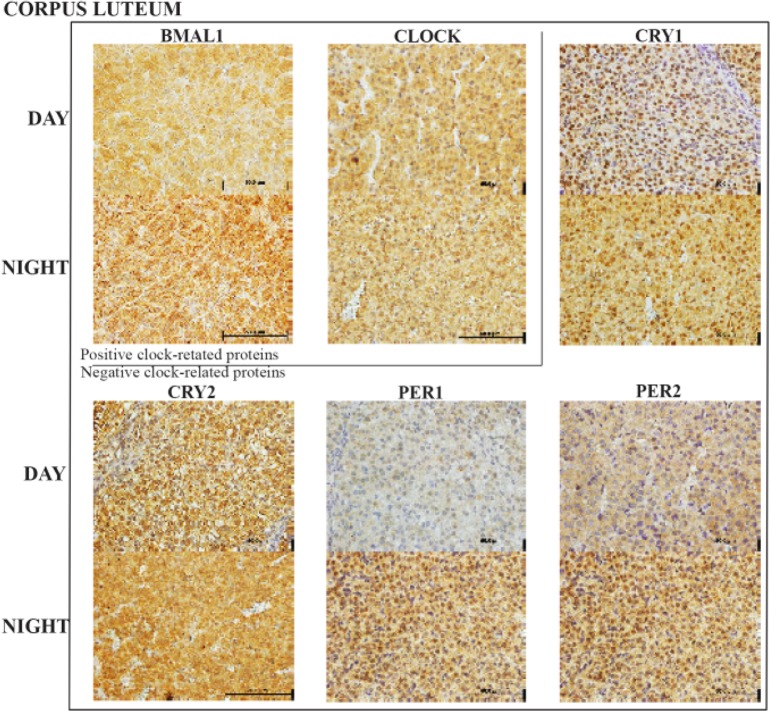
Mean Allred positivity scores (±SEM) for each respective clock protein are shown in figure 1. For each of the four follicle stages assessed, all presented with greater BMAL1 and CLOCK protein scores in the day (09:00 hr) ovarian sections. Conversely, the four negative arm clock proteins (CRY1-2 and PER 1-2) were up regulated in the night ovarian sections (01:00 hr). Of the four negative clock proteins, only CRY1 had a statistically significant difference with time for all follicle stages (primordial follicles, p<0.05; primary follicles, p<0.001; antral follicles, p<0.001; corpus lutea, p<0.05).
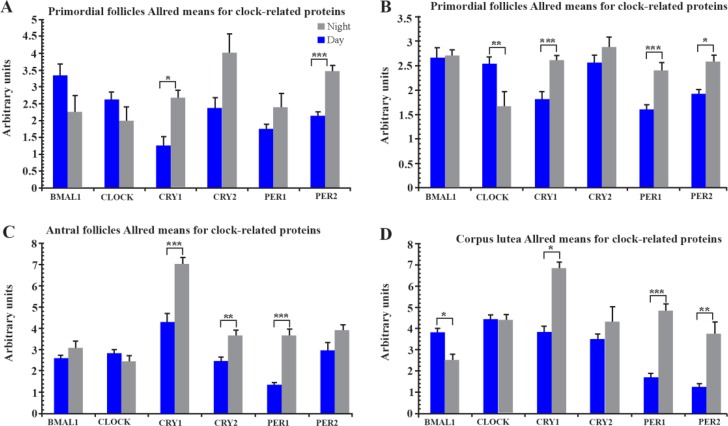
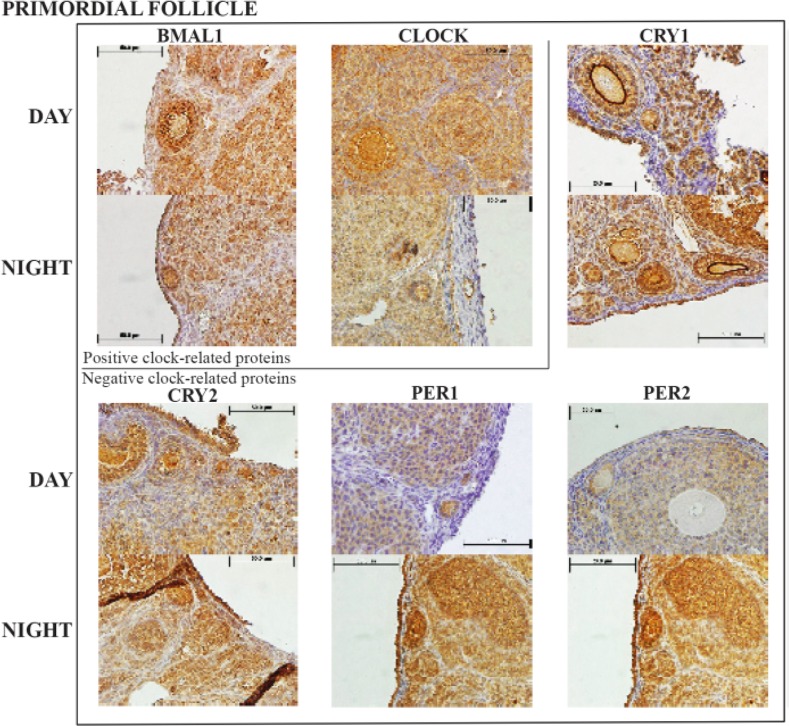
All sections for primordial follicle staining (Figure 1A and figure 2) exhibited a light:dark response with greater BMAL1 and CLOCK expression during the day. However, although BAML1 demonstrated a significant decrease at night (p<0.05), CLOCK demonstrated little variation between day and night. CRY-1 and PER-1 and 2 demonstrated highly significant increases (p<0.001) at night but CRY-2 did not increase.
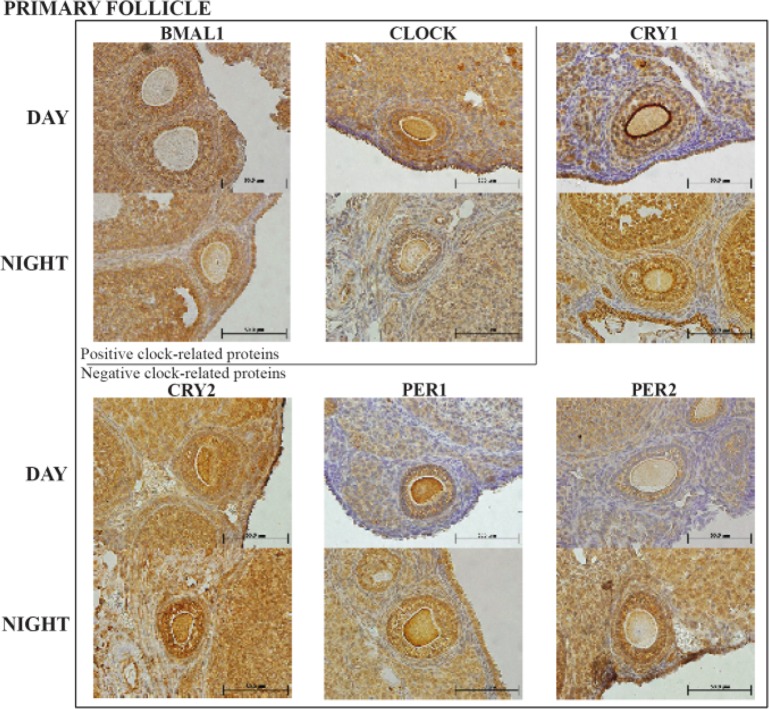
All sections for primary follicle staining (Figure 1B and figure 3) exhibited a light dark response similar to that identified in the primordial follicles for both BMAL1 and CLOCK in daytime. However, BAML1 did not decrease at night whereas CLOCK decreased at night in a similar response identified in primordial follicles. Three of the four negative arm clock proteins, CRY-1, PER-1 and 2, demonstrated highly significant increases at night (p<0.001) with only CRY-2 not increasing significantly.
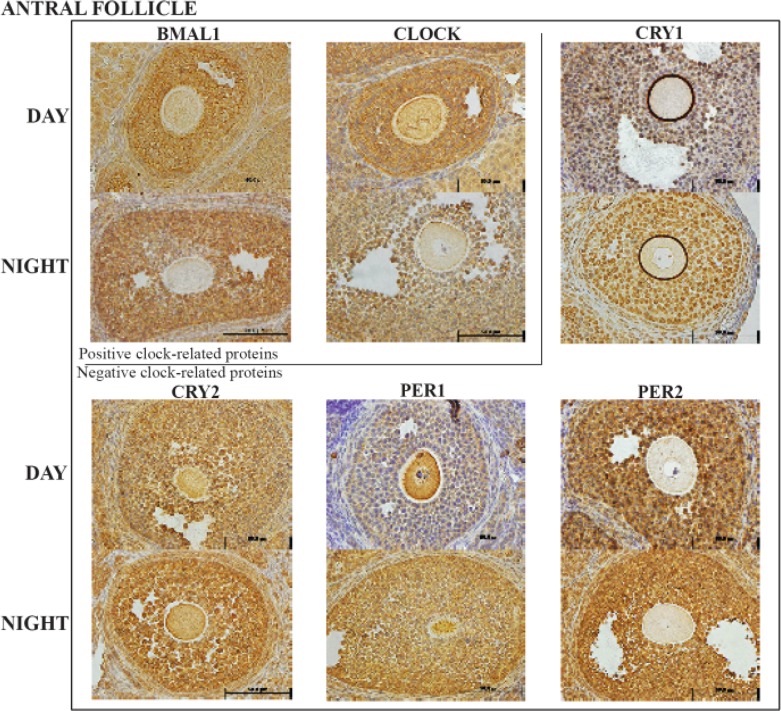
No significant variation for either BMAL1 or CLOCK expression was demonstrated between day and night (Figure 1C and Figure 4). However, Cry-1 and PER-1 demonstrated highly significant increases at night (p< 0.001) and CRY-2 had a smaller but significant increase (p<0.05) at night. Only PER-2 failed to show a significant increase at night (p<0.05).
Whilst BMAL1 had a significant daytime increase in expression (p<0.05), CLOCK had little variation between day and night expression. All four of the negative arm clock proteins were up regulated at night (Figure 1D and figure 5) with PER-2 demonstrating the greatest increase (p<0.001). Although CRY-2 expression was also up regulated, it failed to reach statistical significance.
The function of the ovary is the production and release of oocytes for fertilization at regular intervals and the provision of hormones for initiating and maintaining early pregnancy, which requires regular time keeping over a reproductive life time in a finely controlled process. The ovary maintains a steady periodic course of maturing follicles despite the diminishing pool of available follicles and it is generally considered that this fine control occurs at the pre-antral (hormone unresponsive) stage of ovarian follicle development. Despite this very well regulated organ, to date, little is known about the peripheral clock mechanism of the ovary and in particular the transition from primordial follicles to hormone responsive follicles prepared for ovulation.
The process of primordial recruitment has been vigorously studied with numerous factors implicated in this process (25–27). Anti-mullerian hormone (AMH) is a promising target as it appears to control the amount of primordial follicles able to proceed through development, acting as a regulatory to this development and impeding primordial recruitment (28). However, AMH does not provide an explanation to the complex process of selection of why does one follicle develop over another? Although this current study could not definitively answer this either, it did propose a mechanism that can be further investigated.
The central function of peripheral cellular clocks is the ability to form heterodimers between both the positive arm proteins (BAML1 and CLOCK) and the negative arm proteins (CRY 1 and 2, and PER 1 and 2) and for the heterodimers to translocate to the nucleus to control gene expression. From these data, both the primordial and primary follicles appear to have a similar positive/negative arm feedback loop. However, as follicles enter the hormone responsive antral stage cyclicity of the positive arm appears to be lost between day and night with little change in expression of BAML1 and CLOCK but the negative arm still retains the rhythm of elevated expression at night and lower expression during the day. This pattern continues in the corpus lutea. Previous research has indicated that mRNA expression of Per 2 in the SCN is increased by estrogen exposure (29), whereas Per 2 expression period is shortened in the uterus (30, 31). Furthermore, ovarian BAML1 mRNA expression has been reported to increase at pro-estrous indicating that it may well be estradiol responsive (13). Overall, there appears to be a switch in clock gene responsiveness as follicles move in to the antral stage.
Though the understanding of the role of peripheral cellular clocks is not fully established, there are clear indications that the switching between the positive and negative arms of the clock is strongly implicated in cellular metabolism (31), such as the control of glucose homeostasis, gluconeogenesis and intra-cellular redox (32–35). Given that each follicle stage of development may well have differing metabolic requirements, variable signals from the ovarian cellular clock may coordinate follicle responsiveness both for cell signaling within the ovary and hormone responsiveness. For the present study, this could not be determined but clock protein expression rhymicity in the ovary at estrous was established indicating that the ovary, unlike the testis, has a regulated peripheral cellular clock consistent with many other body tissues and the light: dark cycle is critical in regulating the clock. Further work is required to determine the functional relationship between other stages of the estrous cycle, time, clock protein expression and changes in ovarian metabolic activity.
We are grateful for histology advice from Ms Mandy Fisher, Manager, Histology Unit, Pathology Department, University of Otago.
