
Cesarean section (CS) is a surgical intervention which is being conducted in emergencies to save the lives of mother and child when natural delivery is not possible or is risky for mother or/and child (1). The proportion of cesarean section to the total births in a specific period of time is considered as an important indicator of prenatal care. A rate of lower than 5 percent indicates that significant proportion of women have poor access to pregnancy-related surgeries, while, the rates higher than 15 percent indicate that cesarean section is being conducted for other reasons apart from saving lives (2). In recent years, the rate of CS has increased in different parts of the world, both in developed and developing countries (3).
In Iran, the rate of cesarean section has increased by three times since 1971 and continues to rise even faster than expectations (3). According to World Health Organization (WHO, 2010), Brazil had the highest rate of cesarean section (45.9%) and Chad had the lowest rate (4%) in 2008. Cesarean rate in Iran was 41.9% in 2008 and was considered as the second highest rate among other countries (2). Isfahan in the south of Iran has even higher rate than the national rate (62%, 2012). This rate is 47% greater than the global rate of cesarean section.
Over the past twenty years in Iran, along with the increasing rate of cesarean section, fertility has also declined dramatically (5). The total fertility rate (TFR) in the 1980s was about 6 children per woman, while it declined to replacement fertility rate (2.1) in 2006 (6). TFR has fallen to 1.8 children per woman (7) and even for Isfahan it has dropped to 1.5 children. Hence, recently pronatalist population policy was introduced to encourage childbearing. One of these strategies is promoting vaginal deliveries by making normal vaginal delivery (NVD) free of charge in public hospitals from the beginning of 2014 (8).
In Iran, it was reported that medical reasons account for a low percentage of cases of cesarean section. According to the Ministry of Health and Medical Education, Department of Maternal Health, “fear of pain”, “lack of tolerance of labor pain”, “recommendations of the physician”, “misperceptions about type of delivery and its effect on the wellbeing of the fetus and the mother”, “fashion and norms”, “improper behavior of health personnel in hospital during labor”, “fear of adverse effects of vaginal delivery on anatomy of genital area that affects couple’s sexual relations” are among factors and motivations for intention to do cesarean section, voluntarily in Iran (9). A recent study among 2521 pregnant women in 67 public hospitals in Iran showed that the most important reasons for choosing cesarean were “analgesia during operating procedures”, “less intervention and injury to the fetus”, “preventing damage to genital area”, “no requirement of frequent vaginal examination” and finally suggestion of physicians (9). In another study, the prevalence of cesarean section, its changes in recent decades, and factors affecting these changes with more emphasis on demographic factors was examined. This study suggested that elevation of age at marriage and first birth, women’s employment and access to health services and advanced technology position women in a vicious cycle, and lead to an increase in the cesarean section (4). A systematic review of papers over the last three decades about reasons of cesarean section showed that the most frequent reasons mentioned in the literature for cesarean are previous cesarean section, fear of natural labor, a negative attitude towards natural labor and a positive attitude towards cesarean and medical reasons (10). A recent study in Iran identified four strategies to reduce the rate of CS. These strategies comprise of “standardization”, “education”, “amending regulations”, and “performance supervision” (11).
The main aim of current new population policies of Iran is elevating fertility rate. Since women who give birth by cesarean section tend to have fewer children, rate of cesarean section is considered as one of important challenges in current pronatalist population policies of the country. Therefore, identifying determinants of intention to do cesarean section is important in order to introduce efficient and effective policies and programs to discourage intention for voluntary cesarean section in Iran.
This study aimed to assess what individual and social factors are responsible for women’s intention to do cesarean section (CS) instead of normal vaginal delivery.
Given the complexity of decision to do cesarean section instead of vaginal delivery, a single theory cannot fully explain women’s intention in this regard. The conceptual framework which led this study employed various elements of several theoretical perspectives and previous literature.
The “Theory of Planned Behavior (TPB)” is based on the psychological theory of reasoned action and it hypothesizes that people adopt their behavioral decisions based on reasonable investigation and available information. A specific behavior can be predicted through its intention. Basically, behavioral intention is predictable by three factors; the existence of a positive attitude towards that behavior, feeling of social pressures (subjective norms), and feeling that it can be done and that the participant is able to do it (perceived behavior control) (12, 13). Accordingly, attitudes of women about cesarean section versus vaginal delivery and evaluation of the consequences of this choice is one construct of the model. Another construct of the model is “subjective norm” which means perceived norms of acceptability of cesarean section versus vaginal delivery in the perspective of the society. In addition, it includes the views of those important others who influence pregnant woman’s decision to choose vaginal delivery versus cesarean section. Women act based on their perception of what important others think (e.g. spouse, doctors). Another construct of this model is “perceived behavioral control” that reflects the extent to which a pregnant woman has the ability to control labor pain through vaginal delivery and vice versa.
Medicalization is another theoretical perspective which explains that sometimes non-medical problems are explained under the context of disease or illness or defined as medical conditions (14). Nowadays, childbirth is less likely considered as a natural process. During pregnancy, women are more and more dependent on knowledge of physicians and despite widespread negative consequences of CS for both mother’s and child’s health, increasing of cesarean section is happening without any convincing medical reasons. In this study, medicalization theory is considered to assess the role of physicians in encouraging women to do cesarean section versus normal vaginal delivery.
Finally, below replacement fertility in developed countries has been explained by a Second Demographic Transition Theory. This theoretical perspective explains that many fertility behaviors are due to development of new attitudes and values including individualism (6). We assume that women who are more individualistic have lower fertility intention and vaginal delivery. Therefore, individualism can be an element of conceptual model of this study to explain intention for cesarean section.
Moreover, according to the literature, “body image” can be a factor which might influence women’s decision for CS (15). Some studies have suggested that undergoing CS helps to preserve vaginal strength, preserve normal sexual function, and maintains anatomical and functional arrangement of the pelvic floor and intrapelvic organs (16, 17). This can be one reason for popularity of CS and positive attitudes of women, midwives, and obstetricians towards CS (18). Therefore, selected factors at the proximate level are presumed to influence women’s intention to do cesarean section. These are “perceived body image”, “perceived control”, “individualism” and “attitude towards CS and NVD”, while at the more distal level, there are other factors related to environment which might influence their decision. These are “subjective norms” and “physicians’ role” (Figure 1).
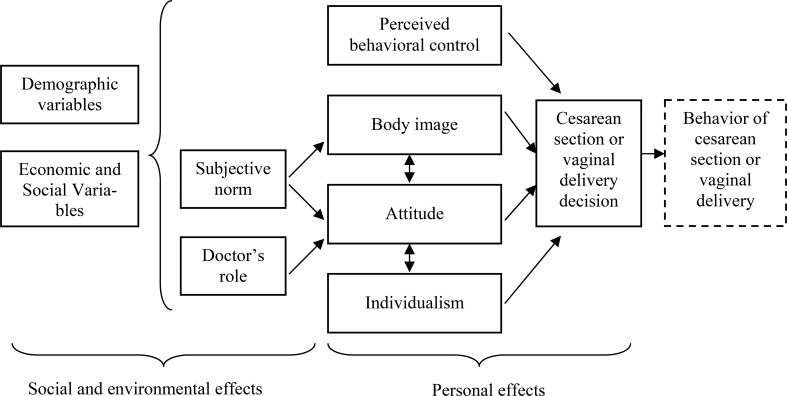
According to the above conceptual framework, this study intended to show which individual (attitude, body image, individualism, perceived behavioral control) and social factors (subjective norms, doctors’ role) can explain variations in intention for CS among women after control of socio-economic and demographic factors.
The study population comprised of pregnant women aged 15 to 49 resided in Isfahan who were in the late stages of their pregnancy (from 24 weeks to 40 weeks), and have attended the selected nine hospitals (four private hospitals and five public hospitals), and agreed to participate in this study during June and July 2014. The sample size was calculated to be 400 pregnant women.
Because of different rates of CS and NVD among women in Isfahan, non-probability sampling method was used to make sure the proportion of CS and NVD in the sample was similar to the study population, hence, from among 400 pregnant women, 300 women with CS intention, and 100 women with NVD intention were recruited. Approval was obtained from selected hospitals in Isfahan using official letter by Allameh Tabatabaie University. Following the initial arrangement with hospital authorities, pregnant women in the labor clinics were briefed about the study and invited to participate in this study. The participation of women was completely voluntary and they signed an informed consent form and they were assured of confidentiality and anonymity. It should be noted that women with medical or fetal indication for CS were excluded from the study.
The study instrument was comprised of seven different sections including 61 items and questions. The first section comprised 17 questions about personal, demographic and socio-economic situation. The second section was comprised of statements of personal attitude towards CS (10 items). The third section was comprised of statements related to perceived behavior control (7 items). Fourth section included items of subjective norm (10 items). The fifth section included items of body image (5 items), the sixth section comprised items of individualism (6 items), and the seventh section comprised items related to the role of the physicians (6 items). The response format for all items was a 5–point Likert Scale (completely agree, agree, no idea, disagree, and completely disagree) (Table 1).
Table 1. The scales, ranges, related items and directions
| Scale | Item | Range and directions of the scores |
|---|---|---|
| Attitude towards type of delivery (10 items) |
| Range (10–50) higher score = positive attitude toward cesarean lower score = negative attitude toward cesarean |
| Perceived behavioral control (7 items) |
| Range (7–35) higher score= having more perceived behavioral control = (tolerance of more labor pain) lower score= having less perceived behavioral control = (tolerance of less labor pain) |
| Subjective norm (10 items) |
| Range (10–50) higher score= the more subjective norm (Normative acceptability of cesarean section) lower score= having less subjective norm (Normative unacceptability of cesarean section) |
| Body image (5 items) |
| Range (5–25) higher score =giving more importance to the appearance lower score= giving less importance to the appearance |
| Individualism (6 items) |
| Range (6–30) higher score= being more individualistic lower score= being less Individualistic |
| The role of the doctor (6 items) |
| Range (6–30) higher score=the more encouraging role of the doctor lower score= the less encouraging role of the doctor |
Items of attitude, perceived behavioral control, and subjective norm, physician role and body image were based on some in-depth interviews with pregnant women as well as items of previously conducted studies which confirmed validity and reliability of scales (19). Selected items were borrowed from a previous study by Vosoughi and Mirzaee (20) and its reliability and validity was confirmed.
Face validity and content validity of the instrument was evaluated. For face validity, credibility of items and questions and indicators were reviewed and confirmed by referring to three experts in this field. Moreover, the questionnaire was filled by 20 pregnant women in the city of Isfahan who were at their late gestational age in pretest, in order to correct vague or difficult to understand questions and make sure that women have the same understanding of the questions and items. Accordingly, difficult items or questions were changed and amended. To evaluate the validity of scales, confirmatory factor analysis was employed. Among the items of each scale, the items that did not have internal consistency with other items were eliminated. In this case, Kaiser-Meyer (KMO) and Bartlett’s test was used to indicate the suitability of the data for construct detection and to extract factors, maximum likelihood method was used and to identify factors, Eigenvalues was employed. The reliability of items was measured by Cronbach’s alpha. Alpha coefficients of all scales were greater than 0.70 (21).
Data were cleaned and entered into SPSS version 16 and statistical analysis was conducted. Bivariate analysis was employed using t-test and chi-square. Finally, binomial logistic regression was used in order to identify determinants of cesarean section after control of other associated factors. The p-value less than 0.05 was considered statistically significant.
From among 400 women participated in this study, the age range was from 18 to 38 with a mean age of 26.6 years old (SD=4.45). About 10% had an education lower than diploma, 40.4% had a diploma, and 48.5% were university educated. Only 4.5% of women had a full time job, about 10% had a part time job, and the majority of them (85.8%) were housewives. The majority (67.5%) reported a monthly family income between 8–10 million Rials, and only about 15% had a monthly family income of greater than 10 million Rials. Only about 3% were on the belief that new strategy of government to make vaginal delivery free of charge has a very good influence on their decision to do vaginal delivery instead of CS, while the majority (about 81%) reported this strategy has had little effect on their intention to choose vaginal delivery (Table 2).
Table 2. Distribution of respondents according to demographic and socio-economic characteristics
| Number | Percent (%) | |
|---|---|---|
| Age group | ||
| 18 to 24 | 117 | 29.4 |
| 25 to 31 | 218 | 54.6 |
| 32 to 38 | 64 | 16.0 |
| Education status | ||
| elementary, secondary and high school | 43 | 10.8 |
| diploma | 163 | 40.8 |
| college education | 194 | 48.4 |
| Employment status | ||
| employed full time | 18 | 4.5 |
| employed part-time | 39 | 9.8 |
| housewife | 343 | 88.7 |
| Family income (Rial per month) | ||
| less than 8×10⁶ | 70 | 17.6 |
| between 8–10×106 | 268 | 67.5 |
| more than 10×106 | 59 | 14.9 |
| total | 400 | 100 |
The results of bivariate analysis suggested no significant relationship between employment of women and intention to do CS, while there was a significant relationship between educational level and cesarean decision intention. Table 3 shows that only 37.2% of women with primary and secondary education reported CS intention, while about 70% with diploma and 87.6 percent of women with a university education reported cesarean section intention (p<0.001).
Table 3. Bivariate analysis of socio-economic and demographic variables and intention to do CS versus NVD
| Variable | NVD intention No (%) | CS intention No (%) | P-value |
|---|---|---|---|
| Employment status | |||
| Employed full-time and part-time | 10 (17.5) | 47 (82.5) | 0.2 |
| Housewife | 90 (26.2) | 253 (73.8) | |
| Education status | |||
| <Diploma | 27 (62.8) | 16 (37.2) | <0.001 |
| Diploma | 49 (30.1) | 114 (69.9) | |
| College education | 24 (12.4) | 170 (87.6) | |
| Family income (per month) | |||
| <8 Million Rials | 43 (61.4) | 27 (38.6) | <0.001 |
| 8–10 Million Rials | 50 (18.7) | 218 (81.3) | |
| >=10 Million rials | 6 (10.2) | 53 (89.8) | |
| Fertility intentions | |||
| One | 13 (16.7) | 65 (83.3) | <0.001 |
| Two | 61 (23.6) | 198 (76.4) | |
| Three and more | 23 (57.5) | 17 (42.5) | |
| I do not know | 3 (13.0) | 20 (87.0) | |
| Age | No (M±SD) | No (M±SD) | |
| Age of pregnant women with one child alive | 69 (24.7±3.77) | 146 (25.0±4.43) | 0.52 |
| Age of pregnant women with two children alive | 26 (28.04±3.63) | 143 (28.14±4.43) | 0.1 |
There was a significant relationship between income and CS intention. The majority (about 90%) of women with high family income (more than 10 million Rials) intended to do cesarean and about 81% of those with moderate family income had such decision and only about 39% with low family income had a cesarean intention (p<0.001). Hence, from among socio-economic factors, education and income were significant correlates of cesarean intention among women.
A significant association was found between fertility intention and CS intention. The majority (83%) of women with fertility intention of one child, had cesarean intention. In contrary, 76.4% of women who decided to have two children had an intention to do cesarean decision, and only 42.5% of women who wanted to have three children and more had a cesarean intention (p<0.001).
To assess the association between mean scores of scale variables of the conceptual model with cesarean section intention, T-test was employed. The mean score of independent scale variables was compared between women with cesarean intention and women with vaginal delivery intention. The results showed that mean score of attitude towards CS was greater among women who intended to do CS compared to women who intended to do NVD (32.3 vs. 22.7, p<0.001). This means that women held positive attitudes towards CS, intended to do CS more than those with negative perspective. In contrast, the mean score of perceived behavioral control (to tolerate labor pain) was significantly lower among women who intended to do CS compared to women who intended to do NVD (17.9 vs. 26.3, p<0.001). Hence, behavioral control in dealing with labor pain among women who chose vaginal delivery was significantly greater than women who intended to do CS. Interestingly, mean score of subjective norms was greater among women who decided to do CS compared to other women (34 vs. 22, p< 0.001). It means that they had greater perception of social acceptability of cesarean than other women. Moreover, women who do care about their body image were more likely to have CS intention. The mean score of body image was significantly greater among women with CS intention than other women (18.3 vs. 11.8, p<0.001). In addition, individualism among women with CS intention was significantly greater than other women who intended to do normal vaginal delivery (p<0.001). Finally, the mean score of role of physicians (doctors) in deciding about CS was significantly greater among women with CS decision than women with NVD decision (Table 4).
Table 4. Bivariate analysis of scale variables (Independent variable) with intention of caesarean section and vaginal delivery
| Scale | Delivery intention | P-value | |||
|---|---|---|---|---|---|
| CS | NVD | ||||
| Total | Mean±SD | Total | Mean±SD | ||
| Attitude towards CS vs. NVD | 292 | 32.27±6.30 | 96 | 22.73±5.86 | <0.001 |
| Perceived behavioral control (tolerate labor pain) | 279 | 17.95±4.93 | 99 | 26.34±4.25 | <0.001 |
| Subjective norm | 296 | 33.97±4.71 | 100 | 22.05±5.94 | <0.001 |
| Body image | 300 | 18.29±3.12 | 100 | 11.85±3.47 | <0.001 |
| Individualism | 299 | 23.29±4.60 | 100 | 20.68±6.14 | <0.001 |
| The role of doctors | 300 | 21.35±4.79 | 100 | 15.41±3.28 | <0.001 |
Variables identified as significant correlates of intention for CS in bivariate analysis were selected and assessed for correlation. In the first model of logistic regression (Table 5), all scale variables were entered into the model in addition to education, income and fertility intention as control variables. In the first model, it was shown that after control of education, income and number of intended children, three factors remained in the model as significant predictors of “Intention for CS”. These factors were subjective norms (OR= 1.19), body image (OR=1.41), and role of physicians (OR=1.33). However, attitudes toward cesarean, perceived behavioral control and individualism lost their importance in the first model. The model showed that with increasing one unit to the score of subjective norms, CS intention was likely to increase 1.19 times (p<0.01). Also, with increasing one unit in the score of body image scale, (the importance of body image in perspective of women), the probability of CS increased 1.46 times (p<0.001). And finally, with increasing one unit in the score of physician’s role, the probability of CS intention increased 1.33 times (p< 0.001).
Table 5. Determinants of intention to do cesarean section using two models of multivariate analysis (Logistic Regression)
| Model 1 | Model 2 | |||||||
|---|---|---|---|---|---|---|---|---|
| B | S.E | EXP(B) | Sig | B | S.E | EXP(B) | Sig | |
| Attitude towards CS/NVD (scale, range 10–50) | - | - | - | - | 0.135 | 0.035 | 1.114 | 0.000 |
| Perceived behavioral control (scale, range 7–35) | - | - | - | - | ||||
| Subjective norm (scale, range 10–50) | 0.203 | 0.45 | 1.195 | 0.000 | ||||
| Body image (scale, range 5–25) | 0.378 | 0.69 | 1.462 | 0.000 | 0.456 | 0.062 | 1.578 | 0.000 |
| Individualism (scale, range 6–36) | - | - | - | - | 0.081 | 0.040 | 1.085 | 0.043 |
| The role of doctors (scale, range 6–36) | 0.263 | 0.065 | 1.326 | 0.000 | 0.326 | 0.062 | 1.385 | 0.000 |
| Constant | −15.141 | 1.828 | 0.000 | 0.000 | −17.336 | 2.202 | 0.000 | 0.000 |
| R square | Nagelkerek R Square=0.787 Cox-Snell R-Square=0.543 | Nagelkerek R Square=0.771 Cox-Snell R-Square=0.524 | ||||||
In the second regression model (Table 5), subjective norm and behavioral control were not entered to avoid multi-collinearity if there is high correlation between these variables and personal attitudes towards CS. The second model showed that attitude towards CS, individualism, body image and the role of the doctor appeared as significant determinants of cesarean intention. Therefore, it can be concluded that the personal attitude and individualism influence intention for cesarean section through subjective norm.
Therefore, it can be concluded that attitude towards CS and individualism in the presence of subjective norm and behavioral control lost their importance, and instead perceived subjective norm became significant. So, subjective norm seems to be a more important factor than individualism and personal attitude in predicting CS intention.
The first model can explain 54% of variations in decision of cesarean section (Cox-Snell R-Square= 0.543), while the 2nd model can explain about 52% of variations in decision about CS (Cox-Snell R-Square=0.524).
This study showed that higher education and greater family income are significant socio-economic correlates of intention to do CS. The role of economic factors has been shown in another study (22). However, this study identified significant determinants of women’s intention for elective cesarean section after control of socio-economic factors. Perceived norms of social acceptability of CS was identified as an important determinant of intention for CS than individualism. This is consistent with the theory of plan behavior (TPB) in which perceived social norm is one predictor of intention to do a behavior. This study also showed that in the absence of perceived norms, individualism significantly predicts intention to do CS. It means that women who do care about their own beliefs, not what others expect or think, tend to have more intention to do CS. Individualism can also influence this decision from another point and that is through lower fertility intention. Certainly, when fewer children is intended, cesarean section will be more considered. Because, one important indication for cesarean section is repeat cesarean section. A woman who has greater fertility intention tends to have lower intention to do CS. Although fertility intention or number of children intended to have, as a key variable was not identified as a significant predictor in this study (2nd regression model), probably it was due to its negative correlation with individualism in this model. In a recent study in 2012 conducted among 780 men and women who were about to marry in Tehran, a significant association was found between intention for one child and individualism (23).
Some beliefs towards CS and NVD are also influential in decision for type of delivery. Being unconscious during CS and bearing no pain during giving birth, holding a belief that cesarean section prevents neonatal death, and believing that medical and post-partum care in cesarean section is much better than NVD, or vaginal delivery will lead to vaginal relaxation, are among those beliefs that encourage cesarean section. Informing women about advantages of normal vaginal delivery without pain, introduction of water delivery in most hospitals, and training of midwives and nurses about respecting and providing the high standard prenatal and postpartum care for women during vaginal delivery can improve women’s views towards vaginal delivery and remove misperceptions in this regard. Positive relationship between attitude towards CS and the intention of CS was also shown in another previous study (24).
The study also showed that doctors strongly influence pregnant women’s decision, and doctors can shape attitudes of women strongly in favor of cesarean section or vice versa. The images which doctors create for pregnant women about labor and vaginal delivery and its consequences, encourage them to hesitate to do vaginal delivery. In fact, doctors as significant others affect pregnant women’s decision. This effect can be particularly the case for women who want vaginal delivery before their pregnancy and then their decision is transformed into CS. It can be claimed that the involvement of doctors in the past decades was to the extent that some researchers believe that the main reason for the decision to do cesarean section was doctor’s recommendations, decisions and environmental conditions, not labor conditions of women (25). Acknowledging the role of the physician is also seen in other studies. A study showed that 70% of women considered the role of doctor as a determinant of choosing the type of delivery (26). Hopkins believes that physicians play an important role in persuading patients to choose cesarean section and indirectly increase the cesarean section rate (27).
Physicians’ recommendation for CS might have various reasons such as better management of their time and better financial income. Therefore, one important strategy would be emphasizing this issue in medical education and changing doctor’s attitudes as well as implementing preventive policies.
Moreover, women, who were more concerned of their body image tend to have greater intention to do cesarean. It is rooted in the beliefs that cesarean section prevents vaginal relaxation after giving birth while vaginal delivery leads to uterine and bladder relaxation and prolapse (28), while, body will return to its previous state much quicker in vaginal delivery compared to SC. Scar of cesarean on abdomen and uterine ruptures mostly due to previous cesarean sections are the other problems of CS (29).
Perhaps one belief that strongly influences women’s decision on CS is the adverse effects of vaginal delivery in loosening the vagina and its adverse effects on quality of sexual relationship after NVD. In addition, some women held a belief that relaxation of bladder would create lack of urine control after NVD in the long term. Consistent with this, another study in Thailand, showed that one significant predictor for women’ preference for cesarean delivery, is a belief that cesarean delivery could preserve sexual satisfaction that might be jeopardized after relaxation due to vaginal delivery (30). Therefore, through enhancing the quality of care during labor, it is possible to minimize the side effects after vaginal delivery and correct such misperception in prenatal courses for pregnant women in hospitals and during prenatal care.
It is important to review the training of students in the health care, in order to restore the role of women in the birth process, providing opportunities for them to decide on the type of childbirth based on consistent information and scientific evidence. Moreover, it is important to discuss beliefs that have been passed down from generation to generation in relation to natural childbirth and cesarean section. Some misperceptions need to be amended with regard to advantages of surgical procedure (CS) compared to NVD. Disclosing such evidence to the media may contribute to changes in this model that is still in force.
This was a cross sectional study which had some limitations that need to be considered in interpretation of these results. In cross sectional studies, causality needs to be made with caution. Enquiring the women at the same time about their intention to do CS or NVD and their attitude towards CS or NVD creates this problem and only longitudinal studies can show cause and effect with more certainty. Moreover, because the sample was restricted to the context of Isfahan city, these results might not be generalizable to other social contexts. Therefore, further similar researches are needed to be carried out in other contexts which broaden the understanding of determinants of CS intention in other contexts. And also it is suggested that more in depth rationales and reasons for intention to do cesarean section or vaginal delivery be explored in a qualitative study.
Choosing cesarean section voluntarily is a multifaceted decision which is shaped by various factors; hence, comprehensive interventions are suggested to discourage voluntary cesarean section. These interventions need to encompass changes in physicians’ role, social norms, body image and correcting misperceptions among women towards CS and NVD during prenatal courses.
The authors would like to appreciate the help of Professor Hassan Saraie, who kindly advised us in this study and provided valuable comments.
