
Molecular mechanisms of sex determination involve a growing network of genes, a large number, which are transcription factors. The transcription factors so far are identified as having a major role in sex determination (1). In humans, the gene for the testis-determining factor resides on the short arm of the Y chromosome. Individuals who are born with the short arm but not the long arm of the Y chromosome are male, while individuals born with the long arm of the Y chromosome but not the short arm are female (2). By analyzing the DNA of rare XX men and XY women, the position of the testis-determining gene has been narrowed down to a 35,000-base-pair region of the Y chromosome located near the tip of the short arm (3). In this region, a male-specific DNA sequence was found that could encode a peptide of 223 amino acids. This peptide is probably a transcription factor, since it contains a DNA-binding domain called the HMG (high-mobility group) box (4, 5). This domain is found in several transcription factors and non-histone chromatin proteins, and it induces bending in the region of DNA to which it binds (6). This gene is called SRY (sex-determining region of the Y chromosome), and there is extensive evidence that it is indeed the gene that encodes the human testis-determining factor (7–10).
Methods for sex determination using PCR for amplification of SRY gene have also been reported (11, 12). These methods can indicate a male genotype by the presence of the amplified product of SRY gene. Nonetheless, the need for trained staff, operating space, equipment, and reagents has impeded its usefulness (13). Hence, there has been an increasing demand for simple and cost-effective molecular tests. Loop mediated isothermal amplification (LAMP), a novel nucleic acid amplification method that relies on an auto-cycling strand displacement DNA synthesis, is performed by Bst DNA polymerase (14–17). Four or six primers that identify six or eight distinct regions are used in this method. It is operated under a constant temperature (60 to 65°C), and it eliminates the need for specialized thermal cycler equipment (18–23). An important advantage of LAMP is its ability to amplify specific sequences of DNA under isothermal conditions (24, 25). Detection of amplification product can be determined via turbidity caused by an increasing quantity of the magnesium pyrophosphate precipitate in solution (26–36). LAMP positive amplicons have been confirmed by adding a number of fluorescent dsDNA intercalating dye including ethidium bromide and SYBR® Premix Ex TaqTM II after the reaction is completed or metal indicators such as magnesium sulphate (MgSO4), calcium chloride (CaCl2), SYBR Green I, propidium iodide, GeneFinderTM, calcein, hydroxynaphthol blue (HNB), phenol red and Gel-RedTM prior to the reaction, allowing observation with the naked eye (37–40). The purpose of this study was to establish a rapid, sensitive, specific, and easy method to detect SRY gene using a visualized detection system.
A total of 15 blood samples from pregnant women at eight weeks of pregnancy were collected. Another set of blood samples from non-pregnant women and men were also obtained using them as plasma negative and positive controls for the study, respectively. Fresh blood samples were drawn into Vacutainer EDTA tubes (BD Cat. 366643) immediately and were centrifuged at 3000 rpm for 10 min in a refrigerated centrifuge; their plasma fractions were collected and stored at −80°C for further analysis. Plasma DNA was extracted using QIAamp Circulating Nucleic Acid Kit (Qiagen, Cat. 55114) by following manufacturer’s protocol. Briefly, 2 ml of plasma was mixed with 200 μl proteinase K, 2.4 ml on ACL buffer by pulse-vortexing for 1 min in a 50 ml conical tube. Then the mixture was incubated in a 60°C water bath for 30 min. Then, 3.6 ml ACB buffer was added to the sample lysate and mixed by pulse-vortexing for 1 min, incubated for 5 min on ice and applied to the QIAamp mini column. Following the multiple wash and centrifugation steps, columns were incubated for 10 min at 56°C and DNA was eluted with 100 μl of AVE buffer and stored at −20°C for further analyses. The extraction quality of nucleic acid was confirmed by 1.5% agarose gel electrophoresis. The nucleic acid was stained with ethidium bromide. The purity of DNA was estimated by measuring the absorbance values at 260 nm and 280 nm using UV-Vis spectrophotometer (Shimadzu UV-1700, Japan).
By means of the Primer Explorer V.4 software (specific for LAMP), specific primers were designed based on SRY genes (GenBank accession JQ811934.1) (Table 1). Figure 1A shows the schematic position of LAMP primers within SRY gene. A basic set of four primers was needed, including FIP (Forward Inner Primer), BIP (Backward Inner Primer), F3 (Forward Outer Primer), and B3 (Backward Outer Primer) to identify six distinct regions on the target DNA. To accelerate the LAMP reaction, two additional primers, i.e., LF (Loop Forward Primer) and LB (Loop Backward Primer) were also used. FIP consisted of the complementary sequence of F1, a T-T-T-T linker, and F2. BIP consisted of B1c, a T-T-T-T linker, and the complementary sequence of B2c. Primers F3 and B3 were located outside F2 and B2 regions, while loop primers LF and LB were located between F2 and F1 and between B1 and B2, respectively (13–16). Finally, the primers were tested for similarities with other sequences available in the GenBank databases using the BLASTN algorithm. LAMP assay was separately performed in a total volume of 25 μl using DNA obtained in a way described before, using designed primers in pregnant women, non-pregnant women (negative control) and men (positive control) samples. Initially, DNA was added to 23 μl of LAMP mixture to provide a final concentration of 20 mM supplied buffer (Thermopol buffer containing 50 mM Tris-HCl, pH=8.8, 10 mM KCl, 10 (NH4)2SO4 mM, 0.1% Triton X100), 2 mM Betaine (Sigma-Aldrich, USA), 1 mM MgSO4, 10 mM dNTP, 0.2 μM of primer F3 and B3, 0.4 μM of primer LF and LB, 0.8 μM of primer FIP and BIP and 8 U of Bst DNA polymerase (New England Biolabs, UK). Tubes were then incubated at 63°C for 60 min in water bath. An agarose gel electrophoresis system (optional, 1.5%) under UV illumination could be also employed to visualize positive reaction.
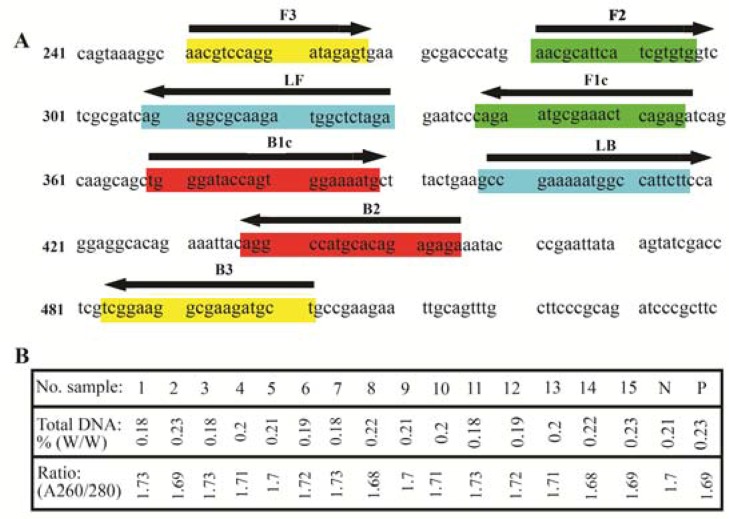
Table 1. Oligonucleotide primers used for LAMP assay
| Name | Length | Sequence (5–3) | Length of product |
|---|---|---|---|
| F3 | 18 nt | AACGTCCAGGATAGAGTG | Fragment with different sizes |
| B3 | 18 nt | AGCATCTTCGCCTTCCGA | |
| FIB (F1c+F2) | 44 nt | ATCTCTGAGTTTCGCATTCTTTTTAACGCATTCATCGTGTGGTC | |
| BIP (B1c+B2) | 44 nt | TGGGATACCAGTGGAAAATGTTTTTCTCTCTGTGCATGGCCTGT | |
| LF | 22 nt | TCTAGAGCCATCTTGCGCCTCT | |
| LB | 22 nt | CCGAAAAATGGCCATTCTTCCA |
The validations of positive LAMP reactions were justified by means of eight staining approaches. In doing so, several dyes were added to the LAMP reaction as described previously (40). Prior to amplification, 2 μl magnesium sulphate (8 mM MgSO4), 1 μl of GeneFinderTM (diluted to 1:10 with 6×loading buffer) (Biov. Bio. China), 1 μl of SYBR Green I (diluted to 1:10 with 6×loading buffer) (Invitrogen, Australia), 1 μl of the hydroxynaphthol blue dye (HNB) (3 mM, Lemongreen, Shanghai, China), 1 μl of phenol red (diluted to 1:10 with 6×loading buffer) (Sigma-Aldrich Chemie GmbH) or 1 μl of the GelRedTM dye (Biotum, India) were separately added from a stock solution to the master mix. After amplification, 0.5 μl ethidium bromide (Sigma) and 2 μl SYBR® Premix Ex TaqTM II (Perfect Real-time, Takara Bio Co., Ltd., RR081A) were added to LAMP reaction separately. The tubes containing MgSO4, GeneFinderTM, SYBR Green I, HNB and phenol red dyes were easily monitored for color change by simply looking at them in daylight, while the ones containing GelRedTM, ethidium bromide and SYBR® Premix Ex TaqTM II were examined under UV light (302 nm) after a short vortex.
DNA must be purified from cellular material in such a manner to prevent degradation. The absorbance ratios (A260/A280) of DNA samples were found to be in range of 1.68–1.73, indicating the purity of DNA (Figure 1B).
The initial optimization of the assay was conducted using a set of four basic primers, and optimal concentrations were determined. The reaction mixture was incubated at temperatures ranging from 60 to 65°C. The optimal temperature was found to be 63°C for 60 min. Values and concentrations of other components of the reaction were optimized. After detection of LAMP by gel electrophoresis, the smeared bands of amplified product indicated the positive reaction (Figure 2A). Our results revealed the positive reaction was highly specific only with fresh blood samples containing XY chromosomes, while no amplification was found in blood samples containing XX chromosomes. Our new LAMP protocol could successfully identify positive samples and positive control. LAMP amplicons were electrophoresed and a large number of fragments (a ladder like pattern) were eventually visualized. As shown in figure 2A typical ladder pattern of the amplified LAMP products with agarose gel electrophoresis was only observed for the positive samples and positive control. The LAMP assay showed no detectable amplification of other samples, including the negative control and negative samples. A total of 15 blood samples from pregnant women were seven male embryos (46.6%) and eight female embryos (53.4%). The authenticity of the results by the follow up was performed after delivery and finally the diagnosis of gender in 15 pregnant women was determined by plasma LAMP method.
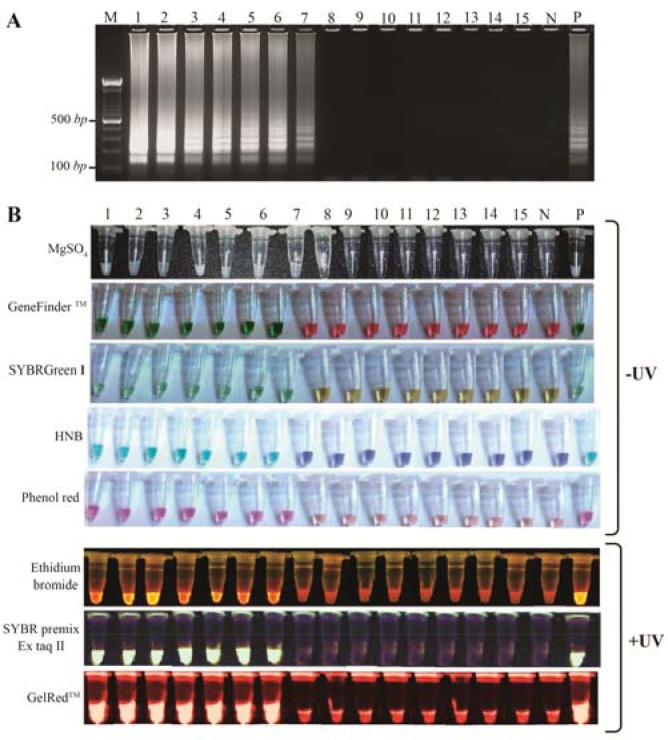
LAMP amplicons could be detected with the naked eye by adding different visual dyes followed by color changing in the solutions. In this regard, all used visual components could successfully make a clear distinction between positive and negative ones (Figure 2B). It is noticeable that positive results by MgSO4, Gene-FinderTM, SYBR Green I, HNB, phenol red, Gel-RedTM, ethidium bromide and SYBR® Premix Ex TaqTM II were turbidity, green, green, sky blue, red, orange, yellow and green, respectively.
The LAMP method, generally, had the following advantages over the other methods such as easy detection, high sensitivity, high efficiency, simple manipulation, safety, low cost and being user friendly. In reality, except for section one which takes equal time (see “Material and Methods” section), LAMP overall requires just 60 min to accomplish (as the least demanding detection method) (13–21). This, in turn, would simplify the detection procedure and result in saving significant time needed for separating the amplified products on the gel and analyzing the data which are commonly used in other PCR-based methods, including nested PCR, reverse transcription PCR, multiplex PCR and immunocapture PCR (29–39). Such visual methods not only involve some expensive instruments but also during a period of time, exposure to the UV light (because it is harmful to the eyes, even watching for a short period would irritate the eyes and cause symptoms similar to conjunctivitis) as well as ethidium bromide could induce a number of serious negative effects on researchers who use these methods (13). More surprisingly, in LAMP amplified products can be easily visualized by means of different in-tube color indicators with no essential requirement of additional staining systems; thus, toxic staining materials would be significantly avoided (39). Simple, cost effective and user friendly equipped labs with some molecular instruments as well as trained personnel are prerequisites to perform PCR assays (35). On the contrary, LAMP can be easily accomplished just in a water bath or temperature block with no need of thermocycler and gel electrophoresis as the same results were recorded by other researchers (29–40). Likewise, exclusive of the primer designing process which is somehow complicated and sensitive, other phases are simply applicable. On the other hand, the presence of LAMP positive amplicons proved to be confirmed by adding a number of fluorescent or metal dyes to the reaction tubes, allowing observation with the naked eye (24–37). In the current study, therefore, LAMP amplified products were confirmed by adding all aforementioned visual systems (see “Methods” section), either prior to or after the reaction along with forming diverse color patterns depending upon the chemical characteristics of the applied chemical substances as dye. According to our results, despite the precise detection of positive LAMP products using all dyes, some were significantly superior when the time of stability, cost and the safety were taken into consideration (Table 2). For instance, regardless of its reasonable color change stability (≥2 weeks), when employing ethidium bromide, a UV transilluminator must be available; both of them are toxic, resulting in deleterious consequences on human health and the environment (25–30). More interestingly, in some cases, just a little fluorescent emission could be observed in negative tubes, presumably arising from the presence of primers and/or DNA templates, leading to an increase in false-positive results (30–35). Alternative to such problems, the first metal dye called magnesium sulphate was utilized, but just an ephemeral color change (i.e. turbidity; no more than a few seconds) was observed as the same result was reported (31–39). Even though short stability of the color change probably cannot be a significant problem as long as just a few numbers of suspicious samples are used, during assessment of a great quantity of infected samples, most of the time, inaccurate results will be accordingly achieved (29–35). The method, nevertheless, could be thereby attributed as a reliable visual observation approach since on the one hand, it is exploited prior to the reaction and on the other hand, there is no need for toxic devices. Anyway, to provide a situation to increase time stability, the second fluorescent dye SYBR® Premix Ex TaqTM II was employed, leading to a clear green color pattern. Notably, regardless of observing a significant growth on time stability (about 1–3 days), the method not only requires UV transilluminator but also its stability is more negatively sensitive (in daylight). Indeed, since the dye must be added after the amplification as it requires opening of the tubes, the occurrence of cross-contamination risk will be accordingly enhanced (28–35). To avoid such contaminations, using separate rooms can be a solution for LAMP setup and analysis. More recently, it has also been pointed out that the visualized LAMP assay demands a high concentration of SYBR Green I, which will hamper the LAMP reaction if it is added before LAMP reaction, so the close-tube LAMP detection based on SYBR Green I might be difficult (32–38). To abbreviate the contamination hazard and also increase color stability, as a result, two additional metal indicators (i.e. HNB and GeneFinderTM) known as close-tube LAMP detection were lastly used. Interestingly, among several different visual dyes to accurately detect LAMP products, both HNB and GeneFinderTM could produce long stable color change and brightness in a close tube-based approach to prevent cross-contamination risk as the best alternatives (35, 37, 40). Two additional metal indicators (phenol red and GelRedTM) were added before LAMP reaction but UV transilluminator was required. Meanwhile, the visual inspection of LAMP products by means of HNB and GeneFinderTM metal dyes was seen as advantageous as there was no need for electrophoresis and subsequent staining with carcinogenic ethidium bromide (40). Lastly, the color brightness and stability of both HNB and GeneFinderTM in the solutions with positive/negative reactions remained constant after 2 weeks of exposure to ambient light, whereas turbidity caused by precipitation of MgSO4 or SYBR® Premix Ex TaqTM II was stable for only 5–10 s and 1–3 days, respectively, which were in agreement with the results reported by previous researchers (35, 37, 39). However, the results obtained here represent those achievable in the research laboratory setting, and it is uncertain whether these results also apply to actual specimens compared with other LAMP assays (Table 3).
Table 2. Comparison of colorimetric assays for detection of SRY gene
| Visual system | Detection method | Safety | Positive reaction | Negative sample | Apply UV ray | Stability | Cross contamination | Use time |
|---|---|---|---|---|---|---|---|---|
| Magnesium Sulfate (MgSO4) | Visual | Yes | Turbidity | No turbidity | No | 5–10 s | No | Prior to amplification |
| GeneFinderTM | Visual | Yes | Green | Orange | No | 2–3 weeks | No | Prior to amplification |
| SYBR Green I | Visual | Yes | Green | Orange | No | 2–3 weeks | No | Prior to amplification |
| Hydroxynaphthol blue (HNB) | Visual | Yes | Sky blue | Violet | No | 2–3 weeks | No | Prior to amplification |
| Phenol red | Visual | Yes | Red | Orange | No | 1 week | No | Prior to amplification |
| Ethidium bromide | Visual | No | Yellow | No color | Yes | 2 weeks | Yes | After amplification |
| SYBR Premix Ex TaqTM II | Visual | Yes | Green | No color | Yes | 1–3 days | Yes | After amplification |
| GelRedTM | Visual | Yes | Orange | No color | Yes | 2 weeks | No | Prior to amplification |
Table 3. Comparison of different LAMP assays
| Assay | Detection method | Safety | Apply UV ray | Apply detect instruments | Cost | User friendly |
|---|---|---|---|---|---|---|
| LAMP with gel detection | Gel electrophoresis | No | Yes | Yes | High | High |
| Colorimetric LAMP without UV | Visual | Yes | No | No | Very low | Very high |
| Colorimetric LAMP with UV | Visual | No | Yes | Yes | High | high |
In conclusion, sex determination using detection of SRY gene by LAMP method in fresh human blood shows the smear and/or ladder band only in male blood samples, but not in female samples. The LAMP assay developed in this study is a valuable tool capable of helping in monitoring the purity and identification of SRY gene for sex determination. LAMP method, all in all, had the following advantages over the other mentioned procedures: (I) no requirement for expensive and sophisticated tools in amplification and detection; (II) no post-amplification treatment of the amplicons; (III) a flexible and easy detection approach, by detecting with naked eyes using diverse visual dyes; (IV) high sensitivity; (V) high efficiency; (VI) safety; and (VII) being user friendly. This robust assay is quick, sensitive and specific enough to be applied for gene detection.
This study was funded by Young Researchers and Elites Club, North Tehran Branch, Islamic Azad University, Tehran, Iran.
