
Infertility is a relatively significant problem that affects approximately 1 in 6 couples world-wide (1). Among them, male factor contributes approximately to 50% of the cases (2, 3). Wide ranges of factors are involved in male infertility, among which genetic factors play a major role in few cases. The regular semen analysis measures only the sperm production and sperm quality which can not reveal the reason for infertility even with normal semen parameters. A single definite factor influencing male infertility is the sperm DNA integrity. The possible sperm nuclear variations are abnormal chromatin structure, Y chromo-some microdeletion, sperm aneuploidy and DNA fragmentations (3). Non-disjunction and anaphase lag are the two mechanisms causing chromosome segregation in meiosis, primarily the non-disjunction leading to production of aneuploid sperm during spermatogenesis in human (4).
The common treatment for severe male factor infertility was intracytoplasmic sperm injection (ICSI) and increased incidence of sex chromosomal aneuploidy in offspring was evident by this method due to bypassing the natural selection criteria (5). During the process of chromatin remodeling, unrepaired DNA breaks were generated as a result of defective spermiogenesis, and oxidative stress could be the other mechanism for DNA damage (6). Sperm aneuploidy and sperm DNA fragmentation in infertile men is more frequent compared to the general population, which needs to be understood well (6, 7). Therefore, our main aim was to evaluate the rate of sperm aneuploidy and DNA fragmentation in infertile men to justify the inclusion of these parameters in routine practice.
This study was performed on 100 infertile men with abnormal semen parameters who were referred to KSHEMA Centre for Genetic Services, K.S. Hegde Medical Academy from 2014 to 2018. Among them, cases with azoospermia were 68%, oligospermia 18%, severe oligospermia 6%, and oligoasthenoteratospermia (OAT) 8%. Ethics committee approval was obtained from the Institutional Ethics committee. Sperm aneuploidy test by Fluorescence In Situ Hybridization (FISH) and sperm DNA fragmentation test by TdT (Terminal deoxynucleotidyl transferase)-mediated dUTP nick end labelling (TUNEL) were carried out on semen samples of patients with oligospermia, severe oligospermia and OAT patients (32%). Among 32 infertile men, 14 (Severe oligospermia and oligospermia (64.7%) and oligoasthenoteratospermia (35.3%)) were willing to give their semen samples. Informed consent was obtained from all the participants. Normozoospermic men who had two normal children were considered and included as a control for sperm aneuploidy and sperm DNA fragmentation index.
Semen samples were collected by masturbation in a sterile container after 3–5 days of sexual abstinence and left at room temperature for 30 min. Processing of semen sample was carried out as previously described by Bernardini et al.’s (8) protocol with modifications. 20 ml of Phosphate Buffer Saline (PBS) was added and centrifuged at 2000 rpm for 10 min and repeated for two more times to get the sperm alone. The supernatant was discarded, and 20 ml of pre-warmed hypotonic solution (0.075 M KCl) was added and incubated for 13 min at 37°C. After incubation, 1 ml of pre-cold Carnoy’s fixative was added and centrifuged at 2000 rpm for 10 min. Final fixation was done with 10 ml of fixative by using vortex and kept in the freezer for 30 min. The fixative change was given until obtaining a clear white pellet.
FISH was standardized based on Sarrate et al. (9) with slight modifications using FAST FISH prenatal enumeration probe kit (Cytocell, UK) to detect the aneuploid cells frequency of spermatozoa in infertile men. This kit includes the centromeric probes to study chromosomes X, Y, 18 (Green, Orange, and Blue, respectively) and unique sequence for chromosomes 13 and 21 (Green and Orange).
Two drops of concentrated cell pellet were dropped onto a marked area of the slide and air dried. The slides were left at room temperature for 1 hr.
The prepared slides were treated with 2x sodium saline citrate (SSC) for 5 minutes. Then slides were transferred into coupling jar containing DTT (25 mM) (Dithiothreitol) and treated for 10 min. The slides were placed in PBS for 2 min at room temperature and dehydrated with ethanol gradient of 70%, 85% and 100% for 2 min each and completely dried at room temperature. Then, the slides were treated with SSC (2x) again for half an hour and dehydrated with ethanol gradient of 70%, 85% and 100% for 2 min each.
Slides were dried at room temperature, and 4 μl of FAST FISH prenatal enumeration probe kit (Cytocell, UK) was added. They were covered with cover-slip and the coverslip was sealed with rubber cement. The slides were then placed in a Start Spin ThermoBrite plate overnight. Denaturation at 75°C for 5 min and hybridization at 37°C for 18 hr were done by the automated program in the ThermoBrite machine.
A coupling jar containing SSC (0.4x)/0.05% Triton x100 was placed in a 73±1°C water bath, 30 min before use. Rubber cement and coverslips were removed carefully and the slide with SSC (0.4x)/Triton x100 was treated for 1 min. Then, the slides were treated with SSC (2x)/Triton x100 for 5 s at room temperature. The slides were air dried and 5 μl of DAPI (4,6-diamidino 2-phenylindole) was applied in the target area and immediately covered with a coverslip and sealed.
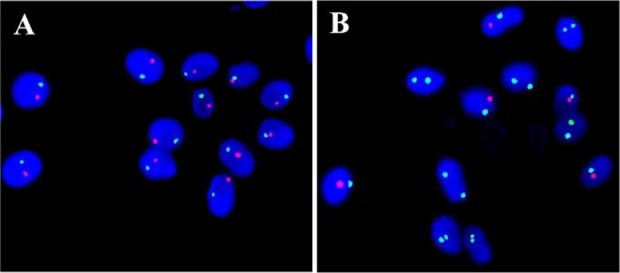
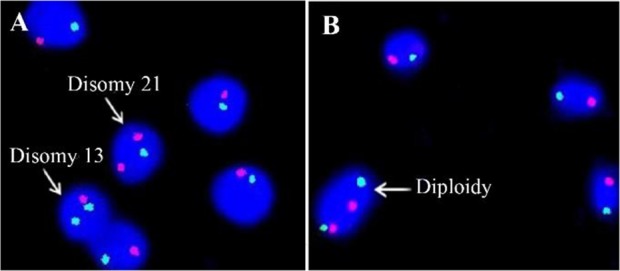
The slides were observed using a suitable filter set on a BX 53 Olympus fluorescence microscope, and the signals present in each sperm were enumerated and captured using a CCD camera attached with the microscope. Good images were captured and documented using the GENASIS Version 7.2 Software. Sperm aneuploidy and diploidy rates for chromosome 13, 21, 18, X and Y were observed and recorded. In sperm, FISH signals were scored based on previously described criteria (2). In brief, the single signal in individual sperm represents a normal signal pattern for an exact number of chromosomes (Figures 1A and B). If additional signals were present in the cell, they were disomic for autosomes (Figure 2A) and diploid for sex chromosomes (Figure 2B). When the sperm contains two signals for each chromosome, then it is considered as diploidy. When there are no signals on sperm, it is considered as nullisomic, and nullisomic sperm could be observed in all the samples analyzed.
Terminal deoxynucleotidyl transferase-mediated deoxyuridine triphosphate (dUTP) In Situ DNA nick end labelling (TUNEL) assay was performed with a slight modification of sperm suspension after density gradient separation as previously described (10). A part of semen sample from the control group and patients were washed with 20 ml of PBS and spun at 2000 rpm for 10 min. The supernatant was discarded, and the cells were resuspended with 4% paraformaldehyde fixation buffer and permeabilized with 0.25% Triton X-100 in PBS. The supernatant was discarded and 1 ml of cold 70% (v/v) ethanol was added and stored at −20°C until further process. DNA strand breaks were detected by using a commercially available kit (Click-iT Plus TUNEL assay for In Situ apoptosis detection with Alexa Fluor dyes, molecular probes, life technologies) according to the manufacturer’s instructions.
Positive control was performed with 1 unit of DNase I diluted into DNase I Reaction Buffer (x 1) for 30 min at room temperature. After incubation, the slides were washed with deionized water and further proceeded to TdT reaction.
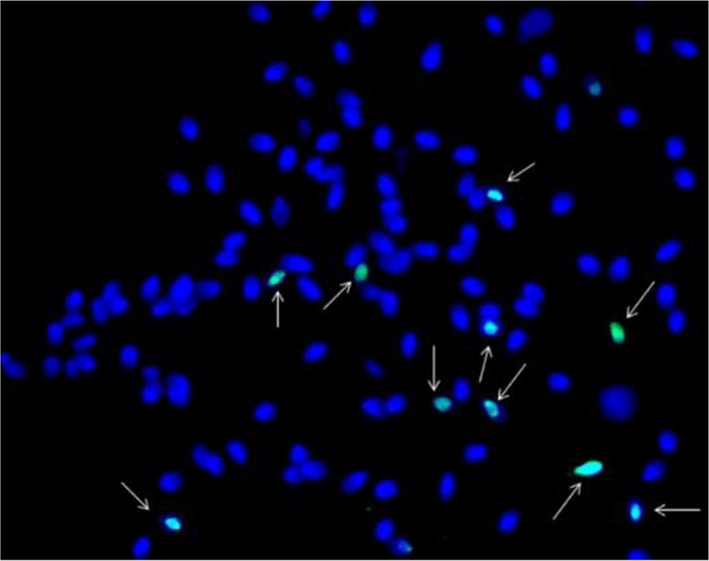
The percentage of spermatozoa with fragmented DNA was determined by direct observation of 500 spermatozoa per sample with Olympus BX 53 fluorescence microscope. The sperm cells were counterstained with Hoechst 33342 (Blue). Fluor 488 picolyl azide dye (Green) was used to detect the sperm with TUNEL positive strand breaks. Sperm with DNA fragmentation were clearly visible in green color (Alexa), and sperm without DNA fragmentation were in blue color (Hoechst 33342) (Figure 3).
The collected data were summarized by using frequency/percentage for qualitative data and mean with standard deviation for quantitative data. To determine the aneuploidy status and DNA fragmentation index, frequency was used. To compare the mean of sperm aneuploidy and DNA fragmentation rate, student t- test was used. The correlation between sperm aneuploidy and sperm DNA fragmentation along with age was assessed by using Spearman’s correlation coefficient. The p<0.05 was considered statistically significant. Data management and analysis were performed by using Microsoft Excel and Statistical Package for the Social Sciences v16.0.1 (SPSS Inc, Chicago, IL, USA).
The age of 100 subjects ranged between 22–48 years with a mean and standard deviation as 35.5± 5.1. Correlation between sperm aneuploidy and DNA fragmentation with age is given in table 1. A significant correlation between age and sex chromosomal aneuploidy was observed (r=0.363, p<0.05). Sperm aneuploidy frequency (10.1±10.8) was found to be higher in infertile men as compared to fertile men. Increased disomy frequency of chromosome 13 and XY disomy was observed. The DNA fragmentation rate (61.6±21.9) was comparatively high in infertile men than fertile men. The results in table 2 indicate a positive significant difference between sperm aneuploidy and sperm with fragmented (Damaged) DNA (p<0.05); there is no significant difference between sperm aneuploidy and sperm without damaged DNA.
Table 1. The correlation of sperm aneuploidy and sperm DNA fragmentation with age
| Spearman’s correlation | p-value | |
|---|---|---|
| Autosomal aneuploidy (%) | 0.221 | 0.224 |
| Sex chromosomal aneuploidy (%) | 0.363 | 0.041 * |
| Sperm with damaged DNA (%) | 0.273 | 0.130 |
| Sperm with intact DNA (%) | 0.207 | 0.256 |
Indicates statistical significance
Table 2. The obtained mean value between total sperm aneuploidy with damaged DNA and without damaged (Intact) DNA
| Mean±SD | p-value | |
|---|---|---|
| Sperm aneuploidy | 4.41±8.6 | - |
| Sperm with damaged DNA | 26.9±34.1 | <0.05 * |
| Sperm without damaged DNA | 16.8±24.0 | >0.05 |
Indicates statistical significance
Our observation showed the percentage of sperm aneuploidy increases by the age of infertile men, mainly on sex chromosomal aneuploidy. Wyrobek et al. (11) had the largest investigation and observed the major association between age and frequencies of aneuploidy and diploid sperm. A study conducted by Martin et al. (12) observed no correlation between paternal age and “sex ratio” in sperm and aneuploidy frequency. The reason for the increased miscarriages and abnormal fetuses is abnormal sperm aneuploidy and the most widely used protocol to estimate the sperm aneuploidy frequency is FISH (13). Our results are similar to those reported by Aran et al. (14) who found an increase in sex chromosome disomy and diploid spermatozoa in infertile men. Moosani et al. (15) observed a significant increase in the frequency of disomy for chromosome 1 and XY disomy by FISH and they also observed increased frequencies of numerical abnormalities by sperm karyotyping. In our study, increased disomy frequency of chromosome 13 and XY was observed.
Our results showed an increased rate of DNA fragmentation in infertile men compared to control men, not with age. A study conducted by Singh et al. (16) revealed an increased effect of DNA damage with age and decreased age-related apoptosis in human sperm. Sperm DNA fragmentation by TUNEL assay is a good predictive parameter by its sensitivity and specificity, but not an independent measure of sperm quality (17).
The main outcome of this study indicates a positive significant correlation between sperm aneuploidy and sperm DNA fragmentation. A study conducted by Di Santo et al. (2) manifested that among 109 infertile men, a significant positive correlation existed between sperm DNA fragmentation and sperm aneuploidy and no significant correlation was found with normal men. In our study, similar results were observed. There are previous studies by different authors which confirm the same result (5–7, 18). There was a positive significant correlation between the sperm chromosome abnormality rate by FISH and DNA fragmentation even by using a combined method of Sperm Chromatin Dispersion (SCD) test (19). Another study on four infertile men who were carriers of balanced chromosomal abnormalities has shown the similar results (7). However, no significant correlation between DNA fragmentation and sperm aneuploidy was found by Balasuriya et al. (20). This type of inconsistent results explained that different tests were used to evaluate the sperm DNA fragmentation; there was a different number of probes to detect sperm aneuploidy by FISH and a different method of semen preparation.
In conclusion, it can be concluded that the sperm aneuploidy and sperm DNA fragmentation are important parameters and they may be suitable for clinical practice. The reason that sperm assay is not carried out in routine practice is due to the lack of standardized protocols. By the current study, these techniques were standardized and could be used for regular diagnosis. High frequency of sperm aneuploidy and sperm DNA fragmentation might contribute to low fertilization rate and poor pregnancy outcome. There is significant relationship observed between sperm aneuploidy and DNA fragmentation. These two parameters are important and has to be investigated separately for clinical practice. However, large scale studies with specific infertile men as the subgroup may have benefit for specific therapeutic management.
Authors would like to thank all the study participants. We extend our gratitude to Mrs. Vani Shetty for her technical support. We kindly express our appreciation to K.S. Hegde Medical Academy, Nitte University.
