
Today, obesity has almost become an epidemic disorder that affects about 2 billion people in total; about 1.6 billion adults are overweight and 400 million adults are classified as obese (1, 2). Obesity may affect both the quality of our life and it might cause a number of diseases (3). In the treatment of obesity, it is also important and necessary to treat complications that are caused by obesity as well as obesity itself (4).
Many studies have shown that embryo development and in turn pregnancy is adversely affected by maternal obesity-induced oocyte changes in recent years. The effects of paternal obesity on embryo development and pregnancy have been investigated only in the last 2 to 3 years. Recently, it is reported that the female and male partners are equally responsible for the adverse effects of obesity on embryo development and pregnancy (2).
Fatty Acid Binding Protein 4 (FABP4) is a recently defined lipid-derived molecule that is involved in the transport of lipids and other hydrophobic molecules between intracellular and extra-cellular domains. Positive correlations between serum FABP4 levels, and markers of metabolic syndrome and vascular disease have been reported in various studies. As a result of studies with FABP4 knockout and FABP4 inhibitor-administered mice, FABP4 has been reported to have therapeutic effects on obesity associated with atherosclerosis, hypertriglyceridemia and insulin resistance (4).
The drug called BMS309403 is a specific inhibitor of FABP4 and inhibits the effect of FABP4 as a competitive hydrophobic ligand (5). Experimental studies have revealed protective effects of the drug against obesity and the development of obesity-induced complications such as atherosclerosis, hyperlipidemia, insulin resistance, and fatty liver disease (6,7).
The aim of our study was to investigate the effects of the drug BMS309403 on male fertility disorder, a common complication of obesity. In line with this goal in the project, obesity was established in male mice, and the histological examination of spermatogenesis status, apoptotic B-cell lymphoma -2 (BCL-2), BCL-2 associated X (BAX) protein expressions and DNA integrity of testis tissue were examined. In addition to the tissue study, total testosterone, sex hormone binding globulin (SHBG), inhibin-B and FABP4 protein levels were analyzed in serum.
Experimental animals: This study was approved by the Necmettin Erbakan University, KONUDAM Experimental Medicine Application and Research Center’s Experimental Animal Ethics Committee (No: 2014-057). A total of 56 male Balb/c mice (16–19 g: 63 days old) were used. The mice were housed in a room with an average temperature of 20°C, approximately 45% relative humidity, ventilated 15 times per hour, in 12/12 hr light-dark period. All groups were fed the same standard mouse chow.
Experimental design: After a 1-week acclimation period, animals were randomly divided into four groups, 1st as control group (CG, n:7), 2nd as obese control group (OCG, n:8), 3rd as obese solvent group (OSG, n:10), and 4th as obese drug group (ODG, n:12). All of the mice were weighed at the beginning of the study and the Lee Index of Obesity (LIO) was calculated (8). Then, The OCG, OSG, and ODG were fed with a high sucrose diet from the beginning to the end of the study. The development of obesity in the mice was evaluated by monitoring LIO every 2 weeks. When the LIO was greater than 0.3, the mice were considered obese (9). At the beginning of the 10th week, it was determined that all the mice in the OCG, OSG, and ODG had LIO: ≥0.3 (Table 1). After this, BMS309403 (15 mg/kg/day) and a solvent of BMS309403 (Dimethyl sulfoxide) were administered to the ODG and to the OSG, respectively by oral gavage for five weeks (6, 10).
Table 1. The body weight (BW) and Lee Index of Obesity (LOI) measurement results (mean±SD)
| Groups | BW/LIO | Initial | 6th week | 9th week | 15th week |
|---|---|---|---|---|---|
| CG | |||||
| BW (g) | 17.29±1.19 | 19.81±1.08 | 21.74±1.03 | 23.16±0.99 | |
| LIO | 0.260±0.008 | 0.268±0.009 | 0.274±0.005 | 0.277±0.004 | |
| OCG | |||||
| BW (g) | 17.20±0.78 | 24.18±0.81 a | 27.46±0.64 a | 32.24±0.91 a | |
| LIO | 0.269±0.004 | 0.294±0.005 a | 0.304±0.005 a | 0.316±0.005 a | |
| OSG | |||||
| BW (g) | 16.90±0.80 | 23.98±0.89 a | 27.75±0.76 a | 31.83±0.88 a | |
| LIO | 0.266±0.005 | 0.291±0.003 a | 0.302±0.005 a | 0.312±0.004 a | |
| ODG | |||||
| BW (g) | 17.06±0.69 | 24.05±0.81 a | 28.10±0.73 a | 34.48±1.25 a,b | |
| LIO | 0.262±0.006 | 0.288±0.006 a | 0.301±0.003 a | 0.320±0.007 a |
Statistical evaluation between the groups (according to CG.
p<0.001 and according to OSG.
p=0.003); CG: Control group; OCG: Obese control group; OSG: Obese solvent group; ODG: Obese drug group
Preparation of high sucrose diet and BMS30940: 30% (v/v) liquid sucrose (Sunar Misir integrated Industry Co) was added to the drinking water (DW) (11, 12). BMS309403 (Cayman Chemical Co, cas No: 300657-03-08) was dissolved in Dimethyl sulfoxide (DMSO, Sigma-Aldrich Chemical Co, cas No: 67-68-5).
Biochemical analysis: At the end of the 14th week, the nutrition of all groups was stopped at 7:00 am and euthanasia was performed with exsanguination under anesthesia (50 mg.kg−1 ketamine/10 mg.kg−1 xylazine) at 1:00 pm. Blood samples taken from the heart were transferred to biochemical tubes with gel and clot activator, allowed to clot at room temperature for 30 min and then centrifuged for 10 min at 2000x g, and the supernatant was stored at −80°C until the analysis.
Total testosterone (Cat No: YHB1275Mo), SHBG (Cat No: YHB1208Mo), FABP4 (Cat No: YHB-1491Mo) and inhibin-B (Cat No: YHB0749Mo) tests were performed in serum through ELISA method (Yehua Biological Technology Co.) Free androgen index (FAI) values were calculated as described (13).
Tissue analysis: Testis sections were stained with Hematoxylin-Eosin and quantitatively assessed through Johnson Score for spermatogenesis and germ cell health. In addition, TUNEL-positive cell counts (Apoptag in situ apoptosis detection kit, Sigma-Aldrich Chemical Co.), BCL-2 and BAX (Abcam Chemical Company, Cat No: ab7973, Cat No: ab7977, respectively) expression measurements were performed through immunohistochemical methods to evaluate apoptosis.
Statistical analysis: The data obtained were statistically evaluated using the Statistical Package for the Social Sciences version 16.0 program. The ANOVA-Tukey HSD test was applied to the TUNEL method and the Johnson Score. Weight and LIO parameters were analyzed through ANOVA in repeated measures. It was checked through Mauchly’s Test of Sphericity, Bonferroni correction and Dunnett test. The Mann-Whitney U test (FABP4, total testosterone, Inhibin-B, SHBG, FAI, BAX, and BCL-2) was applied in a binary comparison between the groups. The value of p< 0.05 was considered statistically significant.
The body weight and LIO: In the OCG, OSG, ODG, obesity developed from the 9th week onwards (LIO ≥0.3). At the end of the 6th week, there was a significant increase in the body weight (BW) of the OCG, OSG, and ODG according to the CG (Table 1).
FABP4, total testosterone, FAI, inhibin-B and SHBG: Serum total testosterone, FAI, inhibin-B, and SHBG values were significantly lower in all obese groups than in the CG. In addition, serum inhibin-B value in the ODG was significantly lower than the one in the OCG and OSG. Serum FABP4 value was found to be higher in the OCG and OSG compared to the CG and ODG (Table 2).
Table 2. Median and interquartile range values of biochemical parameters
| Groups | FABP4 (ng/ml) | Total testosterone (nmol/l) | FAI | Inhibin-B (ng/l) | SHBG (nmol/l) |
|---|---|---|---|---|---|
| CG | 0.347 (0.208) | 8.411 (1.712) | 83.131 (22.73) | 36.148 (13.15) | 9.84 (1.08) |
| OCG | 0.496 (0.118) a | 5.722 (3.016) a | 67.024 (15.39) a | 29.007 (11.21) a | 7.734 (3.08) a |
| OSG | 0.513 (0.136) a | 4.561 (1.952) b | 71.716 (32.67) a | 26.758 (12.77) a | 7.237 (2.70) b |
| ODG | 0.306 (0.149) a,e,g | 4.093 (0.818) c | 56.587 (23.66) c | 19.59 (8.90) c,d,f | 7.368 (3.29) a |
Statistical evaluation between the groups (according to CG.
p: <0.05,
p: <0.01,
p: <0.001; according to OCG.
p: <0.05,
p: <0.001; according to OSG.
p: <0.05,
p: <0.001)
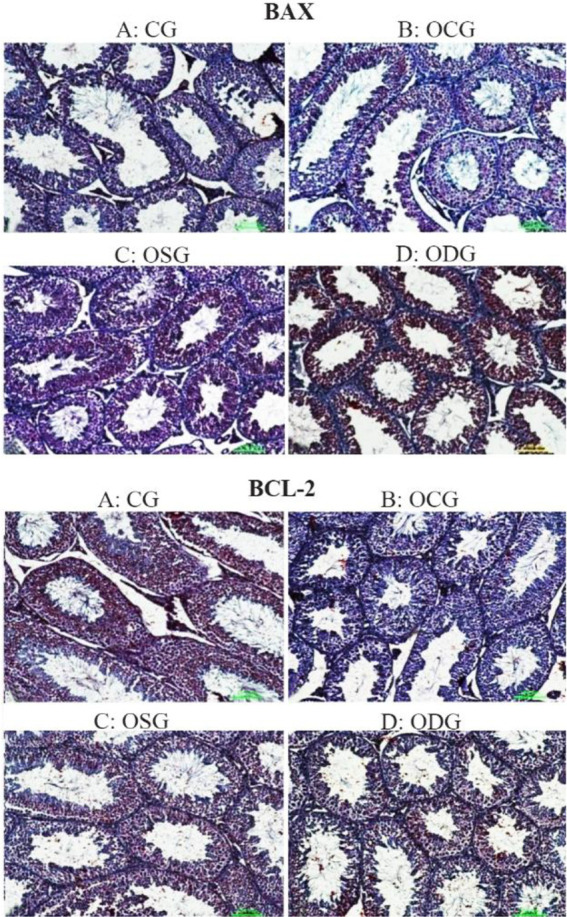
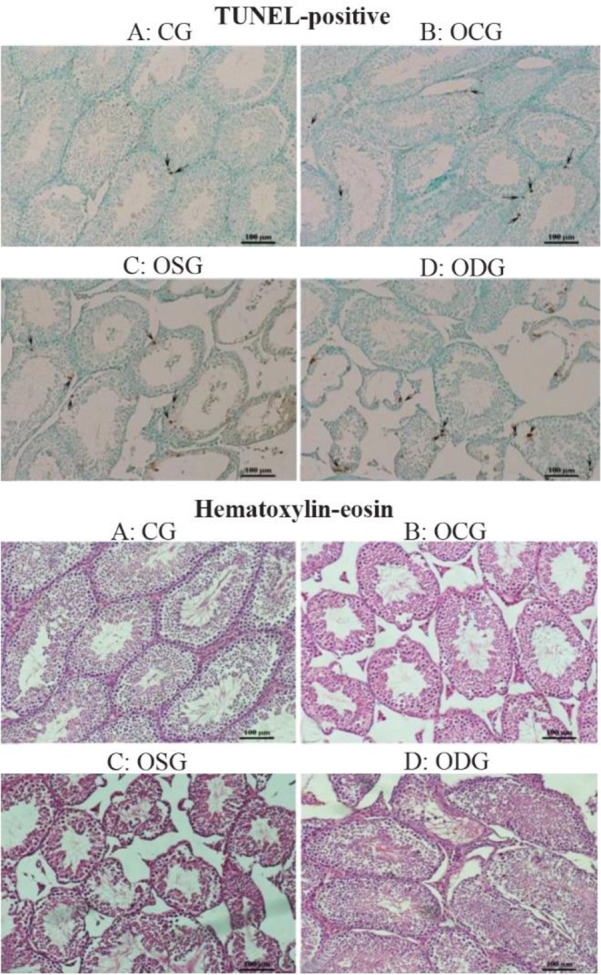
Johnson Score and apoptosis markers: The BAX parameter increased in all obese groups compared to the CG, and the BCL-2 parameter was significantly lower in all obese groups than in the CG (p<0.05). The Johnson Score was lower in all obese groups than in the CG (p<0.05). The number of TUNEL-positive staining cells was found to be higher in the all obese groups than in the CG (p<0.05), and other results are given in table 3.
Table 3. Median (50%) and interquartile range values of BAX, BCL-2 positive cells of groups
| Groups | BAX positive | BCL-2 positive | TUNEL positive | Johnson score | ||||
|---|---|---|---|---|---|---|---|---|
| %25 | %50 | %75 | %25 | %50 | %75 | |||
| CG | 0 | 0 | +1 | +3 | +3 | +3 | 0.14±0.03 a | 9.52±0.17 a |
| OCG | +2 | +2 | +3 | 0 | +1 | +1 | 0.26±0.05 b, c | 6.88±0.12 b |
| OSG | +2 | +2 | +3 | +1 | +1 | +1 | 0.25±0.06 b | 7.05±0.22 b |
| ODG | +2 | +3 | +3 | 0 | +1 | +1 | 0.34±0.04 c | 6.64±0.05 c |
Johnson Score and TUNEL method (mean±SD). Different superscripts in the same columns indicate a significant difference (a–c: p<0.05)
The results of BAX immunohistochemical staining revealed a significant difference between the groups (p=0.001). A significant increase was detected between the CG-OCG, CG-OSG and CGODG groups. BAX expression increased in OCG, OSG and ODG groups compared to CG group. There was no difference between the other group comparisons.
There was a significant difference between the groups of Kruskal Wallis test for BCL-2 immunohistochemical staining (p=0.001). A significant decrease was detected between the groups of CGOCG, CG-OSG and CG-ODG groups according to the results of the Man-Whitney U test. BCL-2 expression decreased in OCG, OSG and ODG groups compared to CG group. There was no difference between the other group comparisons.
There was no positive or negative effect of DMSO, used as a BMS309403 solvent in the study, on obesity and fertility. DMSO is a commonly used lipophilic drug carrier that can penetrate almost all the cells without harming the skin and membranes (14).
In this study, the effects of BMS309403 on male fertility disorders which are one of the complications of obesity have been investigated. Moreover, histological evaluations have been examined in the testicular tissue.
In our study, BMS309403 was administered to mice with diet-induced obesity. This administration led to a higher BW increase than the OCG in the ODG. The reason for BW increase in the ODG may be the inhibition of lipolysis and the increase in adipogenesis as a result of FABP4 inhibition (13). Thus, our findings are consistent with studies investigating the effects of BMS-309403 due to inhibition of FABP4 (4, 15).
FABP4 expression is enhanced by insulin, fatty acids, dexamethasone, and peroxisome proliferator-activated receptor gamma (PPARγ) activation as a marker of adipocyte differentiation. Evidence from genetic mouse models suggests that PPARγ directly increases FABP4 gene expression, while FABP4 decreases PPARγ activity (16). FABP4 regulates cholesterol efflux in macrophages by inhibiting the PPARγ/liver X receptor-α/ATP binding cassette transporter A1 pathway and contributes to foam cell formation (17). In the absence of FABP4 in mice, the production and function of many proinflammatory cytokines (Tumor necrosis factor α, interleukin 1β, interleukin-6, monocyte chemoattractant protein-1) and proinflammatory enzymes (inducible nitric oxide synthase, cyclooxygenase-2) decreased in macrophages. However, in studies conducted in humans, the number of studies in which similar results are obtained is fewer (18). In studies in which FABP4 inhibition was genetically and pharmacologically studied in diabetic obese mice, the inhibition of FABP4 is shown to increase weight gain as opposed to no weight-reducing action. However, it is also shown to reduce the development of obesity-related complications such as insulin resistance, type 2 diabetes mellitus, and atherosclerosis (15).
Deprivation of FABP4 significantly affects two major metabolic processes. The first is the reduction of non-esterified fatty acid release from fat tissue, and the second is the increase in the use of glucose in tissues instead of fatty acids (19). Obesity complications may be due to lipid molecules, such as long-chain free fatty acids, rather than increased fat mass (20). This suggests that treatment methods targeting FABP4 may be effective on secondary metabolic and inflammatory complications of obesity rather than the obesity itself.
In obesity, increased peripheral testosteroneestradiol conversion due to increased peripheral fat tissue (through the high amount of aromatase enzyme in the fat tissue) may cause hypothalamichypophyseal-gonadal axis disturbance and secondary hypogonadism (2). In the suprapubic and scrotal region, increased fat tissue may impair spermatogenesis by raising the testicular temperature. Besides, leptin levels which rise along with increasing fat tissue in obesity may reduce testicular testosterone production (21–23). Due to increased obesity-related DNA fragmentation index and increased reactive oxygen radicals, there may be a decrease in sperm quantity and quality (21). Consequently, erectile dysfunction may develop (24). It has been found that male fertility markers (Serum total testosterone, FAI, inhibin-B, and SHBG) were significantly lower in obese groups (Especially in the ODG) than in the CG (Table 2). It is observed in our findings that the use of BMS309403 did not have any beneficial effects on male fertility, but on the contrary, there may be adverse effects. These adverse effects may be related to the increase in BW and also to the increase in obesity by delivery of BMS309403 to the ODG.
In obese males, fertility impairment can’t be determined by only examining sperm quality by spermiogram method, but also physical and molecular structure of germ cells and the morphological state of sperm should be considered at different maturation stages (2). This condition was evaluated with apoptosis markers and Johnsen Score, and the lowest Johnsen Score in all groups was found in the ODG (Table 3, Figures 1 and 2). Our data comply with the data presented by Palmer et al. (2). In all these findings, pro-apoptotic processes may be induced in experimental obesity in the testis, that Johnsen Score may be reduced, and that BMS309403 administration does not have any healing effects on these processes; on the contrary, it increases apoptosis.
When all the parameters (Biochemical and histological) in our study were evaluated together, it was observed that BMS309403 administration to obese male mice increased pro-apoptotic processes and spermatogenesis disorder and also caused decreases in sex hormone levels (Tables 1–3). BMS309403 leads to an increase in LIO, and as a result, negative changes in reproductive parameters may be developed, accompanied by the increasing LIO.
According to our data the use of BMS309403 did not have any beneficial effects on male fertility, but on the contrary, there may be adverse effects. These adverse effects may be related to the increase in BW and also to the increase in obesity by delivery of BMS309403.
This work was supported by Necmettin Erbakan University Scientific Research Projects Commission (project no. 151518004).
