
Despite having enhanced life expectancy in patients who have cancer, chemotherapy and radiotherapy may cause infertility which should be taken into consideration for improving quality life after cancer treatment. Therefore, these patients should use assisted reproductive techniques before starting the cancer treatment. Ovarian tis sue cryopreservation (OTC), mature and immature oocyte and embryo cryopreservation are the most used fertility preservation techniques (1, 2). Ovarian tissue cryopreservation can have several benefits including development of a large number of follicles in ovaries, no need for ovarian stimulation, no delay in the process of cancer treatment as well as no need for having a partner or gametes donation during cryopreservation; accordingly, in-vestigators have used ovarian tissue cryopreservation for fertility preservation during recent years (3).
Vitrification is a rapid and simple technique which is proposed to preserve fertility in women suffering from cancer before chemotherapy and radiotherapy, and early ovarian failure as well. Tissue injury may be the result of high levels of cryoprotectants and extremely cold temperatures used to preserve the tissue by vitrification. However, vitrification of the ovary requires further investigation due to high density of tissue and the possibility of apoptosis during the freezing and thawing process. Apoptosis may be induced during the freezing process due to changes in physical conditions. When the apoptosis process is induced in the cell, cell death cascade activates the caspases, resulting in cell destruction. There are various reports of cell death after thawing of vitrified ovarian tissue (4, 5). Recently, encapsulation has proven to be a useful method to protect tissues and cells in different conditions. This method is a simple process that avoids destructive intracellular and extracellular ice-crystal formation through a higher rate of cryopreservation; however, it does not require special or expensive equipment (6). There are some studies investigating the effects of vitrification on ovarian tissue but the reports are contradictory due to using high concentrations of cryoprotectants (7–10). However, regardless of the cryopreservation method, sudden damage can happen due to freezing and warming (11, 12). Encapsulation is a method that has been investigated and proposed to protect cells and tissues in different conditions. It was reported that microencapsulation of embryonic stem cells in alginate hydrogel can effectively inhibit intracellular freezing/thawing during heating (13). Alginate hydrogel is a natural polymer extensively used in tissue engineering. It is produced by brown algae consisting of guluronic acid (a-L guluronic-acid) and mannuronic acid (b-D mannuronic-acid). Alginate hydrogel encapsulation is a very simple process that does not need any light or high temperature (14). It has been shown that the encapsulation of follicles isolated from ovarian tissue in alginate hydrogel supports follicle growth and oocyte maturation in vitro (15). In a study by Shikanov et al., the fresh ovaries were encapsulated to improve post-transplantation angiogenesis, and the results showed that encapsulation of the fresh ovary could improve post-transplantation ischemia (16). There has been a successful report of the encapsulation of vitrified ovary with different hydrogels in order to improve post-transplantation angiogenesis (17, 18).
In the mentioned studies, the ovary has been encapsulated and examined after freezing and warming. Since ovary has not yet been encapsulated to improve the possible destructive effects of vitrification, in this study, an attempt was made to investigate the effect of encapsulation in alginate hydrogel on morphology and expression of apoptosis-related genes of vitrified mouse ovary.
Chemicals and reagents: All chemicals and reagents used in this study were from Sigma-Aldrich, UK, unless otherwise stated.
Animals: Twenty-five female 8-week-old National Medical Research Institute (NMRI) mice were sourced from Anatomical Research Center of Kashan University of Medical Sciences and maintained on a 12/12-hr light/dark cycle at controlled temperature (20°C) and provided with unlimited food and water.
Ovarian preparations: Since the morphology of the follicles varies in each phase, the animal cycles should be the same. Therefore, sterile saline (NaCl 0.9%) at 37°C was used to wash the vagina. One drop of vaginal fluid from each mouse was placed on glass slides and was observed under a light microscope (Magnification×400). According to the cytology of vaginal smear, the mice were classified into four phases (Proestrus, estrus, metestrus, and diestrus) (19). In this study, mice in the diestrus phase were used due to the long duration of this phase and enhanced cell visibility. They were killed by cervical dislocation and their ovaries were dissected free of fat and mesentery and stored for the following experiments.
Experimental design: The collected ovaries were divided into five groups (n=5, each group) of nonvitrified ovaries, vitrified ovaries, ovaries that were encapsulated with alginate hydrogel at concentrations of 0.5%, 0.75% and 1% and then vitrified (Exp1, Exp2, and Exp3, respectively).
In each group, the right ovaries were fixed for evaluation and left ovaries were frozen (−70°C) for molecular evaluation.
Vitrification and warming: The vitrification procedure used in the study was according to the Kagawa’s method (17). First, the ovaries were immersed in an equilibrium solution composed of 7.5% ethylene glycol (EG) and 7.5% dimethyl sulfoxide (DMSO) and 20% human serum albumin (CSL Behring, Germany) in HTCM-199 (Gibco, UK) for 25 min on the ice. Then, they were transferred to a vitrification solution composed of EG and DMSO (Each one 20%) and 0.5 mol/L sucrose in HTCM-199 for 15 min on the ice. Finally, they were placed on cryotop before plunging in liquid nitrogen.
After 30 min in liquid nitrogen, a three-step warming process was performed; first, the ovaries were placed in HTCM-199 supplemented with 1 mol/L sucrose for 1 min at 37°C. Then, they were placed in HTCM-199 supplemented with 0.5 mol/L sucrose for 5 min at room temperature. In the third step, they were placed in HTCM-199 alone for 10 min at room temperature.
During all the steps of vitrification and warming, the ovaries were shaken in 1 ml of the stated solutions.
Toxicity test: A toxicity test was conducted to examine the effect of the vitrification solution on the viability of mouse ovarian follicles. In short, the ovaries were exposed to the cryoprotectant solution (n=5) and passed through all stages of the vitrification process, excluding the liquid nitrogen plunge. The cryoprotectant was immediately extracted from the tissue after dehydration by moving the ovaries for 5 min at room temperature into descending sucrose solutions. Then its morphology was compared to the non-vitrified group.
Alginate hydrogel encapsulation: Before vitrification, ovaries in experimental groups were encapsulated in alginate hydrogel. To make an alginate solution, sodium alginate was dissolved in phosphate buffer saline to reach concentrations of 0.5%, 0.75%, and 1% (w/v). Each ovary was transferred to 100 μl of alginate solution and immersed in the cross-linking solution (140 mM NaCl+50 mM CaCl2) and after 2 min, alginate hydrogel was formed around the ovary.
Follicle count and histological evaluation: After warming the ovaries, they were fixed by Bouin’s solution (2 hr) and 10% formalin (24 hr)., After the passage of the tissue and preparing a paraffin block, serial 5-μm sections were prepared; every 5th section of each ovary was mounted on a glass slide, and stained with hematoxylin and eosin. Only follicles with a nucleus were counted. The follicles were classified according to the morphology of the granulosa cells (GCs): (a) primordial follicle, an oocyte surrounded by a layer of flatted GCs; (b) primary follicle, an oocyte surrounded by a layer of cuboidal GCs; (c) secondary follicle, a growing oocyte with several layers of cuboidal GCs; (d) antral, a follicle with multilayered cuboidal GCs with antrum (20). Normal follicles organized GCs with normal staining. Pyknotic oocyte nuclei, shrunken ooplasm, and GCs isolated from the oocyte were considered as degenerate follicles (21).
RNA extraction and cDNA synthesis: Total RNA was extracted from the whole ovary in all groups using an RNA extraction kit (WizolTM Reagent, Korea) according to the manufacturer’s instructions. The Nonodrop and electrophoresis on agarose gel were used to evaluate the extracted RNA quantitatively and qualitatively. Finally, cDNA was synthesized from 1-μg high-quality mRNA using a commercial kit (WizScriptTM RT Master, Korea) according to the manufacturer’s instructions at 42°C for 30 min. The synthesized cDNA samples were stored at −20°C until use.
Real-time RT-PCR: Using specified primers (Table 1), the Bcl-2, Bax, and caspase 3 genes were amplified. HPRT was considered as the housekeeping gene and its expression was checked amongst different groups. The primers were synthesized by Sinacolon Co. (Tehran, Iran). After reverse transcription, 1 μl of reverse-transcribed cDNA product was added to the PCR reaction with 10 μl of PCR 2x mix and 0.5 μl of each primer. The reaction volume was made to 20 μl with DEPC water. The PCR reaction cycles were set for denaturation at 95°C for 30 s, annealing at 60°C (For Bax and Bcl-2) and 55°C (For caspase 3) for 45 s and elongation at 72°C for 45 s for 35 cycles. On 1% (w/v) agarose gel, 1 μl of each amplified product was separated, stained with 1 μg/ml green view, and photographed under UV light.
Table 1. Sequence, size, and temperature of primers
| Name | Primer pair sequences (5-3) | Fragment size (bp) | Tm |
|---|---|---|---|
| HPRT | F: GCTCGAGATGTCATCAAGGAG R: CGTGATTCAAATCCCTGAAG | 131 | 60.00 60.00 |
| Bax | F: TTTGCTACAGGGTTTCATCCAG R: GTCCAGTTCATCGCCAATTC | 139 | 59.82 59.82 |
| Bcl-2 | F: GAGAGCGTCAACAGGGAGAT R: ACAGCCAGGAGAAATCAAACA | 169 | 61.40 61.40 |
| Caspase3 | F: ATGGACAACAACGAAACCTC R: GTACCATTGCGAGCTGAC | 200 | 54.51 57.30 |
After reconfirmation of gene expression with RT–PCR, one-step real-time PCR was performed according to the commercial kit (WisPureTM qPCR Master, Korea). Before the quantitative analysis, optimization procedures were performed by running real-time PCR with or without a template to verify the reaction conditions, including the annealing temperatures of the primers and specific products. Real-time heating conditions included a holding step at 95°C for 5 min, cycles of 95°C for 15 s, 58°C for 30 s and 72°C for 15 s, followed by melt curve at 95°C for 15 s, 60°C for 1 min and 95°C for 15 s.
For each sample, the reference gene (HPRT) and the target genes were amplified in the same run. After completing the PCR run, a melt curve analysis was used to confirm the amplified product and record the CT values. Standard curves were obtained using the logarithmic dilution series of total RNA. Then, relative quantification of target genes was determined using the Pfaffl method.
Statistical analysis: Statistical analysis was carried out using one-way analysis of variance and Fisher’s Least Significant Difference (LSD) post hoc test with SPSS software 16.0. The Kolmogorov– Smirnov method was used to check normality of distribution. The results of the data were expressed as mean±SE. Differences were considered statistically significant if the p-value was <0.05.
Histological evaluation of ovarian tissue: Based on morphological outcomes, ovarian morphology was maintained in all groups. The ovary was covered by simple cuboidal epithelium. The cortical stroma was composed of strands of cellular connective tissue supporting scattered interstitial cells and growing follicles, while the medulla contains the large blood vessels and nerves. In some sections, and in particular, in the center of the ovary in vitrified experimental groups, there was a gap between the most inner granulosa cells and the oocyte, which could be considered as vitrification injuries or encapsulation (Figure 1).
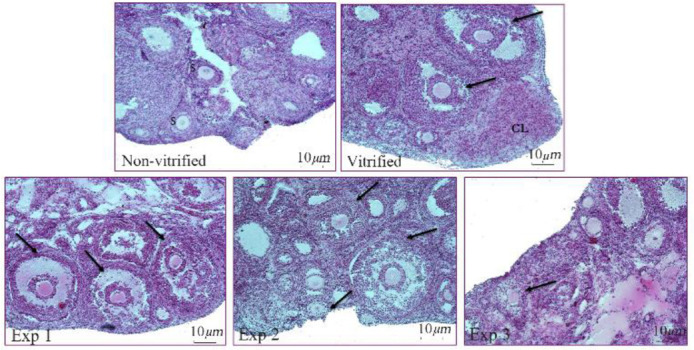
Corpus luteum and follicle count: Mean total follicles in non-vitrified, vitrified, Exp1, 2, and 3 groups were 169.6, 165.8, 128.2, 122.2, and 143.6, respectively indicating that all groups were not significantly different. The average number of intact follicles in vitrified groups decreased in comparison to non-vitrified group, but this reduction was not significant. The lowest number of atretic follicles in the non-vitrified group and the highest number of atretic follicles in the experimental group 1 were observed. The average number of total atretic follicles between the vitrified and experimental groups was not significantly different, while in terms of the mean of total atretic follicles, there was a significant increase in experimental group (p<0.05).
The average number of intact primordial/primary follicles was lower in vitrified and experimental groups than the non-vitrified group, but this reduction was not statistically significant. No significant difference was observed in the average number of intact primordial/primary follicles between the vitrified and experimental group. The mean number of intact secondary follicles in vitrified and experimental groups significantly decreased in comparison to non-vitrified group (p<0.05). There was no significant difference in the mean number of intact secondary follicles between vitrified and experimental groups. Moreover, there was no significant difference between the mean of the intact antral follicles in all groups. The mean number of corpus luteum in all groups was not significantly different. The mean number of corpus luteum in the experimental group 3 was higher than vitrified and other experimental groups, but this increase was not significant (Table 2).
Table 2. Mean±SE of intact follicles counted in different stages of development
| Follicles | Groups | ||||
|---|---|---|---|---|---|
| Non-vitrified | Vitrified | Exp1 | Exp2 | Exp3 | |
| Primordial/primary | 111.8±21.81 | 102±38.89 | 87.2±7.72 | 76±27 | 94±16.6 |
| Intact secondary | 44.2±5.16 | 17.8±4.25 * | 15.4±2.03 * | 16.4±2.31 * | 16.8±3.42 * |
| Intact antral | 1.8±0.8 | 0.6±0.24 | 0.8±0.37 | 0.8±0.37 | 0.8±0.37 |
| Corpus luteum | 10±1.04 | 7.4±1.8 | 7.8±1.85 | 6.8±2.39 | 9±1.34 |
| Intact | 164.2±13.35 | 123.6±21.7 | 83.6±6.8 * | 86.4±3.8 * | 104.2±19.03 * |
| Atretic | 5.4±0.87 | 42.2±6.36 * | 44.6±2.06 * | 35.8±8.41 * | 34.4±2.6 * |
| All follicles | 169.6±3.72 | 165.8±25.11 | 128.2±8.48 | 122.2±7.55 | 143.6±21.16 |
p<0.05: vitrified versus non-vitrified group in each row
Expression of apoptosis-related genes: The expression of genes of interest was compared to the housekeeping gene (HPRT) in the vitrified and experimental groups (Figure 2).
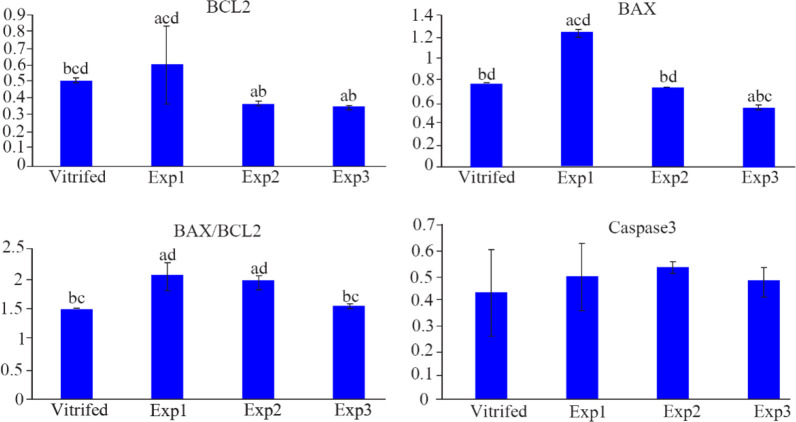
As shown in table 3, the amount of anti-apoptotic gene expression of Bcl-2 in experimental group 1 increased in comparison with the vitrified group, which was statistically significant (p<0.05). The amount of expression of this gene in experimental groups 2 and 3 decreased compared to the vitrified and experimental group 1 and this decrease was statistically significant (p<0.05). There was no significant difference in the expression of this gene between experimental groups 2 and 3. The amount of expression of pro-apoptotic Bax in experimental group 1 was higher than that of the vitrified group, which was statistically significant (p<0.05). The expression level of this gene in the experimental groups 2 and 3 was lower than the vitrified group, and this decrease in experimental group 3 was significant in comparison with the vitrified group (p<0.05). The expression of this gene in the experimental group 3 was significantly lower than the experimental group 2 (p<0.05). The ratio of Bax to Bcl-2 gene expression increased in the experimental groups in comparison to vitrified group. The ratio of expression of this gene in experimental group 2 decreased compared to experimental group 1, but this decrease was not statistically significant (p<0.05). The ratio of expression of this gene in experimental group 3 was lower than the experimental groups 1 and 2, and this decrease was statistically significant (p<0.05). The expression of caspase 3 gene in experimental groups increased in comparison with the vitrified group, but this increase was not significant. There was no significant difference in the expression of this gene among the experimental groups, but the lowest expression was observed in experimental group 3 (p<0.05).
Table 3. Expression of genes related apoptosis in the vitrified and experimental groups
| Genes | Groups | |||
|---|---|---|---|---|
| Vitrified | Exp1 | Exp2 | Exp3 | |
| Bcl2 | 0/52±0/008 bcd | 0/61±0/233 acd | 0/37±0/014 ab | 0/35±0/014 ab |
| Bax | 0/77±0/01 bd | 1/25±0/032 acd | 0/73±0/008 bd | 0/54±0/011 abc |
| Caspase3 | 0/44±0/18 | 0/08±0/14 | 0/51±0/023 | 0/85±0/023 |
| Bax/Bcl2 | 1/48±0/005 bc | 2/04±0/23 ad | 1/97±0/053 ad | 1/54±0/029 bc |
The expression of genes was compared to the housekeeping gene (HPRT) in vitrified and experimental groups; 1: Bcl2. 2: Bax. 3: Bax/Bcl2. 3: caspase3. Data are shown as mean±SE.
significant difference compared to the vitrified.
Significant difference compared to exp1.
Significant difference compared to the exp2.
Significant difference compared to the exp3 (p<0.05)
In this study, the effects of ovarian encapsulation on morphology and expression of apoptosis-related genes were evaluated in vitrified mouse ovary. In the experimental groups, when the ovaries were encapsulated and then vitrified, the results showed that the mean of intact follicles decreased in comparison with non-vitrified and vitrified groups and this decrease was significant in comparison with the non-vitrified group. It seems that 1% concentration of alginate in maintaining intact follicles is better than other concentrations. In a previous study, Xu et al. showed that the culture of mouse follicles at a concentration of 1.5 % allowed for normal growth and follicular development (22). Hornick et al. showed that survival rates of preantral follicles of the monkey, encapsulated with 2% sodium alginate concentration, were significantly higher than those encapsulated at 0.5% concentration (23). Sadeghnia et al. showed that during culture, encapsulation of isolated follicles of ovine supported the integrity of the follicular structure in which the follicular growth was better supported in 2% alginate compared to 1% alginate (24).
Mean number of atretic follicles in experimental groups was significantly higher than the nonvitrified group (p<0.05) and was similar to the vitrified group. Follicular atresia is observed at all stages of ovarian follicles. The encapsulation of the ovarian tissue before cryopreservation failed to eliminate the potential effects of vitrification on the ovarian tissue and also failed to reduce the atretic follicles. Abdi et al. compared the two-dimensional and three-dimensional culture of ovarian follicles using different concentrations of sodium alginate. The results of their study showed that encapsulation of follicles isolated from the ovary with sodium alginate in three-dimensional culture does not damage follicles and presumably the encapsulation of the follicles will maintain the structure of the intercellular and membrane of the granulosa cells and will prevent the death of follicles. The highest survival, development, and maturation rate of follicles was observed in follicles encapsulated with 0.5% sodium alginate concentration (14). In another study, Camboni et al. isolated primordial/primary follicles from the vitrified ovaries and encapsulated them in a hydrogel composed of alginates, and then cultured isolated follicles. The results of this study showed that using an alginate matrix as a suppository for freezing, warming and culture of follicles has many advantages (25). The reason for the difference in results is that in the study of Camboni et al., follicles in the early stages of growth from vitrified ovary were isolated and then encapsulated, but in the present study, the ovaries, which had heterogeneous and different cellular components and follicles at different stages of growth, were encapsulated and then vitrification was performed. Based on the results of this study, the encapsulation and vitrification of the ovary mainly affect the larger ovarian follicles and induce undesirable effects on primordial/primary follicles. Therefore, if after the encapsulation and vitrification of the ovary, follicles in the early stages of growth are isolated and cultivated, better results will be obtained, though culturing of primordial follicles takes time and problems may be encountered (26).
A comparison of the results between the nonvitrified and vitrified groups showed that there was no significant difference between the mean numbers of intact primordial/primary follicles. However, the mean number of secondary follicles after vitrification significantly decreased (p<0.05). This means that vitrification does not have a negative effect on primordial/primary follicles, while secondary follicles are more vulnerable to vitrification. These findings are in line with previous studies (27–29). The results show that vitrification can maintain the morphology of primordial/primary follicles (27). In other studies, damage to the oocyte and granulosa cells was observed in most of the secondary follicles isolated from the frozen ovary (28, 29). Factors such as the lack of proper cryoprotectant infiltration to the tissue center, the formation of ice crystals, and the occurrence of osmotic problems during the stages of vitrification or warming can be effective in reducing the number of intact secondary follicles (30). Also, the number of follicular cell layers can be effective. If the number of follicular cells is greater, preventing the permeation or exodus of the cryoprotectant is easier. On the other hand, the power of cell penetration can change with the growth of follicles, and cellular communication becomes more complicated by increasing cellular granulosa and theca layer (31).
In this study, the comparison of the results between the non-vitrified and vitrified groups showed that the mean number of atretic follicles in the vitrified group was significantly higher than the non-vitrified group (p<0.05), which is consistent with previous studies. Zhang et al. observed a higher rate of apoptosis in vitrified ovarian tissue compared with non-vitrified (32). Isachenko et al. report that vitrification is not a good way to freeze the ovarian tissue to maintain better follicle quality and hormonal activity (33).
The molecular analysis showed that the Bcl-2 (Anti-apoptotic gene), Bax (Pro-apoptotic gene), and caspase 3 gene were expressed in all groups. The expression of the Bcl-2 gene in experimental groups 2 and 3 was significantly lower than other groups (p<0.05). There was a significant increase in the expression of the Bax gene in experimental group 1 compared to other groups (p<0.05). Since the balance between these two genes (Bax and Bcl-2) determines the fate of the cells, the ratio of these two genes was compared in all groups. Comparison of the ratio of Bax to Bcl-2 showed that the expression of this gene in the experimental groups 1 and 2 was significantly higher than other groups (p<0.05), indicating that by increasing the concentration of alginate hydrogel, the ratio of Bax to Bcl-2 decreased and the lowest expression was observed in the experimental group 3 and the highest expression was observed in experimental group 1. Also, the difference between experimental groups 1 and 2 was significant in comparison to vitrified group (p<0.05). Also, the difference between the experimental groups 1 and 2 was significant (p<0.05), but there was no significant difference in experimental group 3. It seems that encapsulation was not able to reduce the expression of apoptosis-related genes but since it does not make a significant difference at high concentrations of alginate hydrogels, better results may be obtained with increasing concentrations similar to morphological outcomes which indicated that the number of intact follicles in the experimental group 3 was greater than the other groups. There was no significant difference in the expression of caspase 3 gene in all groups. The expression of these genes in the experimental group was more than the vitrified group, yet not significantly different. The lowest expression of this gene was in the experimental group 3.
It should be mentioned that in a pilot study, maximum and minimum doses of alginate hydrogel were employed and no significant alterations in histological assessments were found (34). However, in this study, 0.5 mol/L of hydrogel as an intermediate dose was used. In addition, in a molecular approach, no significant effects of alginate hydrogel on gene expression profile were found.
Our study demonstrates that encapsulation of ovaries with concentrations of 0.5, 0.75, and 1% of alginate hydrogel could not improve the morphology and molecular aspects of follicles and better preserve intact follicles of vitrified ovaries. However, it is recommended to use high concentrations of alginate hydrogels for encapsulation based on molecular and morphological findings. Yet, more investigations are needed to evaluate new concentrations of alginate hydrogels or other materials and compounds for encapsulation, other genes involved in apoptosis, oxidative effect, etc., which were not assessed in this study due to several limitations.
The authors wish to thank the Research Deputy of Kashan University of Medical Sciences for financial supports.
