
Infertility among men has become a major problem of the 21st century and 10–15% out of the total population of men have been reported to be infertile during their optimal reproductive age (1). More than 50% of the infertile cases are diagnosed as idiopathic infertility (2). During routine clinical examination, further genetic screening should be provided to individuals diagnosed with azoospermia (2). Earlier studies suggested that 5–10% out of the infertile men are diagnosed with non-obstructive azoospermia (NOA) (2). The occurrence rate of chromosomal anomalies or aberrations is reported to be higher in infertile males as compared to fertile males. Amongst the total number of chromosomal aberrations found in infertile men, Robertsonian trans locations and numerical sex chromosome anomalies are the most common (3). Normally, carriers of balanced translocations lack any detectable phenotypic characteristics because most of the breakpoints reside in the non-repetitive regions which do not affect the expression of rearranged chromosomes. On the other hand, in 5% of the cases, the breakpoints can affect gene expressions by splitting the haploinsufficient genes which may cause spermatogenic arrest and result in infertility in carrier males of balanced translocations (4). Numerical chromosomal aberrations are usually found in azoospermia and severe oligoazoospermia cases. Klinefelter syndrome is the most common numerical chromosomal anomaly in 5% and 10% of severe oligoazoospermic and azoospermic patients, respectively (5). Rare cases of balanced Robertsonian or non-reciprocal translocation are reported to be involved in azoospermic patients (6). Carriers of balanced alterations have the ability to give birth, but after fertilization the embryos may possess an unbalanced alteration. It may further lead to death of the infant due to errors in segregation during meiosis (7). The present study is a case report of a novel chromosomal balanced translocation and molecular characterization of an azoospermic male patient and his female partner who were unable to attain pregnancy upon repeated attempts. The male had a novel balanced chromosomal translocation involving chromosomes19 and 22 along with an increased satellite region above one of short arms of chromosome 13. This is the first report describing a novel balanced chromosomal translocation involving chromosome 19 and 22, associated with azoospermia leading to male infertility.
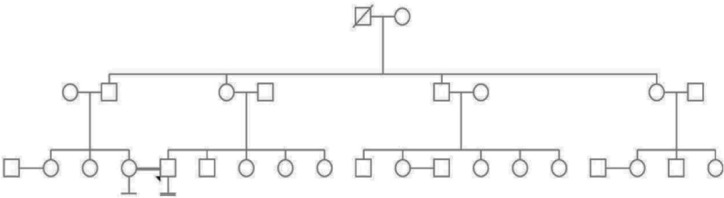
A 28 year old male (Proband) was referred for karyotyping on 14th of December 2018 for general karyotyping. The proband was presented with history of no successful pregnancy after being involved in three years of consanguineous marriage. Semen analysis report of the patient showed low sperm count in the sample provided, and he was diagnosed to have non-obstructive azoospermia (NOA). The proband was presented with no family history of either miscarriage or genetic abnormality among family members for the past two generations as represented with pedigree analysis (Figure 1). Heparinized blood was collected from the proband and his wife for karyotype analysis followed by molecular studies including m-FISH and YMD analysis. Further family screening studies were not carried out due to consent denial aimed to resolve the origin of the translocation.
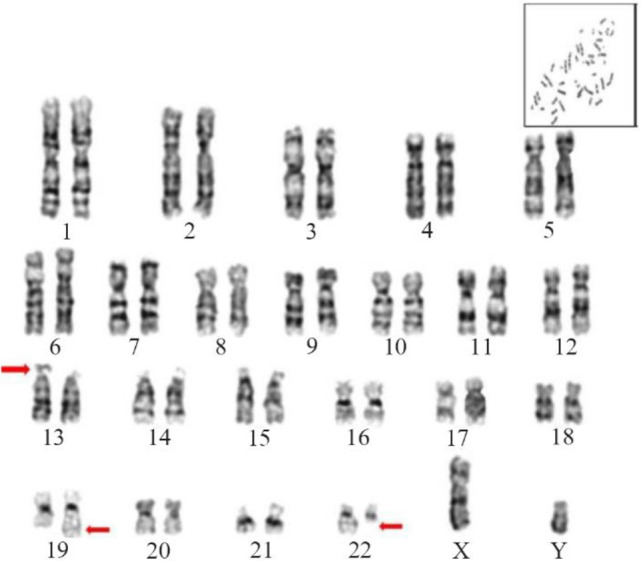
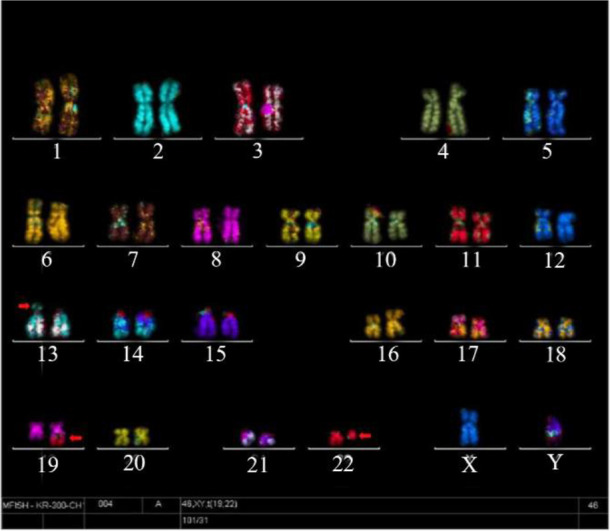
Whole blood was obtained in heparinized tubes from both partners and was processed for karyotyping. In vitro culture was performed using heparinized peripheral blood with RPMI-1640 media complemented with 10% fetal bovine serum, 1% penicillin-streptomycin, and 0.1 μg/ml of colchicine was added at the 67th hour to arrest the cells in metaphase after incubation; next, the cells were harvested, treated with 0.56% potassium chloride, then treated with chilled Carnoy’s fixative until a white pellet was obtained. After that GTG-banding was performed. A novel balanced translocation involving long arm of chromosome 19 and long arm of chromosome 22 was observed. According to ISCN 2016, the karyotype of the male and the female was denoted as 46,XY,t(19;22) (19q13.4;22q11.2),13ps+ and 46,XX, respectively (Figure 2). Also, m-FISH was performed as described earlier with minor modifications (8). m-FISH data coincided with the karyotype analysis and m-FISH data confirmed the chromosomes involved in the balanced translocation (Figure 3).
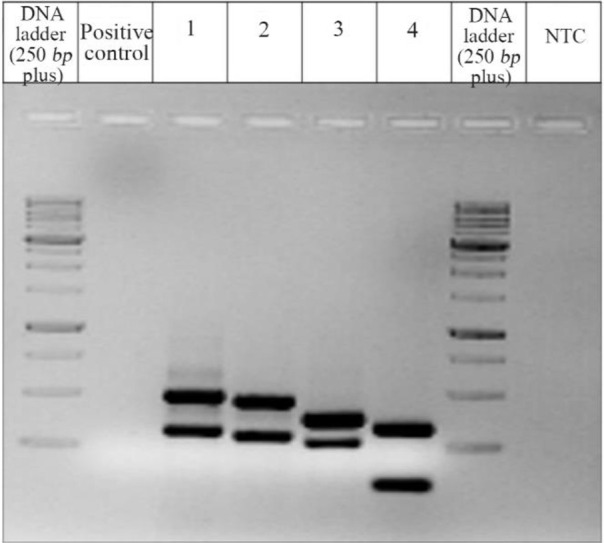
YMD analysis was performed to rule out its association with azoospermia. DNA was isolated by using DNA extraction kit (QIAGEN DNA mini kit, catalogue number-51304) according to the manufacturer’s instructions. A PCR reaction was carried out using primers for AZF loci (AZFa, AZFb and AZFc) involved in Y chromosome microdeletion (9–11) and the PCR product was checked in 1.5% agarose gel. No microdeletion in AZF loci was found in the male partner (Figure 4).
In addition, protein-protein interaction of the proteins located in the breakpoint regions was performed using STRING software (Figure 5A and 5B). Minor alteration(s) in one or few genes in the breakpoint region might be responsible for developing infertility or lower fertility in the patient. Few proteins present in the breakpoint region interacted functionally with each other.
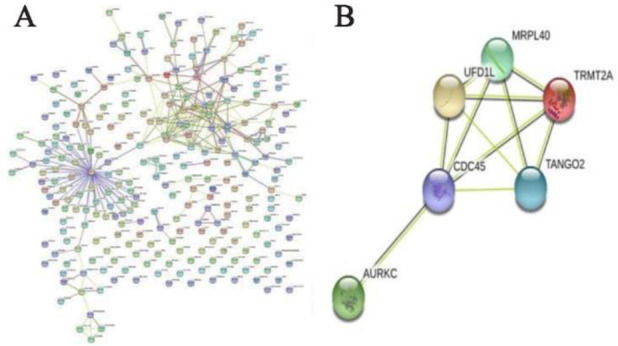
Parental chromosomal rearrangements have been reported in 2–5% of the couples with unsuccessful pregnancy (7). These anomalies include reciprocal and Robertsonian translocations, insertions, inversions and mosaicism (12). Robertsonian translocations account for 35% of the cases carrying a translocation, while 65% of the cases are of reciprocal type (12). Reciprocal translocations, found in 1 out of 500 people, do not produce any phenotypic effects but usually result in recurrent miscarriages, or offspring with chromosomal abnormalities, or infertility in the carriers (13). During meiosis, chromosomes involved in reciprocal translocation form quadrivalent complexes that segregate in such a way that there remain only two possible balanced translocations in the offspring out of 32 translocations (14). The formation of trivalent or quadrivalent structures in translocation carriers during meiosis may lead to reduced fertility, subfertility or infertility due to lack of time and the process involved and also disjunction of the structures which may further lead to production of genetically unbalanced gametes (15). Molecular characterization of breakpoints involved in translocations would elucidate not only the critical genes responsible for the clinical condition but also the mechanism of inactivation through interruption or by position effect (12). It could be speculated that disruption of critical genes through chromosomal rearrangements and their consequent functional impairment possibly result in infertility (12). The karyotype analysis showed a unique balanced translocation between chromosome 19 and 22 along with a satellite region present in chromosome 13. Our finding was further validated by performing mFISH, which also suggested balanced translocation between chromosome 19 and chromosome 22. The breakpoint locus was found to be 19q13.4 and 22q11.2 through karyotype analysis. Y chromosome microdeletion assay was performed (Figure 4) to rule out Y chromosome microdeletion, which is reported to be the common reason for infertility (9). There were not any notable Y chromosome microdeletions, suggesting that the translocation is playing a crucial role in azoospermia. Protein-protein interactions of the genes located at the breakpoints of chromosome 19 and chromosome 22 were further analyzed. Few proteins were filtered which were known to interact with each other and were located in the breakpoint regions (Figure 5A). The main focus was (According to functionality) on one gene, aurora kinase C (AURKC), which is known to be involved in segregation of the chromosomes during cell division (Cytogenetic location: 19q13.43, which is the long arm of chromosome 19 at position 13.43). AURKC plays a very important role to ensure that two dividing cells separate from each other with a complete set of chromosomes. Aurora kinase C is most abundant in male testes, where sperm are produced and stored. AURKC in the testes regulates the division of sperm cells, ensuring that every new sperm cell divides properly and contains one copy of each chromosome; therefore, expression of AURKC, if altered during the translocation, may have contributed to azoospermia (16). According to our bioinformatics analysis, AURKC was found to interact with BIRC8 and CDC45, and CDC45 in turn reacts with TANGO2, UFD1L, MRPL40, RANBP1, and TRMT2A (Figure 5B). All the interactions with a combined score greater than 0.4 were considered for finding a functional link between the proteins. All these proteins play a crucial role in cell division maintenance, protein transport and regulation, nucleic acid metabolism, and protection against apoptosis (17–21). As these proteins were previously known to be involved in basic functioning of the cells, it could be now speculated that alteration in some of the genes present in the breakpoint may lead to lower fertility or infertility of the proband. Further molecular validation is required to evaluate the role of above mentioned proteins in larger cohort of carriers of balanced translocations involving chromosome 19 and 22 in azoospermic individuals.
Karyotype analysis is mandatory for couples diagnosed with infertility to ascertain the chromosomal makeup which will further help in genetic counselling. Further, prenatal diagnosis in every subsequent pregnancy and oocyte or sperm donation followed by preimplantation genetic diagnosis are recommended when a parent proves to be carrier of chromosomal rearrangement. Alternation of expression of critical genes through chromosomal rearrangements could also underline pregnancy outcome. This is the first case till date with a balanced translocation of chromosome 19 and 22 which can be further contributed to the development of azoospermia in the proband.
We would like to acknowledge the contribution of the couple for participating in this study; also, we would like to thank inDNA Life Sciences Pvt. Ltd. for providing the sample for research use.
