
Embryo cryopreservation is a cornerstone of assisted reproductive technology. Since its introduction at the end of the 70s, better reproductive results have been reported. Several studies and meta-analyses have found vitrification techniques to be superior to slow freezing for embryo cryopreservation (1, 2). It is known that thawing is not an innocuous procedure, particularly in slow freezing protocols where only 30–48% of the embryos survive the cryopreservation process. However, vitrification has significantly increased the survival rate of cryopreserved embryos, making it the method of choice to conserve embryos.
The warming process includes carrying out a subsequent culture to verify the viability of the embryos and finally carrying out the embryo transfer. Multiple studies have been published with controversial outcomes, and although a long culture time is widely used, there is still no consensus regarding the optimal culture time between warming and embryo transfer.
Some reports have shown better reproductive results in short time culture after warming the embryos, compared to overnight culture (3). Such reports include both cleavage stage or blastocyst transfers. However, contrary findings have been reported in previous studies (4). For instance, one report showed no difference in reproductive outcomes when comparing short versus long term culture before embryo transfer (5).
Embryo quality has been related to reproductive results (6). The culture environment seems to play an important role in embryo survival and thus in its implantation capacity and reproduction. Overnight culture could be a natural selection process for embryos. Multiple studies have been performed with controversial outcomes and quality concerns. Therefore, a critical analysis of reproductive outcomes is mandatory.
The objective of this systematic review was to evaluate if a post warming culture duration between thawing and transfer of embryos has an impact on reproductive outcomes in IVF patients.
This systematic review adhered to the Preferred Reporting Items for Systematic Reviews and Meta-Analyses (PRISMA) (7) and the recommendations of the Cochrane collaboration (8). The methodology is fully described in the protocol, which was registered on the International Prospective Register of Systematic Reviews (PROSPERO) under the registration number CRD42019137136 and it is fully available in National Institute of Health Research, International Prospective Register of Systematic Reviews at https://www.crd.york.ac.uk/prospero/display_record.php?ID=CRD42019137136.
Types of studies: Inclusion criteria included randomized clinical trials, retrospective or prospective observational studies reported in English language, infertile women undergoing IVF/ET with frozen embryo transfers, trials assessing implantation rates (IR), pregnancy rate (PR) which is defined as the visualization of a gestational sac on transvaginal ultrasound, miscarriage rate (MR) which is defined as a fetal loss before the 20th week of gestation, ectopic pregnancy rate (EPR), defined as a pregnancy that implants outside the uterus or live birth rates (LBR), defined as the delivery of one or more living infants in patients undergoing frozen/thawed embryo transfers; included studies were the ones with a minimum of 16 hr of post thawing culture, defined as long time culture, and 2 hr at most for short time culture. Also, studies must have included patients with at least one transfer of good quality embryo, and ovarian stimulation protocols among groups must have been the same. Endometrial preparation protocols with estradiol and progesterone for frozen embryo transfer must also be the same. And finally, trials included cleavage stage or blastocyst embryo transfers.
Databases and search strategy: A comprehensive search to find eligible jri_articles was conducted in several databases from each database’s earliest inception to October 2019. These databases included Ovid MEDLINE, EMBASE, Web of Science, Scopus, CCRCT, and CDSR. Keywords and controlled vocabulary were used to search for studies evaluating the effect of time elapsed between thawing and embryo transfer on pregnancy rates in patients with cryopreserved thawed embryo transfer.
Selection process: All abstracts and full text manuscripts related to the topic were reviewed for eligibility. Before the formal abstract screening, a pilot study between the reviewers was carried out to clarify any misunderstandings and ensure adequate comprehension. Two reviewers working independently and in duplicate screened all titles and abstracts of the selected jri_articles to assess eligibility. In this phase, upon disagreement between reviewers, the article was evaluated in the full text phase. Disagreements at full text screening were resolved by consensus. Reasons for noneligibility were documented by the reviewers. Chance adjusted inter rater agreement for the title/abstract screening and the full text was calculated using the Kappa statistic. Before and after both screening phases, the total number of included and excluded jri_articles was documented, including reasons for exclusion.
Data extraction: Two reviewers working independently collected data from all eligible jri_articles. To standardize data extraction, a web based data extraction form was designed that included information about the study design, baseline characteristics of patients, time of culture for transferred embryos, and effectiveness regarding pregnancy rates. Two reviewers working independently and in duplicate conducted a pilot phase to assess any disagreement; disagreements were discussed and resolved by consensus. If any disagreement could not be resolved by consensus, a third reviewer made the final decision. If necessary, modifications on the form were performed based on the feedback of the reviewers to determine optimal calibration. In duplicate, two reviewers used a standardized instruction form to extract information about the title, authors, design, country of origin, number of patients, baseline characteristics of patients, time of culture for transferred embryos, and reproductive results including implantation rates, pregnancy rates, miscarriage rate, ectopic pregnancy rate, and live birth rates.
Data synthesis: A narrative synthesis of the findings from the included studies was provided, considering the type of intervention, target population characteristics, type of outcome, and intervention content. Moreover, summaries of intervention effects for each study were provided by calculating risk ratios (For dichotomous outcomes) or standardized mean differences (For continuous outcomes). When more than one study provided data on the same outcome measure, using the same type of intervention and comparator, a cumulative meta-analysis was performed. Statistical analyses were performed using Review Manager v 5.3 and results were pooled following random effects models to best address the heterogeneity in population characteristics across studies. The Chi squared test and the I squared statistic were used to assess heterogeneity between studies. A Chi square cut-off value of p<0.10 and an I squared value >50% were considered indicative of considerable heterogeneity not explained by chance. To explore the causes of inconsistency and subgroup-treatment interactions, prespecified subgroup analyses were developed (Mentioned earlier).
Risk of bias: Cochrane risk of bias tool was used by two authors working independently and in duplicate (7) to assess the quality of RCTs based on the following domains: (a) random sequence generation (Selection bias), (b) allocation concealment (Selection bias), (c) blinding (Performance bias and detection bias), (d) incomplete outcome data (Attrition bias), and (e) selective reporting (Reporting bias). For nonrandomized studies, Robins I tool was used to assess the risk of bias. For any follow up, sub analysis, or post hoc analysis, the bias of the original study was calculated. Also, the overall quality of evidence for each outcome was evaluated using the Grading of Recommendations Assessment, Development, and Evaluation (GRADE) (9). Disagreement was again resolved by consensus, or if not possible, by the final decision of a third reviewer.
Patients and outcomes: Studies included infertile women undergoing IVF/ET with frozen embryo transfers with a minimum of 16 hours of post thawing culture for long time culture, and 2 hours at most for short time culture. Patients with at least one good quality embryo transfer were eligible and ovarian stimulation protocols among groups needed to be the same. Trials of cleavage stage or blastocyst embryo transfers were included as well. Outcomes reported should include implantation rates (IR), pregnancy rates (PR), miscarriage rate (MR), ectopic pregnancy rate (EPR), or live birth rates (LBR).
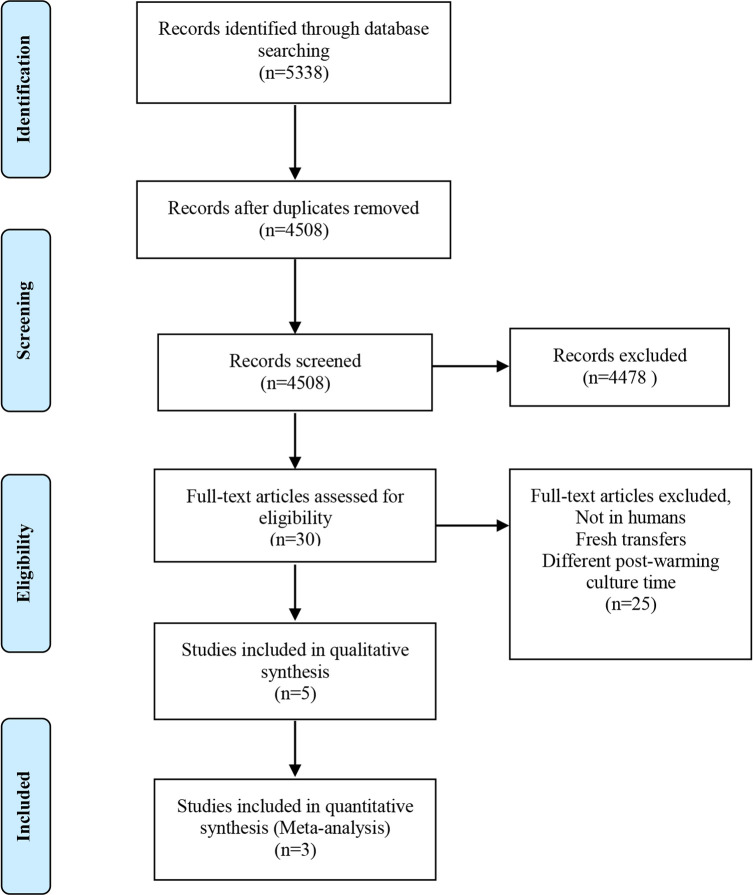
Of the 5338 potentially relevant studies screened by electronic databases, 830 were excluded due to irrelevant and duplicated topics. A total of 4508 studies were revised in the first phase, 4478 were excluded due to reports of fresh transfers, not in humans, or comparison of different times for culture. The full text jri_articles for the remaining 30 studies were evaluated, and 5 studies met the inclusion criteria and were included (Figure 1).
Characteristics of the studies and the participants are listed in table 1. Of the 5 included studies, 2 were designed as RCT, and 3 as retrospective. The studies included were published between 2010 and 2019. One study included exclusively transfers of day 5 embryos; four studies included only transfers of day 3 embryos. The mean age of participants was between 30 and 34 years.
Table 1. Characteristics of the studies and participants
| Study | Year | Country | Study design | Total number of patients | Intervention | Comparison |
|---|---|---|---|---|---|---|
| Herbemontet al. | 2108 | France | RCT * | 162 | 81 | 81 |
| Wang et al. | 2019 | China | Cohort Retrospective | 1654 | 517 | 1127 |
| Agha-Rahimi et al. | 2019 | Iran | Cohort Retrospective | 366 | 195 | 166 |
| Jin et al. | 2013 | China | RCT * | 479 | 242 | 237 |
| Joshi et al. | 2010 | India | Cohort Retrospective | 504 | 415 | 89 |
Randomized control trial
Biochemical pregnancies: Biochemical pregnancies were reported by only two studies; one in blastocyst transfer and one in cleavage stage embryo transfer. Pregnancy rates were 50.6% in short culture time transfers versus 55.6% for long culture time in blastocyst transfers. In cleavage state transfers, pregnancy rates were 37.8% and 28.9% for short and long culture time, respectively. Neither one demonstrated significant differences.
Implantation rates: Implantation rates were reported by three studies. There were similar implantation rates regardless of the culture time (Short versus long); they were 36% versus 38% if a blastocyst was transferred, and 20.8% versus 21.7% and 41.1% versus 36.0% if cleavage stage embryos were transferred. Results showed no statistical difference in implantation rates regardless of the day on which they were transferred (Day 3 or day 5).
Clinical pregnancy rates: Clinical pregnancy rates were reported by all studies included in this review. The results were contradictory. Pregnancies after blastocyst transfers were better after overnight culture; however, this was not statistically significant. Two studies reported better pregnancy results in cleavage stage embryos in short culture groups, and two studies reported opposite results favoring overnight culture. A meta–analysis showed clinical pregnancy rates slightly better after short culture time with a RR of 1.09 (0.95–1.26, 95% CI). None of the studies showed significant clinical differences.
Live birth rates: Four studies reported live birth rates. Overnight culture showed better results if a blastocyst was transferred; this difference was not statistically significant. In transfers of day 3 embryos, two studies reported higher live birth rates after overnight culture, and one reported this outcome in short time culture. None of the studies reported significant differences; results are summarized in table 2.
Table 2. Reproductive results
| Study | Biochemical pregnancy | Implantation rate | Clinical pregnancy rate | Miscarriage | Live birth | Twin pregnancy | Ectopic pregnancy |
|---|---|---|---|---|---|---|---|
| Herbemont et al. | 50.6/55.6 | 36/38 | 42.0/44.4 | 14.6/11.1 | 34.6/35.8 | 2.5/2.5 | − |
| Jin et al. | − | 20.8/21.7 | 40.9/42.8 | 14.7/10.4 | 34.0/37.6 | − | 2.11/1.0 |
| Wang et al. | − | 41.1/36.0 | 58.9/53.7 | 12.2/10.5 | 48.3/44.6 | − | 5.8/6.3 |
| Agha-Rahimi et al. | 37.9/28.9 | − | 30.8/24.1 | − | 19.4/22.2 | − | − |
| Joshi et al. | − | − | 20.3/24.3 | − | − | − | − |
Results are in percentage
Short culture/overnight culture
Herbemont et al. report blastocyst transfers
Abortion rates: Abortion rates were reported in three studies. Results showed low abortion rates in pregnancies reached after short culture time. This was true, independent of the stage in which the embryos were transferred. The results are summarized in table 2. No statistically significant differences were found.
Ectopic pregnancy rates: Ectopic pregnancy rates were reported only by two studies. The results were contradictory. One study reported higher pregnancy rates in short culture and one in overnight culture. Neither of the studies reported a significant difference. Reproduction results are shown in table 2.
Cumulative meta-analysis: Table 3 shows a random effect cumulative meta-analysis of the clinical pregnancy outcome in the three observational studies. The cumulative point estimate resulted in a risk ratio of 1.09 with a 95% confidence interval of 0.95 to 1.26. The Chi squared test for heterogeneity showed a p-value of 2.25 and an I squared of 11%. Figure 2 shows the risk of bias of the studies included in this review.
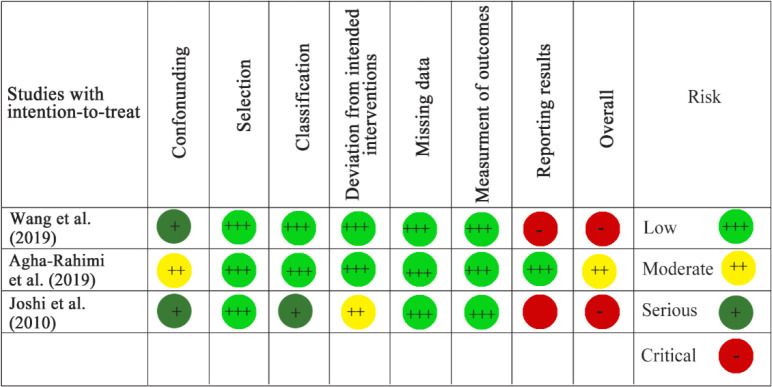
Table 3. Cumulative meta-analysis
| Study or subgroup | Thawing <2 hr | Thawing >16 hr | Risk ratio | ||||
|---|---|---|---|---|---|---|---|
|
| |||||||
| Events | Total | Events | Total | Weight | M-H, random, 95% CI | ||
| Agha-Rahimi et al., 2019 | 60 | 195 | 40 | 166 | 14.9% | 1.28 (0.91, 1.80) | 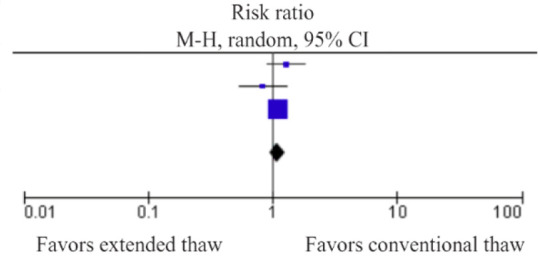 |
| Joshi et al., 2010 | 18 | 89 | 101 | 415 | 9.1% | 0.83 (0.53, 1.30) | |
| Wang et al., 2019 | 189 | 321 | 285 | 531 | 76.0% | 1.10 (0.97, 1.24) | |
| Total (95% CI) | 605 | 1112 | 100.0% | 1.09 (0.95, 1.26) | |||
| Total events | 267 | 426 | |||||
Heterogeneity: Tau2= 0.00; Chi2= 2.25, df= 2 (p=0.32); I2= 11%
Test for overall effect: Z= 1.28 (p=0.20)
Results from this review showed no relevant differences if cryopreserved embryos were transferred after 2 hr of warming or after overnight culture. This suggests no detrimental impact on the reproductive results of overnight culture embryos if a good quality embryo is transferred.
Wang et al. (6) retrospectively analyzed outcomes from 1654 frozen embryo transfers. Results, depending on whether a good quality embryo had been transferred or not, were included in their analysis. Due to the prespecified inclusion criteria of our study, only results from the group with at least one optimal embryo were analyzed. These were divided into two groups of a short culture (2 hr) and a long culture (24 hr) depending on the time elapsed between thawing and transfer. No significant difference in pregnancy rate, live birth rate, abortion, and ectopic pregnancy was found. However, the implantation rate increased in the 2 hr (41.1%) group compared to the 24 hr (36%) group when transferring at least 1 optimal cleavage stage embryo. They concluded that success in implantation rates could depend more on the quality of the embryos than on the post warming culture time. They also hypothesized that good quality embryos could better tolerate the impact of damage on blastomeres of the freezing thawing process than low quality embryos. However, implantation rates have been criticized as a reliable parameter in fertility research (14).
The number of blastomeres on day three seems to be an important issue for implantation potential in cleavage stage embryos. Jin et al. (12) in 2013 reported lower implantation rates in a pilot RCT when embryos with <8 cells were transferred. They also reported different implantation rates depending on the embryo stage at transfer. Embryos between 8 and 16 cells showed better results; however, no statistical difference was found.
The embryo cleavage capacity has been stressed as a possible indicator of good reproductive results after thawing cryopreserved embryos for transfer. Joshi et al. (13) reported no difference in pregnancy rates (24.3% vs. 20.3%) after analyzing 504 embryo transfers. They divided transfers into two groups of overnight culture with 415 transfers, and 2 hr with 89 transfers. They pointed out the importance of a good selection process, not only at cryopreservation time, but also in correct embryo selection after the thawing process. Special emphasis was made regarding cleavage capacity as a good indicator of embryo viability. Overnight culture allows us to evaluate mitosis resumption of blastomeres, and embryo survival capacity. It can help us to select better embryos for transfer in our search for optimal reproductive results. This seems to be important because arrested embryos after long post thaw culture were connected with an increase in chromosomal abnormalities and presumably abortion rate (15). However, the results of our systematic review showed no difference in clinical pregnancy rates, abortion rates, or live birth rates when comparing overnight culture after thawing of embryos versus a short time culture.
Agha-Rahimi et al. (11) included 366 frozen embryo transfers after vitrification in a retrospective cohort study. They reported a high chemical pregnancy rate in patients included in the overnight culture group when compared to the short culture time group. Differences were not significant. Also, no differences were found in clinical pregnancy and live birth rates. They concluded that overnight culture and checking mitosis resumption are not essential in vitrified embryos. This contrasts with current reports (16) which show results after overnight culture following the slow freezing of embryos, a technique almost in disuse.
Herbemont et al. (10) reported results of a randomized clinical trial comparing clinical reproductive results of blastocyst transfers following short and long time culture after warming. They found no difference in pregnancy rates, even when blastocoel reexpansion was statistically different among groups. The results of this review show that there is no difference in pregnancy rates when comparing embryo culture time before transfer, regardless of whether embryos are transferred at a cleavage or blastocyst stage. A cumulative meta-analysis showed slightly more clinical pregnancies if embryos were cultured overnight before transfer. However, differences were not statistically significant.
The results reported in each study limit our ability to gather information on the four primary outcomes originally planned. This is a consequence of partial outcome reporting on behalf of the included studies, most of which report information without confidence intervals thus making a statistical analysis difficult. However, the heterogeneity of reported results within each study is even more important. The only outcome that was reported in considerable number of studies for being able to justify a meta-analysis is the clinical pregnancy rate. This is the reason why in the final meta-analysis included in our manuscript, the only outcome was clinical pregnancy rate.
It would be ideal to include studies that report a risk estimate with a 95% confidence interval. However, this crucial information is missing in reported studies. The observational studies included in the meta-analysis report results per embryonic transfer and do not evaluate the results per transferred embryo. It was not possible to use the two RCTs for a meta-analysis because one of the studies reported transferred embryos in the blastocyst stage while the other reported this information during the cleavage stage. Furthermore, the RCT which reports results in the cleavage stage is also incomparable to the retrospective cohorts; all of them report results during the blastocyst stage.
Limitations of this review include the quality of studies reported and included. Only two were RCTs and most retrospective in design. There was no risk of bias in the included studies with the best quality papers manifesting moderate risks. Moreover, limited number of studies were reported on this subject.
The results of this study indicate no difference if cryopreserved embryos were transferred after overnight culture or after two hours of culture following thawing. However, the findings of this study should be treated with caution due to quality of evidence. Further large scale randomized clinical trials should be conducted to definitively clarify if there is a difference in clinical outcomes after different culture time between thawing and transfer of cryopreserved embryos.
We thank Dr. Sergio Lozano and Dr. Rene Rodriguez Gutierrez for their critical review of the manuscript.
