
The process of spermatozoa production in mammals is defined as spermato-and spermiogenesis, which occurs within the germ epithelium of the seminiferous tubules in the testis. It starts 5–7 days after birth in rodents and 10–13 years after birth in men and continues throughout life (1).
The seminiferous tubules consist of a unique microenvironment or niche (2) which is a determinative factor for germ cell development (3) consisting of intratubular Sertoli cells (4), peritubular myoid cells, and interstitial Leydig cells (5).
Spermatogonial stem cells (SSCs) are the unipotent progenitor cells of spermatogenesis which differentiate into spermatozoa and consequently transfer the genetic information to the next generation (6–9).
In rodents like mice, spermatogenesis begins by spermatogonia which can renew themselves or differentiate into Ap spermatogonia that are interconnected via cytoplasmic bridges (10). Therefore, Ap spermatogonia divide mitotically to form 4, 8, 16, and sometimes 32 Aal spermatogonia which give rise to more differentiated spermatogonia, namely, intermediate and type B spermatogonia (11). Type B spermatogonia undergo the last mitotic division to generate primary spermatocytes which undergo the first meiotic division to produce secondary spermatocytes. Consequently, the second meiotic division finally leads to haploid spermatids (12).
In comparison to mice, there is little information about SSCs in humans. There are three groups of spermatogonia, i.e. Adark, Apale, and type B. Adark spermatogonia are considered as reserve stem cells with dense and stainable chromatin while Apale as self-renewing stem cells have less dense and less stainable chromatin which gives rise to type B spermatogonia (13).
The most important form of male infertility is non-obstructive azoospermia (NOA), which occurs due to lack of spermatozoa in the ejaculate and consequently failure of spermatogenesis (14, 15). While there is no treatment to restore the spermatogenesis in NOA patients, inadequate gonadotropin production can be improved by medical treatment. In the recent decade, isolation of similar cells with SSC potential from other sources of stem cell has been considered in many several different studies (16, 17). The possibility of the production of SSCs or Sertoli cells from other types of stem cells is dependent on the advancements in reproduction research in the future.
According to the number of infertile couples in the world and its daily growth rate, using the scientific tools to increase the knowledge in reproductive systems seems crucial. In the recent decade, several investigations were done to find suitable markers of germ cells to introduce new treatments against infertility.
Octamer-binding transcription factor 4 (Oct-4) is a member of Pit-1, Octamer transcription factor (POU) family as a master regulator for stem cell pluripotency. Oct-4 (About 7 kb) is located on chromosome 6 and encodes two distinct variants known as Oct-4A and Oct-4B. It has been proven that Oct-4 is expressed in spermatogonial stem cells (SSCs) in young mice but not in type B SSC (18). Depending on its level of expression, different functions are considered for Oct-4. In mammals, it has an important role during embryogenesis and in humans, it is required for reprogramming somatic cells. In participating with two other transcription factors, SOX2 and NANOG, it controls the self-renewal and pluripotency of embryonic stem cells (ES cells) in mice and humans. Also, some researches demonstrate that Oct-4 is exclusively expressed in ES cells (21).
A useful marker that is suggested for SSC self-renewal is GFRA (Glial cell line-derived neurotrophic factor family receptor alpha). It has been reported that at low concentration of GFRa, SSCs undergo differentiation phase but the high expression indicates that SSCs undergo self-renewal (22).
In mammals, a unique germ cell marker which is exclusively expressed in the germ cells is DDX4. For the first time, DDX4 gene was discovered in drosophila as a necessary factor for female development (23). Next studies demonstrated that DDX4. (A member of the DEAD (Asp-Glu-Ala-Asp) box family proteins) gene encodes an ATP-dependent RNA helicase which regulates the translation of at least two mRNAs during germ cell development, nanos and gurken (24). The DDX4 gene has a conserved sequence in invertebrates and vertebrates such as C. elegans, planarian, xenopus, zebrafish, frog, mouse, rat, cat, pig, rhesus macaques, goat, chicken, and human. The expression of RNA DDX4 in somatic tissues has only been observed during fetal development. Targeted disruption of exon 9 and 10 in a mouse DDX4 homologue (MVH) has shown infertility in males while females were fertile (25).
In this study, we use fertile and infertile mice as model animals and also infertile men with two levels of infertility (non-obstructive azoospermia) to introduce reliable germ cell marker which could be helpful for future studies for diagnosis of male infertility.
Study population: Testis samples from obstructive azoospermia human were obtained from the Urology Clinics, Medical Faculty, University of Tübingen. Furthermore 3 pairs of mouse testis (C57 BL/6 strain) were used. The animal experiments in this study were approved by the ethical committee of Amol University of special modern technologies (Ir.ausmt.rec.1398.03.07).
SSC isolation: Testis samples from cases with obstructive azoospermia were obtained from the Urology Clinics, Medical Faculty, University of Tübingen, Germany. Furthermore, 3 pairs of mouse testis (C57BL/6 strain) were used. These samples were enzymatically digested with a solution consisting of Dispase (0.5 mg/ml) (Sigma Aldrich, USA), DNAse (0.5 mg/ml) (Sigma Aldrich, USA), Collagenase (0.5 mg/ml) (Sigma Aldrich, USA), and Hank’s Balanced Salt Solution (HBSS) (PAA, USA). Digested testicular cells were grown in germ stem cell (GSC) culture media containing 1% N2 supplement (Invitrogen, USA), StemPro-34, 1% L-glutamine (PAA, USA), 60 ng/ml of progesterone (Sigma Aldrich, USA), 30 ng/ml of estradiol (Sigma Aldrich, USA), 5 μg/ml of bovine serum albumin (BSA) (Sigma Aldrich, USA), 30 μg/ml of pyruvic acid (Sigma Aldrich, USA), 1% MEM vitamins (PAA, USA), 8 ng/ml of GDNF (Sigma Aldrich, USA), 1% non-essential amino acids (PAA, USA), 10 ng/ml of FGF (Sigma Aldrich, USA), 100 U/ml of human LIF (Millipore), 1% penicillin/streptomycin (PAA, Laboratories GmbH, USA), 0.1% ß-mercaptoethanol (Invitrogen, USA), 1% ES cell qualified FBS, 20 ng/ml of epidermal growth factor (EGF), 6 mg/ml of D+ glucose (Sigma Aldrich, USA), 1 μl/ml of DL-lactic acid (Sigma Aldrich, USA) and 100 μg/ml of ascorbic acid (Sigma Aldrich, USA) at 37°C in an atmosphere of approximately 5% CO2.
Immunohistochemistry: After decapsulation of tunica albuginea, testicular tissue was washed with PBS and fixed in 4% paraformaldehyde. In the next step, tissue with thickness of 8–10 μm was sliced with a microtome and placed on hydrophilic plus slides and held until used at room temperature. Throughout immunohistochemical staining with DDX4 (Cat No.: ab13840), slides were washed by xylene and replaced by water slowly with a sequence of decreasing ethanol concentrations. Until staining, antigen retrieval was performed using heat-induced epitope retrieval (HIER) at 95°C for 20 min and non-specific binding sites in the tissue sections were blocked with 10% BSA/0.3% Triton in PBS.
Reverse transcriptase polymerase chain reaction (RT-PCR): The expression level of DDX4 gene in the mice testicular cells was examined by the Fluidigm Biomark system. Testicular germ cells were picked up with a micromanipulator, lysed with a solution of lysis buffer consisting of 2.5 μl 0.2× assay pool, 9 μl of RT-PreAmp Master Mix (Invitrogen, USA), 0.2 μl of SuperScript III RT/Taq (Invitrogen, USA) and 1.3 μl of TE buffer., Next, amplified output of RNA-targeted copies with TaqMan was analyzed by BioMark realtime quantitative PCR (qPCR). Two technical repeat measurements were taken to examine the samples. The normalization of data was carried out using DDX4 (Mm00802445_m1) and mRNA expression fold change compared to MEF feeder cells. Using Excel and GenEx applications, the Ct values were determined.
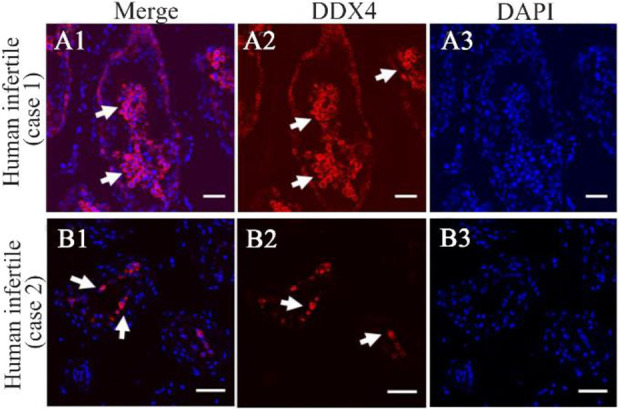
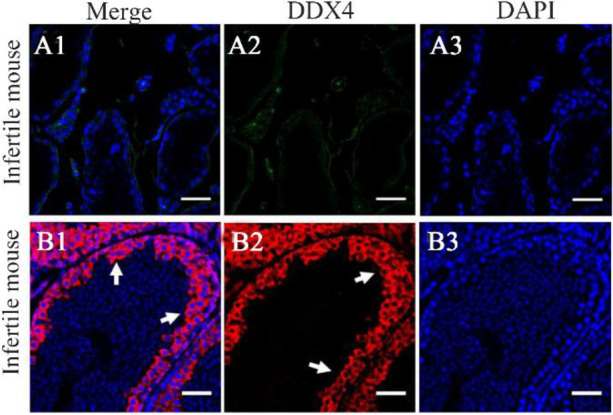
Immunohistochemical analysis of the testis tissue obtained from two human patients with different levels of infertility (Non-obstructive azoospermia) showed different numbers of DDX4 positive cells with different DDX4 expression levels, one with higher (Figure 1; A1) and the other with lower signal intensity (Figure 1; B1). In both cases, the cells were more condensed in the luminal compartment. Also, comparative immunohistochemistry analysis of seminiferous tubules of mice showed that DDX4 was expressed both in the basal and luminal compartment of seminiferous tubules (Undifferentiated and differentiated part) of fertile mice (Figure 2; A1). In contrast, in busulfan-treated mice, no expression of DDX4 was detected (Figure 2; B2). A normal pattern of expression of DDX4 and an abnormal pattern was observed in fertile (Figure 2; B1) and sterile mice (Figure 2; A1), respectively.
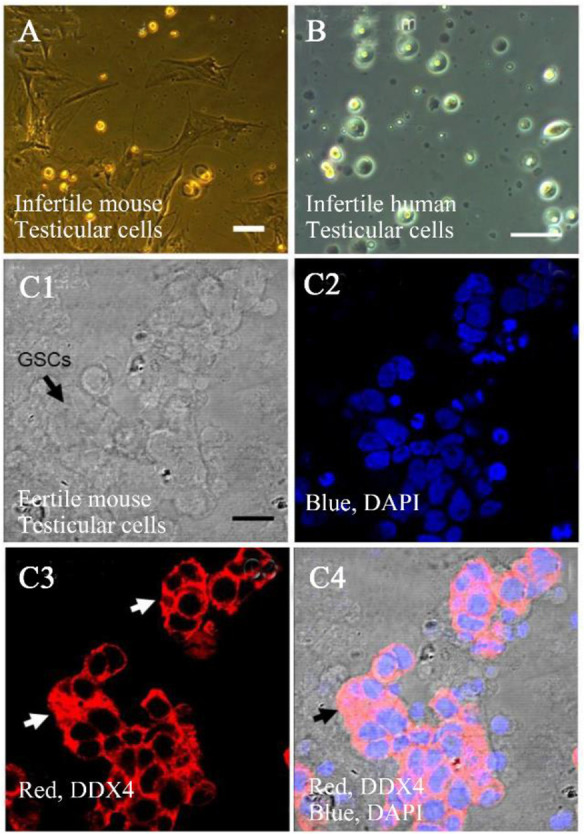
Bright field analysis of testicular cells of infertile human and sterile mouse (Figure 3; A, B) and fertile mouse (Figure 3; C) showed the morphological characteristics of these cells after extraction and expansion. Also, immunohistochemical staining with DDX4 (Figure 3; C3) would be useful for attributing morphological features to positive germ cells.
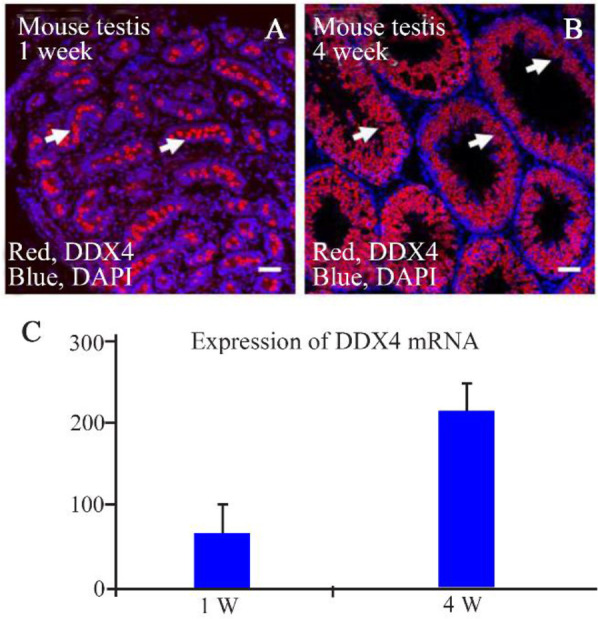
Immunohistochemical analysis of 1 week old mice revealed luminal expression of DDX4 (Figure 4; A). On the other hand, immunohistochemical analysis of 4 week old mice indicated that the cells with DDX4 expression were shifting from the luminal to the undifferentiated basal part of the seminiferous tubules, typical for postnatal testis development (Figure 4; B). Also, Fluidigm real-time PCR indicated a significantly higher expression of DDX4 in 4 week old mice (Figure 4; C).
Spermatogenesis is responsible for sperm production and consequently transportation of genetic information to the next generation. DDX not only have roles in spermatogenesis but also is crucial for primordial germ cell (PGC) formation which anomalies in differentiate of PGSs could lead to dysfunction of spermatogenesis (26–30). Expression of DDX4 has been shown in various species during spermatogenesis but Wenxu Zhu et al. demonstrated that expression of DDX4 was seen in spermatogonia and spermatocytes while no expression was detected in spermatids and spermatozoas (31).
Although many researchers claimed that expression of DDX4 is restricted to germ cells but M. Lejong et al. proved that in chick embryo, in addition to germ cells, DDX4 protein was detected in somatic cells, too (32).
In the last 10 years, finding a useful in vitro tool has been a main objective of reproductive biology research. MACS (Magnetic-activated cell sorting) and FACS (Fluorescence-activated cell sorting) are two of the common in vitro assays used in several investigations. In a recent study, MACS was used to enrich undifferentiated spermatogonia from human testicular cell suspensions (33, 34). Also, in other recent studies, FACS was applied for the characterization of mouse adult testicular macrophage populations (35). In a recently study on gene editing on SSCs mediated by CRISPRCas9, c-kit and GFRa were used as characterization marker (36). In this present study, we clearly showed that DDX4 would use as a specific marker for undifferentiated spermatogonia.
Immunohistochemistry results indicated that the expression of DDX4 in undifferentiated seminiferous tubule cells (Spermatogonia) was positive. Similarly, Abbasi et al. reported that in immunohistochemistry analysis of THY1 (A conserved marker of SSCs of bovine, rodents, and primates) positive cells were all positive for DDX4 (37). Several investigations have analyzed DDX4 expression in normal human and mice (24, 38). In the present study, comparison of two different abnormal cases with different levels of tissue disruption was done which showed that the expression of spermatogonia had decreased. Similarly, Lee et al. reported that, in prepubertal canine (1–3 months), DAZL (As an undifferentiated marker of male germ cell) was expressed in luminal cells but at pubertal age (4 months), these cells were located near the basement membrane of the seminiferous tubules as detected by immunohistochemistry analysis (39). Also overexpression of DDX4 was seen in human cancers like ovarian cancer and neuroblastoma (40).
Also, our immunohistochemistry analysis of two human abnormal cases with different levels of expression of DDX4 has proven that this marker would be useful for future clinical treatments. In a recent clinical study, pathological and immunohistochemical analyses were performed with 145 cases with a testicular germ cell tumor (TGCT) (41). In some kinds of infertility in men like oligozoospermia, the expression of DDX4 in declined dramatically (42). Analysis of sperm mRNA like DDX4 mRNA by micro-TESE (micro testicular sperm extraction) is a functional way to predicting of successful sperm retrieval in nonobstructive azoospermic patients (43). In summary, we claimed that DDX4 could be used as a molecular marker for investigation of spermatogonic disorders.
In this study, DDX4 expression was detected in spermatogonia stem cells in normal, but not in the busulfan-treated mice. Furthermore, two different cases with non-obstructive azoospermia manifested significant down-regulation of the germ cell marker gene expression. Also, comparative analysis between two ages of mice showed different patterns of expression of DDX4. These findings suggest that DDX4 as a male germ cell marker would be useful for future advanced investigations in reproductive medicine.
