
Human papillomavirus (HPV) is the most common sexually transmitted infection (1). The incidence of this infection has been rising recently. It is well known that HPV is responsible for more than 90% of anogenital warts. HPV has been implicated in various types of cancers, including the cervix, vulva, vagina, penis, anus, and oropharynx (2). In most cases, the virus is eliminated in two years after infection. Another outcome is a prolonged persistence of the virus in human cells (3). The persistent infection of human papillomavirus promotes many cytological and immunological changes characterized by deregulated expression of retinoblastoma protein (pRb) and tumor suppressor gene p53 and alters the stability of proteins which control apoptosis (4, 5).
HPV contributes to dysregulation of immune response by impaired function of cytotoxic T cells, inhibits the activation of natural killer (NK) cells, immature dendritic cells, and Th1/Th2 imbalance; these conditions lead to an imbalance between cellular and humoral immune processes (6).
The mechanism for controlling and managing HPV infection includes regulating the changes in cytokines production (7). Inflammatory process due to HPV infection leads to changes in pro- and anti-inflammatory cytokines levels such as interleukin 1 beta (IL-1β), interleukin 6 (IL-6), interleukin 4 (IL-4), tumor necrosis factor-alpha (TNFα), and interferon-gamma (IFNγ) (8).
The variation in production level of particular cytokines as a result of HPV infection, including IL-1β, IL-4 and IL-6 can change the activity of several signaling pathways like Janus Kinases (JAKs), signal transducer and activator of transcription (STAT) proteins, JAK/STAT and nuclear factor kappa-light-chain-enhancer of activated B cells (NF-κB) pathway (9). These events initiate local proliferation of epithelial cells, metastasis and progression of cervical lesion to cervical cancer (10).
Inflammation is also a cofactor for cervical carcinogenesis. It is likely to act by inducing reactive oxygen and nitrogen species (ROS and RNS) production, which causes DNA damage. This DNA damage, in turn, can facilitate the integration of the HPV-DNA and high levels of oncoprotein expression. E6 and E7 oncoproteins act on cellular pathways in ways that promote cellular transformation and tumor formation (11).
IL-4 is a key regulator of humoral immunity. It promotes T-helper cell type 2 (Th2) and inhibits T-helper cell type 1 (Th1) and also has an anti-inflammatory and cytotoxic effect against tumors (12). Interleukin 6 is a pro-inflammatory cytokine which acts as a central regulator of inflammation by regulating several critical cellular pathways and controlling the balance between a pro-inflammatory and an anti-inflammatory cytokine in immune response (13). Interleukin 6 acts on different cells; it is released into circulation when acute or chronic inflammation occurs and is involved in many stages of tumor growth such as proliferation, anti-apoptotic process and angiogenesis via vascular endothelial growth factor (VEGF) (14).
The presence of single-nucleotide polymorphisms (SNPs) in cytokine gene promoters can affect the gene expression. Therefore, SNPs are considered as one of the reasons for the imbalance in cytokine production (16, 17).
IL-4 has many variants of single nucleotide substitutions and one of them is IL-4 -589C>T (rs 2243250). The -589C>T substitution is located in the 5’-UTR (18). There are several SNPs in the IL-6 gene and one of the identified SNPs is the -174G>C (rs1800795) located in the promoter region which plays an essential role in the alteration of transcriptional activation (19). IL-1β -511C>T (rs16944) and IL-1β -31T>C (rs1143627) are two common polymorphisms associated with increased intracellular IL-1β secretion (20). The aim of our work was conducting a case-control study to compare the frequency of the promoter polymorphisms for IL1β -31T>C, -511C>T, IL-4 -589C >T and IL-6 -174G>C in patients with high HPV viral load versus HPV-negative women to determine which of these polymorphisms play an essential role in the development of HPV infection.
Sample description: For molecular genetic studies, 194 samples of DNA were isolated from women’s epithelial cells in the urogenital tract. The women were divided into two groups of cases with high HPV viral load (n=101) and HPV-negative women (n=93). All women included in the study were over 30 years of age. A high prevalence of HPV infection was observed in women aged 18 to 28. However, in 80% of cases, the virus was eliminated within two years of the initial infection. Women over the age of 30 may have a high HPV viral load. This indicates a long-term active replication of the virus. Therefore, women over 30 were included in the study. Criteria for including women in the control group were negative cervical biopsy and normal colposcopy and HPV-negative PCR test. The cases included women older than 30 years with symptoms such as vaginal discharge, menstrual irregularities with bleeding, a positive cervical biopsy and a viral load of more than 103 DNA copies per 105 of human cells. All the collected samples for the case-control study, namely scrapings of epithelial cells from urogenital tract of women, were provided by the Nauka clinical diagnostic laboratory (Rostovon-Don, Russia) from September 2016 to November 2019.
All participants had previously signed informed-consent and laboratory questionnaires. All the experiments were performed according to the principles and ethics rules of the World Medical Association (Declaration of Helsinki) for human experiments.
DNA extraction and HPV quantitative analysis: The total DNA was isolated from scrapings of epithelial cells of the cervical canal of women according to protocols of Amplisens DNA-sorb-AM (Inter LabService, Russia) reagent kit (21). The genotypes of high-risk HPV were analyzed according to protocols of Amplisens HPV HCR genotypetiter software (InterLabService, Russia) by polymerase chain reaction (PCR) with fluorescence in situ hybridization detection.
The quantification of DNA for high-risk HPV types (16, 18, 31, 33, 35, 39, 45, 51, 52, 56, 58, 59) in biological material was done according to the protocols of Amplisens HPV HCR genotypetiter software (InterLabService, Russia). The method is based on the simultaneous amplification of HPV-DNA regions and the β-globin gene region used as an endogenous internal control (22).
The amplification of DNA for each HPV phylogenetic group was detected in a separate fluorescent channel on a 4-channels RotorGene (Group A9 HPV-in JOE fluorophore channel; group A7 HPV–in the ROX fluorophore channel; and HPV types 51 and 56-in Cy5 fluorophore channel) (Appendix Figure 1).
The result of internal control amplification was detected in FAM channel. The four major phylogenetic groups were A9 group (16, 31, 33, 35, 52 and 58), A7 group (18, 39, 45 and 59), as well as HPV-DNA 51 (Group A5) and HPV-DNA 56 (Group A6).
PCR mixture contained (a) control proteinase k (DNA buffer) and 10 μl of k1, k2 and k3, 7 μl of PCR mix-1-FRT HPV screen titer; (b) 8 μl of mixture of PCR buffer and Taq polymerase; and (c) 10 μl of a DNA solution. The amplification program was as follows: 1 cycle at 95°C for 15 min, 1 cycle at 65°C for 2 min, at 93°C for 20 s, at 64°C for 25 s, at 65°C for 55 s, 5 cycles at 95°C for 15 s, at 60°C for 25 s, at 65°C for 25 s, and 25 cycles to register fluorescence emission at 65°C.
The DNA target selected as an endogenous internal control was the fragment of the human genome and must be present in a sample in sufficient quantity equivalent to the cells in the sample (103–105 human DNA copies or more than 500 cells).
Quantitative analysis was performed in the presence of DNA calibrators. The quantitative HPV-DNA analysis was based on the linear dependence relation between the initial DNA target concentration in a test sample and the cycle threshold (Ct). The Ct values obtained were used to calibrate the quantity of HPV-DNA (Copies) per 100.000 human cells. The findings were interpreted in copies of HPV logarithms per 100.000 human cells and were automatically measured and analyzed using the Amplisens HPV HCR genotype-titer software in Microsoft Excel format (Appendix Figure 2).
The sensitivity test included 1000 copies of HPV-DNA per ml, with a linear range of HPV-DNA measurements of 1000–100.000.000 copies of HPV-DNA per ml. For each type of HPV (HPV per 100.000 human cells), the viral load results were log10 transformed to facilitate the interpretation of the results. For minimizing the impact of variance during the selection of samples, the quantitative results were normalized to the genomic DNA quantity (HPV-DNA concentrations per epithelial cell). HPV-DNA concentration was normalized to the number of human cells according to the following formula:
log (HPV-DNA copies/human DNA copies)× 200,000=log (HPV on 100.000 cells)
The results were interpreted using a scale of log ≤3 per 105 human cells (Low clinical significance), 3–5 log per 105 human cells (Clinically significant, risk of dysplasia), and >5 log per 105 human cells (clinically significant, highly probable dysplasia) according to the manufacturer’s instructions and as per their clinical reports (23).
Genotyping: SNPs of IL-4 -589C>T (rs2243250), IL-6 -174G>C (rs1800795), IL-1β -511C>T (rs 16944), IL-1β -31T>C (rs1143627) were analyzed by allele-specific PCR and reagent SNP-express (Lytech, Russia) according to kit protocol. PCR products were analyzed by horizontal submerged 3% agarose gel electrophoresis and under the ultraviolet (UV) transilluminator of GelDoc (Bio-Rad, USA).
Statistical analysis: The allele and genotype frequencies of IL-4, IL-6 and IL-1β genes were compared to healthy women by chi-squared test. The Hardy-Weinberg equilibrium was used to determine the goodness-of-fit of chi-squared test with one degree of freedom through comparing the observed genotype frequencies with the expected genotype frequencies. The SNP genetic association was assessed by the chi-squared test, odds ratio (OR) and its confidence interval (CI). A p<0.05 was considered statistically significant. Statistical analyses were performed using Graph Pad InStat 3.05 software. Intergenic interactions between polymorphic variants of IL-4, IL-6, and IL-1β genes in the HPV-positive and control groups were analyzed using the multifactor dimensionality reduction (MDR) algorithm (Version 3.0.2). The multifactor dimensionality reduction (MDR) algorithm was applied to find the best n-factor model and multilocus genotypes were pooled into high-risk and low-risk groups, reducing predictors of the genotype effectively to one dimension. The result was a set of models, and indices of testing balanced accuracy (TBA) and cross-validation consistency (CVC) were used to determine the best overall model. MDR procedure was used in calculating empirical 1000-fold permutation tests to assess the significance of the selected models. The model based on MDR results with the maximum TBA, CVC and P values for TBA less than 0.05 was considered the best model (24). The haplotype frequencies of IL-1β (rs16944) and IL-1β (rs1143627) were analyzed using the HAPLOVIEW 4.2 tool.
In 101 HPV-positive women the average age was 40.1±7.7 years and 42.3±7.5 years in 93 HPV-negative women. Among 101 HPV infected women, the maximum, middle, minimum HPVDNA load were 8.5, 5.2 and 3.4 log of HPV genomes per 100.000 human cells, respectively. The most prevalent HPV genotypes were HPV 16 (39%) and HPV 18 (14%). The detection frequencies for HPV 31 and 33 were 10% and 9%, respectively. Also, the frequencies of other high-risk HPV genotypes (HPV 51, 45, 56, 39, 52, 58 and 59) were determined to be 1–7%. Also, 11% of cases demonstrated HPV co-infection (Women had two or more types of HPV). The co-infection of HPV and viral load are presented in table 1.
Table 1. HPV co-infection and viral load
| Viral load (log of HPV genomes per 105 human cells) | HPV co-infection genotypes |
|---|---|
| 4.75, 7.07, 6.53 | 16, 18 |
| 4.36 | 16, 56 |
| 7.6 | 16, 33 |
| 3.9 | 16, 18, 39 |
| 4.5 | 16, 45 |
| 5.4 | 33, 56 |
| 6.02 | 16, 51 |
| 6.49 | 33, 45, 51 |
| 4.92 | 31, 45 |
Frequencies distributions for the four investigated gene polymorphisms including IL-4, IL-6 and IL-1β are given in table 2. The polymorphic variants of −589C>T IL-4, IL-6 −174G>C and IL-1β −31T>C were not associated with a high HPV viral load. Female patients with a high HPV viral load had a significantly higher frequency of IL-1β -511T allele (OR=1.71, 95% CI=1.12–2.60; p= 0.012) and IL-1β -511TT genotype (OR=2.02, 95% CI=1.14–3.60; p=0.046) than healthy controls. Gel electrophoresis for IL-1β-511C>T gene is shown in figure 3 (Appendix).
Table 2. Genotypes (abs., %) and allele frequencies for IL-4 −589C>T, IL-6 −174G>C, IL-1β −31T>C and IL-1β -511 C>T genes among women infected with HPV and without HPV
| Gene, polymorphism | Group with high HPV viral load (n=101) | Group without HPV (control) (n=93) | p | OR (95% CI) |
|---|---|---|---|---|
| IL-4 −589C>T | ||||
| C | 0.792 | 0.774 | 1.11 (0.69–1.80) | |
| 0.67 | ||||
| T | 0.208 | 0.226 | 0.90 (0.56–1.46) | |
| CC | (65) 64.3 | (54) 58.1 | 1.30 (0.73–2.33) | |
| TC | (30) 29.7 | (36) 38.7 | 0.33 | 0.67 (0.37–1.22) |
| TT | (6) 5.9 | (3) 3.2 | 1.89 (0.46–7.80) | |
| IL-6 −174G>C | ||||
| G | 0.46 | 0.457 | 1.01 (0.68–1.51) | |
| 0.94 | ||||
| C | 0.54 | 0.543 | 0.99 (0.66–1.47) | |
| GG | (23) 22.8 | (19) 20.4 | 1.24 (0.63–2.45) | |
| CG | (47) 46.5 | (47) 50.5 | 0.84 | 0.85 (0.49–1.49) |
| CC | (31) 30.7 | (27) 29.0 | 1.08 (0.59–2.00) | |
| IL-1β −31T>C | ||||
| T | 0.584 | 0.623 | 0.85 (0.56–1.27) | |
| 0.42 | ||||
| C | 0.415 | 0.376 | 1.18 (0.79–1.77) | |
| TT | (34) 33.7 | (33) 35.5 | 0.92 (0.51–1.66) | |
| TC | (50) 49.5 | (50) 53.8 | 0.47 | 0.84 (0.48–1.48) |
| CC | (17) 16.8 | (10) 10.7 | 1.68 (0.73–3.87) | |
| IL-1β −511C>T | ||||
| C | 0.297 | 0.419 | 0.59 (0.39–0.89) | |
| 0.012 | ||||
| T | 0.703 | 0.580 | 1.71(1.12–2.60) | |
| CC | (11) 10.9 | (17) 18.3 | 0.55 (0.24–1.23) | |
| CT | (38) 37.6 | (44) 47.3 | 0.046 | 0.67 (0.38–1.19) |
| TT | (52) 51.5 | (32) 34.4 | 2.02 (1.14–3.60) |
In the case and control groups, further haplotype analysis of the two SNPs (rs16944 and rs1143627) of IL-1β gene was conducted. Results showed that the frequencies of TT, CC, TC haplotypes in the control group and among women with high HPV viral load did not differ. The -511 C and -31 T haplotype was significantly lower among women with high HPV viral load (5.7% and 12.5%, p=0.018). Therefore, this haplotype can be considered as a protective factor.
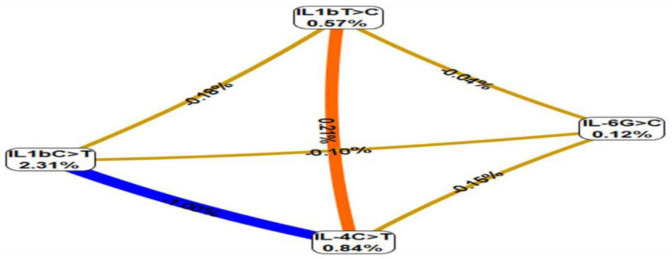
The combined presence of several allelic variants of genes encoding functionally linked protein molecules can lead to new phenotype formation owing to minor but numerous interrelated changes in the genome and proteome function. Therefore, an analysis of intergenic interactions of allelic variants for the cytokine genes was conducted. An analysis of intergenic interactions showed that the four-locus model of gene interaction has a prediction accuracy of 68% and cross-validation consistency of 10/10. The synergistic effect was found for the combination of IL-1β and IL-4 loci (Table 3).
Table 3. Analysis of intergenic interactions by multifactor dimensionality reduction (MDR)
| Genes, polymorphisms in model | Testing balanced accuracy (TBA) | Cross-validation consistency (CVC) | χ2 | p>0.05 | OR (95 % CI) |
|---|---|---|---|---|---|
| IL-4 (rs2243250) IL-6 (rs1800795) IL-1β(rs16944) IL-1β(rs1143627) | 0.68 | 10/10 | 25.95 | 0.0001 | 4.70 (2.55–8.67) |
The results of the MDR showed the interaction among four studied SNPs (Appendix Figure 4). There is an apparent synergism (Red color) between IL-1β-31T>C and IL-4-589C>T in the presence of high HPV viral load. The blue color characterizes the antagonism between IL-4-589C>T and IL-1β-511C>T. Brown color demonstrates additive interaction. The IL-6 -174G>C showed interaction with all other SNPs in the presence of high HPV viral load.
The persistence of human papillomavirus infection is a reason for cytological and immunological changes in cervical epithelial cells that can lead to cancer development. The integration process of E6 and E7 oncoproteins plays an essential role in cervical cancer development (25). However, several other serious factors contribute to development of HPV infection including smoking, immunodeficiency, social and economic conditions, age, genetic differences among individuals and populations and the family’s history records of cervical cancer (26).
In the current study, women with HPV infection aging above 30 years with a high HPV viral load were examined. It is possible that recurrence of HPV infection leads to physiological, hormonal and enzymatic changes in the cervical cells and subsequently a microenvironment for persistent HPV infection is created (27). It has been reported that disease progression takes more than ten years to be apparent and that is the reason for occur rence of HPV symptoms among women beyond 30 years of age (28). There is a balance between cellular and humoral immunity in normal circumstances, but HPV infection leads to changes in immune homeostasis, histological features and acute inflammation. Cytokine genes are responsible for inflammation progression regarded as a potential mechanism connected with the development of HPV infection. Functional single nucleotide substitutions in cytokine genes contribute to altering the expression of inflammatory molecules which play a critical role in inflammation and tumor progression (29, 30).
In neoplastic changes, IL-4 has a potent cytotoxic response against tumors. This cytokine induces cell death and modulates the activation of fibroblasts associated with tumors so that they do not support the growth of new blood vessels necessary for tumor growth. The change of IL-4 synthesis leads to loss of control of tumor cells (31, 32). The -589T allele increases the transcriptional activity of the IL-4 gene (33). In the presence of the polymorphic variant, IL-4 has a positive effect in stimulating other cytokines such as IL-10 and leads to a decrease in IFN-γ and IL-12. Same changes in cytokine result in cancer development and progression (34). Therefore, IL-4 has an essential role in inflammatory processes and cervical carcinogenesis. In our study, the genotypic analysis showed the resemblance of alleles (p=0.67) and genotype (p=0.33) frequencies of IL-4 polymorphism in two women groups. IL-4−589C >T polymorphism is not associated with high HPV viral load.
Circulating levels of IL-6 increase markedly during the development and progression of HPV infection with no autoinhibition of IL-6 secretion. Therefore, cells continue to secrete high levels of IL-6, which inhibit apoptosis, thereby facilitating unlimited proliferation for infected cells (35). The allelic frequency in case and control groups was very similar (p=0.94), as well as genotype distribution (p=0.84). The association of IL-6 -174G>C polymorphism with high HPV viral load was not detected. De Lima Júnioret et al. showed no difference in the frequency of the -174G>C (rs 1800795) polymorphism in Brazilian women infected with HPV and uninfected controls (36) which is in agreement with our findings. At the same time, several studies reported a relationship between presences of -174C allele and low-level expression of IL-6 which led to an increase in the risk of cervical cancer (37, 38).
During the HPV infection, the level of IL-1b increases, inducing changes in BCL-2/BAX protein proportion, p53 activity that inhibits the apoptosis process and DNA damage in cervical epithelial cells (39, 40). The allelic frequency for IL-1β -31T>C in case and control groups showed no significant difference (p=0.42) similar to genotypes distribution (p=0.47). There was no significant influence of IL-1β −31T>C polymorphism on high HPV viral load, but IL-1β -511C>T polymorphism was associated with high HPV viral load. The -511T allele and -511TT genotype were associated with an increased HPV viral load level (OR=1.71, 95% CI=1.12–2.60; p=0.012 and OR=2.02, 95% CI=1.14–3.60; p=0.046, respectively) (Table 2). Several studies reported a relationship between the IL-1β -511C>T gene polymorphism and the high IL-1β level in cervical cancer (41, 42). An increased risk of high viral load may be associated with a high IL-1β gene transcription level. High level of this pro-inflammatory cytokine induces an imbalance in the entire cytokine system and can induce chronic inflammatory reactions. But the haplotype -511C (rs16944) and -31T (rs1143627) of the IL-1β gene is associated with protective effect against HPV infection (Table 4). The different data about association of these polymorphisms may be due to the variety of ethnic groups, differences of sample size, patient recruitment process, genetically variant populations, standards, and geographical or environmental factors (43). Favorable conditions for the persistence of the virus include the combining of multi substitutions of the polymorphic loci in the human genes. In our work, the analysis of gene-gene interactions by MDR showed significant interaction for the combination of polymorphic variants (Table 3). The interaction of the polymorphic variants for the four loci of IL-4 -589C>T, IL-6 -174G>C, IL-1β -31T>C and IL-1β -511C>T genes is associated with HPV viral load increase. This can be connected with a change in the synthesis of cytokines, changes of pro- and anti-inflammatory cytokines balance, modulation of mRNA expression, keratinocyte damage, angiogenesis and a decrease in the immune response. As a result, HPV viral load increases and virus persists in cervical cells for long periods of time.
Table 4. Haplotype analysis of -511C>T (rs16944) and-31T>C (rs1143627) for IL-1β gene
| IL-1β haplotypes | Group with high HPV viral load (%) | Group without HPV (control) (%) | p | OR (95% CI) |
|---|---|---|---|---|
| T/T | 107 (52.7) | 93 (49.8) | 0.570 | 1.13 (0.76–1.68) |
| C/C | 49 (24.1) | 50 (26.8) | 0.539 | 0.87 (0.55–1.37) |
| T/C | 35 (17.5) | 20 (10.9) | 0.061 | 1.74 (0.97–3.3) |
| C/T | 11 (5.7) | 23 (12.5) | 0.018 | 0.41 (0.19–0.86) |
There were several limitations in this study. First, although the analysis of individual SNPs in promoter of IL-4 -589C>T, IL-6 -174G>C and IL-1β -31T>C genes did not reveal statistically significant difference in high HPV viral load in control group, frequency of -511T allele and TT genotype of the IL-1β gene in case group was significantly higher than the one in control group. However, further investigations of these polymorphisms with larger sample size are needed to confirm our results. Second, our study did not include all polymorphic variants for IL-1β, IL-4 and IL-6. It would be interesting to perform a large scale case-control study for analysis of all the polymorphic variants. Third, this study lacked the measurement of IL-1β, IL-4 and IL-6 levels in local environment of the cervical cells. Fourth, the influence of epidemiologic risk factors such as smoking, alcohol intake, sexual behavior, or pathogens such as bacteria and viruses with the risk of development of cervical cancer cells was not investigated.
It would be interesting to assess whether IL-1, IL-4 and IL-6 production is associated with the external environmental or pathogenic factors.
It was hypothesized that IL-1β -511 T allele and TT genotype could play a role in development of HPV infection in our study population. These genetic variants are responsible for higher IL-1β production. Although the individual SNPs of IL-4 -589C>T, IL-6 -174G>C and IL-1β -31T>C genes did not reveal a statistically significant difference in our study, intergenic interactions revealed significant interaction for all polymorphic variants. This demonstrated that the severity of HPV infection can not be determined by one or two genes. Infection development depends on different genes contributing to various pathways besides the influence of other causative factors which induce changes in genes expression. With the development in molecular biology, additional genetic studies are required to clarify the participation of genetic factors in the evolution of HPV infection, and similar analyses should determine whether the synergistic effect of several polymorphisms could serve as a prognostic risk factor for HPV infection.
This study was performed with the equipment of the Center of collective use “High technologies” (Southern Federal University).
