
Infertility is a condition that impacts up to 16% of reproductive-aged women in the United States (U.S.), and many women opt to undergo fertility treatment in the hope of having a healthy baby (1, 2). When women present to fertility centers for assistance, they are evaluated with diagnostic testing and provided a plan of care that will require them to engage in self-management behaviors such as following a prescribed medication regimen, yet adherence to oral medication schedules has been suboptimal, with medication adherence (MA) rates ranging widely from 19% to 74% (3). The literature has shown that women with infertility and their partners are often challenged by the emotional, psychological, physical, and financial burden that can accompany the fertility treatment experiences (4–6). Still, researchers have not established a systematic process to investigate MA supported by a theoretical framework to understand how women’s personal experiences with fertility treatment burden could affect whether treatment regimens are followed correctly. Failure to take any prescribed medication correctly during a fertility treatment cycle could decrease therapeutic effectiveness and escalate healthcare costs for repeated treatments (7, 8). In the U.S. for example, the cost per successful pregnancy and birth for all women who undergo cycle-based treatment is estimated to be over $48.000 (7).
Adherence is defined as “the extent to which a person’s behavior—medication taking, following a diet, and/or executing lifestyle changes—corresponds with agreed recommendations from a health care provider” (9). Women who seek fertility assistance are advised by healthcare professionals to assume healthy lifestyle behaviors (e.g., healthy diet, adequate physical activity, smoking cessation, alcohol restrictions) to optimize treatment outcomes (10–14). Still, patient non-adherence to lifestyle modification recommendations remains problematic for many fertility centers on an international scale, heightening concern about the extent to which women adhere to oral medications during ovarian stimulation cycles (15–19). Preconception counseling is generally tailored to promote healthy lifestyle behaviors with less focus on MA during initial and follow up visits at fertility centers. However, understanding important factors surrounding medication non-adherence (MNA) is also a compelling matter when providing comprehensive preconception education and counseling to women.
While general MA intervention research has identified, compared, and improved health outcomes in other populations, women undergoing fertility treatment have not been the population of focus although background factors such as age, race, education, income, and health insurance status have influenced medication-taking behaviors in other patient populations (20-24). Thus, examining women’s perceptions about oral MA while taking fertility medications addresses an important knowledge gap in reproduction science research which is pivotal to determining if solutions are needed to assist women to overcome these behaviors (25). The purpose of this study was to identify women’s perceived barriers to and facilitators of oral MA during ovarian stimulation while documenting their medication-taking patterns. The primary and secondary study questions are (1) what are women’s perceived barriers to and facilitators of oral medication adherence during ovarian stimulation cycles? and (2) how do certain background factors and personal experiences with fertility treatment impact women’s oral medicationtaking?
The study received ethical approval from the Institutional Review Board of University of Missouri-Kansas City.
This exploratory pilot study used a prospective, cross-sectional, mixed methods design. Quantitative and qualitative data were correlated with one to two ovarian stimulation cycles of monitored oral medication taking using electronic event monitoring (EEM).
A convenience sample of 30 participants with female factor, combined factor, or unexplained infertility was recruited from a singlesite fertility center located in the Midwest region of the U.S. The participants were women taking either letrozole or clomiphene citrate for ovarian stimulation in conjunction with intrauterine insemination cycles who met the inclusion criteria of (1) age 20 to 44 years, (2) taking prescribed oral daily medication (Letrozole or clomiphene citrate), (3) ability to open an electronic monitoring cap with bottle, (4) willingness to use the electronic monitoring cap with bottle to store medications, (5) self-administering fertility medication, (6) ability to read and write in English, and (7) having a telephone or access to a telephone. Sample demographics (Background factors) are provided in the Results section.
A target sample size was predetermined based on a recent study (26) that revealed a correlation (r) of −0.51 between mean Adherence Starts with Knowledge (ASK)-20 Adherence Barrier Survey total scores and total MA scores, which represents a large effect size (r2=0.26) based on criteria for interpreting the value of r2 (27). Thus, a power analysis using the G* Power 3 software indicated that a total sample size of 27 was needed to detect a minimum correlation of 0.51 with 80% power using a t-test for correlation with alpha at 0.05 (28).
Background factors were evaluated using a demographic questionnaire developed by the research personnel to assess age, race/ethnicity, marital status, level of education, income, list of current fertility medications and dosing schedules, and source of payment for infertility services (Self-pay, partial out-of-pocket, fully insured). Medication adherence was assessed by EEM. Medication adherence barriers were measured using the ASK-20 Survey (29). Medication adherence facilitators and personal experiences with fertility treatment were measured by the research staff through conducting structured interviews. Theoretical framework and methodology details are provided in the supplementary data.
The interviews were audiotaped, transcribed verbatim, and data coded following theory and practice-based content analysis guidelines for theme identification (30). Manual data coding instead of using qualitative software was selected to ensure that interpretation of words and phrases could facilitate theme emergence in a meaningful way. Barriers and facilitators were reported as types, frequencies, and percentages. Spearman correlation coefficient or the chi-square test was computed to assess associations between barriers, facilitators, and MA scores depending on study variable type at a significance level of .05. The highest possible MA score was 1.00 indicating 100% adherence to the oral medication regimen. Participants were assigned as “perfect adherers” if they achieved an adherence score of 1.00 and “non-perfect adherers” if they achieved an adherence score of less than 1.00. This stringent cutoff was selected because medication dose-dependent efficacy has not been well established for this population. Background factors and personal experiences were reported as types, frequencies, and percentages. The Mann-Whitney U or chi-square test was computed to test background factor and personal experience differences by adherence group at a significance level of .05.
Baseline demographic data (Background factors) are shown in table 1, which provides group comparisons between the total sample and those who used EEM as well as comparisons by adherence groups.
Table 1. Baseline demographics data and group comparisons
| Background factors | Total n (%) | EEM participants n (%) | p | Perfect adherence n (%) | Non-perfect adherence n (%) | p |
|---|---|---|---|---|---|---|
| Race | ||||||
| Non-Hispanic white | 25 (83.3) | 15 (83.3) | 1.00 | 7 (77.8) | 8 (88.9) | 1.00 |
| Hispanic or Mexican American | 2 (6.7) | 1 (5.6) | 1.00 | 1 (11.1) | 0 | 1.00 |
| Asian | 1 (3.3) | 1 (5.6) | 1.00 | 1 (11.1) | 0 | 1.00 |
| Black or African-American | 1 (3.3) | 1 (5.6) | 1.00 | 0 | 1 (11.1) | 1.00 |
| American Indian or Alaskan Native | 1 (3.3) | 0 | 1.00 | 0 | 0 | -- |
| Ethnicity | ||||||
| Non-Hispanic or Latino | 27 (90) | 17 (94.4) | 1.00 | 8 (88.9) | 9 (100) | 1.00 |
| Hispanic or Latino | 3 (10) | 1 (5.6) | 1.00 | 1 (11.1) | 0 | 1.00 |
| Marital status | ||||||
| Married | 30 (100) | 18 (100) | 1.00 | 9 (100) | 9 (100) | -- |
| Age range | ||||||
| 20–24 years | 1 (3.3) | 1 (5.6) | 1.00 | 1 (11.1) | 0 | 1.00 |
| 25-30 years | 13 (43.3) | 7 (38.9) | 1.00 | 3 (33.3) | 4 (44.4) | 1.00 |
| 31–35 years | 12 (40.0) | 8 (44.4) | 0.77 | 4 (44.4) | 4 (44.4) | 1.00 |
| 36–40 years | 4 (13.3) | 2 (11.1) | 1.00 | 1 (11.1) | 1 (11.1) | 1.00 |
| 41–44 years | 0 | 0 | -- | 0 | 0 | -- |
| Residence | ||||||
| Suburban | 25 (83.3) | 16 (88.9) | 0.70 | 7 (77.8) | 9 (100) | 0.47 |
| Rural | 3 (10.0) | 1 (5.6) | 1.00 | 1 (11.1) | 0 | 1.00 |
| Urban | 2 (6.7) | 1 (5.3) | 1.00 | 1 (11.1) | 0 | 1.00 |
| Household income | ||||||
| $50,000–$74,999 | 4 (13.3) | 3 (16.7) | 1.00 | 3 (33.3) | 0 | 0.21 |
| $75,000–$99,999 | 9 (30) | 5 (27.8) | 1.00 | 3 (33.3) | 2 (22.2) | 1.00 |
| $100,000–$124,000 | 7 (23.3) | 4 (22.2) | 1.00 | 1 (11.1) | 3 (33.3) | 0.58 |
| $125,000–$149,999 | 5 (16.7) | 3 (16.7) | 1.00 | 1 (11.1) | 2 (22.2) | 1.00 |
| More than $150,000 | 5 (16.7) | 3 (16.7) | 1.00 | 1 (11.1) | 2 (22.2) | 1.00 |
| Highest level of education | ||||||
| High school graduate, diploma, or equivalent | 2 (6.7) | 1 (5.6) | 1.00 | 1 (11.1) | 0 | 1.00 |
| Some college, no degree | 2 (6.7) | 1 (5.6) | 1.00 | 1 (11.1) | 0 | 1.00 |
| Associate degree | 5 (16.7) | 3 (16.7) | 1.00 | 2 (22.2) | 1 (11.1) | 1.00 |
| Bachelor’s degree | 15 (50) | 11 (61.1) | 0.56 | 5 (55.6) | 6 (66.7) | 1.00 |
| Master’s degree | 5 (16.7) | 2 (11.1) | 0.70 | 2 (22.2) | 2 (22.2) | 1.00 |
| Doctorate degree | 1 (3.3) | 0 | 1.00 | 0 | 0 | -- |
| Level of infertility insurance coverage | ||||||
| Partial out-of-pocket | 17 (56.7) | 9 (50) | 0.77 | 4 (44.4) | 5 (55.6) | 1.00 |
| All self-pay | 12 (40) | 8 (44.4) | 0.77 | 4 (44.4) | 4 (44.4) | 1.00 |
| Full coverage | 1 (3.3) | 1 (5.6) | 1.00 | 1 (11.1) | 0 | 1.00 |
| Has at least one child | ||||||
| No | 24 (80) | 14 (77.8) | 1.00 | 6 (66.7) | 8 (88.9) | 0.58 |
| Yes | 6 (20) | 4 (22.2) | 1.00 | 3 (33.3) | 1 (11.1) | 0.58 |
| Number of prior treatment cycles at current clinic | ||||||
| 0–1 | 11 (36.7) | 7 (38.9) | 1.00 | 5 (55.6) | 2 (22.2) | 0.34 |
| 2–3 | 14 (46.7) | 7 (38.9) | 0.77 | 1 (11.1) | 6 (66.7) | 0.05 * |
| 4 or more | 5 (16.7) | 4 (22.2) | 0.71 | 3 (33.3) | 1 (11.1) | 0.58 |
Note. Total sample=30. Participants who used EEM n=18. EEM: Electronic event monitoring. Perfect adherence n=9. Non-perfect adherence n=9. Significance was set at 0.05; p-values are based on Fisher’s exact test
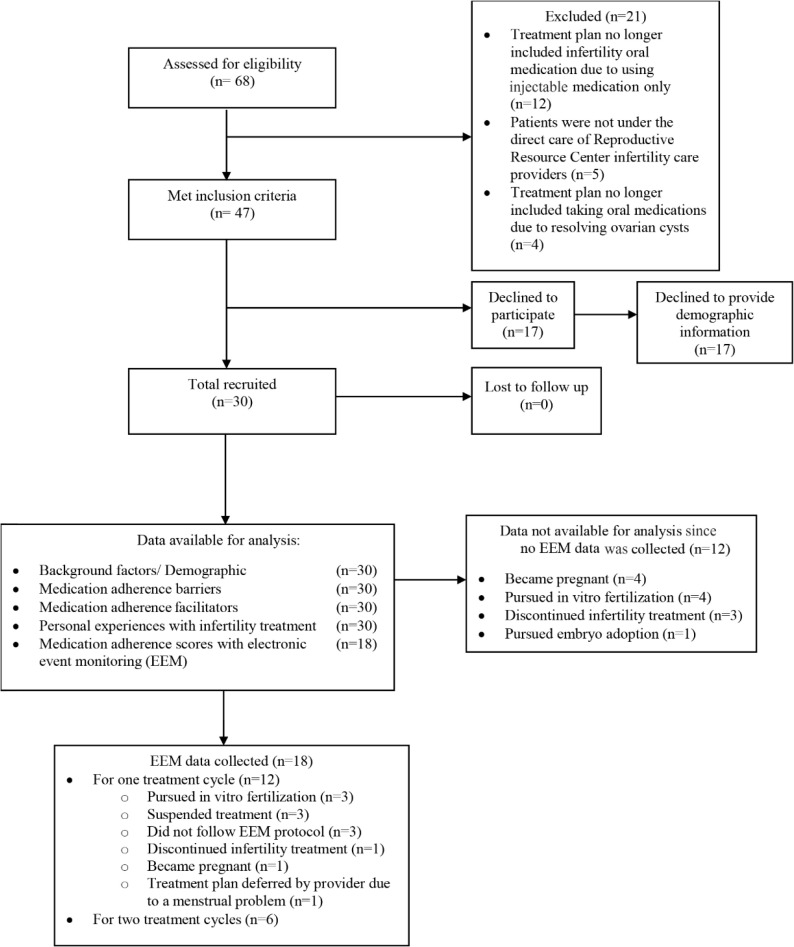
A total of 18 (60%) of the 30 participants used EEM when taking letrozole or clomiphene citrate daily for 5 to 8 days for either one or two treatment cycles, and 12 (40%) participants did not use EEM due to several reasons that are explained in figure 1. However, these 12 women participated in the collection of questionnaire and interview data. Of the 18 (60%) participants who used the EEM, 12 (66.7%) women used EEM for one treatment cycle, and six (33.3%) women used it for two treatment cycles. The median adherence score for all 18 participants who used EEM was 0.98 (Range of 0.75 to 1.00). The median adherence rate of women who used EEM for two treatment cycles (n=6) was 0.97 (Range of 0.85 to 1.00) and the median adherence score of women who used it for one treatment cycle (n=12) was 0.95 (Range of 0.75 to 1.00). There was no significant difference (p=0.62) in the median adherence scores between those who used EEM for one versus two treatment cycles.
The mean total barrier score for all study participants was 34.5 (SD 7.04) with a range of 25 to 49. Of the 18 participants (60%) who used EEM, the median total barrier score was 34 (Range of 25 to 49). Of the 12 (40%) participants who did not use EEM, the median total barrier score was 35.5 (Range of 25 to 42). There was no significant difference (p= 0.43) in the median total barriers scores between those who used EEM and those who did not.
The most commonly reported barriers to medication-taking of the total sample (n=30) were recently feeling sad, down, or blue (53%, n=16), taking medication more than once per day (40%, n=12), taking too many medicines a day (20%, n=6), forgetting things that were important (20%, n=6), worrying if the medication would affect sexual health (17%, n=5), and forgetting to take medication (10%, n=3). Regarding past medication-taking behaviors within the last week to 3 months, women reported taking medication more or less than prescribed (20%, n=6), not having the medication with them when it was time to take it (16.7%, n=5), and having skipped or stopped taking a medication because it made them feel bad (3.3%, n=1). Participant responses to the ASK-20 Survey items are provided in the supplementary data. There was a significant negative correlation (r=−0.49; p=0.02) (27) between the total median barrier scores and the MA.
The mean number of facilitators reported per participant was 3 (Range of 1 to 6) for all 30 participants. Of the 18 participants (60%) who used EEM, the median number of facilitators reported per participant was 3 (Range of 1 to 6). Of the 12 participants (40%) who did not use EEM, the median number of facilitators reported was 2.5 (Range of 1 to 6). There were no significant differences (p=0.34) in the median number of reported facilitators between those who used EEM and those who did not. Emerging themes of MA facilitators were categorized as (1) routine related, (2) physical aid related, (3) healthcare provider related, (4) knowledge related, (5) attitudes and beliefs related, (6) cognition related, (7) motivation related, (8) control beliefs related, and (9) social support related. A detailed list of facilitators with response frequencies and percentages is provided in table 2.
Table 2. Facilitators to medication adherence and thematic categories
| Facilitator type |
%
Within facilitator category |
%
Sample |
|---|---|---|
| Physical related (n=18) | 60.0 | |
| Using a mobile phone alarm (n=10) | 55.5 | |
| Placing pills at a location easily visible (n=9) | 50.0 | |
| Placing pills in medicine cabinet or pill box (n=6) | 33.3 | |
| Using a written schedule (e.g. personal diary ) (n=2) | 11.1 | |
| Keeping pills in possession (e.g. purse ) (n=1) | 5.5 | |
| Routine related (n=15) | 50.0 | |
| Taking pills at mealtime or bedtime (n=11) | 73.3 | |
| Taking pills during a routine activity (e.g. brushing teeth ) (n=2) | 13.3 | |
| Taking pills with other routine medications (e.g. prenatal vitamins ) (n=4) | 26.7 | |
| Social support related (n=13) | 43.3 | |
| Partner reminders (n=10) | 76.9 | |
| Feeling support from important others (n=5) | 38.4 | |
| Hearing about the treatment success stories of other women (n=2) | 15.4 | |
| Motivation related (n=8) | 26.7 | |
| Possessing sense of personal drive/motivation (n=8) | 100.0 | |
| Attitudes and beliefs related (n=6) | 20.0 | |
| Thinking the medication will work (n=3) | 50.0 | |
| Hoping the medication will work (n=3) | 50.0 | |
| Heath care provider related (n=5) | 16.7 | |
| Health care provider instructions (n=4) | 80.0 | |
| Health care provider optimism (n=1) | 20.0 | |
| Cognition related (n=3) | 10.0 | |
| Ability to remember to take pills (n=3) | 100.0 | |
| Control belief related (n=2) | 6.7 | |
| Possessing sense of control over circumstances (n=2) | 100.0 | |
| Knowledge related (n=1) | 3.3 | |
| Understanding how the medication works (n=1) | 100.0 |
Note. Total sample=30
The most commonly reported facilitator categories were physical aid related (60%, n=18), routine related (50%, n=15), social support related (43%, n=13), and motivation related (27%, n=8). Physical aid facilitators included activities such as placing pills in a location easily visible or using a mobile phone alarm as a reminder. Women tended to describe their physical environment in the medication-taking process. Two participants, for example, explained.
“Actually I just leave the pill out on the kitchen counter unless there’s a guest coming over so then every night, I see it, and I remember to take it”
(Participant 26).
“I have an alarm on by phone to remind me to take the letrozole”
(Participant 20).
Routine related facilitators included associating pill-taking with a specific mealtime or taking pills after brushing teeth. Women relied on daily repetitions.
“To make sure that I was consistent, I took the pills at 12:00 PM every day so I took it at lunchtime”
(Participant 14).
“I just put it right next to my toothbrush in the restroom, so it was part of my daily routine”
(Participant 3).
Social support related facilitators included partner reminders and having the support of important others. Women expressed value in the assistance of others when taking the medication.
“My husband is always very conscious of making it a point that it’s not just me and while he can’t take the medicines himself, he’s going to make sure that he’s supportive, carrying them for me, reminding me, making me feel better”
(Participant 10).
Motivation related facilitators included feeling a personal drive to take the medication. For instance, one participant stated “Just my own personal drive”
(Participant 25).
Health provider related facilitators included receiving health provider instructions and feeling the optimism of health provider concerning treatment plan.
“The health care team was actually able to describe the medication very well and how to take it”
(Participant 13).
“I feel encouraged because my health care providers are positive and say let’s give it another round as far as taking medications go and they really listen”
(Participant 5).
Knowledge related facilitators included understanding how the medicine works.
“I understand how the medicine works and it helps me”
(Participant 2).
Attitudes and beliefs related facilitators included thinking and hoping the medication will work.
“I hope the medicine works to get the result that I want in the end”
(Participant 22).
“Just the hope that the outcome is different than the previous cycle”
(Participant 12).
Cognition related facilitators included the ability to remember to take medication.
“Knowing that I have to be the one to remember it”
(Participant 21).
Control beliefs related facilitators included having a mental sense of control over circumstances.
“Taking the medicine makes me feel like I’m doing something about it, and I can control it”
(Participant 3).
The correlation between the number of facilitators reported per participant and MA scores was not significant (r=−0.02; p= 0.46).
Broader themes that emerged from the interviews concerning personal experiences during fertility treatment included (1) individual experiences, (2) social support experiences, and (3) treatment concern experiences. Individual experiences were further subcategorized into:
(1a) feelings of self-blame;
“Part of me is slowly coming to terms with the fact that we are seeking additional treatment and help. I shouldn’t feel this way but there are times I have a bad feeling that it’s my fault”
(Participant 16).
(1b) feelings of emotional distress;
“It’s made me a complete basket case and opened up a lot of emotions if we’re going to be honest about it. I cry randomly”
(Participant 10).
(1c) feelings of psychological distress;
“It’s been very depressing and stressful and turned me into a pessimist over time”
(Participant 28).
(1d) positive view on treatment success;
“I do have some concerns about receiving treatment, but I think my hopefulness of having success outweighs my concerns”
(Participant 3).
(1e) negative view on treatment success;
“I don’t have the faith that it’s going to work”
(Participant 10).
Social support experiences were subcategorized into:
(2a) having a supportive partner;
“My husband has been really supportive, and his attitude has been really great about treatment”
(Participant 9).
(2b) having a broad support system;
“As far as the infertility stuff goes, my parents, his parents and sisters, his friends, and even my friends have been supportive about it”
(Participant 13).
and (2c) feeling a need for greater public awareness and open discussions regarding infertility;
“I wish that more people talked about infertility, more women talked about this. I wish people were more open about going through fertility treatment”
(Participant 18).
Treatment concern experiences were subcategorized into:
(3a) concerns about health risks;
“I’m concerned about what the further down the road impacts on my body could be from taking different hormones and things into my body that aren’t naturally being produced”
(Participant 27).
(3b) concerns about treatment outcomes;
“My biggest concern is we’re not going to be successful with this treatment”
(Participant 6).
and (3c) concerns about financial burden;
“I worry that if the intrauterine insemination doesn’t work, we can’t go any further with treatment because we can’t afford IVF”
(Participant 17).
“On the money side, it has caused a lot of arguments in my marriage, getting the money together and supplementing it monthly for the treatment you need on top of car payments and daycare costs, rent, and stuff like that”
(Participant 28).
Of the 18 participants (60%) who used EEM, nine (50%) participants had a perfect adherence score of 1.00. The remaining nine participants (50%) had adherence scores ranging from 0.75 to 0.95 with a median rate of 0.90. Women in the nonperfect adherers group had a significantly (p= 0.02) higher median total barrier score of 39.0 (Range of 29 to 49) compared to women in the perfect adherence group who had a median total barrier score of 30.0 (Range of 25 to 43). No significant group differences were observed in the number of facilitators reported between groups. The perfect adherers identified a median of 3.00 facilitators (Range of 2 to 5), and the non-perfect adherers identified a median of 3.00 facilitators (Range of 1 to 6), which was not significant. Women with non-perfect adherence were significantly (p=0.02) more likely to have experienced 2 to 3 prior failed cycles compared to women with perfect adherence. Women who were perfect adherers were significantly (p=0.03) more likely to hold a positive view on treatment success compared to women who were non-perfect adherers. Women’s personal experiences with fertility treatment based on adherence group are found in table 3.
Table 3. Personal experiences based on adherence and thematic categories
| Personal experiences |
Perfect adherence
n (%) |
Non-perfect adherence
n (%) | p-values |
|---|---|---|---|
| Individual experiences | |||
| Feelings of self-blame | 0 (0.0) | 2 (22.2) | 0.47 |
| Feelings of emotional distress | 5 (55.6) | 5 (55.6) | 0.10 |
| Feelings of psychological distress | 3 (33.3) | 4 (44.4) | 0.10 |
| Positive view on treatment success | 5 (55.6) | 1 (11.1) | 0.03 * |
| Negative view on treatment success | 2 (22.2) | 4 (33.3) | 0.62 |
| Social support experiences | |||
| Supportive partner | 7 (77.8) | 5 (55.6) | 0.62 |
| Broader support system | 7 (77.8) | 7 (77.8) | 0.10 |
| Need for infertility public awareness | 2 (22.2) | 4 (44.4) | 0.62 |
| Treatment concern experiences | |||
| Concerns about health risks | 2 (22.2) | 5 (55.6) | 0.34 |
| Concerns about treatment outcomes | 3 (33.3) | 3 (33.3) | 0.10 |
| Concerns about financial burden | 2 (22.2) | 2 (22.2) | 0.10 |
Note. Total sample=18. Total cases with perfect adherence: n=9. Total cases with non-perfect adherence: n=9. Significance was set at 0.05; p-values are based on Fisher’s exact test
A post hoc analysis was conducted to test a correlation between women’s MA self-report (The last five items of the ASK-20 Survey) and corresponding MA scores. A higher score on the survey would indicate women reporting non-adherence. There was a significant negative correlation (−0.49; p=0.02) between women’s self-report of non-adherence and respective MA scores.
The purpose of this study was to identify specific barriers to and facilitators of fertility MA while documenting women’s medication-taking behaviors. This study has provided deeper insight concerning the misconception that those who undergo fertility treatment are fully adherent to the fertility medication regimen. As such, the MA patterns found in this study are in alignment with known oral fertility MA behaviors (3) and general MA behaviors (9) across broader patient populations. Letrozole was the medication monitored in this study for 17 of 18 participants. Clomiphene citrate was used by only one participant. Both medications were prescribed once daily for a 5-to 8-day treatment course per cycle. Yet, the dose-dependent efficacy on surrogate measures of fertility treatment effectiveness and pregnancy rates has not been well established for neither letrozole nor clomiphene citrate. Prior studies have compared the uses of letrozole and clomiphene citrate for ovulation induction, although MA behaviors have not been the focus of that research (31, 32). Although pregnancy rates were not the primary study outcome of the current study, examining fertility MA behaviors should be an important step to accomplish pregnancy.
Background factors such as age, race, education, income, and health insurance status have been shown to influence medication-taking behaviors in various patient populations (20–24, 33). In the present study, experiencing 2–3 prior failed cycles was the only background factor that significantly differed between adherence groups; however, the sample demographics were largely homogeneous and the sample size was small. Therefore, discriminating between the demographic variables of women by adherence group was a difficult task, although the sample demographics are in alignment with national statistics for the U.S. population (34).
The mean MA barrier score on the ASK-20 Survey did not approach the maximum score on the total barrier score continuum. Nonetheless, this instrument was successful in discriminating between perfect and non-perfect adherers. These findings are analogous to previous studies that used the ASK-20 Survey to assess MA barriers and MA patterns in other patient populations (35, 36). In patients with asthma, for example, Atsuta et al. (2017) found a correlation of −0.51 between mean ASK-20 Survey total scores and MA scores with a much larger sample size (n=290) than the current study (26). Unlike MA barrier scales, psychometrically sound instruments are lacking in the literature that capture the construct of MA facilitators. Accordingly, qualitative methods have traditionally been employed to investigate people’s perceived facilitators to MA highlighting the uniqueness of each participant when generating this type of study data (37–40).
Although there was no significant relationship between the number of reported facilitators and adherence behaviors, some women identified having a positive social support system as a facilitator during the interviews. Social support has been shown to facilitate healthier behaviors resulting in improved health outcomes (41). The presence of social support has also been associated with improved MA behaviors in varying populations (42–44). Social support is classified into two types of (1) structural support (e.g., marital status, living arrangement) and (2) functional support which is further differentiated into practical support (e.g., picking up prescriptions, reading labels) and emotional support (e.g., encouragement, listening) (44, 45). Women with infertility have reported decreased symptoms of depression as perceived level of social support increased (46).
Although women in the current study expressed feelings of depression, this did not seem to influence MA behaviors. However, depression has been shown to worsen people’s medication taking patterns (47) and depression and anxiety are more prevalent in women with infertility compared to women without the problem (48). In fact, depression and anxiety are well understood to elevate stress levels for women undergoing fertility treatment (18, 49, 50). Whether or not higher stress levels can compromise fertility treatment outcomes remains inconclusive due to conflicting findings (18, 51–53). Some psychological interventions have been tested and shown to reduce psychological distress resulting in higher pregnancy rates during fertility treatment (5, 54) while others have not (55, 56). Additional investigations have been proposed by developing new studies with stronger methodological rigor to strengthen the evidence (53).
Fertility treatment can take emotional toll on women, which could impact their decisions about treatment discontinuation (57–59). Several women enrolled in this study decided to either suspend or discontinue fertility treatment. Early treatment discontinuation is generally considered a primary determining factor of treatment ineffectiveness, yet many women choose to discontinue fertility treatment, including women with infertility insurance coverage (57, 58). Although there are no clear indicators for fertility treatment discontinuation, treatment rejection has been considered a possible causative factor for some women (58–60). In the current study, women who lived in suburban communities and women who were non-perfect adherers were less likely to have a positive view on treatment success. These findings raise speculation as to whether a woman’s level of enthusiasm concerning treatment outcomes influences her decision to discontinue treatment.
Advances in healthcare research and treatment ingenuity have contributed to a paradigm shift that emphasizes customized treatment based on individual needs (61, 62). Because many treatment modalities include prescribing medications, researchers have now directed attention to understanding determinants of MA and identifying predictors of MA (63). Prediction of MA behavior remains a challenge for two reasons:
This novel exploratory pilot study used a mixed methods design that synergized interview data with questionnaire data to generate new knowledge in human reproduction science. Fertility medication-taking patterns were evaluated with the EEM instrument to determine if individual differences in perceived barriers and facilitators between women influenced their actual behaviors. The use of the EEM instrument offered a reliable and valid means to precisely determine at which phase (Initiation, implementation, and discontinuation) fertility MNA occurred. Moreover, the unique ability of EEM to offer actionable medication taking data that could also be shared with study participants during MA interventions provides a significant contribution to MA research. Because little is known concerning how the burden of having infertility and undergoing fertility treatment impacts subsequent MNA, this study offers a unique foundation for future investigation with larger sample sizes.
Although results are useful based on the methodology, several factors limited generalizability of the data. The sample size was very small, and the setting was a single-site center, whereas multiple clinics could have broadened participant recruitment. The study sample was largely homogenous. All participants were married, and the majority were Caucasian, college-educated, and lived in suburban communities. Only 60% of participants used the EEM, compromising the study’s power to discriminate true differences in barrier and facilitator variables between women who were perfect adherers and women who were not. All of them become problematic for drawing inferences from the data about this population. In addition, the convenience sampling approach increased opportunity for sampling bias. The women who declined study participation also declined to provide their demographic information to the researchers. Therefore, selection bias was a concern because there were no data to determine demographic differences between those who participated in the study and those who declined participation. Also, since the majority of participants were Caucasian, which served as the reference variable for race in the analysis, caution should be taken when interpreting these findings for non-Caucasian women. Lastly, there is uncertainty about the degree to which women responded to ASK-20 Survey items based on other prescription medications in addition to fertility medication.
The findings of this study are only exploratory yet useful based on the methodology and offer some theory, research, practice, and policy implications to consider. In accordance with Fishbein and Ajzen’s (2010) Reasoned Action Model, this study demonstrated that a greater number of perceived barriers to fertility MA influence women’s medication-taking behaviors. Therefore, understanding the relationship between MA barriers and fertility treatment discontinuation will be important.
This study has identified women’s multifaceted perceived barriers to and facilitators of MA while undergoing fertility treatment and described those that were associated with women’s actual MA behaviors. The findings of this study also offer new insight about the dynamic interaction between background factors and women’s personal experiences with fertility treatment that influences oral medication-taking patterns during ovarian stimulation cycles. Women who were non-perfect adherers reported a greater degree of barriers to taking prescribed medication during treatment. This provides an important opportunity for health care professionals in fertility clinics to (1) inquire whether or not fertility medication regimens are followed correctly by patients during routine visits, and (2) assist women with minimizing such barriers. Future research should concentrate on oral and injection MA patterns during ovarian stimulation involving intrauterine insemination (IUI) and IVF cycles when medication schedules become more complex, which could elevate the risk for fertility MNA. Moreover, based on the post hoc analysis of this study, which manifested correlation between women’s self-report of MA with their actual fertility medication-taking patterns, simple implementation of a brief MA questionnaire in clinical practice could identify those needing assistance to improve their MA behaviors.
Additional studies are needed to fully understand how fertility MNA behaviors affect pregnancy outcomes. The development and testing of innovative interventions may be necessary to overcome MNA not only in practice but during clinical trials that evaluate the treatment effectiveness of new and existing fertility medications. Nonadherence behaviors during treatment in clinical trials compromise study power, reduce treatment effect size, and weaken overall study findings. In this era of popularity of personalized medicine, more research is focused on tailoring infertility pharmacotherapies to women based on their genetic characteristics to optimize treatment outcomes (69). Still, the benefits of these therapies are dependent upon women’s adherence to the regimen. Future studies are needed that incorporate women’s personal needs into clinical trials and clinical practice guidelines. Gaining knowledge about how treatment burden influences fertility medication taking can assist healthcare providers with making better treatment decisions.
With advancements in reproduction science, women who would ordinarily remain childless have been able to build families. Yet, there are many women who do not have access to fertility treatment due to lack of a covered benefit for these services. Meanwhile, there is national debate concerning expansion of infertility services in the US. Future studies testing cost-effective interventions to improve fertility MA behavior could influence US lawmakers’ decisions to implement new policies that would mandate infertility insurance coverage for women nationwide.
This study serves as a preliminary framework to cultivate ongoing discovery including forthcoming interventional studies aimed at assessing and optimizing fertility MA behaviors to strengthen the future of clinical practice.
D.E.M. contributed to the conception and drafting of the article. D.E.M. and C.L.R. contributed to the design of data acquisition, the analysis and interpretation of data, revising the article critically, and approving the final version to be submitted for publication.
