
Uterine leiomyomata (UL) or fibroids are benign tumors of disordered smooth muscle cells which are clinically apparent in nearly 25% of women by the age of 45 years, while many others remain asymptomatic and are undiagnosed. Symptoms include dysmenorrhoea, menorrhagia, pelvic pressure, pain, lower backache, abdominal distension, anemia, recurrent urinary tract infections and either increased urinary frequency or retention (1). In pregnant women, UL have been associated with premature labor, recurrent miscarriages, abnormal placentation, post-partum haemorrhage, and related complications. They are responsible for about 50% of female infertility (2, 3). UL are clinically managed by various medical or surgical techniques depending on the age, symptoms, and fertility status of the women. Their exact etiology is still elusive; however, there is considerable evidence that estrogen plays a major role in the proliferation of these benign tumors; hence, they rarely grow before menarche and often regress after menopause. Women can develop either solitary or multiple fibroids (4).
Low frequency of chromosomal aberrations such as deletions of 7q, trisomy of chromosome 12, rearrangements affecting the High Mobility Group AT–Hook 2 (HMGA2) located on 12q14 have been associated with the etiology of UL. Mitochondrial DNA mutations and candidate gene polymorphisms have also been associated with UL (5). The most frequent tumor specific genetic alterations reported in UL is the exon-2 variant in Mediator Complex Subunit 12 (MED-12), located on chromosome Xq13.1 (6).
MED-12 is a 1.2 MDa aggregate of 30 protein subunits which is a transcriptional regulator that bridges DNA regulatory sequences to the initiation complex comprising RNA polymerase II. It is concerned with transcriptional regulation and gene expression. Recent exome sequencing studies have revealed recurrent somatic mutations in exon-2 of MED-12 in leiomyomata which is considered as a hotspot region of benign tumors (7, 8).
In the present study, multiple fibroids from a single uterus of a unique patient have been analyzed, as well as, individual fibroids from other patients to detect sequence variants in exon-2 of MED-12 and flanking intronic region by polymerase chain reaction (PCR) followed by sequencing to find out whether multiple UL are monoclonal as reported in the literature.
Fibroid tissue samples were obtained from the fresh specimens collected after performance of surgical procedures like myomectomy, total abdominal hysterectomy (TAH), and laparoscopic hysterectomy on women who were diagnosed with UL. The demographic information of the patients along with their clinical history was collected from the hospital system. The study was approved, and ethical clearance was given by the institutional ethics committee of Vasavi Medical & Research Centre, prior to the commencement of the study (Ethics code: ECR/139/Inst/AP/2013/ RR-16). Duration of the study was from 2013–2017.
A total of twenty-two multiple UL samples were selected for molecular analysis from four patients (Table 1).
Table 1. Patient details
| No. | Patients | Age (years) | Type of UL | Sample |
|---|---|---|---|---|
| 1 | P1 | 40 | Sub serosal | 1F to16F |
| 2 | P2 | 44 | Sub serosal | 17F |
| 3 | P3 | 42 | Sub serosal | 18, 19F, 20F |
| 4 | P4 | 42 | Intramural | 21F and 22F |
An unmarried woman of 40 years (Patient 1: P1) was diagnosed during bimanual pelvic examination with multiple fibroids. Her uterine fibroid was equal to a pregnant uterus of 36 weeks gestation in size. She has been taking alternative medicine (Homeopathy) for hypothyroidism and also medication for hypertension since the past several years. Minimally invasive low transverse mini laparotomy and total abdominal hysterectomy were performed and the sample in toto was sent to pathology department where 84 subserosal fibroids were identified on grossing. The total weight of all the fibroids was 4 kg (Figure 1A). The largest weighed 1.07 kgs and measured 17×10 cm, while the smallest measured 0.5×0.5 cm. The tumors were assorted into large (Above 8 cm), medium (5–7 cm) and small (Below 4 cm) groups according to their size (Figure 1B.) This has been recognized by the Guinness World Records (Guinness number 417249) as a medical marvel. From this patient (P1), 16 fibroid samples were taken for the study.
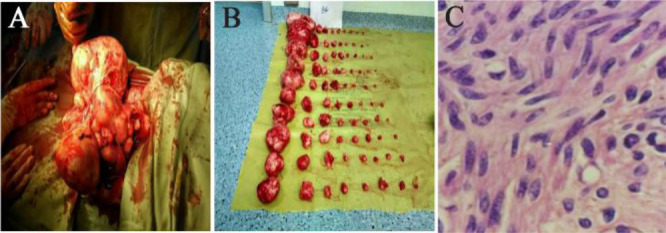
From three patients (P1, P2 and P3), 6 fibroids samples were studied (Table 1) and 22 fibroid samples were randomly selected for analysis from the total 90 fibroid samples (16 samples from P1+6 samples from P2, P3 and P4 (22).
Tissue DNA was isolated from 22 fibroid tissue samples belonging to four women according to the protocol proposed by Shaik et al. (5). DNA was extracted after thoroughly mincing the tissue sample, and digesting by adding TKM2 lysis buffer with 10% sodium dodecyl sulphate and proteinase K. To the digested samples, 150 ul of NaCl was added for protein precipitation. After centrifuging at 8000 rpm, the clear supernatant was added to ice cold isopropanol. The pellet was washed with 70% ethanol twice before dissolving in 20 μl of Tris Ethylene Diamine Tetra Acetic acid (EDTA) buffer and stored at −20°C until required.
The isolated DNA was amplified with specific oligonucleotide primers in a thermal cycler. PCR was carried out using Taq DNA Polymerase (Bangalore Genei, India) and MED-12 specific genomic primers encompassing exon-2: 5′>3′AACGTAAGGGCCCAGCTTTA (Forward primer), 5′>3′CAGGGCCTTTGCTCCTTCTTA (Reverse primer).
Genomic DNA amplification was performed according to the method published earlier by Darooei et al. in 2018 (9) with 30 cycles each consisting of denaturation at 94°C for 30 s, annealing at 60°C for 30 s, and extension at 72°C for 45 s with an initial denaturation at 94°C for 5 min.
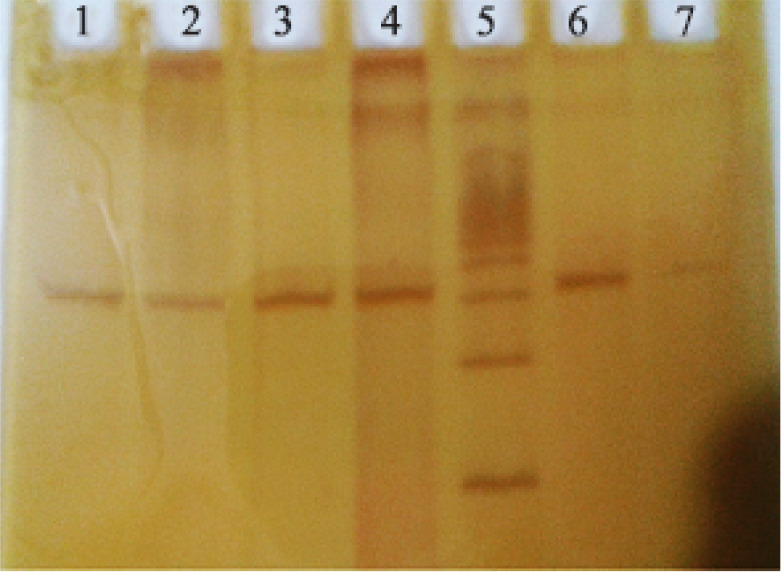
The amplified PCR products for exon-2 of MED-12 were visualized on 12% polyacrylamide (Figure 2) or agarose gel after electrophoresis according to the method published earlier by Govindan et al. in 2012 (10) and sent for DNA sequencing (Vimta labs, India).
Polymerase chain reaction and Sanger sequencing were carried out and the sequence data was evaluated (Annotated with GRCh37:CM000685.1) by manually checking the amino acid sequence of exon-2 of MED-12 using SNPper and Nucleotide BLAST (Basic Local Alignment Search Tool) available at www.SNPper.chip.org and www.ncbi.nim.nih.gov/blast/BL ASTN, respectively.
Bioedit, a freeware sequence analysis program (Version 6.0.0) was used for aligning wild type and patient sequences in order to identify sequence mismatches. Pairwise sequence alignment using Emboss Needle was conducted to identify regions of similarity. Mutation Taster, Provean, Polyphen -2.0, I-Mutant 2.0, PON-PS, and Mutation Assessor software tools were used to predict the pathogenicity of the mutations.
All the ULs were found to be solid, homogenous, and whorled based on gross appearance and had a firm consistency. One of them showed a degenerative change known as “red degeneration”. Another was gritty/granular. Before processing for histopathology, bits of tissue from twenty-two fibroids were secured (Figure 1B).
Multiple sections of different fibroids showed a cellular lesion composed of loose intersecting fascicles of smooth muscle cells containing cigar shaped nuclei. No significant mitosis, necrosis or nuclear atypia was seen in the sections studied. Focal areas of hyalinization, infarct with haemorrhage, calcifications, and hemosiderin were also observed (Figure 1C).
Of the 22 UL tumors sequenced, eight fibroid tissue samples had somatic MED-12 genetic variants. Table 2 shows seven exonic and five intronic variants.
Table 2. Molecular analysis of exon-2, MED-12, from multiple uterine leiomyoma samples
| No | Uterine leiomyoma sample | Uterine leiomyoma size | Nucleotide substitution | Amino acid substitution |
|---|---|---|---|---|
| 1 | P1-9F | 5×2 cm | c.173delinsCC | S58Tfs*27 |
| 2 | P1-4F | 8×5 cm | c.172_174delinsCCCTC | S58Pfs*40 |
| 3 | P1-6F | 8×5 cm | c.173_174delinsTG | S58M |
| 4 | P1-3F | 8.5×5 cm | c.172_174delinsTCCCCTC | A59Pfs*27 |
| 5 | P2-17F | 1×17 cm | c.131G>T | G44V |
| 6 | P3-18F | 12.6×10 cm | g.806_806delT | NA splice site changes in intron 1 |
| 7 | P3-19F | 5×5 cm | c.146_147delinsTG | P49L |
| 8 | P3-20F | 3.5×2 cm | c.117_118insG | N40Rfs*8 |
| g.665_689delAACGTAAGGGCCCAGCTTTAAGTAA | ||||
| 6 base substitutions | NA splice site changes in intron 1 | |||
| g.707_708insAAGTAG | ||||
| g.727_727delA |
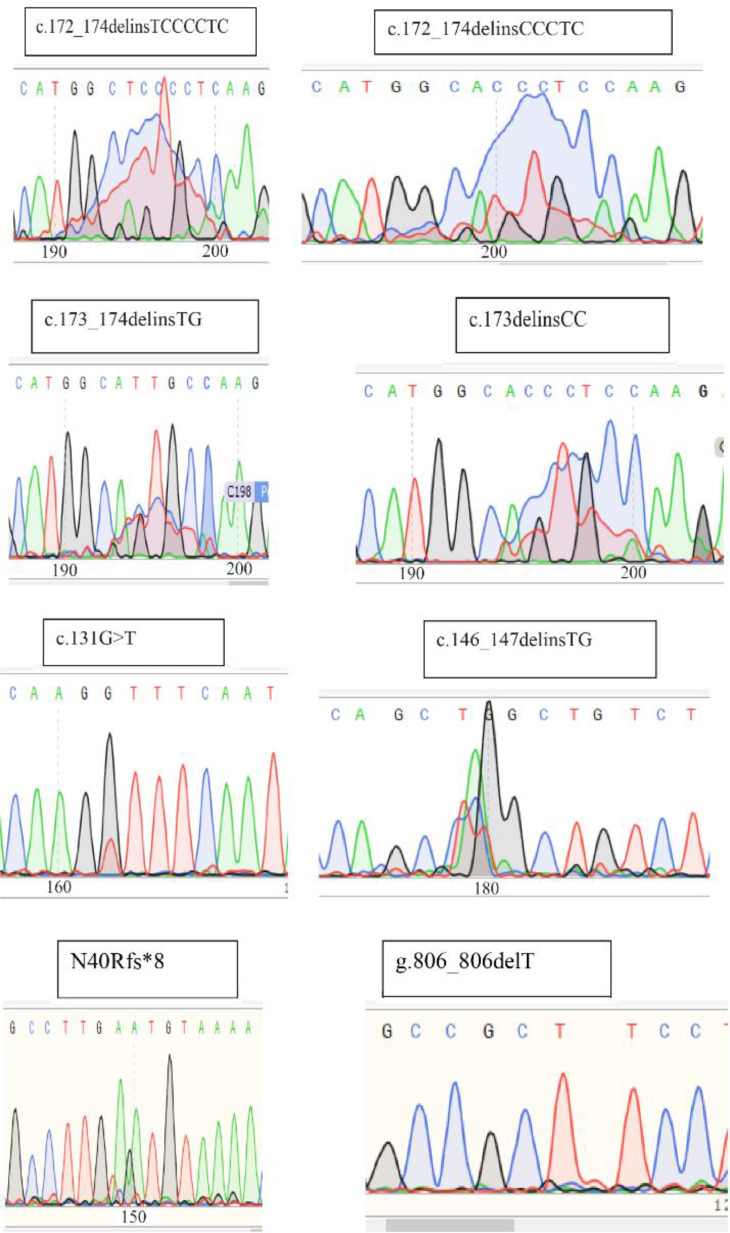
Four fibroids from Patient 1 had sequence variants affecting codon 58 and 59 (Figure 3) indicating that these multiple fibroids may be clonal in origin. All of them had a size above 5 cm, indicating that codon 58, 59 may be involved in fibroid progression rather than initiation.
Patient 2 had the commonly reported codon 44 mutation, G44V, while patient 3 had multiple mutations of two different exonic variants in different fibroids in codon 40 (Sample 20F) and codon 49 (sample 19F) suggesting that each of them may have developed independently and may be polyclonal in origin; moreover, there were five intronic variants in patient 3, four in 20F which is the small UL and one in 18F as the large UL and among them two somatic variants were large deletions/insertions. Both fibroids (21F and 22F) of patient 4 did not have any genetic variant of the MED-12.
Genetic variations in these UL samples consisted of 7 exonic variations (Table 2 and Figure 3), which included deletions and insertions (Delins) in 5 fibroids. The DNA changes were as follows: c.173delinsCC, c.172_174delinsCCCTC, c.173_ 174delinsTG, c.172_174delinsTCCCCTC, and c. 146_147delinsTG, insertion in 20F of P3 c.118_ 119insG, one reported point mutation c.131G>T, G44V and five splice site changes in intron 1-g.806_806delT, g.665_689delAACGTA AGGGC CCAGCTTTAAGTAA, 6 base substitutions, g. 707_708insAAGTAG, g.727_727delA.
In-silico analysis using eight software tools has shown that four of them are damaging (G44V, A59Pfs*27, P49L and S58Tfs*27) (Table 3 and 4).
Table 3. Deleterious effects of MED-12 mutations/variants from multiple UL by various prediction methods
| No | Amino acid change | Mutation taster | Polyphen-2 | Provean | Sift | I-Mutant 2 | PON-PS | Mutation assessor |
|---|---|---|---|---|---|---|---|---|
| 1 | A59Pfs*27 | Disease causing | Possibly damaging | Deleterious | Damaging | Decreasing stability | Severe | Medium |
| 2 | S58Pfs*40 | Disease causing | Possibly damaging | Deleterious | Damaging | Decreasing stability | Non-severe | - |
| 3 | S58M | Disease causing | Probably damaging | Deleterious | Damaging | Increasing stability | Non-severe | - |
| 4 | S58Tfs*27 | Disease causing | Probably damaging | Neutral | Tolerated | Decreasing stability | Neutral (Benign) | Neutral |
| 5 | G44V | Disease causing | Probably damaging | Deleterious | Damaging | Decreasing stability | Non-severe (Pathogenic) | Medium |
| 6 | P49L | Disease causing | Possibly damaging | Deleterious | Tolerated | Decreasing stability | Severe | Low |
| 7 | N40Rfs*8 | Disease causing | Benign | Deleterious | Tolerated | Decreasing | Non-severe | - |
| stability |
Table 4. Prediction scores for MED-12 amino acid substitution mutations in multiple UL
| No | Nucleotide substitution | Amino acid substitution | Provean (cut off=0.25) | Sift (cut off ≤0.05, deleterious) | Polyphen-2 (cut off >0.5–1.0, pathogenic) | I-Mutant (cut off=0) | PON-PS | Mutation assessor (FIS) | MutPred (cut off >0.5 harmful) |
|---|---|---|---|---|---|---|---|---|---|
| 1 | c.172_174delin | A59Pfs*27 | −3.61 | 0.008 | 0.892 | −2.27 | 0.56 | 2.08 | 0.707 |
| sTCCCCTC | |||||||||
| 2 | c.131G>T | G44V | −6.48 | 0.000 | 1.000 | −0.58 | 0.49 | 2.265 | 0.664 |
| c.146_147delin | |||||||||
| 3 | sTG | P49L | −4.96 | 0.083 | 0.913 | −0.25 | 0.59 | 1.525 | 0.207 |
| c.172_174delin | |||||||||
| 4 | sCCCTC | S58Pfs*40 | −2.72 | 0.005 | 0.855 | −1.33 | 0.41 | - | 0.544 |
| c.173_174delin | |||||||||
| 5 | sTG | S58M | −2.73 | 0.002 | 0.996 | 0.22 | 0.49 | - | 0.386 |
| 6 | c.173delinsCC | S58Tfs*27 | −0.07 | 0.561 | 0.983 | −0.59 | - | 0.375 | 0.072 |
| 7 | c.117_118insG | N40Rfs*8 | −3.81 | 0.121 | 0.442 | −0.53 | 0.45 | - | 0.216 |
Multiple sequence alignment of the MED-12 protein showed that G44 and E55 AAs (Amino acids) were highly conserved across the species and variants of these may be deleterious (Table 5).
Table 5. MED-12 gene protein sequence for wild-type and mutated protein
| Variant: MED12_HUMAN G44V multiple sequence alignment across species | ||||||||||||
|---|---|---|---|---|---|---|---|---|---|---|---|---|
|
| ||||||||||||
| Species | 40 | 41 | 42 | 43 | 44 | 45 | 46 | 47 | 48 | 49 | 50 | |
| MED-12_HUMAN | N | V | K | Q | G | F | N | N | Q | P | A | |
| Tr | RAT | N | V | K | Q | G | F | N | N | Q | P | A |
| Tr | BRAFL | S | V | K | Q | G | Y | N | N | Q | P | N |
| Tr | TRIAD | T | L | K | N | G | F | K | N | V | E | L |
| Tr | ACYPI | N | V | K | H | G | F | T | T | S | L | T |
| Tr | DANPL | N | V | K | H | G | F | T | T | T | P | Q |
| Tr | PEDHC | N | V | K | L | G | F | T | T | M | P | Q |
| Tr | DROPS | N | V | K | H | G | F | T | T | T | P | P |
| Tr | DAPPU | N | V | K | Q | G | F | S | H | T | P | N |
| Tr | APIME | N | V | K | L | G | F | A | T | M | P | Q |
| Tr | TRICA | N | V | K | H | G | F | L | T | M | T | H |
| Tr | ATTCE | N | V | K | H | G | F | A | T | T | T | Q |
| Tr | AEDAE | H | V | K | H | G | F | A | T | E | H | K |
| Tr | CIOSA | N | V | K | Q | G | F | I | N | Q | P | P |
| Tr | CIOIN | N | V | K | Q | G | F | I | N | Q | P | P |
| Tr | OIKDI | F | L | K | H | G | F | S | L | N | P | L |
| Tr | IXOSC | N | V | K | Q | G | F | I | T | N | P | Q |
| Tr | BRUMA | R | L | K | K | G | Y | Q | V | A | A | |
| Tr | ASCSU | R | L | K | K | G | Y | Q | V | A | A | |
| Tr | TRISP | K | V | R | Q | G | F | I | Y | K | P | P |
UL are the most common benign smooth muscle tumors found in the uterus. Recurrent somatic mutations in exon-2 of MED-12 were considered as the most frequent genetic aberrations in benign tumors including UL, fibroadenoma, and phyllodes tumors (11). They could be considered as the driver mutations in the etiology of UL (12). Mediator complex is a 1.2 MDa aggregate of 30 protein subunits regulating gene specific as well as global transcription; it exists in multiple functional forms to regulate the gene expression (13). Two of them are the core mediators which combine with RNA pol II to form holoenzyme and the kinase module consisting of Cyclin Dependent Kinase-CDK8, Cyclic C, and MED-12 and MED-13 subunits. The large size and stearic conformation of mediator serves as a central scaffold providing extensive surface area to physically and/or functionally facilitate protein-protein interaction with components of the pre elongation complex (14–20). Sequence alterations in exon-2 of MED-12 gene disrupt the protein and its association with CYCC-CDK8/19 and direct interaction with Cyclin C-CDK8 (21); this increases the expression of RAD51 B involved in tumor development (22–24).
Published evidence indicates that MED-12 somatic sequence variants contribute to the etiology of 70–85% of UL. Exon-2 is considered as the hotspot of this gene as reported from UL studies of different ethnic groups like North American (25), South African (26), Finnish (27), and Saudi Arabian (28). The total somatic mutations of MED-12 were observed in 41% of the UL samples studied. They were found to be more than the Korean (32%) report of Je et al. in 2012 (29) and less than the previous German (48%) study of Markowski et al. (30). Several other studies re-ported higher percentages ranging from 50% to 75% (26, 31–34).
This is the first report from India but the sample size was small to discuss prevalence; however, the importance of this study lies in the fact that each fibroid was investigated as an individual tumor and sequence variants contained codon 58 and 59 in all four fibroids from patient 1, indicating that these multiple fibroids may be clonal in origin. All of them were more than 5 cm in size, suggesting that these codons may be involved in fibroid progression rather than initiation. The sequence variants of these codons replace Serine indicating that this amino acid may be important for MED-12 function. The novel insertions and deletions in exon-2 of the MED-12 in UL have caused frame shifts (A59Pfs*27, S58Tfs*27, S58Pfs*40, N40Rfs*8), which is unique in these multiple tumors. Frameshift mutations result in abnormal protein products with an incorrect amino acid sequence that can be either longer or shorter (N40Rfs*8) than the normal protein (Table 6). The previously reported gain of function mutation c.131 G>A (p. G44V) by Mäkinen et al. was found in patient 2 (Sample 17F), but other mutations were novel like P49L, S58M, S58Pfs* 40, S58Tfs*27, A59Pfs* 27, and N40Rfs*8.
Table 6. MED-12 gene, wild-type and mutated protein sequence in UL
| Codon | Wild type protein sequence | Mutated protein sequence for the amino acid change | ||||||
|---|---|---|---|---|---|---|---|---|
|
| ||||||||
| S58Tfs*27 | N40Rfs*8 | S58Pfs*40 | S58M | A59Pfs*27 | P49L | G44V | ||
| 39 | L | L | L | L | L | L | L | L |
| 40 | N | N | R | N | N | N | N | N |
| 41 | V | V | C | V | V | V | V | V |
| 42 | K | K | K | K | K | K | K | K |
| 43 | Q | Q | T | Q | Q | Q | Q | Q |
| 44 | G | G | R | G | G | G | G | V |
| 45 | F | F | F | F | F | F | F | F |
| 46 | N | N | N | N | N | N | N | |
| 47 | N | N | N | N | N | N | N | |
| 48 | Q | Q | Q | Q | Q | Q | Q | |
| 49 | P | P | P | P | P | L | P | |
| 50 | A | A | A | A | A | A | A | |
| 51 | V | V | V | V | V | V | V | |
| 52 | S | S | S | S | S | S | S | |
| 53 | G | G | G | G | G | G | G | |
| 54 | D | D | D | D | D | D | D | |
| 55 | E | E | E | E | E | E | E | |
| 56 | H | H | H | H | H | H | H | |
| 57 | G | G | G | G | G | G | G | |
| 58 | S | T | P | M | S | S | S | |
| 59 | A | C | S | A | P | A | A | |
| 60 | K | Q | P | K | R | K | K | |
MED-12 was shown to play a direct role in the modulation of Wnt/β-catenin signaling and fibroid proliferation (35, 36). Expression profiling showed that genes upregulated in MED-12, exon -2 mutated fibroadenomas, were associated with dysregulated estrogen signaling (37). The c.131G>T variant may also be considered to cause UL through genomic instability of MED-12 which plays a critical role in UL pathogenesis (38).
These sequence variants could play an indirect role in UL progression by modifying the activity of other genes which encode proteins involved in growth and tumor progression (39).
The UL samples,18F and 20F, of patient 3 have intronic-dels, indels, and base substitutions in the non-coding DNA. A previous study (40) has documented the effect of mutation in non-coding DNA. It is a known fact that the non-coding DNA bears many functional elements and the variants in them can have phenotypic effects and cause disease susceptibility. Literature supports variation in non-coding DNA for disease susceptibility (41–43).
Somatic MED-12 exon-2 variants could be antecedents to genomic rearrangements and may cause genomic instability and drive tumor progression (38). This study needs to be validated on a larger sample size with multiple UL. However, in this study, it has been shown that only a small percentage of UL in analyzed patient exhibited MED-12 variants indicating that UL are not clonal, and each tumor is independent.
The evaluated case was extremely interesting since a single individual had multiple UL and different sequence variants suggesting a genetic heterogeneity and that they may not have arisen from the same common progenitor cell. Earlier studies reported that MED-12 mutations are seen in small UL (6); however, in this study, variants were found in medium and large UL. The results indicate that UL may not have a clonal origin but variants in exon-2 of MED-12 may be involved in its progression.
We would like to appreciate the support provided by MANF (Maulana Azad National Fellowship for Minority Students) and Hyderabad Science Society (HSS).
