
About 10–15% of couples face the problem of infertility during their reproductive years (1). Ovulatory disorders are responsible for about 30 to 40% of female infertility (2). According to the WHO classification of anovulation, about 85% of anovulation cases fall under group II, which is hypothalamic pituitary dysfunction or eugonado-tropic anovulation (3). This group consists predominantly of women with polycystic ovary syndrome (PCOS). Since the last six decades, ovulation inducing drugs have resulted in successful treatment of this group of infertile patients.
Clomiphene citrate (CC) has been widely used for ovulation induction in women with PCOS since its introduction in 1956 (4,5). The ovulation rate with clomiphene is around 80% (6), but still only 40% of these women are able to achieve a pregnancy (7). This discrepancy has been proposed to be due to the antiestrogenic effects of clomiphene on cervical mucus (7) and endometrium (8). Tamoxifen is another non-steroidal selective estrogen receptor modulator (SERM) which has a similar mechanism of action like clomiphene, but acts as an agonist on the estrogen receptors of the endometrium and vaginal mucosa. It is commonly used as an adjuvant in the treatment of breast cancer. Its use in ovulation induction was first reported by Williamson and Ellis in 1973 (9). Although there is a wealth of data on clomiphene, the studies on the use of tamoxifen in ovulation induction are relatively inconclusive, with different studies reporting higher, lower or comparable results, when compared to clomiphene. However, some data is encouraging in terms of ovulation and pregnancy rates (9–11). Tamoxifen has given good results in women with clomiphene failure too (10). The reasons proposed for a better ovulation and pregnancy rates with tamoxifen are favorable cervical mucus and better endometrial thickness and functioning of corpus luteum (10–14). The added advantages of tamoxifen are lower cost and lower chances of ovarian hyperstimulation. This study was conducted with the aim of comparing the efficacy of tamoxifen and clomiphene citrate in induction of ovulation in subfertile women with PCOS and anovulation.
This was a prospective cohort study, conducted over a period of one year in the Department of Reproductive Medicine of a tertiary care center in India. Sample size calculation was done with the use of the OpenEpi software. On the basis of the previous studies, to achieve a statistically valid comparison of the ovulation rates in both groups, considering type I error of 0.05 and a power of 80%, a sample size of at least 50 women in each group was required. One hundred and four women with polycystic ovary syndrome (Diagnosed by the Rotterdam’s criteria) (15) and primary infertility were enrolled in the study after considering the inclusion and exclusion criteria (Figure 1). Proper consent was taken from the patients and the study was approved by the institutional review board. Inclusion criteria of the study were (1) age of <35 years in anovulatory women, (2) BMI of 18–30 kg/m 2, (3) bilaterally patent fallopian tubes, and (4) semen parameters within normal range according to the 2010 WHO manual. Exclusion criteria of the study were (1) hydrosalpinx, adenomyosis or intramural fibroid >4 cm, (2) endometriomas seen in ovaries on ultrasound, (3) patients with previous history of ovarian drilling, (4) history of 3 previous unsuccessful ovulation induction cycles, and (5) other causes of anovulation (Primary or co-existing) such as hypothyroidism and hyperprolactinemia.
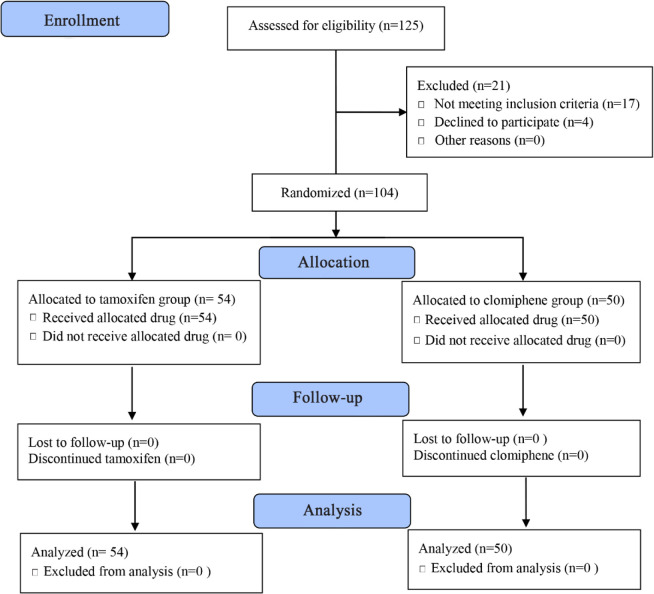
The hysterosalpingography showed bilateral spill of the radiopaque contrast from the fallopian tubes and the semen analysis report was also normal according to the 2010 WHO manual. On third day of a normal menstruation or withdrawal bleeding, serum FSH, LH and estradiol levels were measured, along with performing a baseline transvaginal scan. Although the included anovulatory patients were already diagnosed cases of PCOS, baseline serum FSH and LH levels were measured on the third day of the menstruation to compare the baseline characteristics in both groups. Once it was confirmed that the baseline endometrial thickness was less than 4 mm, there was no cyst in the ovaries and serum estradiol levels were less than 50 pg/ml, the patients were then allocated into group A (n=54) and group B (n=50) (Figure 1) by a nurse on the basis of a computer generated randomization table. The patients allocated in two groups; group A (n=54) received tamoxifen 40 mg once daily for 5 days (Days 3–7) and group B (n=50) received clomiphene citrate 100 mg once daily for 5 days (Days 3–7).
Serial ultrasounds were done from day 11 of the cycle to monitor the number and size of follicles, and to assess the endometrial thickness. Human chorionic gonadotropin (hCG) was administered intramuscularly at a dose of 5000 IU, when at least one follicle reached a mean diameter of ≥18 mm on transvaginal scan. A repeat scan was done after 48 hr and ovulation was documented by one or more of the following criteria, viz. disappearance of the dominant follicle, decrease in the size of the follicle, change in its shape, appearance of internal echoes within it and/or appearance of free fluid in the pouch of Douglas. The couple was advised to have sexual contact during the periovulatory period after hCG administration. Luteal support was given by administration of micronized progesterone 200 mg twice daily vaginally for 14 days, after which serum beta hCG levels were measured. A transvaginal scan was done 2 weeks after the positive serum beta hCG report to evaluate the presence of gestational sac and confirm a clinical pregnancy. Pregnancies were followed till the 12th week of gestation.
The primary outcome measures were the number of developing dominant follicles in each patient (>16 mm), serum estradiol levels on the day of hCG trigger, endometrial thickness on the day of hCG trigger, and ovulation rate per treatment cycle. The secondary outcome measure was pregnancy rate per ovulatory cycle and also per treatment cycle. Comparison was done in both groups using chi-square and student’s t-test and a p-value of less than 0.05 was considered statistically significant.
Both groups were comparable in terms of age, BMI, basal FSH and LH, and duration of infertility (Table 1). The number of dominant follicles (>16 mm) was significantly more in the clomiphene group as compared to the tamoxifen group (2.1+0.2 vs. 1.02+0.4, p<0.05). On the day of hCG administration, the serum estradiol levels were significantly higher in the clomiphene group (196+21.4 vs. 168+15.6 pg/ml, p<0.05), whereas the endometrial thickness was significantly more in the tamoxifen group (10.4+0.3 vs. 8.8+0.7 mm, p<0.05). The ovulation rates were not significantly different in both groups (Gp A–36/54 (66.6%), Gp B–35/50 (70%), p=0.715). Pregnancy rate per treatment cycle and per ovulatory cycle was marginally higher in the tamoxifen group (8/54 (14.81%) and 8/36 (22.22%), respectively), as compared to the clomiphene group (7/50 (14%) and 7/35 (20%), respectively), but the difference did not reach a statistical significance (p=0.905 and 0.818, respectively) (Table 2). There was one miscarriage in the tamoxifen group. There were no ectopic or multiple pregnancies in both groups.
Table 1. Patient characteristics in both the groups
| Tamoxifen (Gp A) | Clomiphene citrate (Gp B) | p-value | |
|---|---|---|---|
| Number of women | 54 | 50 | |
| Age (Yrs) | 26.4 (±2.8) | 25.2 (±2.9) | 0.921 |
| BMI (kg/m2) | 26.2 (±3.6) | 27.0 (±2.8) | 0.734 |
| Basal FSH (mIU/ml) | 5.4 (±0.9) | 4.9 (±1.2) | 0.863 |
| Basal LH (mIU/ml) | 8.8 (±2.4) | 9.2 (±1.01) | 0.572 |
| Duration of infertility (Yrs) | 2.5 (±1.2) | 2.7 (±1.6) | 0.351 |
Values are expressed as Mean+SD
Table 2. Comparison of the results in tamoxifen and clomiphene groups
| Tamoxifen (Gp A) (n-54) | Clomiphene citrate (Gp B) (n-50) | p-value | |
|---|---|---|---|
| No. of dominant follicles (≥16 mm) | 1.02 (±0.4) | 2.1 (±0.2) | 0.001 |
| Estradiol levels on the day of hCG administration (pg/ml) | 168 (±15.6) | 196 (±21.4) | 0.023 |
| Endometrial thickness on hCG day administration (mm) | 10.4 (±0.3) | 8.8 (±0.7) | 0.006 |
| Ovulation rate | 36/54 (66.6%) | 35/50 (70%) | 0.715 |
| Pregnancy rate per treatment cycle | 8/54 (14.81%) | 7/50 (14%) | 0.905 |
| Pregnancy rate per ovulatory cycle | 8/36 (22.22%) | 7/35 (20%) | 0.818 |
Values are expressed as Mean+SD, absolute values (percentages in brackets)
In the present study, the efficacy of tamoxifen for ovulation induction in subfertile women with PCOS was compared to that of clomiphene citrate. Not only the ovulation rates, but also the number of dominant follicles, peak serum estradiol levels, endometrial thickness, pregnancy rates per treatment cycle and per ovulation cycle were compared and studied.
In our study, 36 women ovulated out of 54 (66.6%) in the tamoxifen group, whereas 35 women ovulated out of 50 (70%) in the clomiphene citrate group which showed no statistically significant difference between groups. These findings revealed higher ovulation rates as compared to the rates reported by Boostanfar et al. in a randomized control trial in which ovulation rates with tamoxifen and clomiphene citrate were 44.24 and 45.05%, respectively. The reason could be the difference in the daily dose of tamoxifen and clomiphene, which was 40 mg and 100 mg in our study and 20 mg and 50 mg in the RCT by Boostanfar et al., respectively. But interestingly, the ovulation rates with tamoxifen and clomiphene, in spite of being lower as compared to our study, were similar to each other in the RCT by Boostanfar et al. (17) (Table 3).
Table 3. Comparison of ovulation rates with tamoxifen and clomiphene citrate in different studies
| Study | Year | Daily dose of tamoxifen (mg) | Daily dose of clomiphene (mg) | Ovulation rate with tamoxifen (%) | Ovulation rate with clomiphene (%) | p-value |
|---|---|---|---|---|---|---|
| Present study | 2020 | 40 | 100 | 36/54 (66.6) | 35/50 (70) | 0.71 (NS) |
| Boostanfar et al. (RCT) | 2001 | 20 | 50 | 50/113 (44.24) | 41/91 (45.05) | >0.05 (NS) |
| Nardo (RCT) | 2004 | 20 | 50 | 61/98 (62.24) | 60/127 (47.24) | 0.03 (In favor of Tamox) |
| Badawy and Gibreal (RCT) | 2011 | 20 | 100 | 95/184 (51.63) | 120/187 (64.17) | 0.01 (In favor of CC) |
| Seyedoshohadaei et al. (RCT) | 2011 | 10–30 | 50–150 | 34/50 (68) | 39/50 (78) | >0.05 (NS) |
| Chunfeng and Musen (case-control study) | 2016 | 20 | 50 | 31/38 (81.57) | 25/38 (65.78) | <0.05 (In favor of Tamox) |
| Daqing et al. (RCT) | 2016 | 20 | 50 | 42/49 (85.71) | 33/49 (67.34) | <0.05 (In favor of Tamox) |
| Narayanan et al. (RCT) | 2019 | 40–80 | 50–150 | 70% | 71.4% | 0.93 (NS) |
The ovulation rate with tamoxifen in our study was comparable to that reported by Nardo as 62.24% in a randomized control trial. Although the ovulation rate with clomiphene was much lesser (47.24%) as compared to the present study, the reason could again be the difference in the daily dose of clomiphene which was 100 mg in our study and 50 mg in the RCT by Nardo (18).
In 2011, an RCT conducted by Seyedoshohadaei revealed ovulation rates of 68 and 78%, respectively in the tamoxifen and clomiphene groups, which was comparable to each other and similar to the present study (19).
In another RCT by Badawy and Gibreal in 2011, the ovulation rates were comparable to our study in the clomiphene group, 70 and 64.17%, respectively. In both studies, 100 mg of clomiphene was given daily. However, for tamoxifen, there was a difference in the dose, as it was 40 mg and 20 mg in our study and the RCT by Badawy and Gibreal, respectively. This explained the ovulation rates of 66.6 and 51.63%, respectively. Thus, Badawy and Gibreal reported significantly higher ovulation rates with clomiphene in comparison to tamoxifen, which was in contrast to the present study (20).
The ovulation rates with clomiphene in the present study were comparable to those reported by Chunfeng and Musen in a case-control study in 2016 and Daqing et al. in a RCT in the same year as 65.78 and 67.34%, respectively. However, the ovulation rates with tamoxifen were much higher in both of these studies, being 81.57 and 85.71%, respectively (21, 22). Moreover, Narayanan et al. reported comparable ovulation rates with tamoxifen and clomiphene (70% and 71.4%, p=0.93), similar to the present study (23).
A meta-analysis of four trials, conducted by Steiner et al. in 2005, did not show any significant difference between the tamoxifen and the clomiphene groups regarding the chances of ovulation (OR 0.755, 95% CI 0.513–1.111) (24). Another recent meta-analysis, consisting of seven studies and 1573 participants, did not show any statistically significant difference in the ovulation rates in the tamoxifen and clomiphene groups (25).
In the present study, the mean endometrial thickness was significantly higher in the tamoxifen group as compared to the clomiphene group (10.4+0.3 mm vs. 8.8+0.7 mm, p<0.05). This observation was similar to a few recent RCTs (20, 23, 26) and a case-control study (27) (Table 4). Badawy and Gibreal, Narayanan et al., and Sattar et al. found significantly higher mean of endometrial thickness with tamoxifen in comparison to clomiphene. However, the results of several studies are contradictory, showing similar endometrial thickness with both the drugs (25, 28–30).
Table 4. Comparison of endometrial thickness with tamoxifen and clomiphene citrate in different studies
| Study | Year | Daily dose of tamoxifen (mg) | Daily dose of clomiphene citrate (mg) | Mean endometrial thickness with tamoxifen±SD | Mean endometrial thickness with clomiphene citrate±SD | p-value |
|---|---|---|---|---|---|---|
| Present study | 2020 | 40 | 100 | 10.4±0.3 | 8.8±0.7 | <0.05 |
| Badawy and Gibreal (RCT) | 2011 | 20 | 100 | 10.1±0.1 | 9.3±0.4 | <0.0001 |
| Huang Zuekun et al. (case-control study) | 2011 | 20 | 50 | 10.0±3.25 | 7.3±1.85 | <0.05 |
| Yu et al. (RCT) | 2011 | 20 | 50 | 9.7±1.7 | 8.9±2.4 | >0.05 (NS) |
| Lu (RCT) | 2012 | 20 | 50 | 6.6±1.3 | 6.1±1.5 | >0.05 (NS) |
| Lixia et al. (RCT) | 2015 | 20 | 50 | 9.86±2.56 | 9.0±2.13 | >0.05 (NS) |
| Narayanan et al. (RCT) | 2019 | 40–80 | 50–150 | 10.4±0.45 | 8.77±0.96 | <0.001 |
| Sattar et al. (RCT) | 2020 | 40 | 100 | 9.57±1.04 | 6.62±1.07 | <0.001 |
Jie et al. in 2018 conducted a meta-analysis which included five studies (4 RCTs and one case-control study) to evaluate endometrial thickness on the day of hCG administration. No statistically significant difference was detected in the tamoxifen group when compared with the clomiphene group for endometrial thickness among anovulatory women (25). Interestingly, in most of the studies included in this meta-analysis, 50 mg clomiphene was used, whereas in those studies where endometrial thickness was significantly higher in the tamoxifen group as compared to clomiphene, the latter was given at the dose of 100 mg per day (20, 23, 26) (Table 4). It is known that higher doses of clomiphene results in better ovulation rates (6), but the antiestrogenic effect on endometrium is more with higher doses (31, 32); thus, the higher ovulation rates are not translated into higher pregnancy rates. With this background, along with comparable ovulation rates, and better endometrial thickness even at higher doses, tamoxifen seems to be a better alternative for ovulation induction in anovulatory women.
The pregnancy rates per treatment cycle in our study were 14.81 and 14% for the tamoxifen and clomiphene group, respectively whereas the pregnancy rates per ovulatory cycle were 22.22 and 20% for tamoxifen and clomiphene groups. They were marginally higher in the tamoxifen group, but it was not statistically significant. Most of the studies have reported pregnancy rates per treatment cycle and very few have mentioned pregnancy rates per ovulatory cycle. The observations of the present study were comparable to those of a few more studies in the recent past (17, 18, 28, 30) (Table 5).
Table 5. Comparison of pregnancy rates with tamoxifen and clomiphene citrate in different studies
| Study | Year | Daily dose of tamoxifen (mg) | Daily dose of clomiphene citrate (mg) | Pregnancy rate per treatment cycle with tamoxifen (%) | Pregnancy rate per treatment cycle with clomiphene citrate (%) | p-value |
|---|---|---|---|---|---|---|
| Present study | 2020 | 40 | 100 | 8/54 (14.8) | 7/50 (14) | 0.905 (NS) |
| Boostanfar et al. (RCT) | 2001 | 20 | 50 | 10/113 (8.84) | 6/91 (6.59) | >0.05 (NS) |
| Nardo (RCT) (pregnancy rate per ovulatory cycle) | 2004 | 20 | 50 | 14/61 (22.9) | 11/60 (18.3) | >0.05 (NS) |
| Badawy and Gibreal (RCT) | 2011 | 20 | 100 | 20/184 (10.69) | 35/187 (18.71) | 0.04 (In favor of CC) |
| Seyedoshohdaei et al. (RCT) | 2011 | 10 | 50 | 20/174 (11.49) | 32/199 (16.08) | <0.05 (In favor of CC) |
| Yu et al. (RCT) | 2011 | 20 | 50 | 8/40 (20) | 8/44 (18.18) | >0.05 (NS) |
| Lixia et al. (RCT) | 2016 | 17/80 (21.25) | 16/80 (20) | >0.05 (NS) | ||
| Chunfeng and Musen (case-control study) | 2016 | 20 | 50 | 16/38 (42.10) | 8/38 (21.05) | <0.05 (In favor of Tamox) |
| Daqing et al. (RCT) | 2016 | 20 | 50 | 19/49 (38.77) | 9/49 (18.36) | <0.05 (In favor of Tamox) |
| Qiu-yan | 2016 | 20 | 50 | 18/40 (45) | 8/40 (20) | <0.05 (In favor of Tamox) |
| Narayanan et al. (RCT) | 2019 | 40–80 | 50–150 | 15% | 20% | 0.32 |
Although the pregnancy rates in the clomiphene group in our study were similar to those reported by Chunfeng and Musen (21.05%), Daqing et al. (18.36%), and Qiuyan (20%), the pregnancy rates reported by these authors in the tamoxifen group were much higher (42.10%, 38.77% and 45%, respectively) (21, 22, 33).
Similar to our study, the meta-analysis conducted by Steiner et al. in 2005 (Including four studies, with 273 women) also did not show any statistically significant difference in the pregnancy rates with tamoxifen and clomiphene (24). However, due to small sample size, the results were considered inconclusive and larger studies were required to be conducted.
A systematic review consisting of five trials comparing clomiphene with tamoxifen showed no clear evidence of a difference in live birth, clinical pregnancy, miscarriage, or multiple pregnancy rate (34).
A recent meta-analysis by Jie et al. including 10 studies and 1879 participants did not show any significant difference in the pregnancy rates when tamoxifen and clomiphene were compared (25).
In the present study, tamoxifen administration in comparison with clomiphene citrate resulted in few dominant follicles, better endometrial thickness, and comparable ovulation and pregnancy rates. The added advantages of tamoxifen can be lower incidence of ovarian hyperstimulation syndrome, cost effectiveness, and also a lower risk of epithelial ovarian cancer in comparison to clomiphene citrate (25, 35).
In the present study, in women with PCOS, ovulation induction with tamoxifen resulted in lesser dominant follicles, better endometrial thickness and similar ovulation and pregnancy rates when compared to clomiphene citrate. Thus we conclude that tamoxifen and clomiphene citrate are equally effective in induction of ovulation and achieving a pregnancy in women with PCOS.
We would like to offer gratitude to Dr. M.L. Swarankar for his constant inspiration. We take this opportunity to thank Dr. T.R. Sharma and Mrs K.K. Sharma, who helped in the final proof readings of the manuscript. We also thank all the women who participated in this study.
