
Inhibins are dimeric glycoproteins and members of transforming growth factor (TGF)-β family which regulate synthesis and secretion of follicle stimulating hormone (FSH) from pituitary. Inhibin suppresses FSH secretion and lowers concentration of serum inhibin which has been associated with follicular depletion (1) and increased FSH level (Ovarian reserve marker) (2–4). Inhibin exists in two forms of inhibin A and inhibin B, and is composed of heterodimer of inhibin α subunit and two related inhibin β subunits (Inhibin β A and inhibin β B , respectively) (Figure 1). Inhibin A suppresses the secretion of FSH from pituitary whereas inhibin B initiates the folliculogenesis (5). Inhibin A is predominantly produced during mid menstrual cycle while inhibin B is produced by granulosa cells during early follicular phase. Interestingly, homodimer of inhibin beta subunit can also form another hormone, activin which exerts opposite effect on FSH synthesis and secretion than inhibin and participates in menstrual cycle regulation, cell proliferation, and differentiation (5). Balance of inhibin and activin is required for regulation of reproductive cycle in females (6).
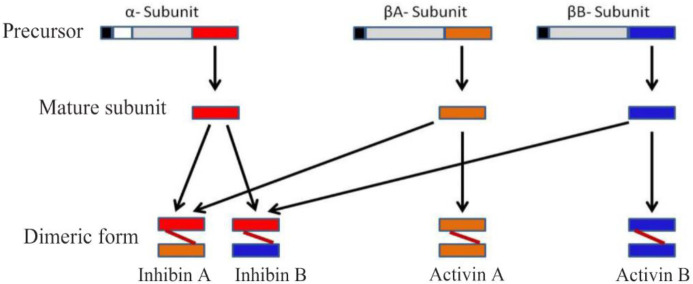
Several studies on infertility reported that over-expression of inhibin α subunit gene in rats results in decreased rate of folliculogenesis with approximately 50% reduction in oocyte maturation that ultimately leads to reduced fertility (7). The study by shelling et al. in 2000 reported all inhibin subunits encoding genes as candidate genes for premature ovarian failure (POF) (8). Furthermore, a missense mutation of p.A257T in INHA serves as a susceptibility factor for POF because it impairs the bioactivity of inhibin B (9). This missense mutation was studied in different ethnic groups by several studies (8, 10, 11).
In the present study, two novel mutations, p.I310N and p.D386N, in inhibin β B subunit were identified in the cases with primary amenorrhea that might lead to decreased bioactive inhibin level. Decreased inhibin level might result in elevation of FSH by disturbing the negative feedback to pituitary, leading to ovarian dysgenesis.
Two cases suspected with primary amenorrhea were recruited for the study and they were referred from the Department of Obstetrics and Gynecology, Sir Sunderlal Hospital, Varanasi, India to our centre (Centre for genetic Disorders, Banaras Hindu University, Varanasi, India) in 2016–2017. Clinical history and photographs were collected from each case after receiving informed written consent. This study was approved by institutional ethics committee (No.: F.Sc./Ethics Committee/2015-16/7). Both cases had the following clinical history; the first case was a 17 year old girl with primary amenorrhea along with poorly developed secondary sexual characteristics, breast Tanner stage I, absent pubic and axillary hair. She was diagnosed with absence of uterus during ultrasound scan. The second case was a 21 year old female who had primary amenorrhea along with poorly developed secondary sexual characteristics. Ultrasound showed absence of uterus and ovaries.
Whole blood cultures were set in RPMI-1640 medium at pH=7.2 (Sigma-Aldrich, USA) with 10% fetal bovine serum (Hi-media, India) and induced by phytohaemagglutinin-M (Sigma-Aldrich, USA). Next, 30–50 meta-phases were analyzed by Saline Trypsin Giemsa (STG) method using Ikaros karyotyping system—Metasystems software (Carl Zeiss Microscopy GmbH, Germany). Karyotyping was performed according to ISCN nomenclature.
Serum was isolated from each sample which was stored at −80°C until use for hormonal assay. Follicle stimulating hormone (FSH) and luteinizing hormone (LH) were measured by chemiluminescence method (Immulite-1000 Analyser, Siemens Healthcare Diagnostics Products, USA) as per the manufacturer’s instructions.
All exons and exon-intron boundaries of all subunits of inhibin gene (INHA, INHBA, and INHBB) were amplified and directly sequenced. Primers were designed by primer blast software (https://www.ncbi.nlm.nih.gov/tools/primer-blast/) (Table 1). PCR products were sequenced in an automated 3130 Genetic Analyzer (Applied Biosystems, USA) using a BigDye Terminator v3.1 Cycle Sequencing Kit (Applied Biosystems, USA) according to the manufacturer’s protocol. The identified mutations were screened in 150 control individuals from the same population by Sanger sequencing.
Table 1. Primer list used for sequence analysis of INHA, INHBA, and INHBB gene
| Primers | Sequences (5'→3') | Product size (bp) | Annealing temperature (°C) |
|---|---|---|---|
| INHA_EX1F | TGCGTCAGAGATAGGAGGTCT | 531 | 60 |
| INHA_EX1R | CCATGCTGTGCCTTGCTTTT | ||
| INHA_EX2.1F | CTCCTGCTGAAGAGGAGGG | 546 | 58 |
| INHA_EX2.1R | CGCAGAGCAGAGGGAGAC | ||
| INHA_EX2.2F | CCTGGTGGCCCACACTC | 539 | 62 |
| INHA_EX2.2R | AACTCTGCCTTTCCTCCCAG | ||
| INHBB_EX1F | CAGTGACCCGCGACCTC | 797 | 62 |
| INHBB_EX1R | GAGCTAGCAAGGAGAGGGAG | ||
| INHBB_EX2.1F | AGCAGAGAGTGTGTTTCCCC | 513 | 60 |
| INHBB_EX2.1R | ACTCCAGGCCTCGCTTG | ||
| INHBB_EX2.2F | GTGGACCCAGGCGAAGAG | 495 | 60 |
| INHBB_EX2.2R | GCTGGAAGAAGCCCACC | ||
| INHBA_EX1F | AGTTCCTCCTGGGACTGTCA | 700 | 60 |
| INHBA_EX1R | ACAGCCACAAACCTACAGCA | ||
| INHBA_EX2.1F | AACTCTTGCTCCCTTTCCCC | 322 | 58 |
| INHBA_EX2.1R | ACATCGGCTGGAATGACTGG | ||
| INHBA_EX2.2F | TGACCTTGCCATCACACTCC | 663 | 58 |
| INHBA_EX2.2R | ACAGAAGACTCCTGCTTGCC |
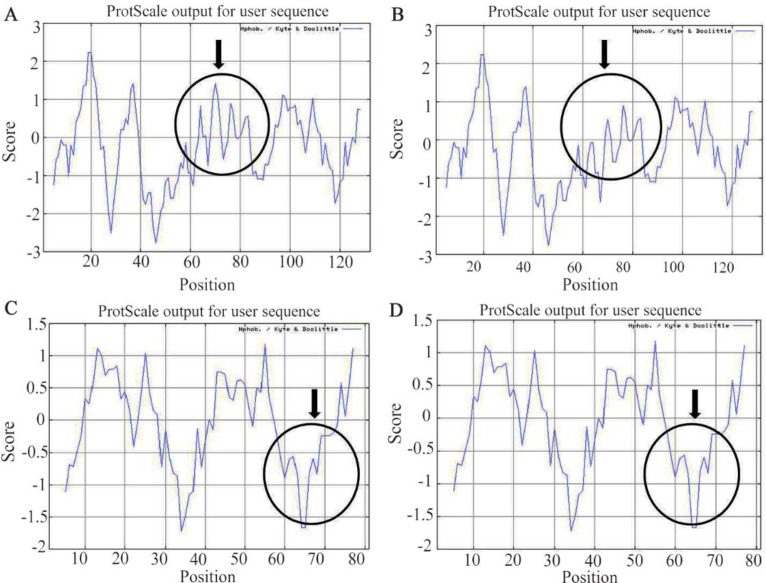
Obtained nucleotide substitutions were further analyzed using MutationTaster online tool (www.mutationtaster.org) and other prediction tools like predictSNP, SIFT, Panther, SNAP, Polyphen-1, Polyphen-2, PhD-SNP, and MAPP. Hydrophobicity profile and helix-forming properties of wild-type and mutant INHBB protein were also examined by ProtScale program available at the ExPASy web server.
The inhibin β B subunit was homology modeled by using coordinates from Protein Data Bank. Three protein structures named 3rjr_A, 5hly_A, and 5hlz_A were utilized for modeling using Modeller 9.15 and selection of the best model was done by using four different web servers and tools, i.e. RAMPAGE (http://mordred.bioc.cam.ac.uk/∼rapper/rampage.php) for Ramachandran plot analysis, ERRAT program (http://services.mbi.ucla.edu/ERRAT/) for verifying protein structures determined by crystallography, PDBsum (http://www.ebi.ac.k/thornton-srv/databases/pdbsum/Generate.html) for structural analyses, and Modeller 9.15 to find out the best model among all. The figures were produced using standalone tool, DeepView–Swiss-PdbViewer (http://spdbv.vital-it.ch/).
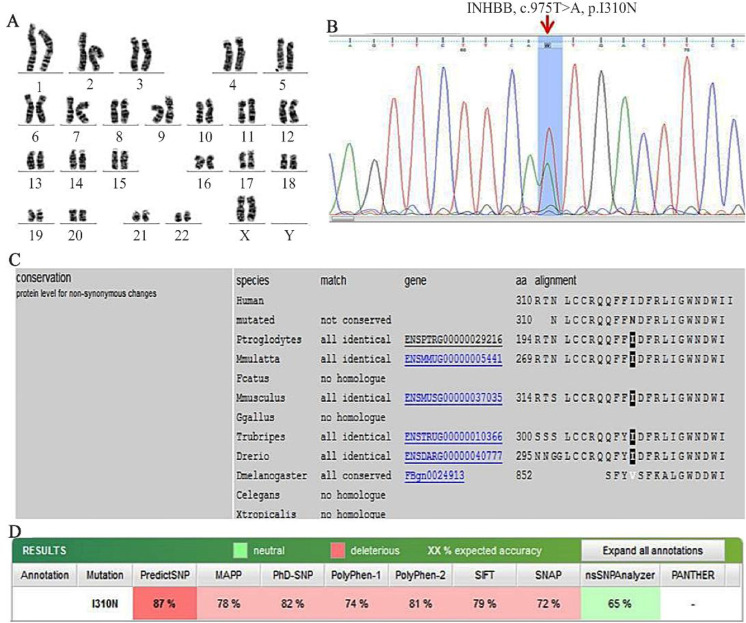
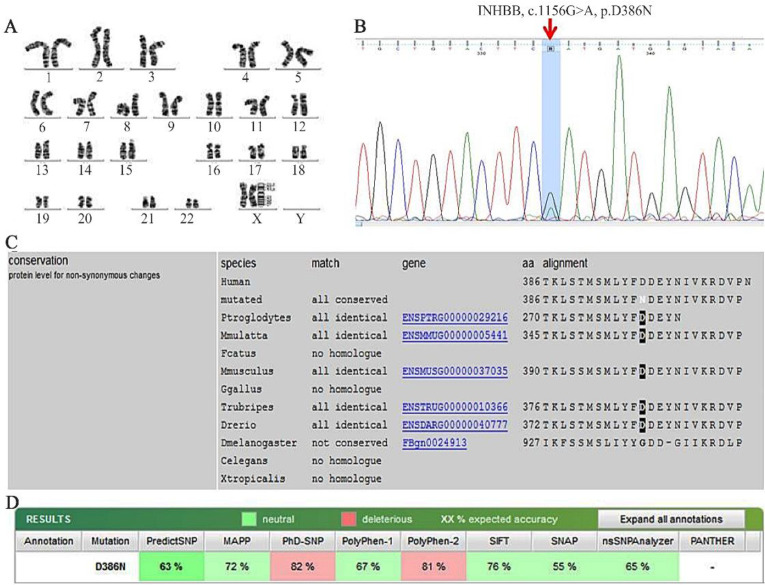
Cytogenetic analysis revealed 46,XX karyotype signifying the normal chromosome constitution in both cases (Figures 2A, 3A). Hormonal assay from serum showed FSH and LH levels of 90.3 and 18.5 mIU/ml, respectively in case 1. In case 2, the measured level of FSH and LH was 55.95 and 16.09 mIU/ml, respectively. Higher level of both FSH and LH, biomarker of gonadal dysgenesis, was observed in both cases. Resequencing of INHA, INHBA and INHBB genes identified two novel non-synonymous substitutions of c.975T>A in case 1 and c.1156G>A in case 2. These variations were translated into p.I310N and p.D386N, respectively (Figures 2B, 3B). Both isoleucine at position 310 and aspartic acid at 386 position were also highly conserved across species during evolution except a few of them (Figures 2C, 3C). P.I310N variation was predicted to be pathogenic by several in silico prediction tools (Mutation Taster, SIFT, SNAP, Polyphen-1, Polyphen-2, PhD-SNP, MAPP and predictSNP) (Figure 2D) while p.D386N mutation was predicted as neutral (Figure 3D).
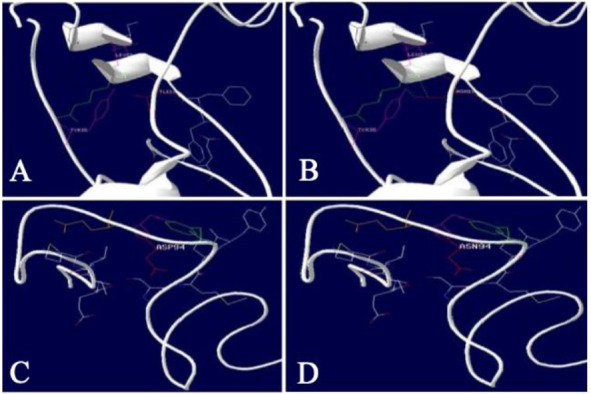
The study of intramolecular hydrogen bonding pattern of p.I310N mutation revealed the formation of three new hydrogen bonds in mutant protein with TYR327, ARG313, and LEU314 (Figures 4A, 4B). The analysis of alteration in hydro-phobicity of the protein due to this mutation revealed minor changes in protein microenvironment (Figures 5A, 5B). On the other hand, intra-molecular hydrogen bonding pattern and hydro-phobicity analysis of p.D386N mutation showed the neutral effect (Figures 4C, 4D, 5C, 5D).
The present study reports two mutations (p.I310-N and p.D386N) in inhibin β B subunit, identified in females with primary amenorrhea. The first identified mutation results in alteration in intra-molecular hydrogen bonding pattern as well as protein microenvironment due to hydrophobicity change while the second mutation does not show any pathogenic effect. The alteration in protein microenvironment might interfere with normal function of inhibin B protein that leads to disturbance in inhibin and activin balance. Activin and inhibin balance plays an important role in regulation of ovarian cycle through FSH level. As inhibin β B subunit involves in multiple complexes with antagonistic functions, the consequences of mutations related to loss-of-function or gain-of-function of protein might be difficult to predict. However, there is no report till date that mutation in inhibin β B subunit is involved in ovarian dysgenesis in females. An independent study reported that p.M370T substitution is involved in spermatogenic impairment in males (12). Furthermore, very low level of inhibin B in prepubertal girls is a biomarker for premature ovarian failure (13, 14). INHA has been more studied in ovarian failure and several mutations have been reported by different studies (10, 11, 15–17).
A nucleotide substitution (INHA 769G>A) in inhibin α subunit is well studied in different populations with reference to premature ovarian failure (8, 11, 15–17). Dixit et al. also reported three different mutations (p.S92N, p.H175Q, p.A182D) in INHA gene in patients with premature ovarian failure (10). A p.H175Q mutation in INHA was observed by Dixit et al. in a patient who experienced menopause at the age of 30 years with high level of FSH and LH (78 IU/l and 47 IU/l, respectively). Interestingly, another patient of this study with p.A182D mutation in INHA never menstruated and had underdeveloped secondary sexual characteristics.
Our study has demonstrated for the first time that mutation in INHBB subunit might lead to ovarian dysgenesis. Mutations in inhibin gene might affect the FSH level either through inhibition by inhibin or stimulation by activin through disturbing the ratio between inhibin and activin. Inhibin is suggested as a marker for ovarian reserve in premature ovarian failure patients and early screening of inhibin gene is necessary for identification of ovarian reserve to manage ovarian failure.
We thank the guardians for giving consent to publish the data. We are also thankful to Centre for Genetic Disorders, BHU, Varanasi, India for chromosomal analysis, Taq inhouse as a gift by CGD and Genetic analyser ABI3130, innovative programme of UGC for hormonal assay experiment by Immulite 1000.
