
It seems that using human chorionic gonadotropin (hCG) is a good clinical practice in final oocyte maturation in gonadotropin releasing hormone antagonist (GnRH-ant) cycles (1). The introduction of GnRH-ant as a method for downregulating the pituitary is an alternative for final oocyte maturation by using gonadotropin releasing hormone agonist (GnRH-a) instead of hCG (2–4). One of the main risk factors for the development of ovarian hyperstimulation syndrome (OHSS) is the presence of endogenous or exogenous hCG (5).
OHSS can be stratified into early and late onset, differentiated by the appearance of symptoms before or after day 10 of oocyte pick up (OPU) (6). Both early and late onset OHSS are induced by high hCG concentrations, leading to the release of various chemical mediators that cause an increase in vascular permeability and subsequent third space fluid loss (7). Early onset OHSS often occurs by the exogenous hCG delivered for the triggering of oocyte maturation whereas late onset OHSS occurs when hCG is produced by the trophoblast of the implanting embryo (8). The generally accepted classification of OHSS by Golan and Weissman (9) has recently been supplemented by additional classification criteria for reporting clinical trials by Humaidan et al. (10). The syndrome presents with varying forms of severity, with milder forms developing in 20–30% of all in vitro fertilization (IVF) cycles which are often self-limiting and of no clinical concern (11), and with clinically significant forms developing in 0.21–0.44% of all cycles as reported by data between 2014 and 2016 (12–14).
The initial presentation of OHSS includes a combination of classical symptoms, nausea and vomiting, abdominal pain and bloating, as well as a combination of classical signs, including weight gain, tachycardia with or without orthostatic hypotension, and tachypnoea with dyspnea (10). This presentation is not sufficient for the diagnosis of OHSS as additional tests including ultrasound, liver function tests, hematocrit, electrolytes, serum creatinine and 24 hr urine output are required for its diagnosis and classification of severity (10). Recent developments in its pathophysiology and management have been described by both Humaidan et al. in 2016 as well as the Royal College of Obstetricians and Gynecologists (RCOG) (10, 15).
One of the main advantages of GnRH-a trigger over hCG in GnRH-ant cycles is the reduction and possible elimination of OHSS (16–18). Unfortunately, early studies with GnRH-a trigger for oocyte maturation had been underwhelming due to high rates of early pregnancy loss and low rates of clinical pregnancy (19, 20). While this has been true for fresh autologous transfers, recent “freeze-all” approach studies have demonstrated a cumulative live birth rate of 39.8% after the first transfer and 65.9% after six embryo transfer cycles (21). It has been reported that dual trigger for final oocyte maturation in normal responders improves both oocyte quality as well as pregnancy outcomes when compared to hCG trigger alone (22, 23). The association between coadministration of hCG with GnRH-a and risk of OHSS in high responders has neither been reviewed systematically nor quantified. Therefore, the purpose of the present systematic review was to summarize the current literature on the efficacy and safety of coadministration of hCG with GnRH-a trigger in high responders in reducing the risk of OHSS while maintaining acceptable birth rates. By elucidating these associations, clinicians would be able to determine the safest and the most effective protocols for their patients by assessing the advantages and disadvantages of the available literature.
Search strategy: First, PubMed (Medline) and Ovid MEDLINE were searched from inception through February 2020 to identify studies that assessed the efficacy and safety of coadministration of hCG with GnRH-a trigger in high responders for the elimination of OHSS. The following keywords and phrases were used as the search strategy; first, “Gonadotropin releasing hormone antagonist” or “Gonadotropin releasing hormone agonist” or “GnRH antagonist” or “GnRH agonist” and then “Human chorionic gonadotropin” or hCG and “Ovarian hyperstimulation syndrome” or OHSS were applied. The search strategy was not restricted by publication time or language. Reference lists of retrieved jri_articles were screened to check whether all pertinent literature was included. The preparation, implementation, and reporting of this systematic review was in accordance with guidelines for systematic reviews, Preferred Reporting Items for Systematic Reviews and Meta-Analyses (PRISMA) (Doc. S1) (24).
Screening and study selection: All identified publications were evaluated through a three-step parallel review of title, abstract, and full text performed independently by two researchers, based on predefined inclusion and exclusion criteria. Discrepancies were resolved through discussion with a third author. Moreover, the references of the retrieved jri_articles were screened for possible eligible papers. In cases where information included in the original manuscript was insufficient, corresponding authors were requested to supply more data.
Case-control studies, prospective and retrospective cohort studies, cross-sectional studies as well as clinical trials examining high responders and comparing the outcomes of coadministration of hCG and GnRH-a as well as GnRH-a alone for final oocyte maturation in women undergoing GnRH-ant cycles were considered as eligible materials for inclusion. Case reports, non-human studies, narrative reviews, descriptions of methodologies, and conference abstracts were excluded.
Data extraction and quality assessment: Data extraction was performed independently by two investigators, and in case of discrepancies, the final decision was reached by discussion with a third investigator, when necessary. The extracted data included the first author, publication year, study type, exclusion and inclusion criteria of participants, number of IVF cycles, type of intervention, combinations and doses of triggers, the method of luteal phase support, time of initiation of luteal phase support, target concentrations for luteal phase support, number of oocytes recovered, fertilization rate, total number of blastocysts transferred, mean number of transferred blastocysts, number of frozen supernumerary blastocysts, implantation rate, fetal heart rates, rate of clinical pregnancy, rate of ongoing pregnancy, rate of biochemical pregnancy, rate of biochemical miscarriage, rate of clinical miscarriage, rate of early pregnancy losses, rate of live births, rate of OHSS, rate of severe OHSS, age, body mass index (BMI), number of antral follicles, follicles on the day of trigger, polycystic ovarian syndrome (PCOS), polycystic ovarian morphology (PCOM), and prior OHSS.
Quality assessment was performed independently by two investigators using the Newcastle-Ottawa Scale (NOS) which was designed to evaluate non-randomized studies included in systematic reviews, specifically cohort and case-control studies. This scale assists researchers in evaluating studies with respect to selection of participants, comparability of study groups, and the ascertainment of exposure in case-control studies or outcome of interest in cohort studies. To determine the quality of a study, a star rating system was used with a maximum assessment of nine stars (25).
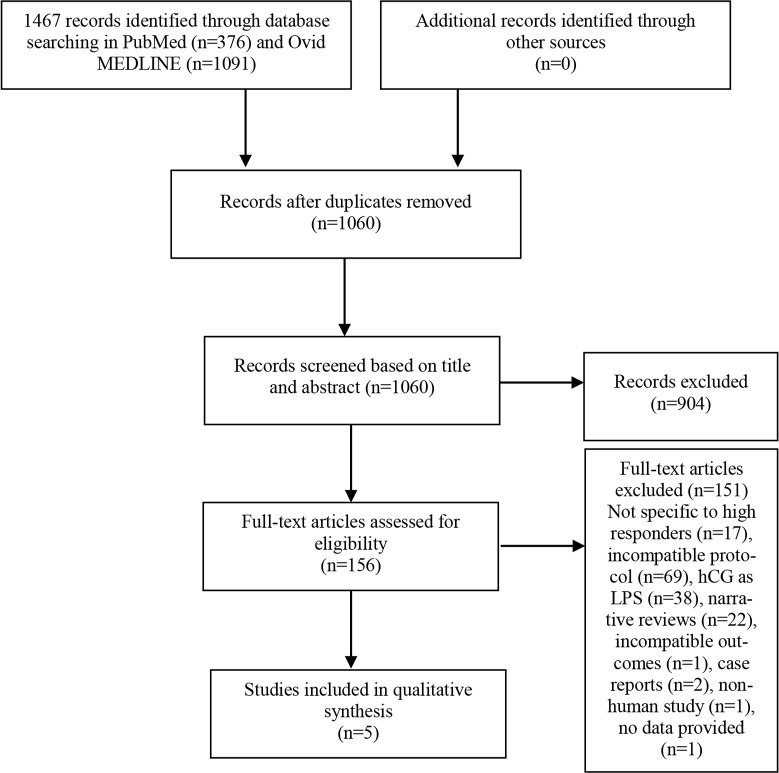
Literature search: The search yielded 1467 records which were reduced to 1060 after excluding duplicates. From 1060 unique references identified, 5 primary studies were included for this systematic review (26–30). Figure 1 shows a flow diagram indicating the number of studies retrieved from the literature, screened, assessed for eligibility, and included in this systematic review as well as the main reasons for exclusion of the jri_articles which required full text appraisal.
Protocol characteristics: Protocol characteristics of included studies are presented in table 1. The five retrospective studies (26–30) included a total of 674 GnRH-ant cycles of which 314 cycles were triggered with GnRH-a alone and 360 cycles with GnRH-a and hCG at the same time. One 3 arm study included two arms that were both triggered with hCG, one downregulated with GnRH-a and the other downregulated with GnRH-ant (29). Oocyte maturation was triggered when at least two follicles reached a diameter ≥18 mm (26), when at least three follicles reached a diameter ≥18 mm (27), or when three follicles reached a diameter ≥17 mm (28, 29). One study did not specify when oocyte maturation was triggered (30).
Table 1. Protocol characteristics
| First author, year | Shapiro et al. 2008 1 | Shapiro et al. 2011 2 | Griffin et al. 2012 3 | O’Neill et al. 2016 4 | Huang et al. 2016 5 | |||||||
|---|---|---|---|---|---|---|---|---|---|---|---|---|
| Inclusion criteria | High ovarian responders | High ovarian responders (≥20 follicles, serum and E2 ≥2,500 pg/ml before trigger ) | High ovarian responders (previous OHSS, previous cycle cancelled for risk of OHSS, >13 follicles of ≥11 mm) Peak E2 <4000 pg/ml on the day of triggering, age <40 | High ovarian responders (given prior treatment cycles, age, ovarian reserve testing, infertility diagnosis, and PCOS) | High ovarian responders, PCOS g, PCOM h, previous OHSS | |||||||
| Exclusion criteria | Not specified | Not specified | Not specified | No age or weight-based exclusion criteria, additional GnRH-a or hCG was given after trigger | Age >40, endometriosis, hypogonadotropic hypogonadism, freezing cycles and uterine abnormalities | |||||||
| Number of cycles | 45 | 182 | 91 | 24 | 68 | 34 | 108 | 66 | 74 | 25 | 23 | 33 |
| Interventions | Dual trigger | Dual trigger | GnRH agonist trigger | GnRH agonist trigger + ELS c | GnRH agonist trigger | Dual trigger | GnRH agonist trigger | Dual trigger | hCG triggere | hCG trigger | GnRH agonist trigger | Dual trigger |
| Triggering dose | Leuprolide acetate 4 mg plus variable hCG a | Leuprolide acetate 4 mg plus variable hCG b | Leuprolide acetate 4 mg | Leuprolide acetate 4 mg | Leuprolide acetate 1 mg | Leuprolide acetate 1 mg plus 1000 IU hCG | Leuprolide acetate 4 mg | Leuprolide acetate 4 mg plus 1000 IU hCG | hCG 10000 IU | Triptorelin pamoate 0.2 mg | Triptorelin pamoate 0.2 mg plus variable hCGf | |
| Initiation of luteal phase support | P starting on the day after OPU d E2 started as needed | 2–5 days after OPU d | Immediately after OPU d | The day after OPU d | The day after OPU d | The day after OPU d | ||||||
| Luteal phase support | Not specified | E2 patches 0.1 mg, 2–4 changed every 72 hr E2 2 mg TDS PO injectable P 100 mg IM OD Vaginal Suppositories P 400 mg PV BD | E2 patches 0.3 mg, every other day (max 0.4 mg every other day and/or with addition of E2 2 mg BD PO ) Injectable P 50 mg IM OD (max 75 mg) | E2 patches 0.1 mg, 2–4 changed every other day injectable P 50 mg IM OD | E2 6 mg PO per day vaginal suppositories P 90 mg PV per day | E2 6 mg PO per day vaginal suppositories P 90 mg PV per day | E2 6 mg PO per day injectable P 100 mg IM per day | E2 6 mg PO per day injectable P 100 mg IM per day plus 300 IU hCG under certain conditions f | ||||
| Luteal phase support, target concentration | E2 >200 pg/ml P >15 ng/ml | E2 ≥200 pg/ml P ≥15 ng/ml | E2 >200 pg/ml P >20 ng/ml | E2 >200 pg/ml P >20 ng/ml | Not specified | |||||||
Dose dependent on weight and OHSS risk factors.
Dose dependent on weight only.
Enhanced luteal support.
Oocyte pick up.
Pituitary suppression using GnRH-agonist.
Serum E2 <800 pg/ml during close monitoring from the 2nd to the 6th day after OPU.
Polycystic ovary syndrome.
Polycystic ovarian morphology
For GnRH-a triggering without hCG, 4 mg leuprolide acetate was used in 3 studies (26, 27, 30), 1 mg leuprolide acetate was used in one study (28) and 0.2 mg triptorelin pamoate was used in another study (29). For dual triggering, in one study, variable hCG doses dependent on weight and OHSS risk factors with 4 mg leuprolide acetate (27) were used and in another study, variable hCG doses dependent on weight with 4 mg leuprolide acetate (30) were applied; moreover, 1000 IU hCG with 1 mg leuprolide acetate (28) and 1000 IU hCG with 4 mg leuprolide acetate (26) were used in two other studies. Only in one study, variable hCG doses depending on serum levels of estradiol (E2), and the number of follicles ≥11 mm on the day of trigger (500 IU for cycles with peak E2 >5000 pg/ml or follicle number ≥25, 750 IU for cycles with peak E2 3500–5000 pg/ml and follicle number <25, 1000 IU for cycles with peak E2 <3500 pg/ml and follicle number <25) were used with 0.2 mg triptorelin pamoate (29).
Oocyte pick up (OPU) occurred between 34 and 36 hr after triggering in three studies (27, 29, 30), between 35 and 36 hr in one study (26) and at 35 hr in another study (28). In one study, the type of luteal phase support (LPS) was not specified (27); in one study, E2 0.1 mg 2–4 patches which changed every 72 hr, oral E2 2 mg three times daily, injectable progesterone (P) 100 mg IM daily, and vaginal P suppositories 400 mg twice daily (30) were used. E2 0.3 mg patches every other day and injectable P 50 mg IM daily were applied in another research, increasing the doses of E2 to a maximum of 0.4 mg patches every other day and/or with addition of oral micronized E2 2 mg twice daily and the doses of P to injectable 75 mg IM daily as required (28). E2 0.1 mg 2–4 patches which changed every other day and injectable P 50 mg IM daily (26), and a total of 6 mg oral estradiol valerate daily and injectable P 100 mg IM daily were used, respectively in two separate studies; in the latter study, dual trigger group only received an additional 300 IU hCG if serum E2 levels dropped below 800 pg/ml during close monitoring from the 2nd to 6th day after OPU (29). In three studies, LPS started on the day after OPU (26, 28, 29), P on day after OPU, and E2 was used as needed (27). In one study, LPS started 2–5 days after OPU in both GnRH-a and dual trigger group initially, but modified GnRH-a group received LPS immediately after OPU (30). In another study, LPS target concentrations of E2 levels >200 pg/ml and P levels >15 ng/ml (27), and target concentrations of E2 levels ≥200 pg/ml and P levels ≥15 ng/ml (30), and target concentrations of E2 levels >200 pg/ml and P levels >20 ng/ml (26, 28) were used in three independent studies. In one study, no LPS target concentrations were specified (29).
Risk factors for ovarian hyperstimulation: Risk factors for ovarian hyperstimulation of study arms can be found in table 2. Women in dual trigger in comparison to GnRH-a group were significantly younger as reported by O’Neill et al. (32.4 vs. 31.0; p<0.05) (26). The same study by O’Neill et al. showed statistically significant lower incidence of PCOS in the dual trigger and GnRH-a group (20% vs. 38%; p<0.05) (26); in contrast, statistically significant higher incidence of PCOS in the dual trigger and GnRH-a group was reported by Huang et al. (60.6% vs. 21.7%; p=0.001) (29). Statistically significant mean values of antral follicles were significantly lower in dual trigger and GnRH-a groups as reported by O’Neil et al. (18 vs. 23%; p<0.01) (26), and Shapiro et al. (20.0±9.9 vs. 27.6±17.7; p<0.001) (30). Statistically significant lower mean levels of E2 on the day of trigger were reported by Shapiro et al. when comparing dual trigger group with GnRH-a group (4,748±1,493 vs. 5,625±2,313; p<0.001).
Table 2. OHSS risk factors
| First Author (year) | Shapiro et al. 2008 1, a | Shapiro et al. 2011 2, a | Griffin et al. 2012 3, a | O’Neill et al. 2016 4, d | Huang et al. 2016 5, a | |||||||
|---|---|---|---|---|---|---|---|---|---|---|---|---|
| Intervention | Dual trigger | Dual trigger | GnRH agonist trigger | GnRH agonist trigger + ELS b | GnRH agonist trigger | Dual trigger | GnRHa trigger | Dual trigger | hCG trigger e | hCG trigger | GnRH agonist trigger | Dual trigger |
| Number of cycles | 45 | 182 | 91 | 24 | 68 | 34 | 108 | 66 | 74 | 25 | 23 | 33 |
| Age (years) | 30.1±4.8 | 31.3±4.2 | 30.1±3.9 | 29.3±4.9 | 31.9±3.9 | 31.5±3.8 | 32.4 (30.3–35.1) | 31.0 (29.0–34.1) | 32.3±3.1 | 33.8±3.3 | 32.6±3.1 | 33.5±4.1 |
| Antral follicle number | - | 20.0±9.9 | 27.6±17.7 | 22.6±11.1 | - | - | 23 (16–31) | 18 (11–25) | - | - | - | - |
| E2 day of trigger (pg/ml) | 4870±1670 | 4748±1493 | 5625±2313 | 7567±2486 | c | c | 3604 (2843–4536) | 2993 (2597–4280) | 5182±2113 | 3893±1673 | 4663±1545 | 5390±2212 |
| Follicles day of trigger (n) | 27.3±8.3 | 27.6±5.9 | 31.8±8.0 | 36.6±10.3 | - | - | 31 (25–35) | 28 (22–34) | 18.3±5.5 | 15.6±7.1 | 20.1±5.7 | 22.7±8.0 |
| BMI (kg/m2 ) | - | - | - | - | 26.8±6.0 | 24.4±5.3 | 23 (21–27) | 23 (20.7–25.3) | 21.3±2.9 | 22.9±4.3 | 22.0±3.0 | 22.1±4.3 |
| PCOM g n(%) | - | - | - | - | - | - | - | - | 37/74 (50) | 11/25 (44) | 18/23 (78.3) | 28/33 (84.8) |
| PCOS f n(%) | - | - | - | - | - | - | 41/108 (38) | 13/66 (20) | 16/74 (21.6) | 9/25 (36) | 5/23 (21.7) | 20/33 (60.6) |
| Prior OHSS n(%) | 1 (2.22) | - | - | - | - | - | 6/108 (6) | 4/66 (6) | 7/74 (9.5) | 4/25 (16) | 7/23 (30.4) | 15/33 (45.5) |
Mean + SD unless otherwise indicated.
Enhanced luteal support.
Inclusion criteria; peak E2 <4000 pg/ml.
Median (Interquartile range) unless otherwise indicated.
Pituitary suppression using GnRH-agonist.
Polycystic ovary syndrome.
Polycystic ovarian morphology
Clinical pregnancy rate: Clinical findings of the included studies are presented in table 3. Clinical pregnancy rate reported by Shapiro et al. in 2008 was 53.3% (27). Statistically significant higher rate of clinical pregnancy in the dual trigger group and GnRH-a trigger group was reported by Griffin et al. in 2012 (58.8% vs. 36.8%; p=0.03) (28). In contrast, no statistically significant difference in unadjusted analysis of the rate of clinical pregnancy was observed in the dual trigger group and GnRH-a group as reported by O’Neill et al. (63% vs. 44%; p=0.12) (26). There was no statistically significant difference in clinical pregnancy rate in the dual trigger group and GnRH-a group reported by Huang et al. (48.5% vs. 17.4%) (29).
Table 3. Summary of findings
| First Author (year) | Shapiro et al. 2008 1, a | Shapiro et al. 2011 2, a | Griffin et al. 2012 3, a | O’Neill et al. 2016 4, d | Huang et al. 2016 5, a | |||||||
|---|---|---|---|---|---|---|---|---|---|---|---|---|
| Intervention | Dual trigger | Dual trigger | GnRH agonist trigger | GnRH agonist trigger+ELS h | GnRH agonist trigger | Dual trigger | GnRHa trigger | Dual trigger | hCG trigger f | hCG trigger | GnRH agonist trigger | Dual trigger |
| Oocytes recovered (n) | 20.4±6.0 | 20.4±6.2 | 27.1±11.2 | 25.4±10.3 | 24±10 | 23±10 | 16.5 (11–21.5) | 17.5 (12–24) | 14.7±6.4 | 14.0±8.6 | 18.5±7.1 | 23.4±10.5 |
| Fertilization rate (%) | (62.8) | - | - | - | 81.9±18.1 | 79.2±13.9 | (50) | (73) | 75.4±16.0 | 73.4±19.1 | 68.5±20.7 | 82.2±10.0 |
| No. of transferred blastocysts b | 1.78±0.42 | 1.9±0.3 | 2.0±0.4 | 1.9±0.3 | 1.8±0.4 | 1.8±0.5 | - | - | - | - | - | - |
| No. of frozen supernumerary blastocysts b | 3.53±3.08 | - | - | - | 4.3±4.7 | 3.6±3.1 | - | - | - | - | - | - |
| Fetal poles (n) | - | 166 | 37 | 17 | 27 | 26 | - | - | - | - | - | - |
| Total blastocysts transferred (n) | - | 340 | 180 | 45 | 122 | 62 | - | - | - | - | - | - |
| Implantation rate n(%) | (47.5) | 166/340 (48.8) | 37/180 (20.6) | 17/45 (37.8) | 27/122 (22.1) | 26/62 (41.9) | - | - | (17.0±3.2) | (14.2±4.8) | (5.8±2.8) | (22.5±5.2) |
| Number of cycles | 45 | 182 | 91 | 24 | 68 | 34 | 66 | 108 | 74 | 25 | 23 | 33 |
| Biochemical pregnancy rate n(%) | 29/45 (64.4) | 137/182 (75.3) | 55/91 (60.4) | 15/24 (62.5) | 43/68 (63.2) | 26/34 (76.5) | - | - | 32/74 (43.2) | 10/25 (40) | 8 (34.8) | 19/33 (57.6) |
| Biochemical miscarriage rate (%) | - | - | - | - | 14/43 (32.6) | 4/26 (15.4) | - | - | - | - | - | - |
| Early pregnancy losses n(%) | 5/29 (17.2) | 32/137 (23.4) | 32/55 (58.2) | 3/15 (20.0) | - | - | - | - | 7/32 (21.9) | 2/10 (20) | 4/8 (50.0) | 3/19 (15.8) |
| Clinical pregnancy rate n(%) | 24/45 (53.3) | - | - | - | 25/68 (36.8) | 20/34 (58.8) | (44) e | (63) e | 26/74 (35.1) | 8/25 (32) | 4/23 (17.4) | 16/33 (48.5) |
| Clinical miscarriage rate n(%) | - | - | - | - | 6/43 (14.0) | 3/26 (11.5) | (7) e | (6) e | - | - | - | - |
| Ongoing pregnancy rate n(%) | 24/45 (53.3) | 105/182 (57.7) | 23/91 (25.3) | 12/24 (50.0) | - | - | - | - | 24/74 (32.4) | 6/25 (24) | 4/23 (17.4) | 15/33 (45.5) |
| Live birth rate n(%) | - | - | - | - | 21/68 (30.9) | 18/34 (52.9) | - | - | - | - | - | - |
| OHSS n(%) | 0/45 (0) | c | 0/68 (0) | 1/34 (2.9) | 0/108 (0) | 6/66 (9) | ||||||
| Severe OHSS n(%) | 0/45 (0) | 1/182 (0.55) | 0/91 (0) | 0/24 (0) | 0/68 (0) | 0/34 (0) | 0/108 (0) | 4/66 (6) | 25/74 (33.8) g | 6/25 (24.0) g | 0/23 (0) g | 0/33 (0) g |
Mean + SD unless otherwise indicated.
Per transfer.
Cases reported only when required removal of ascitic fluid.
Median (Interquartile range) unless otherwise indicated.
Limited analysis on patients who had blastocysts transfers – based on unadjusted analyses.
Pituitary suppression using GnRH-agonist.
Cases reported as moderate to severe OHSS.
Enhanced luteal support
Fertilization rate: Fertilization rate reported by Shapiro et al. was 62.8% (27). There was no statistically significant difference in fertilization rate between the dual trigger and GnRH-a trigger reported by Griffin et al. (79.2%±13.9 SD vs. 81.9%±18.1 SD; p>0.05) (28). In contrast, statistically significant fertilization rates in favor of the dual trigger group against GnRH-a were reported by both O’Neil et al. (73% vs. 50%; p<0.01) and Huang et al. (82.2%±10.0 SD vs. 68.5%±20.7 SD) (29). No fertilization rate was reported by Shapiro et al. (30).
Ongoing pregnancy rate and live birth rate: Ongoing pregnancy rate reported by Shapiro et al. was 53.3% per transfer (95% CI: 37.9%–68.3%) (27). There was no statistically significant difference in ongoing pregnancy rate between dual trigger and GnRH-a group reported by Huang et al. (45.5% vs. 17.4%) (29). Statistically significant higher rate of ongoing pregnancy in dual trigger group and GnRH-a trigger group was reported by Shapiro et al. (57.7% vs. 25.3%; p<0.001) (30). Statistically significant higher live birth rate in the dual trigger group and GnRH-a trigger group was reported by Griffin et al. (52.9% vs. 30.9%; p=0.03) (28). O’Neill et al. reported neither the ongoing pregnancy rate nor the live birth rate in their study (26).
Early pregnancy loss rate: Early pregnancy loss is defined as any complications that may arise during the first 13 weeks of pregnancy, also known as the first trimester (31). Early pregnancy loss rate reported by Shapiro et al. was 17.2% (95% CI: 5.9%–35.8%), including 3 cases of abnormally rising hCG which resolved before ultrasound, 1 presumed ectopic which resolved after administration of methotrexate as ultrasound failed to visualize an intrauterine sac and one anembryonic intrauterine gestation (27). No statistically significant difference in early pregnancy loss rate was found between the dual trigger group and GnRH-a trigger group in Huang et al.’s study (15.8% vs. 50.0%) (29). Statistically significant lower rate of early pregnancy loss in dual trigger group and GnRH-a trigger group was reported by Shapiro et al. (23.4% vs. 58.2%; p<0.001) (30).
Clinical and biochemical miscarriage rate: Biochemical miscarriage is defined as “A pregnancy diagnosed only by the detection of HCG in serum or urine and that does not develop into a clinical pregnancy” (32), and clinical miscarriage is defined as “Intrauterine pregnancy demise confirmed by ultrasound or histology” (32). No statistically significant rate of clinical miscarriage in dual trigger group and GnRH-a trigger group was reported by Griffin et al. (11.5% vs. 14.0%; p>0.05) (28). No statistically significant difference in unadjusted analysis of the rate of clinical miscarriage in dual trigger group and GnRH-a trigger group was reported by O’Neill et al. (6.0% vs. 7.0%; p=0.90) (26). No statistically significant rate of biochemical pregnancy loss was reported in dual trigger group and GnRH-a trigger group by Griffin et al. (15.4% vs. 32.6%; p>0.05) (28).
OHSS rate and criteria for reporting: No cases of any form of OHSS were reported by Shapiro et al. in 2008 (27). There were no statistically significant differences in OHSS rates in dual trigger and GnRH-a trigger groups reported by Shapiro et al. (0.55% vs. 0%; p=0.723) (30) and Griffin et al. (2.9% vs. 0%; p>0.05) (28). There was a statistically significant higher rate of OHSS in dual trigger group and GnRH-a group as reported by O’Neill et al. (9% vs. 0%; p<0.01) (26). There were no cases of “Moderate-to-severe” OHSS in either dual trigger or GnRH-a group as reported by Huang et al. (29). In one study, OHSS was reported only when clinically significant symptoms occurred that required removal of ascitic fluid (30). The focus of one study was on mild OHSS but the inclusion criteria were not specified (27); in two studies, Golan and Weissman 1989 classification for OHSS (26, 29, 33) and Golan and Weissman 2009 classification of OHSS were used (9, 28).
Quality assessment: The primary studies were subjected to the quality assessment of NOS. The methodological quality ranged from 5 points to 7 points maximally, with a median of 6 points. Among the 5 included studies, only 1 study demonstrated score >6 points. Medium quality was scored by 4 studies, and no studies demonstrated four points or less, indicating low quality. The factors that mostly affected the quality of the jri_articles were the evidence that outcome of interest was not present at the beginning of study and the comparability of the study groups based on the design or analysis. The assessment of methodological quality according to NOS is summarized in table 4.
Table 4. Quality assessment of cohort studies
| Author, year | Selection | Comparability | Outcome | Total quality score | |||||
|---|---|---|---|---|---|---|---|---|---|
|
| |||||||||
| (1) Representativeness of the exposed cohort | (2) Selection of the non-exposed cohort | (3) Ascertainment of exposure | (4) Demonstration that outcome of interest was not present at the start of study | (1) Comparability of cohorts on the basis of the design or analysis a | (1) Assessment of outcome | (2) Was follow-up long enough for outcomes to occur? | (3) Adequacy of follow up of cohorts | ||
| Shapiro et al. 2008 1 | ★ | - | ★ | - | - | ★ | ★ | ★ | 5 |
| Shapiro et al. 2011 2 | ★ | ★ | ★ | - | - | ★ | ★ | ★ | 6 |
| Griffin et al. 2012 3 | ★ | ★ | ★ | - | - | ★ | ★ | ★ | 6 |
| O’Neill et al. 2016 4 | ★ | ★ | ★ | - | ★ | ★ | ★ | ★ | 7 |
| Huang et al. 2016 5 | ★ | ★ | ★ | - | - | ★ | ★ | ★ | 6 |
A maximum of 2 stars can be awarded for this item. A study controlling for age receives one star, and a study controlling for other major risk factors receives an additional star
Main findings and interpretation: In this systematic review, the efficacy and safety of coadministration of hCG with GnRH-a trigger in high responders for the elimination of OHSS were examined. Data from 5 retrospective studies were included to provide a comprehensive assessment (26–30). Comparison of the data from the studies obtained indicated that the use of dual trigger versus GnRH-a trigger shows no statistically significant difference in rates of OHSS (27, 28, 30). While all studies demonstrated no statistically significant differences in the rates of OHSS, only one study manifested a statistically significant difference in favor of the dual trigger group in ongoing pregnancy rate, one study demonstrated significant difference in early pregnancy loss (30), and two studies showed significant difference in fertilization rates (29). Huang et al. reported zero cases of “moderate-to-severe” OHSS in both dual trigger and GnRH-a group (29), while O’Neil et al. demonstrated a statistically significant higher incidence of OHSS occurring in dual trigger group rather than GnRH-a group, while maintaining a higher but not statistically significant clinical pregnancy rate (26).
It should be considered that this is an unadjusted non statistically significant higher pregnancy rate since 88% of dual trigger patients had blastocyst transfers when compared to 45% of GnRH-a trigger group. Only 2 of the 6 patients with OHSS had removal of excess fluid using paracentesis or thoracentesis (26). Neither Shapiro et al. in 2008 nor Shapiro et al. in 2011 mentioned any OHSS classification in their study (27, 30). This limitation in reporting OHSS creates a heterogenic study sample that does not allow us to accurately evaluate and compare outcomes from these studies.
Compared to other studies, Shapiro et al. achieved a pregnancy rate of 53.3% and early pregnancy loss of 17.2%, whereas GnRH-a trigger studies demonstrated pregnancy rates as low as 6% and early pregnancy loss rates of 79% (19, 27). In Shapiro et al.’s 3 arm study, the purpose was to replicate the results of 2008 (27), which showed statistically significant higher implantation rate (48.8% vs. 20.6%; p<0.001), pregnancy rate (75.3% vs. 60.4%; p=0.031), ongoing pregnancy rate (57.7% vs. 25.3%; p<0.001), and lower early pregnancy loss rate (23.4% vs. 58.2%; p<0.001) while maintaining low rate of OHSS (0.55% vs. 0%; p=0.723) when dual trigger was compared to GnRH-a alone (30). This difference in outcomes, using GnRH-a trigger, can be attributed to the differences that exist in the duration and surge of gonadotrophins when compared to the natural cycle (34, 35).
It is generally accepted that the luteal phase is defective after ovarian stimulation with gonadotrophins, hCG and GnRH analogues, which requires luteal phase supplementation in the form of P alone or in combination with E2 (36–42). The luteinizing hormone (LH) surge induced by GnRH-a consists of 2 phases, an ascending limb lasting more than 4 hr and a descending limb lasting more than 20 hr, totaling around 24 to 36 hr (35), where the natural mid-cycle surge is characterized by 3 phases of a rapidly ascending phase lasting for 14 hr, a plateau of 14 hr, and a descending phase of 20 hr totaling around 48 hr (43). In the trial published in 2011, Shapiro et al. were able to identify the deficiency in gonadotrophin profile that GnRH-a trigger produced which leads to follow up participants being given a more aggressive luteal support with E2 and P supplements initiated immediately after OPU, and the term Enhanced Luteal Support (ELS) was coined accordingly (30). Even though the ELS group of the study was quite small when compared to the original group, statistical analysis of the authors demonstrated statistically significant improvements in implantation rate, ongoing pregnancy rate, and early pregnancy loss rate despite using the same GnRH-a trigger in both groups (30).
LH is strongly correlated with progesterone (P) (44) and vascular endothelial growth factor A (VEGF-A) release (45–50), which are both crucial for normal implantation and early neovascularization. The negative feedback effect on the pituitary produced by supraphysiologic levels of gonadotrophins in ovulation induction (51–54) in combination with the further lower concentrations induced by GnRH-a triggering leads to reduction in implantation and pregnancy rate along with increased pregnancy loss rate (39).
The purpose of several methods is to strike a balance between levels of VEGF-A and P that allows normal implantation and neovascularization to take place but are not sufficient to produce clinical symptoms of OHSS. The use of hCG as LPS at OPU in GnRH-a triggered patients has shown non-significant marginally increased rates of OHSS when compared to dual trigger group (55) while producing significantly lower concentrations of VEGF-A to a full dose of hCG at OPU (56). The decrease in the incidence of OHSS in both GnRH-a with hCG as LPS and dual triggered cycles can be attributed to significantly lower levels of vascular endothelial growth factor receptor 2 (VEGFR2) during both OPU and OPU+5 days when compared to hCG triggered cycles (56). VEGFR2 is believed to act as the chief receptor in enhancing endothelial permeability by the breakdown of cell-cell contact which eventually leads to OHSS (57). While comparable levels of VEGFA were demonstrated in GnRH-a with hCG as LPS, dual trigger, and hCG triggered cycles during OPU+5, VEGF-A was significantly lower in GnRH-a with hCG as LPS cycles during OPU when compared to hCG triggered cycles (56).
This is also supported by the fact that low doses of hCG in both dual trigger and in GnRH-a triggered cycles as LPS can rescue corpora lutea by producing sufficiently high levels of 17a-Hydro-xyprogesterone (17OH-P) during OPU, while producing similar pregnancy outcomes (58). The administration of hCG, either as dual trigger or at OPU for high responders, results in high pregnancy rates after fresh embryo transfers (55). Personalized low-dose hCG during triggering and throughout the first 6 days after OPU was adopted for high responders as reported by Huang et al. (29). The purpose was further reduction of risk of OHSS while rescuing corpus luteum if needed. A freeze-all strategy using the same protocol was not used at this point since there is no evidence for statistically significant superior clinical pregnancy rates using this method (59). The aim was to combine the methodology of administering hCG at the same time with GnRH-a as well as providing a supplemental dose of hCG if needed during the close monitoring of E2 levels. This study was able to demonstrate improved reproductive outcomes in the dual trigger group compared with the classical LPS without hCG (29).
Griffin et al. in 2012 were able to specifically extend the study to high risk patients with suboptimal predictive factors of success, indicating the most important factors are serum levels of LH on the day of trigger and peak serum E2 levels ≥4000 pg/ml (28). The study further showed the beneficial effect of coadministration of 1000 IU of hCG at the time of triggering for patients that do not meet these criteria, for which Griffin et al. demonstrated statistically significant better reproductive outcomes of live birth rate and no statistically significant rate of OHSS. While Shapiro et al. indicated statistically significant improvement in early pregnancy loss for the dual trigger group, Griffin et al. found no statistically significant difference between both clinical and biochemical miscarriage rates (28, 30). Despite the findings of Kummer et al. who stated “For every one unit increase in LH on the day of the trigger, the clinical pregnancy rate increased by 13%” (60), Griffin et al. opted not to report LH levels and based their study design on peak E2 levels since it is a better recognized marker for OHSS risk stratification (10, 61).
On the other hand, recent improvements of cryo-preservation techniques has shifted the standard of practice in high responders from fresh embryo transfer to elective frozen embryo transfer cycles with the well-known method of GnRH-a trigger (21, 62, 63). This allows for the postponement of embryo transfer in an already defective endometrium post trigger and allows the next cycle to reset the hormonal changes and development of the endometrium, thereby increasing the chances for implantation. As of today, only in one randomized control trial, a dual trigger protocol was used and outcomes in fresh and cryopreserved groups were compared (59), while controlling for differences in embryo quality. This resulted in non-significant superior pregnancy rate which was observed in the cryopreservation group (59). The major differences in each group were superior transferred embryos in the fresh group and superior endometrial receptivity in the cryopreservation group (59).
Several limitations and concerns related to dual trigger research should be discussed. Sufficient enrollment for well powered randomized clinical trials in a reasonable amount of time can also be challenging, primarily due to women’s concerns about the risks associated with a trial, while many factors that affected the outcome of pregnancy cannot be controlled. Consequently, many of the trials conducted in this field are underpowered to detect significant differences in clinical outcomes (64). The luteal phase in IVF protocols is still not fully understood, leading to suboptimal luteal phase support which can negatively affect the outcomes of these studies. The variability in type, route of administration, and duration of LPS complicates our ability to assess and compare its significance in outcomes as well as the its relative impact on the overall protocol. Clinical trials with no control group or unclear choice of control group are limited as they may overestimate the effect size of an intervention. A considerable degree of under- and over-reporting of the adverse events is another major obstacle in this research field which could lead to either over- or underestimation, respectively, of the safety of interventions (65). Finally, due to the inability of randomization, ethical considerations and lack of resources, most research studies conducted in this field are observational leading to the inclusion of different types of bias such as inadequate control of confounding factors, information, and selection bias.
Moreover, this systematic review is limited by the small number of studies and small sample size, and thus many of the effect estimates are fraught with uncertainties, making it difficult to draw generalized conclusions. Furthermore, it should also be noted that the studies available suffer from some heterogeneity since there is no widely accepted protocol for the matter in question. Due to the large diversity in study populations, different classifications of high responders and implemented protocols, it was not possible to conduct a meta-analysis. In addition, the retrospective design of the studies increases the risk of selection and ascertainment bias. Confounding factors were not taken into consideration in the design or analysis in any of the studies included, except for one study (26). Due to the publication date, these studies suffer from a lack of standardization in their reporting of OHSS data which should no longer be the case after the recent guidelines were published by both Humaidan et al. and the RCOG in the same year (10, 66).
In conclusion, the efficacy of dual trigger for oocyte maturation using low dose hCG as an adjuvant to GnRH-a in improvement of positive pregnancy outcomes is partly demonstrated by the studies reviewed. Comparable rates of OHSS were demonstrated in most of the studies included. Yet, this was not the case for one of the studies where a statistically significant difference was reported in the dual trigger group. When comparing dual trigger and GnRH-a only groups, no statistically significant differences were observed in terms of the clinical pregnancy rate, fertilization rate, live birth rate, and early pregnancy loss rate as well as clinical and biochemical miscarriages. Although the use of low dose hCG in dual trigger as well as LPS does demonstrate its efficacy as an improved method for maintaining comparable pregnancy rates without significant increase in the risk of OHSS by allowing implantation and neovascularization of the embryos to take place, larger well-conducted double-blind clinical studies are needed to evaluate the efficacy of this protocol.
