
Infertility is a common problem in Kazakhstan, as well as most countries of the world. There is no reliable data on the number of infertile couples in the Republic of Kazakhstan (RK). According to various sources, the frequency of the problem ranges from 12 to 15.5% (1). Kazakhstan began the era of development in assisted reproductive technologies (ARTs) by the opening of the first IVF laboratory in Almaty in 1995. The first child after IVF in the country was born in 1996 (2). This registered information can help health authorities, patients seeking medical treatment, medical professionals, and laboratory professionals to ensure optimal patient care. The registry can provide the public with a better understanding of ART procedures (3). The starting point of the rapid development of ART was at the beginning of the new millennium. Kazakhstan has introduced almost all reproductive technologies, including preimplantation genetic testing (PGT) and the a-CGH method for the last 25 years (4). More than 10% of patients in Kazakhstan’s ART clinics are foreigners, especially from Central Asia (5).
KARM was created in 2008 to collect data on access, practice, and outcomes of ART, with the ultimate goal of reducing the burden of infertility on the country (https://karm.kz/). The data is collected voluntarily. This is the first study in which the efficacy and availability of ART in Kazakhstan were analyzed. In this paper, the results, availability and 6-year trends were presented which were related to ART procedures performed in Kazakhstan between 2011 and 2016.
Data from the annual reports of IVF clinics related to ART cycles conducted between January 2011 and December 2016 were collected. For the collection of the data, the recommended form of the European Society of Human Reproduction and Embryology (ESHRE) was used (6). There are 23 infertility treatment centers that provide ART services in Kazakhstan. Due to the lack of a mandate to submit ART data, 10 IVF clinics did not provide such information. Data were processed in Microsoft Excel.
The number of registered cycles of IVF, ICSI, frozen-thawed embryo transfer (FET), surrogacy, egg donation (ED), and preimplantation genetic testing (PGT) conducted in clinics during 2011 to 2016 were compared. The characteristics of the registered cycles and the treatment results were described for the fresh ET and FET cycles, number of transferred embryos and multiple pregnancies.
Since this is the first regional report, and the volume and quality of data are still inconsistent, it was decided to focus on descriptive analysis. The availability rate of ART in the country was calculated by dividing the number of treatment cycles per million of the population (6). The clinical pregnancy rate (PR) and delivery rate (DR) were calculated by dividing the total number of pregnancies or births by the number of aspiration or transfers. For the definitions, the proposals of the International Committee for Monitoring Assisted Reproductive Technology (ICMART) and the World Health Organization (WHO) Revised Glossary on ART Terminology were used (7).
In this study, publicly available data of Kazakhstan Association of Reproductive Medicine elicited from annual reports of IVF clinics were used. The dataset does not contain any identifiable personal information. Ethical approval was given by the School of Public Health Kazakhstan Medical University, Almaty, Kazakhstan (No: IRB-A108 from 19.12.2019).
In 2016, 23 infertility treatment centers in the Republic of Kazakhstan provided ART services, from which only 4 were public clinics and 19 private ones.
ART clinics operate in large cities of the country, but most of them are located in the Nur-Sultan (the capital of the country) and Almaty, where the population exceeds 1 million (Figure 1). In 2011, only 10 clinics provided ART treatment, of which one clinic performed more than 1000 cycles per year. In 2016, the situation changed and the number of clinics increased to 23, of which two clinics carried out more than 1000 cycles of ART annually. The number of ART cycles has increased by 65%, from 3950 in 2011, to 6520 in 2016 (Figure 2).
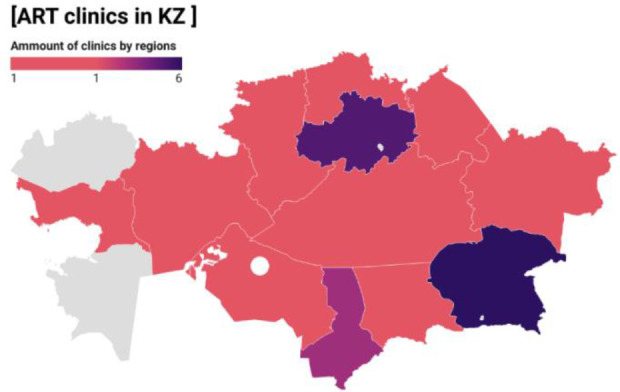
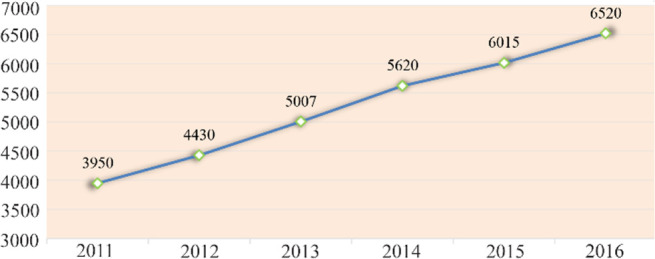
Table 1 presents data on different programs conducted in Kazakhstan for over 6 years.
Table 1. Comparative data on the number of ART programs in the RK (2011–2016)
| Year | Number of cycles | Annual growth (%) | No. of IVF cycles/million people | ||||||
|---|---|---|---|---|---|---|---|---|---|
|
| |||||||||
| IVF | ICSI | FET | ED | PGT | SM | Total | |||
| 2011 | 1785 | 952 | 564 | 302 | 85 | 262 | 3950 | 236.9 | |
| 2012 | 1780 | 1086 | 826 | 358 | 57 | 323 | 4430 | 12% | 261.9 |
| 2013 | 1403 | 1699 | 980 | 591 | 82 | 252 | 5007 | 13% | 291.7 |
| 2014 | 1354 | 2055 | 1269 | 484 | 179 | 279 | 5620 | 12.2% | 322.7 |
| 2015 | 1283 | 2516 | 1210 | 600 | 132 | 274 | 6015 | 7.0% | 340.4 |
| 2016 | 1120 | 2835 | 1449 | 633 | 195 | 288 | 6520 | 8.3% | 364.0 |
The structure of aspiration cycles is shown in figure 3. In 2011, conventional IVF was performed in 65% of the cycles, while, in 2016, ICSI has been performed 2 times more often, amounting to 72% of aspiration cycles. In table 2, evolution of PR and DR after IVF, ICSI, and FET during the period 2011–2016 is reported.
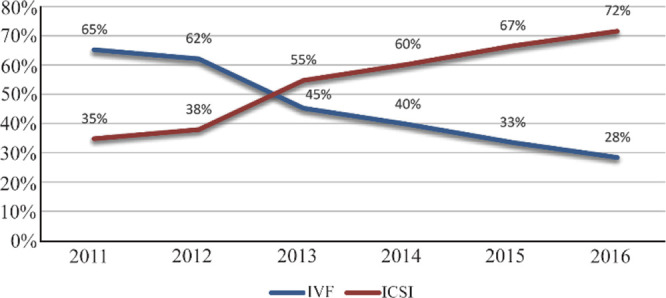
Table 2. Pregnancy and delivery rates after ART cycles during 2011–2016 in the RK
| Year | IVF | ICSI | FET | ||||||
|---|---|---|---|---|---|---|---|---|---|
|
| |||||||||
| Cycles | CPR% | DR% | Cycles | CPR% | DR% | FET | CPR% | DR% | |
| 2011 | 1785 | 38.4% | 26.4% | 952 | 43% | 26% | 564 | 37% | 24.0% |
| 2012 | 1780 | 37.5% | 24.7% | 1086 | 41.8% | 28.3% | 826 | 34.2% | 22.8% |
| 2013 | 1403 | 36.7% | 25.1% | 1699 | 42.2% | 32.60% | 980 | 37.3% | 25.2% |
| 2014 | 1354 | 36.0% | 23.6% | 2055 | 41.0% | 25% | 1269 | 39.9% | 26.9% |
| 2015 | 1283 | 36.5% | 24.8% | 2516 | 42.80% | 32.3% | 1210 | 41% | 29.5% |
| 2016 | 1120 | 37.5% | 28.3% | 2835 | 43.70% | 27.2% | 1449 | 42.5% | 31.4% |
CPR (clinical pregnancy rate) = clinical pregnancies/cycles. DR (delivery rate) =total deliveries/cycles.
IVF (in vitro fertilization) and ICSI (intracytoplasmic sperm injection) are measured per oocyte retrieval cycle. FET (frozen embryo transfer) is measured per thawing cycle
PR after conventional IVF fluctuated between 38.4% and 37.5% similar to ICSI (between 41.8% and 43.7%). In FET, a clear tendency to increased PR was observed during the period by 5.5%, from 37.0% in 2011 to 42.5% in 2016.
In contrast, the percentage of three embryo transfers decreased from 21.0% to 5.7% (p<0001). The transfer of 4 embryos (1.3% of cases in 2011) disappeared totally in 2016. In table 3, the percentage of twins in cycles of IVF/ICSI has decreased slowly from 17.5% in 2011 to 15% in 2016. Also, the percentage of triplets decreased from 3.2% to 2.5% (from 2011 to 2016, respectively). The situation with FET is slightly different, where twins increased both in number and percentage over the 6 years by 3.3% (from 2011 to 2016). The percentage of triplets declined from 3% in 2011 to 1% in 2016.
Table 3. The percentage of twins and triplets in IVF/ICSI and FET
| Year | IVF/ICSI | FET | ||||||||
|---|---|---|---|---|---|---|---|---|---|---|
|
| ||||||||||
| Deliveries | Twins | % | Triplets | % | Deliveries | Twins | % | Triplets | % | |
| 2011 | 719 | 126 | 17.50% | 23 | 3.20% | 135 | 13 | 9.70% | 4 | 3.0% |
| 2012 | 747 | 106 | 14.20% | 29 | 4.00% | 188 | 23 | 12.00% | 2 | 1.2% |
| 2013 | 906 | 167 | 18.40% | 29 | 3.30% | 247 | 32 | 13.00% | 4 | 1.8% |
| 2014 | 833 | 149 | 17.90% | 22 | 2.70% | 341 | 55 | 16.00% | 6 | 1.9% |
| 2015 | 1131 | 196 | 17.30% | 27 | 2.40% | 357 | 44 | 12.40% | 5 | 1.3% |
| 2016 | 1088 | 163 | 15% | 27 | 2.50% | 455 | 59 | 13% | 4 | 1% |
The analysis showed that the effectiveness of ART in the Republic of Kazakhstan (RK) fits well with European data reported by ESHRE and European IVF-Monitoring Consortium (EIM). In the ESHRE last published report (cycles performed in 2015), the PR and DR (all treatment modalities included) varied significantly from one country to another, with PR ranging from 19.6 to 44.0%, and DR ranging from 10.2 to 40.0% in fresh cycles after IVF or ICSI. After FER, with own embryos and PR per thawing of 29.2%, the DR varied between 12.8 and 37.5% among different countries (10). The proportion of ICSI cycles was similar in EIM and in RK (70% and 72%, respectively) (10). Fresh cycles were by far the most common ART intervention, but an increase in FET could be observed from 14.2% of all transfers in 2011 to 22.2% in 2016. This reflects the growing practice of cryopreservation documented in other regions of the world, although it is somewhat behind this international trend (10, 11).
Egg donation cycles accounted for about 10% of procedures per year (7% in 2011 and 9.7% in 2016). This low rate is mainly due to social and religious reasons, but the law allows everyone to use them freely.
Despite the small number of ART cycles, many foreigners come to Kazakhstan to do IVF (5). The popularity and growth of medical tourism in Kazakhstan is due to the liberal legislation that allows to carry out all existing ART procedures with low cost as well as relatively high efficiency of treatment, by experienced specialists who speak English.
The use of ART in Kazakhstan is regulated in accordance with the Code of the Republic of Kazakhstan “On people’s health and the health care system” (September 18, 2009, No. 193-IV) (12) and the Code “On marriage and the family” (December 26, 2011, No. 518-IV) (9). The order “On approval of the rules on the procedure and conditions for the use of assisted reproductive methods and technologies” (October 30, 2009, No. 627) (8) and the Order “On approval of the rules and conditions for the storage of germ cells (gametes)” (October 30, 2009, No. 624) were issued by Ministry of Health to implement the provisions of the country’s laws (13).
The legislation of the RK gives the right to access infertility treatments, including IVF, ICSI, gametes donation, intrauterine insemination with the husband’s or donor semen, and preimplantation testing for married couples with registered or unregistered marriage. Single women have also the right to access ART, with informed voluntary written consent to medical intervention (12).
In accordance with the legislation of the RK, citizens have the right to protect their reproductive rights and free reproductive choice, to receive services for reproductive health and family planning, to receive reliable and complete information about their reproductive health, and to protect health during pregnancy, childbirth, and after childbirth (8).
In the RK, surrogate motherhood is allowed for medical reasons, which involves carrying and giving birth to a child under a contract between the surrogate mother and biological parents in a registered marriage with or without remuneration. According to the law, a surrogate mother cannot refuse to give her born child to persons who have concluded a contract with her (9).
In using assisted reproductive methods and technologies, selecting the sex of the future child is not allowed, except in cases where it is possible to inherit diseases related to sex (12).
Germ cell (gametes) donors provide their gametes (sperm, oocytes) to others to overcome infertility and do not assume parental responsibilities towards the unborn child. The limit for one donor is the birth of 20 children (8).
Embryo donors are IVF patients who still have unused cryopreserved embryos in the Bank which can be used for donation to infertile couples, as well as to unmarried women (recipients) (13). Throughout the years of the study, the use of ART remained infrequent. Since the use of health services is an indicator of access to health care, ICMART proposed using ART as an indirect indicator of access to infertility treatment (14).
The government annually allocates quotas (subsidies) for IVF programs considering low availability of ART treatment to the population. The number of quotas allocated by the Ministry of Health is limited and free treatment is provided only to couples with tubal factor or male factor infertility. Government funding for ART cycles started with 100 programs in 2010, and grew to 900 cycles in 2016. Thus, in Kazakhstan, no more than 15% of all patients who received treatment in ART clinics in 2016 received reimbursement for ART (2). At the end of 2016, total health spending, including gross capital formation, amounted to 1 trillion 1,762 billion tenge (5 billion 148 million US dollars) or 3.8% of GDP (15, 16).
In this study, a number of limitations were recognized, including limitations related to data gaps, heterogeneity, and data validation since annual reporting, analysis, and control in Kazakhstan are not mandatory.
Thus, the results of the study indicate an increase in the number of ART cycles in Kazakhstan from 2011 to 2016 by 65%. The increase in the number of cycles is due to information availability, an increase in population incomes and the development of private IVF clinics, and possibly an increase in the subsidization of IVF by the government.
The laws of Kazakhstan are loyal to infertile couples, and give a choice for a variety of solutions. Since the use of ART in Central Asian countries is more infrequent in comparison to Europe, there is a need to combine IVF data in different nations. This will allow for a deeper assessment of the scientific evidence and reduction of infertility burden through joint efforts.
Not applicable.
