
The Rh Blood Group System is one of the 43 blood group systems ever identified in humans (https://www.isbtweb.org/working-parties/red-cell-immunogenetics-and-blood-group-terminology/). It is the most important post-ABO blood group system in blood transfusion medicine, and the RHD antigen of this system is a major cause of hemolytic disease of the fetus and newborn (HDFN). The disease is characterized by fetal anemia, jaundice and, in severe cases, kernicterus, hydrops fetalis, and intrauterine or postnatal death (1–3).
With the combined pre- and postnatal use of RhIG in the late 1990s, the risk of alloimmunization was minimized (about 0.2%), but the probability of this disease has not yet been reduced to zero, and it is still of particular importance in blood transfusion medicine (2, 4, 5). Another issue that is relevant here is that a significant percentage of prenatal RhIG injections are unnecessary due to fetal RHD status in RHD negative cases (about 40% of pregnancies in the European population), and since this medicinal product is of human origin, firstly, its production is low in some countries, and secondly, the possibility of transmitting known and unknown infections and sometimes allergic side effects continues to exist (6–8). Thus, proper and targeted use of the product will have a significant role in maintaining maternal and fetal health.
By discovering cell-free fetal DNA (cffDNA) in the bloodstream of pregnant women, Lo et al. introduced the use of a noninvasive sampling method in prenatal research (9). Following this discovery, Lo et al. and Faas et al., in two separate studies in 1998 also demonstrated the feasibility of fetal RHD genotyping using this DNA source (10, 11).
Determination of fetal RHD status in RHD-negative pregnant women is done nowadays for the targeted injection of RhIG to nonimmunized mothers carrying RHD positive fetus, and for the timely follow-up and proper management of immunized mothers carrying RHD positive fetus at risk of HDFN. In addition, this test can prevent unnecessary procedures for immunized mothers whose fetuses are genotyped as RHD negative.
Numerous studies on fetal RHD genotyping are still being conducted in many parts of the world, and even in some countries, fetal RHD genotyping is performed routinely as part of a screening program for RHD negative mothers during pregnancy. One of the most cited studies on this topic is conducted by Müller et al., who reported that the sensitivity of RHD genotyping of the fetus is as high as that of serological methods (12). In Iran, very few studies are available on this subject, and fetal RHD genotyping is not formally performed at any center for the purposes mentioned (13, 14). Therefore, the main objective of this study was to establish a reliable method with high accuracy for fetal RHD genotyping in the Iranian obstetric population using real-time polymerase chain reaction (PCR) technique and specific labeled probes, as well as appropriate controls (RASSF1A and SRY genes) to confirm the presence of cffDNA.
The study design and sampling: The present study was conducted as a prospective observational cohort project. All samples were collected after obtaining informed consent during a 13-month period (May 2019 to June 2020). Samples (using accidental sampling method) were collected from RHD negative pregnant women (gestation period of 7 to 38 weeks) related to RHD positive biological fathers who were referred to the prenatal section of Moheb Yas Hospital in Tehran for a routine ultrasound examination. Any history of interfering factors in fetal RHD genotyping such as neoplasms (interfering with RASSF1A methylation) as well as bone marrow transplantation and blood transfusions in the past three months led to exclusion of samples. It is necessary to state that the current study was approved by the Ethics Committee of High Institute for Research and Education in Transfusion Medicine (Ethical No.: IR. TMI.REC.1396.031).
Seven milliliters of whole blood were collected in EDTA tubes and shipped directly to Blood Group Genotyping Central Lab in the Iranian Blood Transfusion Organization. The plasma of most samples was isolated immediately or within a maximum of 48 hr at 4°C (except for five samples) and stored at −70°C until subsequent steps.
CfDNA extraction from maternal plasma: CfDNA (including maternal and fetal DNA) from 1 ml of maternal plasma was manually purified using a kit for DNA isolation from blood plasma (TestGene Co., Russia) and was eluted in the final volume of 50 μl of elution buffer. In cases where the mother’s gestational age was below 14 weeks, the buffer volume was considered to be 35 μl.
Confirmation of the presence of total DNA and cffDNA in the extracted sample: The beta-globin gene was used to assess the presence of total DNA (maternal and fetal). The SRY gene (as an internal control) was also used to confirm the presence of cffDNA. Since the SRY gene is detectable only if the fetus is male, in cases where neither the fetal RHD nor the SRY is detectable, another marker should be used to confirm the presence of cff-DNA. Evaluation of an epigenetic marker called RASSF1A (a tumor suppressor gene) could be a good option for this purpose, which was also used in the present study. This gene is hypermethylated in fetal-derived DNA and hypomethylated in maternal-derived DNA. Using the BstUI methylation-sensitive enzyme, it is possible to digest the maternal DNA and identify the RASSF1A gene in case of the presence of fetal DNA and conducting PCR on it, and this will confirm the presence of cffDNA (15). To this aim, 30 μl of cfDNA was incubated for 1 hr at 60°C in the presence of 10 units of BstUI enzyme (New England Biolabs, UK) and then, using this treated DNA, the amplification or nonamplification of the RASSF1A gene was evaluated by real-time PCR. To evaluate the completeness of the digestion, the beta-actin gene was used as a control. This gene is digested by BstUI enzymes of both maternal and fetal origin and unlike the hypermethylated RASSF1A, it will not replicate itself in the PCR process (15).
Real-time PCR analysis: DNA samples were analyzed by LightCycler 96 Real-Time PCR System (Roche Applied Science, Switzerland) and Taq-Man probe technology (dual-labeled hydrolysis probes). The sequences of used primers and probes were adopted from previous studies (3, 16–18) and synthesized by Metabion Company (Metabion GmbH, Germany).
Reaction mixture and amplification conditions: For each sample, amplification reactions were performed in a final volume of 25 μl and in three separate duplexes (the first for amplification of RHD exons 5 and 7, the next for RHD exon 10 and beta-globin, and the third for SRY and beta-globin). The reaction mixtures contained 1 μl of each primer and probe, 12.5 μl of TaqMan PCR Master Mix (PCR Biosystems Ltd., UK), 5 μl of DNA template (including samples and controls), and 1.5 μl of sterile H2O. The PCR procedure consisted of initial denaturation at 95°C for 10 min, followed by 50 cycles of denaturation at 95°C for 30 s, annealing at 61°C for 30 s, and extension at 72°C for 30 s.
When PCR for the RASSF1A and beta-actin genes was required, after cfDNA treatment with the enzyme, the amplification reaction was performed in duplex mode, and PCR conditions were similar to those in rest of the genes.
Interpretation of PCR results: The DNA analysis was performed in triplicate and PCR results were classified as either positive, negative, or invalid for each of the mentioned genes. Whenever at least two of the three replicates were amplified, they were considered positive and if none of the three replicates were amplified, they were considered negative. If only one of the three replicates was amplified, testing for that gene would be repeated in triplicate, and if four out of six amplification reactions were amplified, the result was interpreted as positive and otherwise invalid.
The fetal RHD genotype results were also classified as either RHD negative, RHD positive, or inconclusive. When none of the three exons showed amplification during the PCR as RHD negative, two or three exons were amplified as RHD positive, otherwise they were considered inconclusive.
Cord blood analysis: Within 24 hr after delivery, using the umbilical cord blood, the RHD status of neonates was evaluated as direct agglutination by means of Anti-D Duoclone Monoclonal (Lorne Laboratories Ltd., UK) and Anti-D Blend Monoclonal (CE-Immundiagnostika GmbH, Ger-many) reagents. If RHD was negative at this stage, a Weak D test (including the AHG phase) was done. Serological results of postnatal RHD were compared with those of fetal RHD genotype.
Fetal RHD genotyping in maternal plasma: A total of 40 RHD negative pregnant women (mean age of 29.3 years) from different Iranian ethnicities were evaluated in this study to determine the fetal RHD genotype.
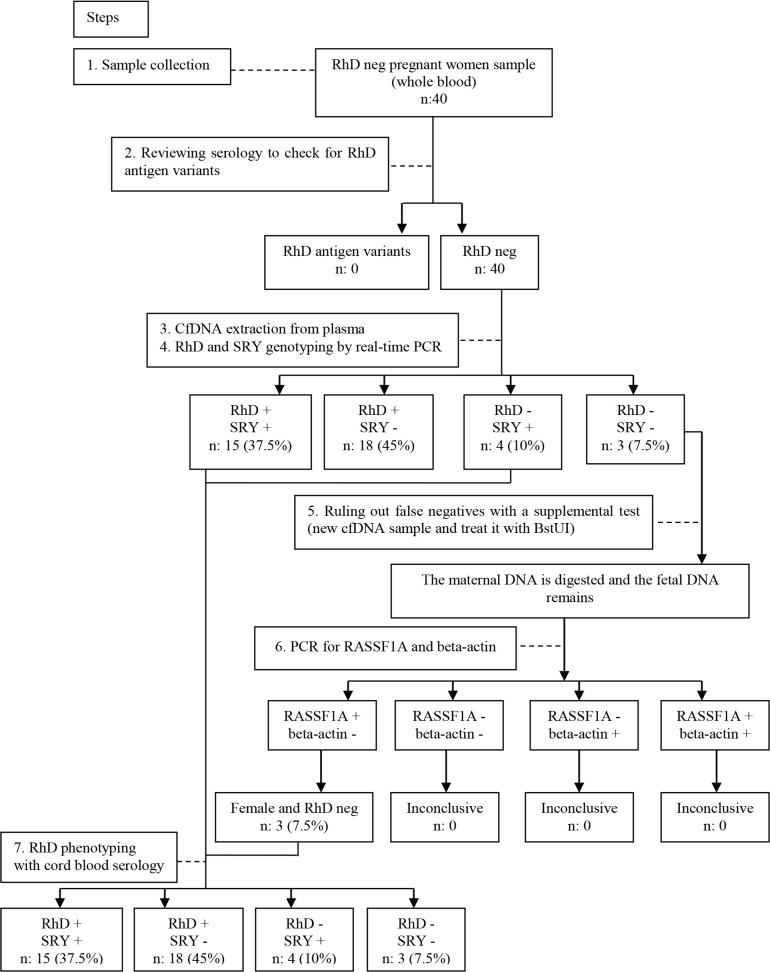
By examining exons 5, 7, and 10 of the RHD gene, 33 (82.5%) of the subjects were genotyped as heterozygous positive for RHD (including 2 cases of twin pregnancy) and seven cases (17.5%) were also RHD negative, which was in full agreement with the results of postnatal serotype using umbilical cord blood.
The mean Ct value for positive results of RHD exons 5, 7, and 10 (in duplex mode) based on pregnancy trimester is shown in table 1.
Table 1. Mean Ct value of real-time PCR for exons 5, 7, and 10 of RHD in different pregnancy trimesters
| Trimester (gestational week) | Mean Ct value | ||
|---|---|---|---|
|
| |||
| RHD exon 5 | RHD exon 7 | RHD exon 10 | |
| 1st (7–13) (n=3) | 37.69 | 38.36 | 37.84 |
| 2nd (14–27) (n=23) | 34.61 | 35.56 | 34.85 |
| 3rd (28–40) (n=14) | 33.58 | 33.92 | 34.30 |
Evaluation of the SRY and RASSF1A genes in cffDNA: Examination of the SRY gene revealed that 19 mothers (47.5%) had a male fetus while 21 (52.5%) had a female fetus, which were correctly correlated with the gender of the newborns.
Of the 40 subjects, three were negative for SRY and RHD. Their DNA was treated with BstUI enzyme, and PCR was performed for RASSF1A and beta-actin genes. CffDNA was detected in all three cases, and the probability of false negative results was also rejected.
An overview of the steps and results of this study can be seen as a flowchart in figure 1.
Nowadays, as far as blood transfusion medicine and the HDFN are concerned, noninvasive genotyping of some fetal blood groups, especially RHD is of paramount clinical value. Our study was carried out in this regard using a duplex real-time PCR on RHD exons 5, 7, and 10, and the results indicated the high accuracy of the applied method in fetal RHD determination for this sample size. One of the important strengths of the present study compared to previous studies conducted in Iran is the use of dedicated probes that provide the opportunity to use this method as a diagnostic test for patients.
According to this study, about 17.5% of mothers did not need RhIG, and if a statistical study is carried out across Iran, it will indicate that within a year, many people receive this product unnecessarily. In fact, this issue will underscore the importance of establishing and applying this test in Iran to prevent the unnecessary consumption of a blood product. Based on the results of this study, prenatal injection of RhIG is recommended only to mothers whose fetal RHD is reported to be positive or inconclusive, and postnatal injection based on cord blood serology results is recommended only for mothers who have an RHD positive baby. One of the issues that needs to be addressed in this and other similar studies is the issue of false positive and negative results in fetal RHD genotyping, which may make interpretation of the results difficult. In false negative results, the mother does not receive antenatal RhIG, and since the fetal RHD is positive, there is a possibility of maternal alloimmunization and the risk of HDFN in the current or subsequent pregnancy. However, this possibility is very low because after birth, serologic test using cord blood also provides the opportunity to correctly determine the phenotype and the mother can receive RhIG postnatally (7, 19, 20). In false positive cases, there is a problem of the loss of RhIG and its unnecessary injection (21).
The Rh blood group system has a wide genetic diversity, and this has always been a major challenge in RH genotyping; moreover, the main cause of false positive results in fetal RHD genotyping is often related to variants of this gene in the studied mothers (22). There are various ways to deal with this challenge. Knowing the genetic background of RHD in the population under study would be probably helpful in such cases. A study conducted by Khosroshahi et al. in 2019 in Iran on 200 RHD negative individuals showed that 99% of them were homozygous for the complete deletion of the RHD gene, and the remaining 1% could not be identified with the serological reagents used in that study due to weak and partial RHD variants (23). Also, in another study conducted in Iran in 2021 on 200 subjects, 99% of the RHD negative cases had the mechanism of homozygous deletion of the RHD gene and nonfunctional variants were observed in 1% of cases (24). These results suggest that RHD negative phenotype in the majority of individuals is the result of the deletion of the whole RHD gene, and the frequency of nonfunctional RHD variants, such as pseudogenes, is very low in the Iranian population, and they are very unlikely to be included in the study as RHD negative.
In order to reduce false positives in fetal RHD genotyping, attempts were made at the outset of this study to recruit only mothers who were completely serologically negative by using two different anti-D reagents (which, as claimed by the manufacturers, are able to identify most of the common variants of RHD) and by performing a Weak D test. However, it seems that only two types of reagents will not be able to detect all variants, especially those with low prevalence.
Furthermore, the primers and probes used in this study were designed and selected so that some of the maternal variants could be partially represented by the positive or negative pattern of their composition. For example, the forward primer and probe of RHD exon 5 were designed so that in presence of pseudogenes and some partial variants of RHD (such as DIV, DVI types I, II, and III), no amplification could be done. However, our set-up does not cover the genotyping of all RHD variants. Although none of the subjects in this study showed a positive or negative pattern associated with the presence of these variants, the study’s strategy was that in the case of suspected variant RHD, the fetal RHD genotype should be reported as inconclusive.
Concerning false negative results, it can also be stated that the main reason is the low amount of cffDNA in the plasma sample and most is also seen when sampling is done in the early weeks of pregnancy (22). In our study, no false negative results were observed, and all participants, even those with pregnancy before 14 weeks were correctly genotyped. However, firstly, the number of these cases (before 14 weeks) was not large enough to make sure that this method is also highly accurate for the early weeks of gestation. Secondly, neither RhIG injection nor the timely follow-up and treatment of immunized mothers whose fetuses are at risk for HDFN makes sampling in the early weeks necessary, but it is preferable to do the sampling in later weeks (e.g. from the 14 th week onward) where the cffDNA amount is higher.
The use of the RASSF1A (a universal fetal marker) also played an important role in rejecting false negatives in cases where SRY and RHD were negative, and the results of the three cases for whom the RASSF1A assay was performed also showed that RASSF1A is an appropriate and useful marker for internal controls in determining the fetal RHD genotype; however, to verify its accuracy, a study with a larger sample size must be conducted.
The main limitation of the present study was the low sample size, which can be addressed in future studies to increase the power of the study. The cost effectiveness of the present study should also be dealt with in future studies. Our next goal in future is also to determine the genotype of other HDFN-related blood groups at the Blood Group Genotyping Central Lab in Iranian Blood Transfusion Organization and to seek more collaboration with clinicians for the better management of the disease.
Noninvasive determination of fetal RHD genotype using the reliable strategy of this study is applicable and can be performed with high accuracy. This method is an alternative to invasive methods and can help targeted injection of RhIG and prevent unnecessary injection in RhD negative mothers who carry an RhD negative fetus.
The results of this and similar works can be useful in setting up and applying this test in different parts of Iran and other countries in the world.
This project was financially supported by the High Institute for Research and Education in Transfusion Medicine, Tehran, Iran.
