
Natural cycle in vitro fertilization (IVF) is increasingly being performed after discussion and identification of characteristics of patient groups that are more suited to natural cycle IVF (1). Similarly, a recent review indicated that the success rate of in vitro fertilization (IVF) and embryo transfer (ET) treatment depended on the number of oocytes which are collected by oocyte pick-up (OPU) procedure (2). As such, there is no doubt for both clinicians and patients of the importance of ovarian stimulation treatment as a component of IVF-ET. However, ovarian hyper-stimulation, such as short and long gonadotropin-releasing agonist (GnRH-a) protocols that require repeated gonadotropin injections, sometime causes occurrence of ovarian hyperstimulation syndrome (OHSS). Considering that the severity of OHSS would increase after achieving pregnancy with a fresh embryo transfer, the use of frozen embryo transfer has been accepted as a standard for IVF-ET to avoid late-onset OHSS (3). Moreover, the pregnancy rate does not differ significantly between ET and FET (4). However, the use of frozen embryos poses an economic burden to patients, with the cost being covered in some countries, such as in Japan and Germany, but not in others, such as in the United States and United Kingdom without private insurance. In particular, patients of relatively young age who have been unsuccessful in achieving pregnancy, despite undergoing several attempts of intrauterine insemination (IUI), tend to hesitate to proceed with IVF treatment due to the associated cost. To address this issue, in our clinic, patients under the age of 35 years were selected to proceed with natural cycle IVF as a treatment option before conventional IVF treatment. Specifically, natural cycle IVF is offered to women who meet the age criterion and have not previously undergone any type of ovarian stimulation treatment, such as the use of human chorionic gonadotropin (hCG) or GnRH-α. Fresh ET is used for natural cycle IVF whereas frozen ET is only used for women with a thin uterine endometrium. Natural cycle IVF, using fresh ET, typically costs JPY150,000.
The pregnancy rate of IUI within the natural cycle has been estimated at 10% (5). It seems that this rate could be improved using OPU and fresh ET with a natural cycle IVF compared to IUI. Therefore, the purpose of this study was to compare the pregnancy outcomes through natural cycle IVF and IUI.
Study population: Overall, 537 cycles of infertile women (≤35 years of age) were included in our retrospective cohort study. Women were treated with IUI (n=246: IUI group) or OPU and natural cycle fresh ET IVF (n=291: IVF group) at the Center for Reproductive Medicine and Implantation Research, Sugiyama Clinic Shinjuku, Tokyo, Japan, between April 2017 and February 2018. The treatment was selected by patients. All women included had a history of regular menstrual cycle, between 26 and 32 days, and had not received any prior fertility treatment. Furthermore, all women underwent infertility check-up before the start of this study, confirming the absence of abnormalities of the uterus, adnexa, and ovaries using transvaginal ultrasound, hysterosalpingography, and hysteroscopy. None of the patients showed endometrial polyps, submucous fibroids, or hydrosalpinges. Male factors and tubal obstruction which are diagnosed by hysterosalpingography were excluded in both groups. The anti-Müllerian hormone (AMH) was measured using a commercially available kit (AMH Gen II, Beckman Coulter, Japan).
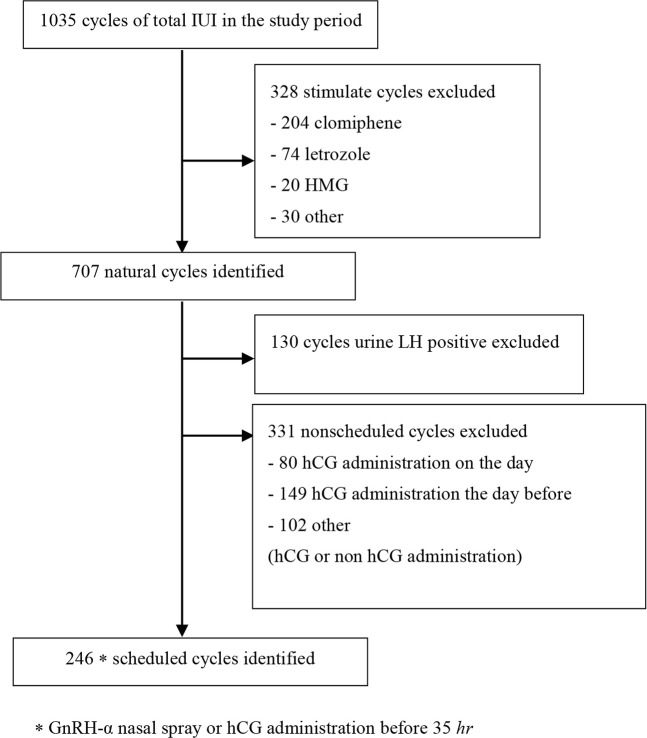
Process of patient selection: The flow diagram of cycle identification and inclusion/exclusion of the IUI group is shown in figure 1. Of 1,035 cycles of IUI performed over our study period, 784 cycles were excluded as follows: 323 were excluded due to the use of ovarian stimulation, such as clomiphene citrate, letrozole, or HMG injection; other 130 cycles were excluded due to a positive LH surge; and 331 due to short duration of hCG administration before IUI. Ultimately, 246 cycles of IUI were included in our analysis (Figure 1).
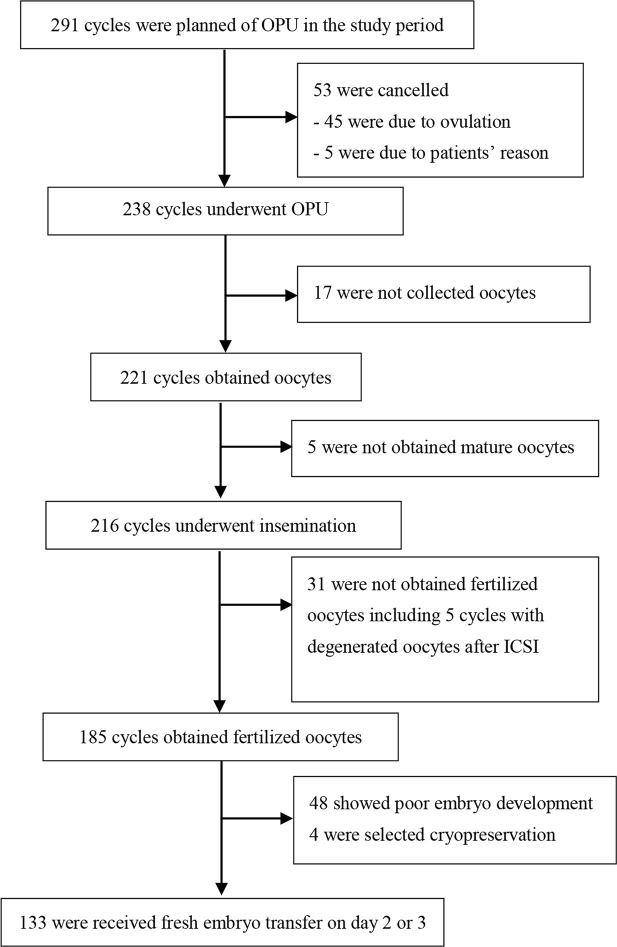
The flow diagram of cycle identification and inclusion/exclusion of IVF group is shown in figure 2. OPU was cancelled in 53 cycles due to ovulation or patient preference. Of the remaining 238 cycles, oocytes could not be collected in 17 cycles and mature oocytes were not retrieved in 5. Therefore, 216 cycles were available for insemination using either intracytoplasmic sperm injection (ICSI, n=180) or conventional insemination (n=36). Fertilized oocytes could not be obtained in 31 cases, including 5 cycles with degeneration of the oocyte after ICSI. Of the remaining 185 cycles with fertilized oocytes, poor embryo development was identified in 48 cycles. Four additional embryos were cryopreserved due to the presence of a thin endometrium. Ultimately, fresh ET for IVF was performed in 133 cycles. This study was approved by research ethics committee of Sugiyama Clinic, Shinjuku, and all patients provided written informed consent before treatment initiation. All data were anonymized prior to the analysis.
IVF procedure: In the IVF group, patients visited our clinic on the 10th to 12th day of their menstrual cycle. Follicle size and endometrial thickness were verified using transvaginal ultrasound. Levels of estradiol (E2), luteinizing hormone (LH), and progesterone (P4) were also measured. When the criteria of a developing follicle diameter ≥17 mm and E2 level ≥200 pg/ml were achieved, two 300 μg doses of gonadotropin-releasing hormone agonist (GnRH-α; via nasal spray; Buserequr®, Fuji-Pharma, Japan) or a 250 μg dose of hCG (Ovidrel®, Merk-Serono, Japan) were administered for the patient, and OPU was performed 35 hr later, as previously published (6, 7). Repeated visits were made until the conditions for OPU were achieved.
OPU, insemination procedures, and embryo culture were performed as previously described (8), with a usable embryo obtained for fresh ET, 2–3 days after insemination for all patients in the IVF group. The criteria for a usable embryo were as follows: development at least to the three-cell stage, 2 days after insemination, with <20% fragmentation, or development at least to the seven-cell stage, 3 days after insemination, with <20% fragmentation (9). Fresh ET was performed as per our previously published method (10). Assisted hatching and hyaluronan-enriched transfer medium were not used in any case. The fresh ET was cancelled when a thin uterine endometrium (<7 mm) was observed on the day of ET or a usable embryo could not be obtained.
Based on 2010 WHO criteria, semen parameter and sperm preparation was performed using the swim-up technique after density gradient centrifugation using the Percoll method (Kitazato corporation, Japan). Gems® Geri® medium (Genea Biomedx, Australia) was used as the culture medium for embryos.
IUI procedure: In the IUI group, all patients underwent natural cycle IUI without the use of a stimulated cycle (e.g. Clomiphene citrate, Letrozole, or human menopausal gonadotropin (HMG)). Patients visited our clinic on the 10th to 12th day of their menstrual cycle. Transvaginal ultrasound was performed to verify follicle size and endometrial thickness, and levels of urinary LH were monitored to identify a surge in LH. When an LH surge was not detected, IUI was performed 35 hr after administration of a 300 μg dose of GnRH-α (via nasal spray) or a 250 μg dose of hCG by injection (11). For patients with an observed LH surge, IUI was performed within 24 hr after the short duration of hCG administration; these cases were not included in our analysis.
Sperm preparation was performed by density gradient centrifugation, using the Percoll method (Kitazato corporation, Japan).
Data analysis: Clinical pregnancy was defined by confirmation of a gestational sac, using transvaginal ultrasound, and ongoing pregnancy by confirmation of visible fetal heart beat at 10 weeks of gestation. Clinical outcomes, outcomes of assisted reproductive technology (ART) cycles, and the rate of ongoing pregnancy were compared between the IVF and IUI groups. Between-group differences were evaluated using the chi-squared or Fisher’s exact test as appropriate. All statistical analyses were performed using EZR1 (a modified version of the R-commander). A p-value <0.05 was considered significant for all analyses.
The background of patients in both groups is summarized in table 1, with key features summarized as follows: the average age of patients was 32.3±2.4 years in the IVF group and 32.5±2.5 years in the IUI group; and mean period of infertility and AMH values were 23.7±14.6 months and 3.7±2.9 ng/ml, respectively, in the IVF group, and 17.1±10.6 months and 3.0±2.4 ng/ml, respectively, in the IUI group.
Table 1. Background of patients in the IVF and IUI groups
| IVF group | IUI group | p | |
|---|---|---|---|
| Patients, n | 291 | 246 | |
| Age, years * | 32.3±2.4 | 32.5±2.4 | 0.12 |
| Infertility period, months * | 23.7±14.6 | 17.1±10.6 | 1.80 |
| AMH values, ng/ml * | 3.7±2.9 | 3.0±2.4 | 2.80 |
mean±standard deviation, AMH=Anti-Mullerian Hormone, IUI= Intrauterine Insemination, IVF=In Vitro Fertilization
Outcomes of IVF and IUI are reported in table 2. Clinical pregnancy was achieved in 49 of 133 cycles in the IVF group and 25 of 246 cycles in the IUI group. The clinical pregnancy rate per OPU in the IVF group was 20.6% [49/38], which was significantly higher than that in the IUI group (10.1%, p<0.01). The clinical pregnancy rate per fresh ET was 36.8%. The ongoing pregnancy rate in the IVF group was 19.7%, which was significantly higher than the one in the IUI group (9.7%, p<0.01). The rate of miscarriage was not different between the groups, 4.1% in the IVF group and 8.0% in the IUI group.
Table 2. Reproductive outcomes in the IVF and IUI groups
| IVF group | IUI group | p | |
|---|---|---|---|
| Scheduled IUI, n | - | 246 | |
| Underwent OPU, n | 238 | - | |
| Clinical pregnancy, n | 49 | 25 | |
| Clinical pregnancy rate per OPU, % | 20.6 * | 10.1 | 0.002 |
| Clinical pregnancy rate per ET, % | 36.8 | - | |
| Ongoing pregnancy, n | 47 | 23 | |
| Ongoing pregnancy rate per OPU, % | 19.7 * | 9.3 | 0.001 |
| Miscarriage, n [%] | 2 (4.1) | 2 (8.0) | 0.481 |
p<0.01; IUI=Intrauterine Insemination, IVF=In Vitro Fertilization, OPU=Oocyte Pick-Up; ET=Embryo Transfer, IVF=In Vitro Fertilization, ICSI=Intracytoplasmic Sperm Injection
Pregnancy outcomes per ET in the conventional IVF and ICSI groups are reported in table 3. Total cycles of conventional IVF were 103 and 30 in the ICSI group. Clinical pregnancy was achieved in 37/103 cycles in the conventional IVF group and 12/30 cycles in the ICSI group. The clinical pregnancy rate per insemination in the conventional IVF group was 35.9%, which was not significantly lower than the 40.0% in the ICSI group (p=0.684).
Table 3. Pregnancy outcomes per ET in the conventional IVF and ICSI groups
| Conventional IVF group (n=103) | ICSI group (n=30) | p-value | |
|---|---|---|---|
| Clinical pregnancy, n (% ) | 37 (35.9) | 12 (40.0) | 0.684 |
| Ongoing pregnancy, n (% ) | 35 (34.0) | 12 (40.0) | 0.543 |
In our study, the clinical pregnancy rate per OPU was 20.6% (and 36.8% per ET) in the IVF group which was significantly higher than the rate of 10.1% in the IUI group. Based on our findings, in young women with a regular menstrual cycle, a clinical pregnancy rate >35% can be expected when a usable embryo could be obtained for natural cycle IVF treatment, compared to a rate of 17% for IUI. These findings are comparable to previously reported pregnancy rates for IUI and IVF (12). Our findings indicate that the disruption in oocytes pick-up within the fallopian tube might be the cause of infertility among the majority of women with no abnormal findings after infertility check-up. Therefore, patients receiving IVF treatment, even within the natural cycle, can expect a higher pregnancy rate than those who undergo repeated IUI.
According to a systematic review of natural cycle IVF treatment published in 2002 (10), the advantages of natural cycle IVF include a lower cost and lower physical and emotional burden than conventional IVF treatment, with almost no risk for ovarian hyperstimulation syndrome (OHSS) and multiple gestation. The disadvantage of natural cycle IVF is lower pregnancy rate in comparison to conventional cycle. However, our study revealed that natural cycle IVF can also be expected to have a sufficiently high pregnancy rate when performed on appropriate patients. Of note, the cost for conventional IVF in Japan is between US $4,400 and US $5,000 per treatment, which is significantly higher than that of IUI, which is between US $200 and US $300. The high cost of IVF is a common reason for young couples not to proceed from IUI to IVF. In our clinic, the cost of natural cycle IVF was lower than that of conventional IVF, between US$1,300–1,400, for women aged ≤35 years who have a regular menstrual cycle. Through natural cycle IVF, the number of patient visits, consultations, and the amount of medication used is far lower than with IVF. This cost is also made possible by the fact that there is no material or human consumption involved in the freezing and thawing process of the embryos in the laboratory.
Although this cost is still higher than that for IUI, it is not prohibitive and provides a higher chance to achieve pregnancy. Natural cycle IVF also obviates the burden of daily injections of gonadotropin to increase the follicle growth required for conventional IVF and the associated risk of severe OHSS after OPU. Among women ≤35 years of age, affordability and use of limited medical resources are essential issues to consider, along with patient safety and pregnancy success (14).
According to previous studies, natural cycle IVF is not recommended for infertile couples who were unsuccessful in conceiving with conventional infertility treatment, as the pregnancy rate for natural IVF of 12–14% per ET is lower than that for conventional IVF (15, 16). However, these studies did not consider the women’s age and only one previous study evaluated the outcomes of natural cycle IVF among women ≤35 years old similar to our study (17); in the above mentioned study, clinical pregnancy and live birth rates were 24.8% and 15.2% per ET, respectively, with the clinical pregnancy rate per ET being comparable to our findings. As maternal age is a key predictive factor of IVF treatment, comparisons of pregnancy rates between natural cycle and conventional IVF across a wide range of maternal age might be clinically difficult to interpret. In our study, natural cycle IVF yielded an acceptable pregnancy rate because ≤35 year old individuals were selected including only women who had already tried IUI several times but did not want to pursue conventional IVF treatment due to physical and financial reasons. Therefore, natural cycle IVF is the only appropriate option for these young women. This is consistent with previously reported recommendations for natural cycle IVF for young women with a short duration of infertility, older women, as well as those with a long duration of infertility (18). In addition to the age factor, recent reports have indicated that endometrial thickness is a negative prognostic factor for the success rate of natural cycle IVF (17, 19).
Cancellation of OPU is a major issue to consider with natural cycle IVF treatment, as no medication is used to prevent ovulation. Consequently, the cancellation rate of natural cycle IVF is a significant issue with a previous study reporting a cancellation rate of 17.5% (11), which was comparable to our rate of 18.2%. This rate is relatively higher than that for the standard stimulation long-, short-, or antagonist protocol. Certainly, appropriate prevention of ovulation increases the number of available OPU cycles and, consequently, increases the pregnancy rate with conventional IVF. Five main limitations of our study should be acknowledged in order to be able to interpret the findings. First, our data are from a single institution and, therefore, our results may not be applicable to other institutions in Japan and other countries. Second, the retrospective design of our study prevents the identification of predictive factors of pregnancy success. A prospective randomized controlled trial should be conducted in the future. Third, although the clinical pregnancy rate of one single natural cycle treatment was assessed, cumulative pregnancy rates could have been compared as well if sufficient data were extracted. Fourth, the number of participants was smaller than the number in previous studies and data from national registry was only collected (5). Lastly, perinatal outcomes of pregnancy should be included, as per previous studies (20).
Natural cycle IVF treatment yielded a higher clinical pregnancy rate (20.6% per OPU and 36.8% per ET) among women ≤35 years of age, compared to IUI. The pregnancy rate of IUI, performed using nasal spray GnRH-a or hCG, yielded a pregnancy rate of only 10.1%. Lowering the cost for natural cycle than for conventional IVF might help patients to proceed from repeated IUI to natural cycle IVF, which would be an appropriate choice for younger women. Future research must be conducted with larger sample size in order to be able to evaluate perinatal outcomes and provide the evidence needed to support natural cycle IVF as an affordable, less invasive, and safe alternative to IUI.
We gratefully acknowledge the work of past and present members of Center for Reproductive Medicine and Implantation Research, Sugiyama Clinic Shinjuku, Tokyo, Japan.
Funding: No funding to declare.
