
Polycystic ovary syndrome (PCOS) affects 10% of women at reproductive age (1). Oxidative stress markers are increased in women with polycystic ovary syndrome (2). The problem is also associated with mitochondrial dysfunction that negatively impacts the oocyte quality and subsequent ovulation in these women (3). PCOS is the most common cause of anovulation in women. Around 15–40% of affected women do not ovulate with clomiphene citrate. Clomiphene citrate resistance is the term used for failure in ovulation in spite of taking the medication (4). These women need gonadotrophins for ovulation beside monitoring which are expensive interventions.
Coenzyme Q10 is an antioxidant component of the electron transport chain. Coenzyme Q10 exists naturally in human body and although it’s generally well tolerated, a variety of side effects have been associated with the substance. These include nausea, heartburn, decreased appetite, and diarrhea (5). Coenzyme Q10 supplementation has been shown to improve mitochondrial distribution, spindle formation, and chromosome alignment in the oocytes of obese mice (6). A randomized controlled trial in humans showed that Coenzyme Q10 is a useful adjuvant in improving ovulation in women with clomiphene resistant PCOS (7); in the trial, 180 mg of Coenzyme Q10 was used per day and it was suggested to conduct further research to find its optimum dosage and duration of administration. There is no definite evidence on the optimal dosing of Coenzyme Q10 and the commonly recommended dose is between 100–200 mg (8). Coenzyme Q10 is present in natural sources in very limited amounts (9). Therefore, this study was conducted to assess the effecting of adding low-dosage supplementation of Co-enzyme Q10 on ovulation in women with clomiphene resistant PCOS.
PCOS women with clomiphene resistant in need of ovulation induction were recruited from the fertility clinic at Aziz Medical Center, Karachi, Pakistan from 1st July 2020 to 1st November 2020. The study was approved by the ethics review committee of the institution. The study was an open label randomized controlled trial registered in clinicaltrial.gov (No. NCT04302532, full protocol available at https://clinicaltrials.gov/show/NCT04302532). All women provided informed consent before randomization.
PCOS women, aged 20 to 35 years, with clomiphene resistant were included. Polycystic ovary syndrome was diagnosed according to Rotterdam criteria (10). Women were classified as having clomiphene resistance if they were unable to ovulate for two to three cycles with a daily dose of 150 mg of clomiphene citrate administered from day 2 to day 6 of the cycle.
For the study purpose, all women with hyperprolactinemia, hypercortisolism, and thyroid disorders were excluded as assessed by history and examination. Also, women whose male partners did not have a normal semen analysis according to the World Health Organization criteria were excluded or the women who had tubal pathology as assessed by the hysterosalpingogram. Women who were taking cholesterol lowering medication, beta blockers, or antidepressants were also excluded from the study.
Each woman was enrolled on day 2 of her cycle and had the initial scan done on day 2 to assess the follicle count and endometrial thickness. To ensure uniformity, all scans were done by RI. A Mindray’s DP-2200 scanner with a 5 to 7.5 MHz frequency endovaginal transducer was used for all procedures. All scans were performed by the lead author who has been a specialist in ultrasound and fertility and has 10 years of experience.
Each woman was then randomized to one of the two groups including group A (the study group) and group B (the control group). Group A received oral clomiphene citrate (clomid, 150 mg, 3 tablets) (Pacific Pharmaceuticals Ltd., Pakistan), Coenzyme Q10 (Capsule Celeron SR, 120 mg), capsule (Genetics Pharmaceuticals, Pakistan) while group B received oral clomiphene citrate (clomid, 150 mg, 3 tablets) (Pacific Pharmaceuticals Ltd., Pakistan) only.
All women were informed in detail about the study protocol. They were advised to be present on day 2 of their menstrual cycle, and were strictly instructed not to take any medicines without the advice of fertility physicians. They were provided with an emergency contact number for this purpose. All recruited women followed a protocol where they had ultrasound assessments for follicular size and endometrial thickness on days 8, 10, 12, and 14.
Serum progesterone (ng/ml) was measured on cycle days 21–23 by Radioimmunoassay (RIA) using an antibody-coated-tube method (Coat-A-Count; Diagnostic Products Corporation, USA). HCG injection (IVF-C Injection 5000–10,000 IU; Galaxy Pharma, Pakistan) was given when at least one follicle measuring at least 18 mm was found. Patients were advised to have intercourse 24–36 hr after HCG injection. Serum HCG was determined 2 weeks after HCG injection in the absence of menstruation for diagnosis of pregnancy. Growing follicles were defined as those measuring <14 mm and mature follicles as 18–22 mm.
There is no fixed definition of ovulation. For the study purpose, ovulation was considered as disappearance of the dominant follicle on transvaginal scan, presence of free follicular fluid in the pouch of Douglas, and midluteal phase progesterone value of >5 ng/ml. The primary outcome was the number of women who ovulated. A pregnancy was confirmed with a positive beta-hCG in serum, which was the secondary outcome.
To calculate an adequate sample size, the literature regarding comparisons between Coenzyme Q10 and clomiphene citrate was searched. There is only one study which directly compares effect of combining Coenzyme Q10 with clomiphene citrate (7). Using that study as reference and assuming similar proportions, the sample size for the study came out to be 58 patients in each group. The sample size for ovulation was calculated by using the WHO software where alpha= 1%, power of the test as 1-beta=95%, anticipated population proportion 1=37.3%, and anticipated population proportion 2=6%. Two-sided test procedure to test for the equivalence of the proportion was applied in order to calculate the sample size (Sample Size Determination in Health Studies, Version 2.00, Copyright (c) 1996–98, World Health Organization). To compensate for protocol deviation, the sample size was inflated by 20% so that at least 70 women were randomized to each arm of the study.
A computer generated randomization scheme and sealed envelopes were used to allocate women into two groups including Coenzyme Q10 and clomiphene citrate (Combined group) and clomiphene citrate only (CC). The investigator was blinded and the allocation was done by a nurse. Yet, the women knew that they were allocated to the treatment group.
The quantitative variables of age, duration of infertility in years, body mass index in kg/m2, level of FSH and LH in IU/L were expressed by means and standard deviation and independent t-test was applied to compare the groups. Frequency and percentages were computed for qualitative variables including type of infertility, pregnancy, and ovulation. Chi square test and Fischer’s exact test were administered to compare these variables at significance level of p<0.05. Binomial logistic regression analysis was conducted to measure the strength of these associations with conception. Predictive variables included age, duration of infertility in years, type of infertility (primary/secondary), group of patients (combination/clomiphene citrate), ovulation (no/yes), and obesity (non-obese/obese).
SPSS vs. 15.0 (SPSS Inc., USA) was used for all statistical analyses at the significance level of 5%.
Over the study period, 155 women satisfied the inclusion criteria and of these 6 refused to participate. The remaining 149 women who consented were randomized. The trial profile is shown in figure 1.
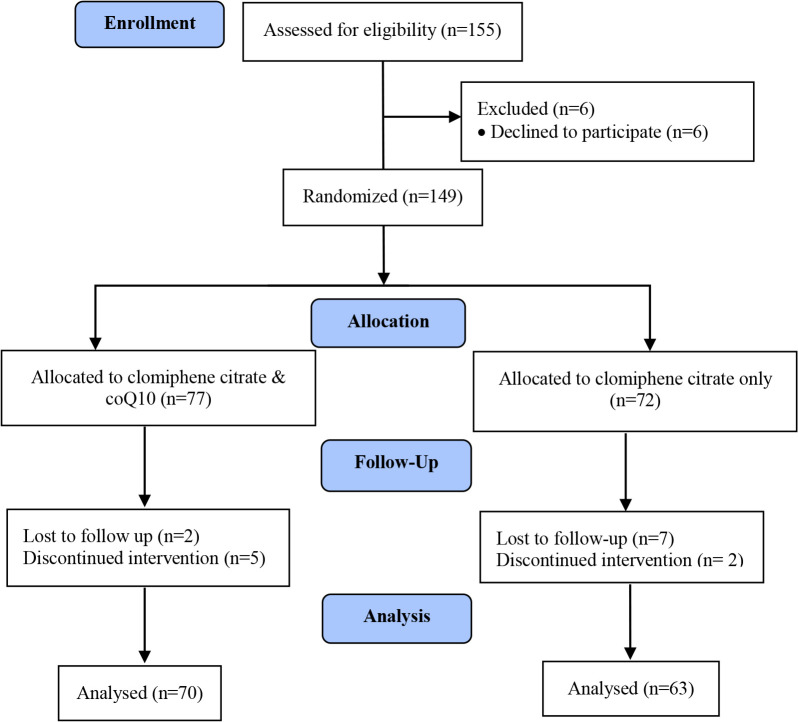
A total of 77 women were randomly allocated to combination group. Seven had to be excluded from analysis, because of protocol deviation (n=5) and two did not comply with follow up.
Totally, 72 women were assigned for induction with clomiphene citrate alone and 9 women were excluded because they were lost to follow up (n=7) or had to be excluded due to protocol deviation (n=2).
The characteristics of both similar groups are shown in table 1. The primary outcome was the number of women who ovulated per cycle. The proportion of women who ovulated with combination was 49/70 (70%) and it was 12/63 (19%) in the clomiphene citrate group. This difference was statistically significant (p<0.001). More women conceived in the combination group than the control group (48.6% vs. 6.3%, p<0.001). The endometrial thickness at the time of trigger (8.76±1.20 vs. 6.25±0.84, p=0.001) and the mean number of follicles ≥18 mm in size (1.86±0.64 vs. 1.48±0.76, p=0.002) were also significantly different in both groups. Other parameters are shown in table 2.
Table 1. Basic characteristics of study population
| Groups | |||
|---|---|---|---|
|
| |||
| Combination n=70 | Clomiphene citrate n=63 | p-value | |
|
| |||
| Mean±SD or N (%) | Mean±SD or N (%) | ||
| Age in years | 28.16±4.44 | 29.17±4.18 | 0.17 |
| Duration of infertility in years | 3.59±1.15 | 3.79±1.22 | 0.31 |
| BMI in kg/m 2 | 29.34±3.0 | 30.11±2.76 | 0.12 |
| FSH in IU/L | 5.69±1.15 | 6.06±1.19 | 0.06 |
| LH in IU/L | 5.49±0.85 | 5.70±0.99 | 0.18 |
| Type of infertility: n (%) | 0.39 | ||
| Primary | 34 (48.6) | 26 (41.3) | |
| Secondary | 36 (51.4) | 37 (58.7) | |
Table 2. Treatment outcomes in groups
| Combination n=70 | Clomiphene citrate n=3 | p-value | |
|---|---|---|---|
| Number of follicles ≥14 mm | 1.46±0.93 | 0.63±0.52 | 0.001 |
| Number of follicles ≥18 mm | 1.86±0.64 | 1.48±0.76 | 0.002 |
| Endometrial thickness at the time of trigger | 8.76±1.20 | 6.25±0.84 | 0.001 |
| Progesterone level (ng/ml) | 8.13±2.83 | 5.59±1.78 | 0.001 |
| Ovulation | 0.001 | ||
| Yes | 9 (70%) | 12 (19%) | |
| No | 21 (30%) | 51 (81%) | |
| Pregnancy | 0.001 | ||
| Yes | 34 (48.6%) | 4 (6.3%) | |
| No | 36 (51.4%) | 59 (93.7%) |
When stratified according to obesity, 85.3% of non-obese women who received combination ovulated whereas only 55.6% of obese women ovulated. This difference was statistically significant. Moreover, 48.6% of non-obese women conceived in the combination group as compared to 6.3% of obese women. This difference was also statistically significant (Table 3).
Table 3. Treatment outcomes in groups stratified according to obesity
| Combination | p-value | CC | p-value | |||
|---|---|---|---|---|---|---|
|
|
| |||||
| Lean PCOS cases n=34 | Obese PCOS cases n=36 | Lean PCOS cases n=33 | Obese PCOS cases n=30 | |||
| Number of follicles ≥14 mm | 1.88±1.03 | 1.06±0.58 | 0.001 | 0.55±0.51 | 0.74±0.51 | 0.15 |
| Number of follicles ≥18 mm | 1.88±0.54 | 1.83±0.74 | 0.753 | 1.36±0.74 | 1.60±0.77 | 0.22 |
| Endometrial thickness at the time of trigger | 9.38±1.21 | 8.17±0.85 | 0.005 | 6.45±0.75 | 6.09±0.9 | 0.09 |
| Progesterone level (ng/ml) | 9.06±3.17 | 7.25±2.17 | 0.007 | 5.12±1.87 | 6.10±1.56 | 0.02 |
| Ovulation | 0.002 | 0.409 | ||||
| Yes | 29 (85.3%) | 20 (55.6%) | 5 (15.2%) | 7 (23.3%) | ||
| No | 5 (14.7%) | 16 (44.4%) | 28 (84.8) | 23 (76.7%) | ||
| Pregnancy | 0.007 | 0.349 | ||||
| Yes | 23 (67.6%) | 11 (30.6%) | 3 (9.1%) | 1 (3.3%) | ||
| No | 11 (32.4%) | 25 (69.4%) | 30 (90.9) | 29 (96.7%) | ||
Three miscarriages occurred in the combination group and one woman had ovarian hyperstimulation in the control group. All these complications were seen among obese women.
Women who received combination were six times more likely to conceive than women who only received clomiphene citrate (AOR=6.344, 95% CI: 1.452–27.71, p=0.014). Moreover, non-obese were 3 times more likely to conceive than obese women (AOR=3.379, 95% CI: 1.056–10.815, p=0.040) (Table 4).
Table 4. Variables associated with conception: binomial logistic regression (n=133)
| B | S.E. | Adjusted odds ratio | 95% CI | Sig | |
|---|---|---|---|---|---|
| Age | 0.166 | 0.077 | 1.181 | 1.016±1.372 | 0.030 |
| Duration of infertility | 0.027 | 0.307 | 1.027 | 0.563±1.875 | 0.930 |
| Type of infertility (primary) | −0.275 | 0.646 | 0.760 | 0.214±2.695 | 0.671 |
| Group (clomiphene and coenzyme Q10) | 1.847 | 0.752 | 6.344 | 1.452±27.719 | 0.014 |
| Ovulation (no) | −4.002 | 1.104 | 0.018 | 0.002±0.159 | 0.<0001 |
| Obesity (non-obese) | 1.217 | 0.594 | 3.379 | 1.056±10.815 | 0.040 |
Predictive variables: Age, duration of infertility in years, type of infertility (primary: 1/secondary: 0), group (combination: 1/clomiphene citrate: 0), ovulation (no: 1/yes: 0), obesity (non-obese: 1/obese: 0)
The proportion of women with polycystic ovary syndrome who ovulated with combination was greater than those with clomiphene citrate alone. Those who were given combination had greater conception rate per cycle than those who received clomiphene only. Women who received combination were six times more likely to conceive than women who only received clomiphene citrate. The endometrial thickness at the time of trigger and the mean number of follicles ≥18 mm in size were also greater in the combination group than the clomiphene only group. Non-obese women had a better ovulation and conception rate per cycle with combination. Moreover, non-obese were 3 times more likely to conceive than obese women.
The major strength of this study is its prospective randomized controlled design and use of daily dose of Coenzyme Q10 and continuous supplementation for the whole cycle to assess the effect on endometrium. In this study, a lower dose of Coenzyme Q10 was utilized in contrast with previously reported cases which might be less cumbersome and cost effective in all setups.
Our study was not powered to assess the difference between obese and non-obese population; therefore, the obtained results for this subpopulation need further evaluation in larger trials.
The major limitation is the single center design and generalizability of results may be a concern. Clomiphene citrate is the standard therapy for ovulation induction in women with PCOS. If anovulation persists for three cycles of treatment at the highest recommended dose of 150 mg/day, the woman is considered to be resistant to treatment and some other therapy is introduced into the protocol as an adjuvant or the drug is substituted (11).
Our analysis showed significantly improved ovulation rate in resistant women with Coenzyme Q10. Studies on female mice have shown the favorable effect of Coenzyme Q10 on reproductive lifespan and those who receive Coenzyme Q10 produce greater number of healthier eggs and exhibit superior ovarian response. This effect has been explained in the context of amount of mitochondria present in the oocyte (12). Our results are in agreement with the animal studies and the only trial done on humans (7, 13).
High estrogen concentration is seen in women with PCOS that enhances extra mitochondrial oxidative stress in endometrial cells and leads to decreased implantation and poor pregnancy rates (14). In our study, women treated with combination had better conception rate and better endometrial thickness at the time of trigger.
Patient acceptability and cost of treatment are two major determinants of compliance with treatment. In this study, a lower dose was used in contrast to previously documented research (7) but the treatment was given for a full cycle. It has been shown that the potential for embryo implantation is correlated with the ATP levels of the embryo (15). It was hypothesized that there may be a cumulative effect of Coenzyme Q10 in the secretory phase which may help implantation and improve pregnancy rate. In our study, 48% of women conceived, which is higher than the rate previously reported. Researchers reported a conception rate of 37.3% with the combination. Therefore, it seems that continuation of administrating Coenzyme Q10 for full treatment cycle is beneficial. Our results are marginally better than the previous study (7) and therefore continuation of antioxidant administration is recommended.
Our analysis showed that improvement in ovulation and conception rate with combination of Co-enzyme Q10 and clomiphene citrate is more pronounced in women who are not obese. Non-obese were 3 times more likely to conceive than obese women. This may be due to increased oxidative stress in women who are obese (16). A study from Egypt (7) showed no significant difference with combination of Coenzyme Q10 and clomiphene citrate in ovulation and conception rate for both obese and lean PCOS cases; in the study, 180 mg of Coenzyme Q10 was used and the authors of the study concluded that their sample was not large enough to detect a difference. This difference could be explained by the fact that a lower dose was used in the current study and women who are obese may need a higher dose to ovulate. Moreover, our study had almost equal number of obese and lean PCOS cases. Therefore, further trials are required to assess the difference in this subpopulation.
Pre-treatment with Coenzyme Q10 has been shown to improve ovarian response to stimulation and embryological parameters in young women with poor ovarian reserve in IVF-ICSI cycles (17). However, the mentioned study is different from our study population as clomiphene citrate was given to women with polycystic ovary syndrome. The administration of Coenzyme Q10 leads to ovulation in these women and eliminates the need for gonadotrophins. In our study, women's age was associated with better conception rate, highlighting the fact that Coenzyme Q10 and clomiphene citrate may have an effect on the aging ovary and may be responsible for improving conception.
Coenzyme Q10 produced results in a shorter span of time as compared to metformin, which needs 1–3 months to generate an effect and was significantly cheaper than gonadotrophins. Clomiphene citrate and Coenzyme Q10 are generally considered safe and no adverse effects have been detected with the treatment in any patient. Our results are in agreement with other reports (7). Coenzyme Q10 can be used as an alternative in low resource settings and for women who need rapid protocols. Coenzyme Q10 seems to be a promising adjuvant to oral ovulation agents such as clomiphene citrate.
Clomiphene resistance is commonly used in women with polycystic ovary syndrome. The next management involves induction with gonadotrophins that is expensive and needs multiple visits and sophisticated monitoring. A recent meta-analysis showed that Coenzyme Q10 may improve cumulative pregnancy rate in women but may not improve live birth rate and miscarriage rate (17). However, the researchers stated the need for further evidence in diverse populations.
Coenzyme Q10 is a valuable adjunct in women with PCOS undergoing ovulation induction. It improves ovulation, conception, and endometrial thickness.
Our study protocol did not have an extended follow up and several questions would not be answered by our analysis. Therefore, further trials incorporating an extended follow up should be conducted to assess the effect of combination in women with PCOS. This low cost treatment adjuvant may prove advantageous in such cases.
