
To reduce and minimize human errors during IVF, developing an automated system to assist embryologists in the laboratory has become eminent. Conventional embryo grading or annotation of embryo morphokinetics is conducted through manual observation of the embryo culture by an embryologist which is energy- and time-consuming (1). Machine learning (ML) could potentially serve as a solution, especially with the recent advancement in neural networks and publicly available learning resources. In vitro fertilization as one of the effective treatments for infertility has become a trending subject for artificial intelligence (AI) and ML experiments. Efficiency of cell annotation and separating cells based on morphokinetic differences reduce the challenge of subjective assessment of embryo cells. Research in AI and ML in medical field had been established by a number of researchers who attempted the application of neural network system for binary image classification such as euploid prediction (2–4) and livebirth prediction (5–7), and for multiclass classification such as classification of embryo development stage (8–11) and embryo grading (12–14).
Typically, an embryo culture is maintained for 5 days from the fertilization stage up to the blastocyst stage. Through the time-lapse technology, the entire embryo development process could be recorded and compressed into a time-lapse video which becomes the main reference for observation. The embryologists normally require 5 min to observe and annotate a single embryo development cycle (15). Automation of the classification process would therefore accelerate the embryo annotation procedure and reduce the subjectivity of individual embryologist assessment. In this study, utilization of convolutional neural network (CNN) as part of deep learning algorithm was initiated to construct an AI model capable of classifying embryo developmental stages based on annotated datasets from expert embryologists. According to VerMilyea et al., an artificial model is 24.7% more accurate than the embryologists in meticulously assessing embryo morphology on day 5 and predicting clinical pregnancy (13).
The embryo developmental stages are distinguished by specific events in the process of fertilization, cleavage, morula formation up until the blastulation. Embryo morphokinetics refers to the time-associated transformation of the embryo as the cells go through cell division or cell splitting.
Upon intracytoplasmic sperm injection (ICSI), a procedure of injecting a selected sperm cell directly into an ooplasm (16), the embryo culture/morphokinetics begins (denoted as time zero) and is maintained for 5 to 6 days until the critical blastocyst stage is reached.
This study utilized images of embryos that were cultured in MIRI® time-lapse incubators (37°C, 5% CO2, and 5% O2), a closed incubator system that permits the record-keeping of uninterrupted time-lapse videos (Single data center: Morula IVF Jakarta Clinic, Jakarta, Indonesia). Images were captured in a sequence of time, then merged and compiled to create a time-lapse video of the embryo morphokinetics. The time-lapse incubator can accommodate multiple embryos at a time while maintaining a sterile environment for the embryo growth. Time-lapse technology has elicited an increase in the probability of clinical pregnancy and embryo implantation in IVF (17). The annotated time-lapse video was used as a dataset in this prospective study with 163 embryo cycles which consisted of the selected time-points: t1, t2, t3, t4, t5, t6, t7, t8, t9+, tcompaction, tM, tSB, tB, and tEB. While maintaining the integrity of the dataset, imbalanced dataset could not be avoided. Instantaneous cell split between two time-points periodically occur resulting in rapid morphological changes; hence, the dataset of embryos in t3, t5, t6 and t7 are smaller in quantity (18). Table 1 summarizes the dataset used in this study which amounts to 15.831 embryo images at different developmental stages.
Table 1. Embryo dataset
| Time point | T1 | T2 | T3 | T4 | T5 | T6 | T7 | T8 | T9+ | Compaction | Morula | Early blastocyst | Blastocyst | Expanded blastocyst |
|---|---|---|---|---|---|---|---|---|---|---|---|---|---|---|
| Image no. | 3189 | 1388 | 348 | 1540 | 323 | 378 | 445 | - | - | - | - | - | - | - |
| Image no. | - | - | - | - | - | - | - | 1575 | 1197 | 1135 | 1668 | 754 | 930 | 961 |
Convolutional neural network is a feed-forward neural network (FFNN) which uses a mathematical linear equation between matrices called the convolution (19). A basic CNN would require convolutional, pooling, and fully-connected layers to represent its characteristics (20). A supervised dataset is fed into the CNN with input images that have been grouped based on the header or pre-classified classes as part of the original images. The last layer would consist of a 1×1 dimensional node with multiple depths; depth in this context depicts the possible number of classifications and simplification was done through a nonlinear function (21).
To produce a CNN model, TensorFlow and Keras library were implemented since both are open-source libraries created by Google and community developers. TensorFlow employs graphics processing unit (GPU) as one of the computational devices to accelerate data clustering and training process (22). To represent a TensorFlow for model algorithms, dataflow graphs utilize layers as mathematical matrix operators and each type of layer produces a different mathematical output (23). TensorFlow is designed to provide an efficient memory and computation, a stable numerical system, and maintain an idiom to differentiate its ecosystem (24). Alternatively, Keras is particularly built for easy and efficient experimentation besides faster results in research (25). Keras itself is a high-level application programming interface (API) which can serve neural network purposes.
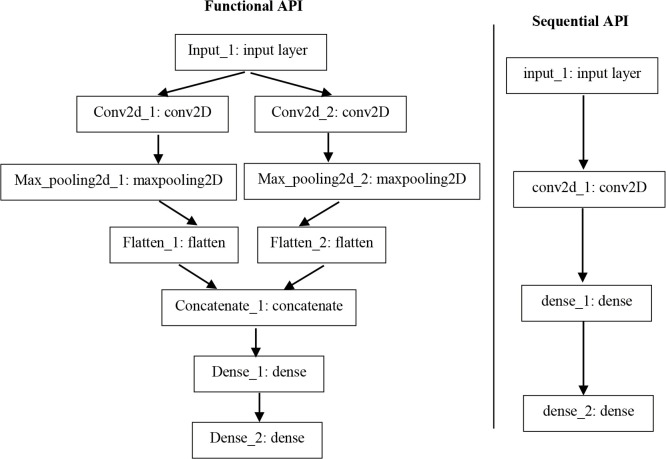
TensorFlow and Keras have published multiple open-source pre-trained models on TensorFlow Hub that could be used for transfer learning using a newly introduced dataset. The transfer learning allows leveraging feature representations from pre-trained models with pre-defined layers and altering the end point of the model into a desired classification. Each individual pre-trained model is unique; for instance, inception_v3 has 313 layers, ResNet has 566 layers while efficientnet_b6 has 669 layers (22). In transfer learning, a pre-trained model with all its layers is considered as a singular layer (one entity) which allows users to use either sequential or functional API. Figure 1 shows the architectural differences between functional and sequential API. Functional API provides flexibility in creating multiple parallel layers, while sequential API exhibits linear layers. To achieve a robust AI model, this study combined pre-trained model selection, data augmentation, and hyperparameter selection. Pre-trained model selection was conducted through trials of multiple different model architectures trained for 100 learning steps or epochs. Data augmentation consisted of random image rotation and image flip in the dataset, and hyperparameter selection comprised testing multiple optimizers and learning rates. Configuration selection was performed in a shorter training time (30 learning steps or epochs) compared to the final model built (200 learning steps or epochs).
Ethical committee approval: This study was approved by the local research ethics committee in the Faculty of Medicine, Universitas Indonesia, Jakarta (number: KET-351/UN2.F1/ETIK/PPM. 00.02/2020).
In this study, multiple model architectures with different hyperparameters were compared with/without data augmentation to identify the most suitable architecture which best achieves the functions of embryonic cell detection and annotation. Retrospective IVF patient data on successful embryo development up to the expanded blastocyst were obtained for this study. The dataset consisted of image records of the embryonic cells after sperm injection, at the T1 to T9 stage, compaction, morula, and blastocyst stage. Figure 2 shows the sequence of the embryonic development and different morphokinetic parameters captured using the time-lapse incubator camera. These images had undergone the pre-processing steps of cropping, thresholding, erosion, and dilation prior to extraction from the original time-lapse videos. Six pre-trained models were used in this study with multiple parameters to identify which model has the highest accuracy. Sequential API was used for the comparison because of its capability to gain access to TensorFlow Hub and linear model layer computation. The pre-trained model yielded an x amount of output which was then narrowed to a specific classification using a dense layer. The dense layer serves to limit the outputs to the desired classification. The pre-trained model selection was conducted using the following parameters: 100 epochs, Adam optimizer, and 5E-03 learning rate without data augmentation. Table 2 shows the output accuracy of the different pre-trained models with similar parameters. Pre-trained models with the highest accuracy would subsequently be used for hyperparameter selection and final model training.
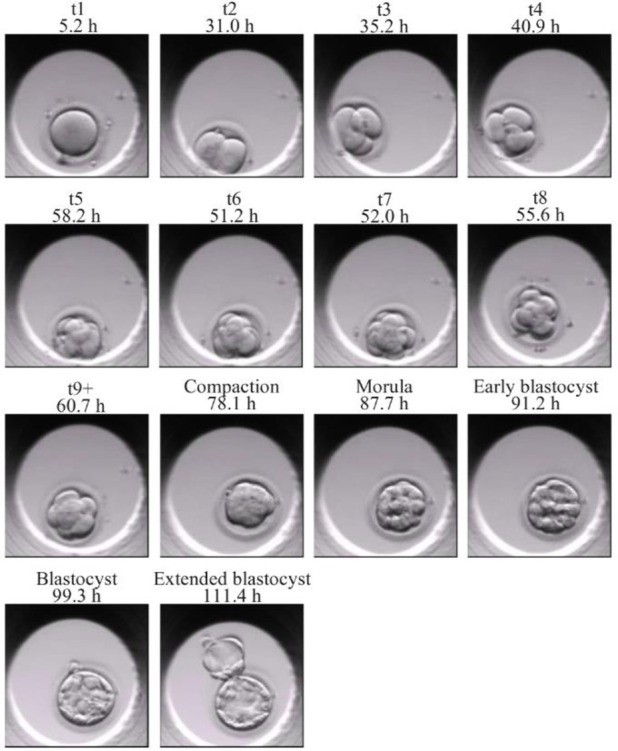
Table 2. Performances of pre-trained models
| No | Model | Accuracy (%) |
|---|---|---|
| 1 | Inception_v3 | 40–50 |
| 2 | Efficientnet_b3 | 50–60 |
| 3 | Mobilenet_v1_100_224 | 35–45 |
| 4 | Mobilenet_v3_large_075_224 | 55–60 |
| 5 | Efficientnet_b6 | 55–60 |
| 6 | Resnet_v2_152 | 55–60 |
Evidently, some architectures performed better than the others. Each pre-trained model has a different layer approach which influences its performance. The purpose of the layers is to update the model’s weight for each node; more layers presumably yield a better performance. In this study, efficientnet_b6 architecture performance was proven to be superior and it utilized more layers than the other models and thus was used for the hyperparameter selection. The trial for hyperparameter selection was conducted over 30 epochs to expedite the initial probability results that would become a benchmark for downstream training steps.
Optimizer, learning rate, and data augmentation were factors that were tested using commonly used hyperparameters and similar configuration attempts. The optimizers were derived from the Keras library. The learning rate used a sequence order of number selection. The data augmentation was conducted to potentially increase the model performance by using two randomly selected settings. Learning rate determines the model capability to adapt with training progress. A small value of learning rate indicates a slow training progress while a high learning rate value would result in different loss functions. The calculation for each learning rate differs for each optimizer, since each uses a different set of mathematical approaches to comply with their individual goals. The combination of learning rate and optimizer yielded better test results as shown in table 3.
Table 3. Learning rate comparison
| No | Optimizer | Learning rate | The highest training accuracy (%) |
|---|---|---|---|
| 1 | Adamax | 5E-03 | 58.78 |
| 2 | Adadelta | 5E-02 | 41.69 |
| 3 | RMSprop | 1E-03 | 57.91 |
| 4 | Nadam | 5E-03 | 58.49 |
| 5 | Adagrad | 5E-02 | 57.61 |
| 6 | Adam | 5E-03 | 60.83 |
| 7 | FTRL | 5E-02 | 58.49 |
| 8 | Adam-AMSGrad | 1E-03 | 61.42 |
| 9 | SGD | 1E-02 | 58.88 |
Implementing random rotation and random flip on the embryo image dataset did not provide any improvement in the model accuracy. In fact, it generated a slightly lower accuracy compared to the original dateset, 58.40% and 59.86%, respectively. The data augmentation process produced 32 different versions of an individual image with the same dimension. Random zoom data augmentation or partial image entry was excluded and considered unnecessary because the original input dataset had no incomplete frames and all embryo images were confined in one frame. The images were gathered from a single data center which generates equal light intensity of images, hence random augmentation of light intensity was excluded. Additionally, all images collected for the study were clear images without any distortions, thus random distortion of image or noise augmentation was excluded. Nonetheless, model training using the original image dataset is assumed to produce better outcomes than using the altered images.
Consequently, the model was trained using the efficientnet_b6 architecture for 200 epochs to finalize the training sequence. Training for 200 epochs was determined to expectedly improve the model performance. In general, 200 epochs were deemed sufficient for the training and that a higher epoch value would not contribute to a significant difference.
Table 4 shows the results of a 200 epoch model training without data augmentation. Models with the Adam AMSGrad optimizer and the learning rate of 1E-03 yielded the highest performance compared to other hyperparameter selection models.
Table 4. Model finalization
| No | Optimizer | Learning rate | Test | Validation | ||
|---|---|---|---|---|---|---|
|
| ||||||
| Accuracy (%) | Loss | Accuracy (%) | Loss | |||
| 1 | Adamax | 5E-03 | 67.58 | 1.40 | 55.76 | 1.67 |
| 2 | Adadelta | 5E-02 | 57.52 | 1.63 | 53.42 | 1.72 |
| 3 | RMSprop | 1E-03 | 67.29 | 1.41 | 57.03 | 1.68 |
| 4 | Nadam | 5E-03 | 66.99 | 1.46 | 56.05 | 1.75 |
| 5 | Adagrad | 5E-02 | 65.92 | 1.43 | 56.35 | 1.66 |
| 6 | Adam | 5E-03 | 65.63 | 1.50 | 55.96 | 1.75 |
| 7 | FTRL | 5E-02 | 65.92 | 1.41 | 57.03 | 1.62 |
| 8 | Adam AMSGrad | 1E-03 | 67.68 | 1.40 | 57.71 | 1.65 |
| 9 | SGD | 1E-02 | 66.24 | 1.43 | 55.47 | 1.66 |
In this study, Keras and TensorFlow were used to perform transfer learning and the performances of several pre-trained models with various configurations were compared. Furthermore, hyperparameter selection was attempted to identify models with the most optimized performance. Pre-trained models with the efficientnet_b6 architecture yielded the highest accuracy compared to other pre-trained model architectures. Ultimately, the hyperparameters were compared with different configurations and the model with the optimizer Adam AMSGrad and 1E-03 learning rate was determined to produce the highest accuracy of 67.68% without the use of data augmentation. Each pre-trained model architecture exhibited unique layers, even for similar models with different iterations. The complex 660 layers of the efficientnet_b6 architecture in this study overpowered the performances of other models. The differences in the model architectures and input data size therefore had an effect on the model performances. Previous studies on embryo development classification (8–11) utilized the early stages of embryo development up to t4, t4+, t5, t4+, respectively. The novelty of the current study was the added time-points in the morphokinetic parameters, summing up to 14 kinetic stage classifications (up to the expanded blastocyst stage), discernable by the AI model.
The advanced technology such as CNN is capable for image classification to support and improve the decision-making process of medical personnel. Such technology would provide embryologists with a benchmark to annotate embryos at t1 up to tEB, instead of relying solely on manual observation. Moreover, the AI model constructed in this study could significantly be improved through training with a larger dataset as data is a crucial factor that determines a model’s performance in the field of machine learning and artificial intelligence.
The authors would like to thank embryology staff from Morula IVF Jakarta for participating in this study and allowing us to utilize historical embryo time-lapse datasets.
