
Polycystic ovary syndrome (PCOS) is a very common endocrine disorder that is present in approximately 7% of women of reproductive age. It is a heterogeneous syndrome that usually presents during adolescence (1) and is characterized by features of oligo-anovulation combined with symptoms of androgen excess, both having substantial psychological, social, and medical consequences (2) such as type 2 diabetes mellitus, metabolic syndrome, and possibly cardiovascular diseases and endometrial carcinoma (3). However, it is important to make an early diagnosis in order to prevent early and late sequel of the syndrome (4). The etiology is unknown (5) but environmental and genetic factors have important roles in the development of PCOS (6). The studies investigating the prevalence of PCOS in adolescents are few in number (7); the rate of a confirmed diagnosis of PCOS was 0.56% in a cross-sectional study using electronic medical records from integrated health care delivery system in Southern California (1), yet clinical PCOS was present in 3% of the population studied in Iran in another cross-sectional study (8). The prevalence rates of PCOS depend to a great extent on the criteria used to define this disorder (9). The diagnostic criteria for polycystic ovary syndrome in adolescents are controversial, primarily because the diagnostic pathological features detected in adult women may be assumed as normal pubertal physiological events. Features of PCOS overlap with signs of normal pubertal development (7). However, global consensus regarding a PCOS criterion remains controversial (10) especially in adolescents. Specifically, challenges include the risk of underdiagnosis, delayed and/or poor diagnosis, and overdiagnosis as well as the additional risk of the use of inconsistent nonevidence-based approaches in the diagnosis and management of PCOS (11).
At the present there are 3 different criteria in diagnosis of PCOS among adult women. All require the exclusion of other potential mimicking etiologies (12) (Table 1).
Table 1. PCOS definitions (1990–2009)
| PCOS definitions | Biochemical hyperandrogenism | Menstrual dysfunction | Polycystic ovaries on ultrasound |
|---|---|---|---|
|
| |||
|
* Elevated total/free testosterone
or * Clinical hyperandrogenism: Ferriman-Gallwey score ≥8 |
* Oligomenorrhea (less than 6–9 menses per year)
or * Oligo-ovulation | * ≥12 follicles in one ovary or * Ovarian volume ≥10 cm3 | |
| NICHD (1990) 1 | ✓ | ✓ | - |
| Rotterdam (2003) 2 | ✓ | ✓ | ✓ |
| 2 of 3 criteria | |||
| AE – PCOS Society (2009) | ✓ | ✓ | ✓ |
| 1 of 2 criteria | |||
National Institute of Child Health and Human Development.
Androgen excess and polycystic ovary syndrome
Recently, two sets of adolescent PCO criteria were suggested, one by an ESHRE/ASRM working group (13) and the other by Endocrine Society Clinical Practice Guideline (14) (Table 2). It should be noted, however, that neither of the proposed criteria for diagnosis of PCO in adolescents have been approved.
Table 2. Suggested diagnostic criteria for polycystic ovary syndrome in adolescents
| Reference | ESHRE/ASRM (2012) 1 | Endocrine society (2013) |
|---|---|---|
| Criteria | 1- Clinical or biochemical hyperandrogenism 2 | 1- Clinical or biochemical hyperandrogenism 2- Persistent oligo-/anovulation |
| 2- Oligo-/anovulation 3 | ||
| 3- Polycystic ovarian morphology 4 | ||
| Limitation | All 3 criteria with exclusion of other mimicking etiologies | 2 of 3 criteria with exclusion of other mimicking etiologies |
European Society of Human Reproduction and Embryology/American Society for Reproductive Medicine
Increased serum androgens and/or progressive hirsutism
Oligo-/amenorrhea for at least 2 years or primary amenorrhea by the age of 16
Ovarian volume >10 cm3
With this background, a cross-sectional study was conducted in Mashhad city, Iran to screen adolescent girls aged 14–19 years for PCOS based on adult criteria extracted from National Institutes of Health (NIH) (1992), Rotterdam (2003), and AE–PCOS Society (2009) and adolescent criteria from ESHRE/ASRM (2012) and Endocrine Society (2013) to determine whether the prevalence of polycystic ovary syndrome in adolescents is significantly different from adults using two criteria categories (adults and adolescents). In other words, the purpose of this study was to provide evidence to examine the validity of the above mentioned criteria.
The study was approved by the Institutional Ethical Committee of Mashhad University of Medical Sciences (IR.MUMS.REC.1395.62). The consent of the high school’s principals was also received. Students of the high school and their parents initially attended an interactive introductory lecture by the senior research staff where the study design and purpose were elucidated. After obtaining the signed consent from girls and their parents, the subjects were asked to fill out a demographic questionnaire. This cross-sectional study was carried out with 650 high school adolescent girls in Mashhad from December 2018 to June 2019.
Based on the results of a similar study conducted by Akbarzadeh et al. (15) in Shiraz and the formula for determining the sample size, sample size was estimated to be 500 people with 95% confidence interval; however, 600 people were included in the study for more certainty and to predict 20% loss in sample.
The study participates consisted of girls aged 14–19 years, who were unmarried, had attained menarche more than 2 years before the study, and were willing to participate in the study. They were selected by multistage random sampling method. Sampling was done in two stages from eight districts categorized by Mashhad Ministry of Education. First, the list of all schools in each district was prepared and several high schools were systematically and randomly selected. In proportion to the number of students in each district and high school, the required number of samples in each district and high school was determined; in the second stage, by referring to the list of students, the samples were collected considering the purpose of the study. First, the demographic questionnaire was complete by the subjects. After measuring height, weight, waist and hip circumference, a physical examination was conducted to look for signs of clinical hyperandrogenism (hirsutism, acne, androgenic alopecia, and acanthosis nigricans) and also to exclude other conditions that could mimic PCOS such as Cushing syndrome, adrenal hyperplasia or androgen producing neoplasm by a single physician.
Degree of hirsutism was assessed using modified Ferriman-Gallwey (mF-G) scoring in nine regions (16). Girls with at least one clinical presentation including menstrual disorders (oligomenorrhea and amenorrhea), hirsutism (mFG score of 8 or higher), obesity (BMI >30 kg/m2), androgenetic alopecia and severe acne, on the first day of the normal menstrual cycle and/or menstruation following injection of 150 mg intramuscular progesterone, were referred to a reference lab for blood tests to be taken at 8 AM in order to check fasting blood sugar (FBS) and fasting insulin levels, prolactin (PRL), dehydroepiandrosterone sulfate (DHEAS), 17-hydroxyprogesterone (17-OHP), total and free testosterone, androstenedione, sex hormone binding globulin (SHBG), luteinizing hormone (LH), follicle-stimulating hormone (FSH), cholesterol, triglyceride, low-density lipoprotein cholesterol (LDL), high-density lipoprotein cholesterol (HDL), and thyroid-stimulating hormone (TSH).
They were also referred to an experienced radiologist for pelvic ultrasound which was performed using the 3.5-MHz transabdominal transducer (Philips HD11xe) to check the thickness of the endometrium and ovaries. Ultrasounds were performed on the first to third days of the menstrual cycle. The diagnosis of polycystic ovary syndrome was based on Rotterdam, NIH, AES, Endocrine Society (2013), and ESHRE/ASRM (2012) criteria.
Definitions: The NIH criteria define PCOS as presence of hyperandrogenism, chronic anovulation, and exclusion of other causes of these symptoms (17). The Rotterdam criteria define PCOS when two out of three criteria are developed including menstrual irregularity, androgen excess, and polycystic ovary morphology (PCOM) on ultrasound (18). The Androgen Excess-PCOS Society criteria define the disorder as presence of hyperandrogenism (clinical and/or biochemical), ovarian dysfunction (oligo-anovulation and/or polycystic ovaries), and the exclusion of related disorders (19). The Endocrine Society (2013) criteria explain the disorder as presence of clinical and/or biochemical evidence of hyperandrogenisms together with persistent olig-/amenorrhea (14). The ESHRE/ASRM (2012) criteria refer to clinical and/or biochemical evidence of hyper-androgenisms, oligo/anovulation, and polycystic ovaries (20).
Clinical hyperandrogenism is identified by Ferriman-Gallwey (FG) score ≥8 and/or severe acne and/or androgenic alopecia (19). Biochemical hyperandrogenism is identified by a total testosterone concentration >55 ng/dl (20). Oligo/amenorrhea for at least 2 years after menarche and/or primary amenorrhea by the age 16 years are the rest of symptoms (10). Polycystic ovaries are identified by increased ovarian volume >10 cm3 or 12 or more follicles with a 2–9 mm diameter in at least one of the ovaries (10). Acne was scored based on its number, type, and distribution (21).
Hormonal analysis: Follicle stimulating hormone (FSH), luteinizing hormone (LH), prolactin (PRL), thyroid stimulating hormone (TSH), and total testosterone (TT) were measured by immunoassay system (ADVIA Centaur, Siemens Healthcare Diagnostics Inc., USA). Dehydroepiandrosterone sulfate (DHEAS), 17-hydroxyprogesterone(17-O HP), and insulin levels were measured by chemiluminescence immunoassay (CLIA, DiaSorin, Italy). Sex hormone binding globulin (SHBG) was measured by immunoenzymometric assay (IEMA, Mercodia, Sweden). Androstenedione and free testosterone were measured by immunoenzymatic colorimetric method (Androstenedione and free testosterone ELISA, DiaMetra, Italy). Glucose, cholesterol and triglyceride levels were measured by enzymatic colorimetric method (Man company, Iran). Specifically, the upper limit of normal values were as follows: androstenedione=2.3 ng/ml, DHEAS= 246 μg/dl, FBS=100 g/dl, fasting insulin=19 μU/ml, cholesterol=2.5 mmol/l, triglyceride=1.7 mmol/L, and 17-hydroxyprogesteron= 200 ng/dl.
Statistical analysis: Descriptive statistic and chi-square test were used to analyze the data through SPSS vs 22 (SPSS Inc., USA) and the significance level was set at p≤0.05.
A study checklist was completed for 650 girls aged 14–19 years. Of 639 girls who met our inclusion criteria, 576 completed the study procedure. Figure 1 shows the data collection procedure.
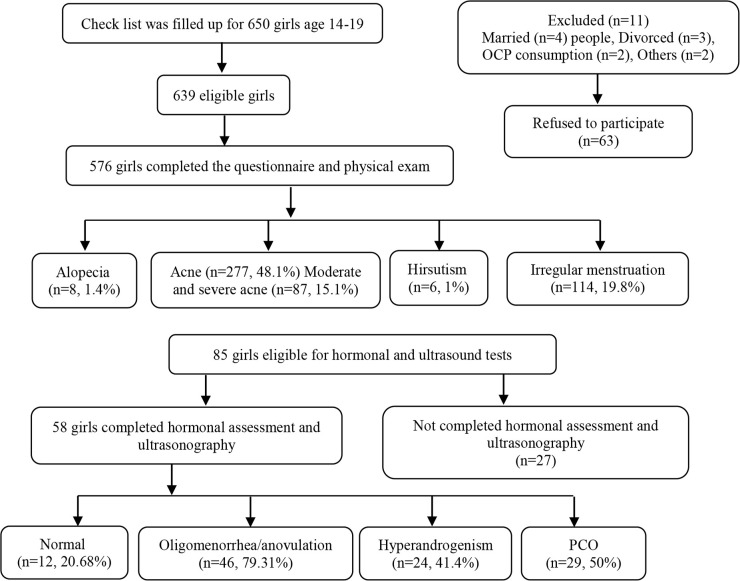
The mean age of adolescent girls was 16.73±3.4 years with median of 17 years. The highest number of participants, 63.5% (n=366), were in the 11th grade and the lowest number of them, 13.9% (n=80), were in the 12th grade, respectively. Table 3 shows the characteristics of participants. The mean age for the first menstrual period of the adolescent girls was 12.5±1.16 years. Most participants, 79.5% (n=458), had none of the symptoms of irregular menstruation, hirsutism, and alopecia and 114 (19.8%) had irregular menstruation (intervals of more than 35 days or less than 21 days).
Table 3. Descriptive statistics
| Variables | N | Range | Minimum | Maximum | Mean | Std. deviation |
|---|---|---|---|---|---|---|
| Wight ( kg ) | 573 | 85.00 | 35.00 | 120.00 | 55.84 | 10.88 |
| Height ( cm ) | 573 | 75.00 | 106.00 | 181.00 | 161.13 | 6.49 |
| BMI (body mass index [ kg/m 2 ] ) | 573 | 28.70 | 12.800 | 41.500 | 21.37 | 4.07 |
| Waist circumference [ cm ] | 572 | 78.00 | 38.00 | 116.00 | 74.25 | 9.54 |
| Hip circumference [ cm ] | 572 | 102.00 | 40.00 | 142.00 | 94.47 | 9.36 |
| Age of the first menstruation | 576 | 7.00 | 9.00 | 16.00 | 12.50 | 1.16 |
| FSH ( IU/ml ) | 58 | 57.00 | 2.00 | 59.00 | 6.48 | 7.39 |
| LH ( IU/ml ) | 58 | 20.80 | 1.00 | 21.80 | 5.77 | 3.52 |
| Triglyceride ( mmol/L ) | 58 | 119.00 | 40.00 | 159.00 | 73.22 | 27.50 |
| Cholesterol ( mmol/L ) | 58 | 178.00 | 16.00 | 194.00 | 138.55 | 31.15 |
| Fasting blood sugar ( mg/dl ) | 58 | 47.00 | 68.00 | 115.00 | 89.10 | 8.27 |
| Fasting insulin level ( IU/ml ) | 58 | 107.80 | 2.20 | 110.00 | 13.37 | 15.75 |
| Fasting prolactin level ( IU/ml ) | 58 | 37.60 | 5.60 | 43.20 | 14.62 | 8.31 |
| HDL ( mg/dl ) | 58 | 55.80 | 32.20 | 88.00 | 45.05 | 10.81 |
| LDL ( mg/dl ) | 58 | 130.00 | 1.00 | 131.00 | 76.48 | 22.76 |
| TSH ( mIU/L ) | 57 | 4.48 | 0.04 | 4.52 | 1.96 | 0.93 |
| Valid N (listwise) | 57 |
Overall, 4.3% (n=25) of participants were obese (BMI ≥30 kg/m 2) and 10.8% (n=62) were over-weight (BMI: 25.0–29.9 kg/m2), 17.5% (n=101) had at least one clinical symptom of hyperandrogenemia; for example, 15.1% (n=87) had moderate or severe acne and 1.4% (n=8) and 1% (n=6) had alopecia and hirsutism, respectively. Moreover, 20.68% (n=12), 41.4% (n=24), 65.2% (n=30), 6.8% (n=4), and 8.6% (n=5) of the 58 girls who underwent blood tests had normal laboratory indicators, high free or total testosterone level, elevated androstenedione level, high FBS, and high fasting insulin levels, respectively.
Also, 60.9% (n=28) of girls with oligomenorrhea had normal free testosterone levels, while the majority of girls with oligomenorrhea, 65.2% (n=30), had abnormal levels of androstenedione.
Furthermore, 50% (n=29) of all adolescents who underwent ultrasound had at least one polycystic ovary. Out of 576 participants, 24 girls met Rotterdam criteria, 21 met NIH criteria, 21 girls met AES criteria, 4 girls met ESHRE/ASRM (2012) criteria, and 21 girls met the guidelines published by Endocrine Society (2013). Therefore, the prevalence of PCOS using Rotterdam, NIH, AES, ESHRE/ASRM (2012), and Endocrine Society (2013) criteria was 4.2% (95%CI: 2.7–6.1), 3.6% (95%CI: 2.3–5.5), 3.6% (95%CI: 2.3–5.5), 0.7% (95%CI: 0.2–1.8), and 3.6% (95%CI: 2.3–5.5), respectively. The prevalence of PCOS using 2018 updated Rotterdam criteria (22) was 3.6% (95% CI: 2.3–5.5) which is similar to the one released by Endocrine Society (2013).
It was revealed that 47.8% of girls (n=22) with oligomenorrhea had abnormal levels of dehydroepiandrosterone sulfate but there were not any suspicious cases of congenital adrenal hyperplasia, androgen-secreting tumors, and Cushing syndrome based on physical exam and hormonal assessment.
Most girls with high levels of androgen as well as all girls with polycystic ovary syndrome based on both adult and adolescent criteria were in the group with normal BMI and there was no significant statistical difference between them. According to both adult and adolescent criteria, the majority of adolescent girls with polycystic ovary syndrome did not have alopecia but 100% of adolescent girls who had polycystic ovary syndrome based on adults and adolescent’s criteria also had oligomenorrhea (p=0.001).
Although adolescents with abnormal free testosterone (p=0.025), total testosterone (p=0.034), and dehydroepiandrosterone sulfate (0.015) had insulin resistance, most patients with polycystic ovary syndrome based on adult and adolescent criteria did not have insulin resistance.
The aim of the present study was to determine prevalence of PCOS with various criteria in high school girls in Mashhad city, Iran. The mean age at menarche was 12.5±1.16 years, consistent with other previous studies in similar populations (4, 8, 15, 23–27). In this study, it was found that higher percentage of girls with PCOS were having menstrual irregularity as compared to normal girls which was similar to other reported investigations (15, 23, 24, 27).
The prevalence of PCOS using Rotterdam criteria was 4.2% (95%CI: 2.7–6.1) which was almost similar to the results of Salehpour et al.’s (3.42%) (28) and of Kaewnin et al.’s study (5.29%) (26) but lower as compared to other previously reported studies. The prevalence of this phenotype was reported as 13.54% by Desai et al. (23), 8.3% by Esmaeilzadeh et al. (25), 22.5% by Joshi et al. (4), 9.13% by Nidhi (9), and 14.1% by Rashidi et al. (29). In the present study, the prevalence of PCOS using NIH criteria was 3.6% (95%CI: 2.3–5.5) which was almost similar to the results of Rashidi et al.’s study (4.8%) (29) but lower as compared to other previously reported studies. The prevalence of this phenotype was reported as 7.1% by Ramezani et al. (30) and 11.34% by Asgharnia et al. (24). Christensen reported the prevalence of PCOS (0.56%) based on NIH criteria which was lower than our study (1). In the present study, the prevalence of PCOS using AES criteria was 3.6% (95%CI: 2.3–5.5) which was lower in comparison to the value reported by Joshi et al. (10.7%), Rashidi et al. (12%) and Mehrabian et al. (7.92%) (4, 29, 31). In the present study, the prevalence of PCOS using Endocrine Society (2013) guidelines was 3.6% (95%CI: 2.3–5.5) which was almost similar to the results reported by Hashemipour et al. (3%) and Rahmanpour et al. (2.9%) (8, 32) but lower as compared to Ramezani et al.’s reported value (5.8%) (30).
The difference in prevalence estimates can be partly attributed to the way the diagnostic criteria were applied, such as differences in the definition of clinical or biochemical hyperandrogenism, menstrual disorders, polycystic ovaries, and study settings (4). In the present study, the prevalence of PCOs using ESHRE/ASRM (2012) criteria was 0.7% (95%CI: 0.2–1.8). Until the writing of this article, no study was found using such criteria but the results are consistent with one study which reported the similar rate for confirmed diagnosis of PCOS (1).
There was no significant difference between diet and unhealthy behaviors of cases with PCOS, yet physical activities showed significant relation with PCOS which was lower in PCOS cases as compared to normal individuals which is consistent with the results of Desai et al.’s study (23). In our study, contrary to the results of many previous studies (1), most adolescents with abnormal androgen levels, as well as those with polycystic ovary syndrome, had a normal body mass index that was consistent with the results of the Asgharnia et al.’s and Rahmanpour et al.’s studies (24, 32).
It seems that, according to the findings of our study, among the clinical symptoms of hyper-androgenism including hirsutism, severe acne and alopecia, it is more likely that hirsutism is associated with this syndrome in adolescents which is consist with previous research (33) and 100% of adolescent girls who had polycystic ovary syndrome had oligomenorrhea (p=0.001). In our study, menstrual disorders were a common problem in adolescents (19.8%), especially in patients with polycystic ovary syndrome and oligomenorrhea (79.3%), which were the source of anxiety for the girls and their parents (15, 23, 25). As noted by other investigators, oligomenorrhea in adolescent girls is not a transient stage in the physiological maturation of the hypothalamic–pituitary–ovarian axis but is an early sign of PCOS (24, 34, 35). Therefore, early detection of the PCOS based on oligo/amenorrhea offers an opportunity for early intervention to prevent or limit the impact of symptoms during reproduction process (36). In our study, despite the presence of polycystic ovaries in some adolescent girls, they did not have polycystic ovary syndrome because features of PCOS overlap with signs of normal pubertal development in some cases (20). Based on international guidelines, the adolescents who have features of PCOS but do not meet the diagnostic criteria should be labeled as “at risk” PCOS cases and they should be re-evaluated before they achieve full reproductive maturity. This timing is 3 years post menarche in relation to menstrual cycle irregularity and 8 years post menarche in relation to use of pelvic ultrasound to review the polycystic ovarian morphology (11, 22).
Our study does have some limitations. Our results may therefore be underestimated; after completing the questionnaire and physical exam, a number of people were eligible to have an ultrasound and a blood test, but they refused to do so which may have affected our estimation. Due to socio-cultural constraints, a vaginal approach could not be applied for ultrasonography and no sensitive tool was used for determining the polycystic ovaries. The assessment of PCOS was conducted via transabdominal ultrasound in our study because most of these girls were not yet sexually active.
To our knowledge, this is the first cross-sectional study carried out to find prevalence of PCOS based on adults and adolescent’s diagnostic criteria. Considering the possible multistage sampling method and unselected community-based population, relatively high sample size and limited inclusion and exclusion criteria, it seems that the results of the current research can be generalizable to similar Iranian high school adolescent girls. Our study showed that PCOS was a common endocrine disorder in adolescents, which was consistent with the results of other studies (9, 20, 33).
All in all, in order to improve clinicians’ confidence in accurate diagnosis of adolescents, to prevent underdiagnosis of the disorder and overestimation of the PCOS prevalence in the adolescents due to its overlap with signs of pubertal development, it is suggested to simultaneously consider and evaluate all three criteria of oligo/amenorrhea, clinical or biochemical hyperandrogenism, and polycystic ovaries, which is in line with the recommendations of Carmina et al. and ESHRE/ASRM working group (12, 37). Based on recent international guidelines, adolescents who have persistent oligo-anovulation or hyperandrogenism can be considered at risk for PCOS and must be reassessed in adulthood.
This article has been approved and funded by the Research Vice Chancellor of Mashhad University of Medical Sciences, Iran (No.940770). The authors would like to express their appreciation for assistance and participation of individuals in this study.
