
The 47,XYY sex chromosome complement occurs in approximately 1 in 1000 live male births (1), making it the most common sex chromosome anomaly after Klinefelter syndrome (2–3). The majority of XYY cases are caused by non-disjunction at meiosis II after a normal chiasmate meiosis I, but other mechanisms can include post-zygotic mitotic error or non-disjunction at meiosis II after a nullichiasmate meiosis (4–7). Studies have reported a possible association between 47,XYY and fertility problems, with a proposed mechanism stating that germ cells with an extra Y chromosome have abnormal meiotic pairing, leading to disrupted meiosis, eventual sperm apoptosis, subsequent oligozoospermia and infertility, and a low rate of aneuploid spermatozoa (3, 8), although other researchers suggest that the extra Y chromosome in XYY men is lost before meiosis (5–7), thus conserving fertility in these patients. Studies comparing sperm aneuploidy between fertile and infertile XYY men reveal that most sperm produced by XYY men have a normal karyotype, but many groups noted an increased incidence of hyperhaploid sperm in the semen of men with 47,XYY syndrome, thereby increasing the risk of passing the extra Y chromosome to off-spring; however, this is more of a secondary finding rather than a direct cause of infertility (3, 5–7, 9–15).
Deletions of the azoospermia factor (AZF) regions on the Y chromosome (AZFa, AZFb, and AZFc) are associated with male infertility (16), and it is thought that they arise in early embryogenesis due to variants in TSPY, mismatch repair (MMR), or X-specific genes (17). The AZFc region, located on the distal portion of the Y chromosome long arm, is critical for male fertility as it contains many gene families required for normal spermatogenesis, and AZF deletions have been shown to have an effect on total motile sperm count (18–20). Deletions of the AZFc region are the most frequent molecular genetic cause of severe infertility, and these have been observed in 5–10% of individuals with azoospermia and severe oligozoospermia (21). Most AZFc deletions are generated by intrachromosomal homologous recombination between repeated sequence blocks organized into palindromic structures (known as amplicon blocks) with an almost identical sequence (22–23).
The first of these recombinations to be described, and the best characterized deletion of AZFc, results from a recombination between the b2 and b4 amplicons (18, 21–26). The b2/b4 deletion removes all of the known AZFc genes, including all members of the Deleted in Azoospermia (DAZ) gene family which consist of four nearly identical copies arranged in two head to head clusters (22, 27), resulting in spermatogenic failure. Other infertility-linked partial AZFc deletions were subsequently reported, including the g1/g2 (28), b1/b3 (29), gr/gr (29), b2/b3 (30), and g1/g3 deletions (31). Because of their rarity, it is not possible to accurately assign causality to partial AZFc deletions that do not fit these previously determined breakpoints, although studies have reported that just the loss of some copies of the DAZ genes might cause spermatogenic impairment (28, 32–37). Data suggest that partial AZFc deletions removing DAZ1/DAZ2, the proximal copies of DAZ, seem to be associated with spermatogenic impairment, whereas those removing DAZ3/DAZ4, the distal copies of DAZ, may have no or little effect on fertility (38).
The combination of sex chromosome abnormalities and AZF deletions is rare, but patients with Klinefelter syndrome (47,XXY) have been reported to have Y chromosome microdeletions in varying degrees (39–42). There was one case of an individual with 45,X/46,XY mosaicism and a deletion of the AZFb and AZFc regions (43), and a further eight male patients with AZF deletions were reported among individuals with isodicentric Y chromosomes (44).
To date, there are no reports in the literature of individuals with both 47,XYY and AZFc deletions, but the lack of reported cases may be partly due to the limitations of screening techniques in Y chromosome microdeletion. The standard Y-microdeletion assay (multiplex PCR) which is recommended by the EAA/EMQN best practice guidelines (45) will not detect the most commonly-reported partial deletions of AZFc, whereas the Multiplex Ligation-dependent Probe Amplification (MLPA) (46) assay used in this study has been shown to be an effective method for the detection of all known AZFc partial deletions (47). The MLPA method lends itself to the simultaneous analysis of multiple chromosomal regions, and the current version of the kit at the time of writing (P360-B2) contains probes that bind to all three AZF regions –16 sites in AZFa, 18 in AZFb, and 21 in AZFc.
The aim of this study was to identify the incidence of 47,XYY men in a large cohort of 2000 consecutive fertility-based referrals in order to determine if such karyotypes are causative of or possibly merely coincident with an individual’s fertility issues.
Study cohort: A cohort of 2000 men was collected at the Wessex Regional Genetics Laboratory in the UK between February 2015 and August 2020. All cases were referred from local or national UK fertility centers and they consented to be included in the analysis as part of their routine clinical care within the UK National Health Service; therefore, ethics committee approval was not sought for this study. The majority of referrals had azoospermia, oligozoospermia or oligoasthenoteratospermia, but all referrals for Y microdeletion analysis were included in the cohort regardless of phenotype. As the cohort is ongoing, it was decided to limit the cohort size to the first 2000 samples in order to allow an easy comparison between the XYY detection rate in our cohort and the published figure of 1 in 1000 for the general population. MLPA analysis was performed on all cases, but karyotyping and cystic fibrosis genotyping were only performed on the 758 local cases.
MLPA analysis: MLPA was carried out according to the manufacturer’s instructions using the current version of the P360 Y microdeletion probe-mix (MRC-Holland, The Netherlands) at the time of testing. MLPA PCR products (1 μl) were separated on an ABI 3100 Sequencer and analyzed using GeneMarker software, v1.85 (Soft-Genetics, USA).
Karyotyping and cystic fibrosis genotyping: G-banded chromosomes were prepared using standard methods (48). Analysis of the 50 most common North-West European CFTR pathogenic variants was performed employing Elucigene CF50 (CF-EU2v1) kit using fluorescent ARMS (Elucigene, UK) which detects variants through the amplificatory refraction mutation system (utilizing variant-specific PCR primers). PCR products (1 μl) were separated on an ABI 3100 Sequencer and analyzed by GeneMarker software, v1.85 (SoftGenetics, USA).
Phenotype of the 47,XYY patient with the gr/gr AZFc partial deletions: The proband was a 34 year old male referred from a fertility center in 2019 with a diagnosis of oligozoospermia and secondary infertility. The proband and his partner had a pregnancy in 2016 that ended in miscarriage. There is no history of low libido and the couple were having regular intercourse. Body habitus of the patient cannot be commented as the clinical information was obtained via a phone consultation. He was not reported to have high BMI and had asthma that was well controlled by inhalers. There was no history of trauma or major operation around the testicles. His hormone levels were as following: LH (luteinizing hormone) of 6.8 IU/L, FSH (follicle stimulating hormone) of 15.3 IU/L, SHBG (sex hormone binding globulin) of 26 nmol/L, and testosterone of 9.8 nmol/L. Semen analysis showed a concentration of 3 million/ml, motility of 25%, and progressive motility of 13%. Semen morphology could not be assessed due to the low concentration. The couple went on to have subsequent natural pregnancy and normal delivery of healthy female baby took place in 2020.
In total, 170 of the 2000 individuals (8.5%) had a Y chromosome abnormality detected by MLPA. These individuals and their given phenotypic details (taken from the referral forms) are summarized in table 1. Microduplications within the AZFc region were not included as these have previously been reported at high levels in controls (47). Most of the variants detected in the cohort (137/170, 80.6%) were deletions of the AZFc region, including 58 with a gr/gr deletion (34%), 39 with a b2/b4 deletion (22.9%), and a further 35 (20.6%) with a partial AZFc deletion that did not fit with any of the known common breakpoints. The gr/gr and b2/b4 deletions were more prevalent in individuals with azoospermia.
Table 1. A summary of the 170 Y chromosome variants detected by MLPA
| Variant type | Phenotype | Subtotals for each variant type | |||||||
|---|---|---|---|---|---|---|---|---|---|
|
| |||||||||
| Azoospermia | Cryptozoospermia | Oligozoospermia | OATS | Severe OATS | Severe Oligozoospermia | Sertoli cell only Syndrome | Not given | ||
| AZFa, AZFb, and AZFc deletion | 1 | 1 | 2 | ||||||
| AZFb and AZFc deletion | 6 | 1 | 7 | ||||||
| AZFa deletion | 3 | 1 | 4 | ||||||
| AZFa partial deletion | 2 | 2 | |||||||
| AZFb deletion | 2 | 2 | |||||||
| AZFb partial deletion | 2 | 2 | |||||||
| AZFc b1/b3 deletion | 1 | 1 | 1 | 3 | |||||
| AZFc b2/b3 deletion | 3 | 1 | 2 | 2 | 2 | 5 | 15 | ||
| AZFc b2/b4 deletion | 20 | 5 | 4 | 5 | 9 | 43 | |||
| AZFc gr/gr deletion | 22 | 6 | 4 | 5 | 7 | 13 | 57 | ||
| AZFc partial deletion (deleted one copy of DAZ2 only) | 3 | 1 | 1 | 4 | 9 | ||||
| AZFc partial deletion (not categorizable) | 3 | 1 | 1 | 2 | 3 | 10 | |||
| 46,XY/45,X mosaic | 1 | 1 | 2 | ||||||
| 46,Xidic(Y) (deleted AZFb and AZFc) | 1 | 1 | |||||||
| 46,XY/46,Xidic(Y) mosaic (deleted AZFb and AZFc) | 1 | 1 | |||||||
| 46,XY/46,Xidic(Y) mosaic (deleted AZFc) | 1 | 1 | |||||||
| 46,XY/46,Xr(Y) mosaic | 1 | 1 | 1 | 3 | |||||
| 46,XX (SRY-positive) | 2 | 2 | |||||||
| 47,XYY | 1 | 1 | 1 | 3 | |||||
| 47,XYY and a homozygous AZFc gr/gr deletion | 1 | 1 | |||||||
| 66 | 2 | 19 | 4 | 14 | 19 | 1 | 45 | 170 | |
Of the 2000 individuals referred for Y chromosome microdeletion analysis, four were found to have a Y chromosome dosage based on the MLPA result consistent with a 47,XYY karyotype. Three of the four men were referred from national centers, and only the karyotype for one of those was available (the individual with Sertoli cell only syndrome). The fourth individual (who had the additional gr/gr deletion) is presented in detail in the current study, and he is the only individual whose cystic fibrosis genotyping results are known. The fourth patient mentioned above was found to have a standard 47,XYY karyotype in all cells examined (Figure 1). Cystic fibrosis genotyping showed no evidence of a common pathogenic CFTR variant. The Y chromosome based on MLPA results showed ratios consistent with 47,XYY, apart from those probes located within the region of AZFc which corresponds to the gr/gr deletion. The ratios for the probes within that region were consistent with an overall loss of two copies, indicating that both of his Y chromosomes are likely to have a gr/gr deletion.
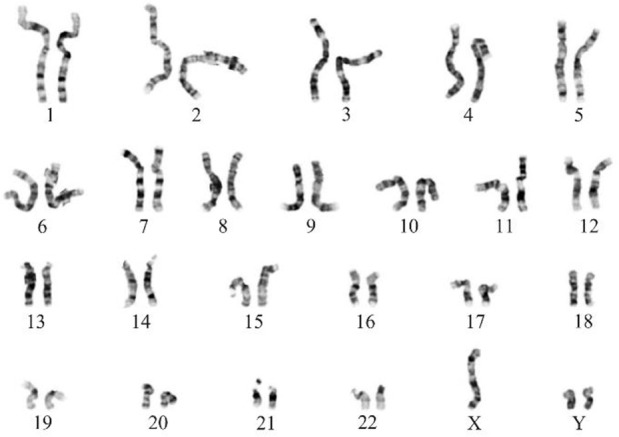
In the XYY patient presented here as the main focus of the manuscript, the data suggest that he has a gr/gr deletion on both Y chromosomes. The simplest explanation for his Y chromosome would be the duplication of a paternally-inherited Y chromosome with an existing gr/gr deletion. The Y chromosome may have been duplicated in his father with both copies contained within a 24,YY sperm, or it may have been inherited within a 23,Y sperm and duplicated post fertilization. The proband was referred with oligozoospermia and secondary infertility, so he has fathered a child already (as has his own father, although it is not clear if the proband’s father had secondary infertility). Unfortunately, no paternal sample was available in order to prove this theory. However, although the gr/gr deletion has been shown to double the risk of severe spermatogenic failure, <2% of men with a gr/gr deletion were found to be affected (49), and the gr/gr deletion is known to result in highly variable spermatogenic phenotypes from normal to azoospermia (50); also, it is detected more frequently in oligozoospermic men than in normozoospermic men (51). Thus, phenotypic variability among gr/gr deletion carriers has previously been well-documented, so paternal inheritance in a proband with secondary infertility would be consistent with a gr/gr deletion.
Although one study reported fertility problems in four consanguineous men with XYY (7), there are now known to be many autosomal recessive fertility genes, such as AURKC, SPATA16, CATSPER1, GNRHR, and MTHFR, and homozygosity for variants in these genes has been shown to cause infertility in other consanguineous men (8, 52). The XYY karyotype in those men may therefore have been coincidental with a homozygous autosomal-recessive variant. Also, the methodology used by other groups who published jri_articles on infertile XYY men may not have detected Y chromosome microdeletions. The manuscript detailing the four consanguineous XYY men had karyotype analysis only (7), while those groups that mentioned PCR analysis (5, 15) may have used methodologies such as the EAA/EMQN based multiplex PCR method (45) which would not detect the most commonly-reported partial deletions of AZFc (as the actual details of the PCR methods used were not detailed in those manuscripts).
Although the detection of four 47,XYY karyotypes (1 in 500) in our cohort is two times more than the expected population frequency of 1 in 1000, the individual with Sertoli cell only syndrome does not fit in with the proposed mechanism of disrupted meiosis/sperm apoptosis (3, 8, 53), and there might be an alternative explanation for the fertility issues of the man with the additional gr/gr deletions. The remaining two XYY individuals may therefore have been detected incidentally. The discovery of a homozygous gr/gr deletion in an XYY individual from our cohort suggests that there might be another alternative explanation for the fertility issues of infertile XYY men.
The authors would like to thank the clinicians and patients who contributed to the study, and also the cytogenetics team at the Wessex Regional Genetics Laboratory (especially Nicola Savage and Frideriki Maggouta) who undertook the karyotyping of the relevant local cases.
