
Polycystic ovary syndrome (PCOS) is an endocrine-metabolic disorder; it is known as one of the most common reasons for infertility with anovulation and hyperandrogenism (1). Obesity is found in 50–80% of PCOS cases and this finding is supported by many pieces of evidence (2). It has been shown that obesity increases the severity of PCOS and increased concentrations of Tumor Necrosis Factor-alpha (TNF-α) and other inflammatory factors are seen in women with PCOS; increased insulin resistance and obesity worsen the inflammatory condition (3, 4).
Despite extensive research on the disease worldwide, PCOS etiology is still unknown; it may be due to the complexity of its pathophysiology with endocrine-metabolic dysfunction in the hypothalamic-pituitary-adrenal axis (5). Studies over the past decade have shown that the high prevalence of type 2 diabetes, cardiovascular diseases, metabolic syndrome, and insulin resistance in PCOS can be due to chronic low-grade inflammation (6). Some markers are indicators of low-grade chronic inflammation, such as TNF-α, c-reactive protein (CRP) and a variety of interleukins (7). Interleukin-1 (IL-1) is a multifunctional cytokine that plays an inflammatory role in the reproductive system, stimulates the release of progesterone and estradiol (8), and promotes ovarian follicular development (9).
Interleukin-6 (IL-6) belongs to the gp130 cytokine family, which has many other cytokines; they are effective in cardiovascular disease pathogenesis. The IL-1 family has 11 cytokines and 10 receptors that increase during cardiovascular diseases. IL-6 and TNF-α levels are significantly higher in patients with metabolic disorders (10–12). CRP is an acute-phase protein produced by the liver under the influence of interleukin-6. It is one of the most reliable markers which increases during inflammatory conditions in PCOS women (12–15), but some studies have reported the opposite findings (16, 17).
Aromatase is one of the key enzymes in PCOS pathogenesis that converts 19-carbon androgens to 18-carbon estrogens. It is located in cytochrome P450 reductase, and its gene is located on chromosome 15 (18, 19). The main role of aromatase is sex hormone balancing during chronic inflammation (20). The reduced activity of aromatase in PCOS women results in elevated serum levels of androgens (21). Pro-inflammatory cytokines stimulate aromatase activity and inflammatory condition converts androgens to estrogens. In addition, testosterone also inhibits aromatase activity (22).
Various effects of estrogens in the inflammatory process are related to downstream metabolites of estrogen as active hormones; they have opposite effects on the immune responses. Thus, cytokines and other involved factors in inflammatory conditions can activate the aromatase and change the ratio of estrogens to androgens. For example, IL-1, TNF-α, and IL-6 have been shown to activate aromatase in different cells (23). They are implicated in fertility development and implantation of a fertilized egg in the uterus and their dysfunction can be the cause of abortion and infertility (24, 25). Hirsutism is defined as increased terminal hair growth in a male pattern in women, which is not only the most common symptom of hyperandrogenism, but also one of the symptoms of PCOS with prevalence of about 90% (26, 27). The association between hirsutism and obesity has been reported in previous research (28, 29).
There are conflicting studies on the role of inflammation in PCOS. As the main reason for inflammation in PCOS is still unknown (30), the first purpose of the present study was to assess inflammatory factors (IL-6, IL-1, and high-sensitivity C-reactive protein (hs-CRP)), aromatase activity, and hirsutism in PCOS women, and to make a comparison with normal women. The secondary aim of the current study was to evaluate the relationship between inflammatory factors, aromatase activity, hirsutism, and obesity.
Subjects: In the present study, 204 women were included with the age range of 18–36 years. Among them, 102 individuals had PCOS, and 102 were healthy controls. The PCOS cases were selected from outpatients, who were referred to Fatemieh Hospital affiliated to Hamadan University of Medical Sciences, from April to October 2020. They were analyzed based on the Rotterdam criteria, with the presence of the features as described below: polycystic ovaries, biochemical and/or clinical signs of hyperandrogenism, and oligo-or anovulation (31).
All subjects with secondary causes of PCOS were excluded from the study. The secondary causes include prolactinoma, virilizing ovarian tumors, Cushing syndrome, or congenital adrenal hyperplasia, and adrenal tumors. Controls were selected from a population with similar socioeconomic status and were matched for age to PCOS cases. Control subjects had normal ovulation and no signs of hyperandrogenism. None of the studied cases had systemic diseases or were taking any medications, which might influence reproductive physiology.
After receiving approval from the research ethics committee of Hamadan University of Medical Sciences (IR.UMSHA.REC.1399.470), the studied individuals including cases and controls became aware of the study’s purposes and they signed the informed consent. The biochemical tests were free of charge for participants, but their results were announced to the individuals in the study.
Weight was measured via a balance beam scale to the nearest 0.1 kg; all studied cases had light clothes while weighing. The stadiometer was also used for height measurement and the degree of measurement accuracy was nearest 0.5 cm. The BMI index was also calculated according to the weight/height2 formula. To measure waist circumference, the distance between the lowest rib and the iliac crest was measured at the level of the umbilicus and it was done in duplicate by a flexible tape. Hirsutism was evaluated based on Ferriman-Gallwey scores and women with a score of <8 were defined as cases without hirsutism (27). In this study, the hirsutism score of the participating women was between 8 and 12.
Blood specimens were collected at 8:00–9:00 AM on the 3rd to 6th days of the spontaneous menstrual cycle; it was done when patients fasted for at least 12 hr. Follicle-stimulating hormone (FSH), luteinizing hormone (LH), dehydroepiandrosterone sulfate (DHEA-S), and testosterone levels were measured with electrochemiluminescence immunoassay (ECLIA) using commercial kits (DRG Instruments GmbH, Germany). Also, estradiol level was determined with the ECLIA method via a German kit (Roche Diagnostics GmbH, Germany). In the following steps, the testosterone-to-estradiol ratio was calculated to measure aromatase activity. Finally, the serum level of inflammatory markers such as IL-6, IL-1, and hs-CRP was measured.
Interleukin-1: IL-1 was measured by the ELISA method (BT LAB, China, Cat. No.: E0077Hu). Colorimetric streptavidin-biotin-based sandwich immunoassay with detection limit of 0.52 pg/ml was the basis for measurement.
Interleukin-6: IL-6 was measured by the ELISA method (Biovendor, Czech Republic, Cat. No.: RD194015200R) with detection limit of 0.32 pg/ ml.
High-sensitivity C-reactive protein: hs-CRP was assessed by an ELISA kit (Monobind, USA, Cat. 3125-300A), according to the manufacturer’s instructions and the limit of detection for the ELISA was 0.014 μg/ml.
Statistical analysis: Data are shown as median and interquartile range (IQR: 25%–75%). Statistical analysis was performed using SPSS software vs. 22 (IBM, USA). The groups were compared by using Mann-Whitney U test and student’s t-test. The Spearman and Pearson correlations were utilized to investigate relationships among variables and a bivariate correlation analysis (calculation of the Pearson coefficient) was applied to evaluate the relation of aromatase activity, inflammatory factors (IL-1, IL-6, hs CRP), and BMI. Multiple logistic regression analyses (backward approach) were performed to evaluate the independent effect of variables on PCOS odds. Differences in the frequency of hirsutism between the PCOS women and the healthy subjects were assessed using Chi-square tests and statistical significance was set at p<0.05.
Demographic data and biochemical parameters: The women were matched for age (p=0.462). The mean and standard deviation of BMI was 27.07±3.33 kg/m2 and 26.21±3.84 kg/m2 in the PCOS and the control group, respectively. Table 1 shows the biochemical and clinical characteristics of both groups. Although no significant difference was detected between the two groups (p=0.341) in BMI, the waist size in the PCOS group was much larger than the control group (p=0.001). The ratio of LH/FSH and DHEA-S concentration was significantly higher in PCOS group (p<0.001).
Table 1. Clinical characteristics and biochemical findings of studied individuals (median, IQR)
| Control group (n=102) | PCOS group (n=102) | p-value * | |||
|---|---|---|---|---|---|
|
| |||||
| Variables | Med | IQR | Med | IQR | |
| Age (year) | 25 | 7 | 26 | 5 | 0.462 |
| Waist ( cm ) | 88 | 13 | 91 | 16 | 0.001 |
| LH/FSH | 1.085 | 1.174 | 2.51 | 2.174 | <0.001 |
| DHEAS ( nmol/l ) | 8.7 | 1.5 | 10.45 | 1.55 | <0.001 |
| Estradiol ( pg/ml ) | 30.5 | 12 | 58.65 | 49.73 | <0.001 |
| Testosterone ( nmol/l ) | 0.8 | 0.4 | 0.9 | 0.3 | <0.001 |
| IL-1 ( pg/ml ) | 3.2 | 1.1 | 4.6 | 1.2 | <0.001 |
| IL-6 ( pg/ml ) | 3.0 | 0.9 | 3.95 | 1.55 | <0.001 |
| hs-CRP ( μg/ml ) | 2.2 | 0.8 | 10 | 4 | <0.001 |
| Aromatase activity | 0.025 | 0.018 | 0.015 | 0.013 | <0.001 |
BMI: Body Mass Index; FSH: Follicle-Stimulating Hormone; LH: Luteinizing Hormone; DHEAS: Dehydroepiandrosterone Sulfate; IL1: Interleukin-1; IL-6: Interleukin-6; hs-CRP: high-sensitivity C-reactive protein.
Mann-whinney U test
Analysis of IL-1, IL-6, hs-CRP, and aromatase activity: IL-1 has a significantly higher level in PCOS in comparison to the controls. The median level of IL-6 was different in PCOS women compared to the controls. Serum hs-CRP was significantly higher in PCOS women, compared to the control group and the aromatase activity was also different in PCOS compared to the control group (all p<0.001), as shown in table 1.
Comparison of biochemical factors based on BMI: The studied women were categorized into four groups as follows: group I, which included 60 normal women with BMI ≥25 kg/m2; group II included 42 normal women with BMI <25 kg/m2; group III included 78 PCOS women with BMI ≥25 kg/m2; and group IV included 24 PCOS women with BMI <25 kg/m2. The biochemical characteristics of the studied individuals are presented in table 2. By comparing the two groups of women with PCOS, only hs-CRP was different between the two PCOS subgroups (p<0.001). However, in the obese control group, all inflammatory factors increased (p<0.001).
Table 2. Inflammatory factors and aromatase activity in studied subjects based on BMI (median, IQR)
| Parameters | Control group (n=102) | PCOS group (n=102) | ||||||||
|---|---|---|---|---|---|---|---|---|---|---|
|
| ||||||||||
| Group I | Group II | p-value | Group III | Group IV | p-value * | |||||
| BMI <25 (42) | BMI≥25 (60) | BMI<25 (24) | BMI≥25 (78) | |||||||
|
|
| |||||||||
| Median | IQR | Median | IQR | Median | IQR | Median | IQR | |||
| IL-1 ( pg/ml ) | 2.65 | 0.65 | 3.60 | 0.9 | <0.001 | 4.55 | 1 | 4.70 | 1.3 | 0.137 |
| IL-6 ( pg/ml ) | 2.80 | 0.525 | 3.40 | 1 | <0.001 | 3.85 | 0.95 | 4.00 | 1.8 | 0.434 |
| hs-CRP ( μg/ml ) | 1.95 | 0.725 | 2.40 | 0.975 | <0.001 | 7.35 | 2.875 | 10.50 | 3.6 | <0.001 |
| Aromatase activity | 0.03 | 0.024 | 0.023 | 0.018 | 0.275 | 0.015 | 0.026 | 0.015 | 0.013 | 0.473 |
IL-1: Interleukin-1; IL-6: Interleukin-6; hs-CRP: high-sensitivity C-reactive protein.
Kruskal-wallis test
Comparison of hirsutism based on BMI: Of the women with hirsutism, 82% belonged to PCOS and 18% to control group (p<0.001). Also, 86.9% of individuals with hirsutism were obese or over-weight. Table 3 shows the frequency of hirsutism based on BMI in each group. The results showed that in both control and PCOS groups, the frequency of hirsutism was significantly higher in women with BMI ≥25 kg/m2 (p<0.05).
Table 3. Frequency of hirsutism in control and case groups based on their BMI
| Group | With hirsutism (N%) | No hirsutism (N%) | χ 2 | p-value | |
|---|---|---|---|---|---|
| Control group | |||||
| BMI <25 | 1 (9.1%) | 41 (45.1%) | |||
| 5.240 | 0.022 | ||||
| BMI ≥25 | 10 (90.9%) | 50 (54.9%) | |||
| PCOS group | |||||
| BMI <25 | 7 (14%) | 17 (32.7%) | |||
| 4.95 | 0.026 | ||||
| BMI ≥25 | 43 (86%) | 35 (67.3%) |
BMI: Body Mass Index
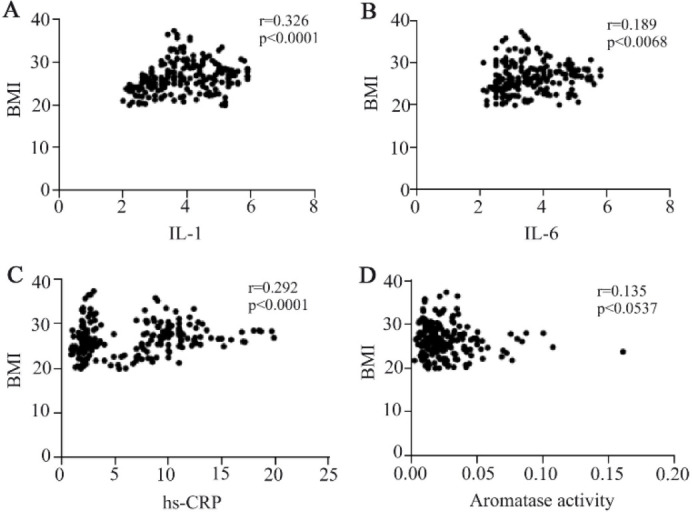
Correlation analysis of BMI with IL-1, IL-6, hs-CRP, and aromatase activity: According to the statistical analysis, the BMI had a significant positive association with IL-1 (p<0.0001, r=0.326), IL-6 (p<0.0068, r=0.189), and hs-CRP (p<0.0001, r=0.292), but no significant association was found with aromatase activity (p=0.0537, r=−0.135) (Figure 1).
Elevated inflammatory markers and odds of PCOS: Logistic regression analysis showed that IL-1 increment is more effective to cause disease compared to other inflammatory factors (OR=9.474, p<0.001) (Table 4). Moreover, logistic regression analysis (backward approach) showed that only hs-CRP can worsen PCOS symptoms (OR=6.324, p<0.001).
Table 4. Multiple logistic regression model of IL-1 and other confounding variables to predict PCOS
| Dependent variables | Independent variables | Odds ratio Exp (β) | CI for Exp (β) | p-value |
|---|---|---|---|---|
| PCOS | IL-1 | 9.474 | 5.279–17.004 | <0.001 |
| IL-6 | 3.192 | 2.147–4.745 | <0.001 | |
| hs-CRP | 6.324 | 2.940–13.604 | <0.001 |
IL-1: Interleukin-1; IL-6: Interleukin-6; hs-CRP: high-sensitivity C-reactive protein
PCOS is a metabolic disease with a prevalence of 5–10% in women of childbearing age. There is a link between the disease, chronic inflammation, and increased androgen (2, 32). It has many clinical consequences including obesity, insulin resistance, metabolic syndrome, etc. (33). The obesity rate in PCOS women is higher than normal ones with reported prevalence of more than 50% (2, 34). Obesity is a metabolic disease with chronic inflammation, in which the concentration of inflammatory cytokines increase. In recent years, more research has been conducted on the role of inflammation in PCOS and some researchers believe that obesity and visceral adipose tissue are associated with inflammation (35).
In 2001, it was first shown that hs-CRP levels in PCOS women were higher in comparison to normal ones. The results of a meta-analysis showed that hs-CRP levels in PCOS women were higher than controls (14). In addition, hs-CRP increment has not been observed in some studies (16, 17). The results of our study revealed an increase in the concentration of hs-CRP in healthy obese people compared to healthy lean ones (36). hs-CRP elevation in obese and insulin-resistant individuals was also reported by other studies (35).
IL-6 is known as a pro-inflammatory cytokine that stimulates CRP production. The results of our study showed a significantly higher concentration of IL-6 in PCOS women (p<0.001). A significant increment in IL-6 concentration was seen in healthy obese individuals compared to the healthy lean ones, while such increment was not observed in obese women in comparison to the lean ones in the PCOS group. There are conflicting results regarding the association between IL-6 and PCOS (37).
The results of the meta-analysis by Escobar-Morreale et al. showed no significant relationship between IL-6 concentration and PCOS (38). The results of the two studies in India and Taiwan confirm the findings of the present study and a significant association has been reported between IL-6 and PCOS (7). Another study in Saudi Arabia showed that the concentration of IL-6 in PCOS women was markedly higher in comparison to controls. Based on the division of patients into two subgroups according to the cut-off values of central obesity, the plasma concentration of IL-6 was higher in obese women than in normal-weight ones in PCOS group (39).
Another inflammatory cytokine, IL-1, plays an important role in fertilization and ovulation. Many studies confirm the increase in IL-1 concentration and its receptors in PCOS (35, 40). The results of our study also showed an increase in the concentration of IL-1 in PCOS women. In addition, the concentration of IL-1 increased in healthy obese women compared to healthy lean ones, but this increase was not observed when comparing obese and lean PCOS women.
Aromatase plays an important role in regulating GnRH/LH secretion in men and women, ovulation, and the growth of female follicles besides its neuroprotective actions (41). The expression of aromatase was found significantly reduced in granulosa cells from PCOS women and decreased levels of aromatase enzyme results in increased blood androgen and LH concentration (42).
Other studies have demonstrated that the key role of aromatase is to balance sex hormones during chronic inflammation. In the present study, aromatase activity decreased in inflammatory conditions in PCOS group. Cytokines in inflammatory conditions activate the aromatase expression and convert estrogens to androgens. For example, IL-6, IL-1, and TNF-α have been shown to activate the aromatase in different cells (20, 43).
Jakimiuk et al. showed when follicle diameter reaches 7 mm in ovaries of PCOS cases, aroma-tase expression is activated and estrogen is produced. Due to aromatase activity reduction, estradiol levels also decrease in PCOS women (44). In a study by Liu et al., it has been shown that FSH is the main factor to stimulate aromatase expression and estradiol (E2) can enhance the effect of FSH. The anti-müllerian hormone inhibits aroma-tase expression increment and estrogen production induced by FSH. As the balance of these hormones is disturbed in PCOS, it is probably one of the reasons for decreased aromatase function of this mechanism (45).
A study in Iraq examined the association of sex hormones and aromatase and BMI in women with PCOS. The results showed a negative relationship between aromatase and sex hormones, and a positive relationship between this enzyme and BMI (46). The findings of our study contradict the results of the previously mentioned ones. In our study, there was a significant difference between the enzyme activity of aromatase in PCOS women compared to the control group. Our results expressed a negative relationship between aromatase and BMI and estradiol.
A study in China reported similar findings to the present study. While BMI was not matched in their study, estradiol/testosterone (E2/T) was significantly lower. In the present study, no significant difference was found in E2/T between BMI subgroups of either PCOS or control and it demonstrates the independence of E2/T from the weight. Aromatase activity showed a decrement in PCOS individuals which was also BMI independent (47).
In our study, a significant association was found between PCOS and inflammatory factors. By dividing control and PCOS women into two groups based on BMI, increased inflammatory markers were seen in controls with normal BMI, while in the PCOS group, CRP significantly increased in obese individuals. By comparing IL-6 and IL-1 in obese controls, a significant increase was seen; however, only hs-CRP changed in obese women with PCOS.
In the present study, hirsutism frequency showed an increase in PCOS women. A correlation was observed between hirsutism and BMI in PCOS cases which was consistent with Bakry et al.’s findings (28). In line with our results, Lumezi and Berisha reported an association between obesity and increased hirsutism in PCOS (29). Barber et al. showed that 5-alpha reductase activity positively correlated with increasing adiposity (48). Since the increase in 5-alpha reductase activity causes hirsutism, it can be concluded that obesity is likely one of the mechanisms in incidence of hirsutism in PCOS individuals. The results of our study also showed a positive relationship between obesity and hirsutism.
Independent of BMI, inflammatory factors and interleukins increase in PCOS individuals. This finding was similar to Goswami et al.’s study; they reported higher levels of hs-CRP in obese PCOS women in comparison to lean ones, but TNFα findings were similar between both groups (7). In the present study, IL-6 did not show any correlations with obesity in PCOS group. Another study by Goswami et al. showed higher levels of IL-6 in obese PCOS women compared to lean ones (7). In this study, it was shown that IL-1 and IL-6 increment in PCOS is independent of BMI. There were some significant limitations in the present study; the first was a small sample size of patients, and the second lack of evaluation of IL-1, IL-6, and hs-CRP gene expression. Therefore, it is necessary to design studies with larger sample sizes to confirm the findings of the present study. It seems that separate determination of cited inflammatory markers and aromatase metabolites may strengthen the results.
The results of the present study showed that inflammatory factors increase in PCOS; by eliminating interfering factors, they may be the main reasons for occurrence and exacerbation of the disease symptoms. Although the incidence of hirsutism in PCOS is associated with obesity, the increment in inflammatory factors is not BMI dependent.
