
The fetal membrane is a naturally occurring, protective barrier inside the uterus (1). The amniotic membrane is the largest of the three layers that comprise the chorion, allantois, and amnion (2). The thickness of this layer ranges from 0.02–0.5 mm and covers the amniotic cavity (2). The human amniotic membrane has been identified as a potential healer for wounds due to its beneficial clinical qualities, including anti-inflammation, angiogenic properties, antimicrobial induction, non-immunogenic epithelialization, and a variety of important growth factors (3). It is now widely utilized in tissue engineering, from skin wound healing to ophthalmology, in both animals and humans (3).
The composition of amniotic fluid is intricate, consisting of cellular components, carbohydrates, proteins, lipids, electrolytes, and metabolites within extracellular vesicles. Its presence in the uterus proves beneficial for the development and protection of the fetus due to its nutritional elements as well as its antibacterial, anti-inflammatory, and regenerative characteristics (4). These properties are attributed to the presence of molecules such as cystatin C, lactoferrin, lysozyme, transferrin, beta-lysine, peroxidases, immunoglobulins, and zinc-peptide complexes. Furthermore, chemokines such as CXCL1 and CXCL14 also contribute to its broad-spectrum antimicrobial properties (5). Body membranes are increasingly being used in tissue engineering, and they have been shown to be extremely therapeutic against scarred skin surfaces, peritoneum, and microbial infections of the injured eye (6). Controlling bacterial infections plays an important role in wound healing. It has been determined that the application of processed amniotic fluid to patients with burns and wounds can be beneficial due to the abundance of antibacterial, antifungal, antiviral, anti-parasitic, and anti-inflammatory proteins (5).
Antibiotic-resistant infections are becoming more common nowadays (7). Antibiotic use has resulted in the development of bacterial resistance, which has been linked to increased morbidity, mortality, and healthcare costs. The importance of improving the global regulatory framework for antibiotic use has been emphasized (8). Antibiotic resistance can be avoided by replacing natural compounds with antibacterial properties (8). Staphylococcus aureus, Streptococcus pyogenes, Shigella, Klebsiella pneumoniae, and Escherichia coli are among the most common bacterial infections in the world that have provoked concern due to the emergence of antibiotic resistance (9–15).
So far, some studies have been conducted on the antibacterial effect of amniotic fluid, most of which have shown its antibacterial property against Escherichia coli bacteria, and studies have also been performed on S. aureus and S. saprophyticus as pathogenic bacteria (16–19); human body surfaces naturally contain some beneficial probiotic bacteria including Lactobacillus plantarum which are essential for the body. Probiotics, such as Lactobacillus plantarum, have been shown to have antioxidant and immune-boosting properties (20). They are also sensitive to antibiotics (20). Probiotics can be found in nature, infant feces, and various fermented foods (20). Lactobacillus plantarum, the largest Lactobacillus species, has been shown to significantly reduce ulcer inflammation, regulate gastric microbiota, and reduce gastric mucosal inflammation (21, 22). In this study, it was used as a representative of probiotic bacteria to compare the antibacterial properties of amniotic fluid with those of pathogenic bacteria. Therefore, the present study was conducted to determine the antibacterial effect of amniotic fluid and also to compare its effect on pathogenic and probiotic bacteria.
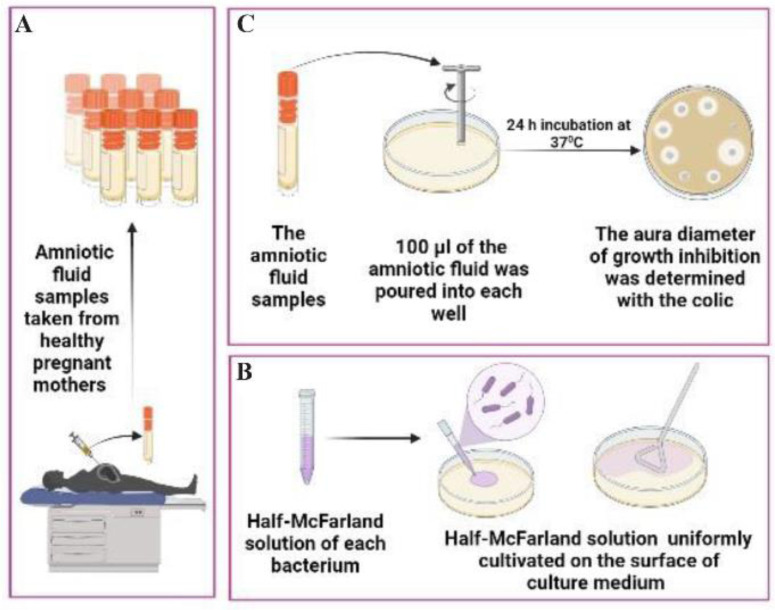
Study design: This experimental study was performed on amniotic fluid samples taken from healthy pregnant mothers before selective cesarean section, in sterile conditions of the hospital. The reason for choosing a cesarean delivery for sampling was to prevent fluid contamination with vaginal microbial flora during a normal vaginal delivery (NVD). Inclusion criteria of the study were the age range of 19–38 years, cesarean section after completion of pregnancy period, not taking antibiotics one month before delivery, no congenital anomalies of the neonate, and negative serological tests for HIV viruses, hepatitis C and B, toxoplasmosis, and syphilis before cesarean section. Exclusion criteria of the study included dissatisfaction of the person from participating in the study, a record of high-risk sexual behaviors, and use of injectable materials, tattoos, blood injection, chromosomal abnormalities, and chronic maternal illness. All information related to the inclusion and exclusion criteria in the study was obtained by completing the relevant questionnaires and also examination by a gynecologist. All stages of the study were done according to the Helsinki Declaration and after the review and approval by the Ethics Committee of Birjand University of Medical Sciences with the code of ethics IR.BUMS.REC.1401.120. Finally, 43 people were randomly selected and they were sampled by a gynecologist in the gynecological diseases section of Valiasr Hospital in Birjand. Figure 1 shows a summary of the method of conducting this study.
Bacterial strains: Standard strains were provided from the Pasteur Institute's Microbial Collection Center. Bacteria regeneration procedures with separate culture of each of the pathogenic bacteria strains of Bacillus cereus (B. cereus, ATCC 11778), Escherichia coli (E. coli, ATCC 25922), Staphylococcus aureus (S. aureus, ATCC 29213), Shigella flexneri (S. flexneri, ATCC 12022), Pseudomonas aeruginosa (P. aeruginosa, ATCC 27883), Klebsiella pneumoniae (K. pneumoniae, ATCC 700603), Streptococcus pyogenes (S. pyogenes, ATCC 10403), and probiotic Lactobacillus plantarum (L. plantarum, PTCC 1745) were performed in neutrite broth (Merck Group, Germany) and incubation was done at 37°C for 24 hr.
Laboratory assessment: To investigate the antibacterial property of amniotic fluid, the agar well-diffusion method was used according to the CLSI guideline (23, 24). In this method, 100 μl of a half-McFarland solution (1.5×10⁸ CFU/ml) of each bacterium was first inoculated on the surface of an 8 cm plate containing the culture medium of Mueller-Hinton agar (Merck Group, Germany) and cultivated uniformly with the help of a loop on the surface of the culture medium. Then, with a sterile Pasteur pipette, the wells with a diameter of 6 mm and distances of 2 cm from each other were drilled in the culture medium and 100 μl of one of the amniotic fluid samples was poured into each well. The plates were then placed in an incubator of 37 °C for 24 hr, and after this time, the results of aura formation of bacterial growth inhibition were recorded around each well. The aura diameter of growth inhibition zone was determined under the light of the lamp.
Statistical analysis: First, the normality assessment for data distribution was performed in each of groups using the shapiro-Wilk test. Then, aura diameter of growth inhibition zone in amniotic fluid was compared between the groups with Kruskal-Wallis test, and the Tukey test was used as post-hoc test. The percentage of cases with aura formation in the studied groups was also examined by the diagram. All relevant analyses were performed by SPSS software v.22 (IBM, US) and at a significant level of 0.05.
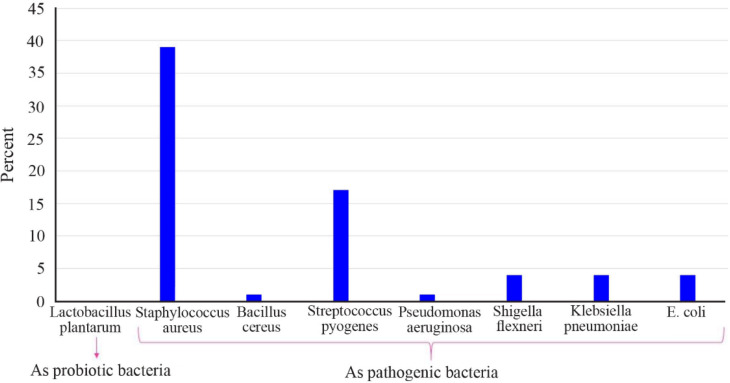
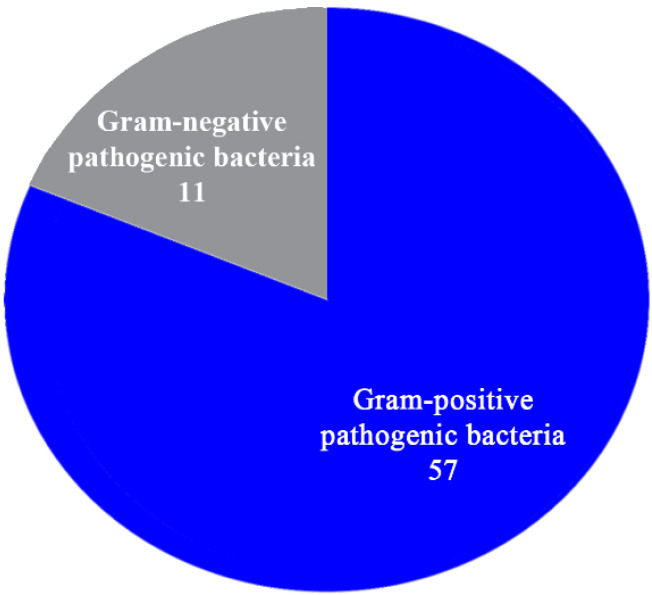
In the present study, which was performed to investigate the antibacterial effect of amniotic fluid in laboratory conditions, the antibacterial effects of amniotic fluid were observed by growth inhibition aura of bacteria around wells containing amniotic fluid for most studied strains. According to the findings of this study, under the influence of amniotic fluid, the average growth inhibition aura of pathogenic bacteria and the average growth inhibition aura of L. plantarum were 1.87 and 0, respectively. Thus, the rate of growth inhibition in the group of pathogenic bacteria was significantly higher than that of L. plantarum as probiotic bacteria (p=0.001). As observed in figure 2, in 39% of the samples, a growth inhibition aura was formed for S. aureus bacteria. A growth inhibition aura was then observed in 17% of the samples for S. pyogenes and in 4% for S. flexneri, K. pneumonia, and E. coli bacteria and in 1% for B. cereus and P. aeruginosa bacteria. While none of the amniotic fluids in this study inhibited the probiotic bacteria Lactobacillus plantarum, there was no aura of growth inhibition around the wells containing amniotic fluid for this bacterium. Figure 3 shows that 57% of amniotic fluid samples inhibited growth in gram-positive pathogenic bacteria while 13% inhibited growth in gram-negative pathogenic bacteria. This difference is most likely due to the structure of bacterial cell wall. The cell wall of gram-negative bacteria consists of outer membrane, lipopolysaccharide, and a thin layer of peptidoglycan while gram-positive bacteria have a very thick peptidoglycan layer.
As can be observed in table 1, the aura diameter of growth inhibition for the strains of the studied bacteria was significantly different depending on the sample of amniotic fluid (p<0.001). This difference in the effect was also observed in the type of bacteria. The aura diameter of growth inhibition zone of amniotic fluid was the maximum around the wells created on the microbial plate of S. aureus (6.38±7.92). The Tukey test shows (Table 2) that the aura diameter of growth inhibition zone is significantly higher for this bacterium compared to all other bacteria tested (p<0.001). This test also showed that aura diameter of growth inhibition zone in S. pyogenes strain was significantly higher than Lactobacillus plantarum (p= 0.004), B. cereus (p=0.004), and P. aeruginosa (p= 0.001) strains.
Table 1. Median diameter of inhibition zone of amniotic fluid by different strains
| Bacteria | Median (Q1–Q3) | Kruskal-Wallis test (p-value) |
|---|---|---|
| E. coli | 0 (0–0) | 172.12 (<0.001α, β, γ, ξ) |
| K. pneumoniae | 0 (0–0) | |
| S. flexneri | 0 (0–0) | |
| P. aeruginosa | 0 (0–0) | |
| S. pyogenes | 0 (0–7) | |
| B. cereus | 0 (0–0) | |
| S. aureus | 10 (0–13.5) | |
| L. plantarum | 0 (0–0) |
p-value <0.001
Bold number shows significant difference at 0.05 significant level
α: significant between S. aureus and all other bacteria groups
β: significant between S. pyogenes and L. plantarum bacteria
γ: significant between S. pyogenes and B. cereus bacteria
ξ: significant between S. pyogenes and P. aeruginosa bacteria
Table 2. Comparison of the diameter of inhibition zone of amniotic fluid in different strains using Tukey test
| E. coli | K. pneumoniae | S. flexneri | P. aeruginosa | S. pyogenes | B. cereus | S. aureus | L. plantarum | |
|---|---|---|---|---|---|---|---|---|
| E. coli | - | 1.000 | 1.000 | 1.000 | 0.053 | 0.996 | <0.001 | 0.976 |
| K. pneumoniae | 1.000 | - | 1.000 | 0.993 | 0.132 | 0.963 | <0.001 | 0.884 |
| S. flexneri | 1.000 | 1.000 | - | 0.996 | 0.109 | 0.976 | <0.001 | 0.914 |
| P. aeruginosa | 1.000 | 0.993 | 0.996 | - | 0.013 | 1.000 | <0.001 | 0.999 |
| S. pyogenes | 0.053 | 0.132 | 0.109 | 0.013 | - | 0.005 | <0.001 | 0.002 |
| B. cereus | 0.996 | 0.963 | 0.976 | 1.000 | 0.005 | - | <0.001 | 1.000 |
| S. aureus | <0.001 | <0.001 | <0.001 | <0.001 | <0.001 | <0.001 | - | <0.001 |
| L. plantarum | 0.976 | 0.884 | 0.914 | 0.999 | 0.002 | 1.000 | <0.001 | - |
In this study, the antibacterial effect of 43 amniotic fluid samples on pathogenic bacteria, including E. coli, P. aeruginosa, S. flexneri, K. pneumoniae, S. aureus, S. pyogenes, and B. cereus, as well as non-pathogenic Lactobacillus plantarum, was investigated. Also, a comparison was made between the effects of this liquid on pathogenic and non-pathogenic bacteria. The results showed that the amniotic fluid samples had an antibacterial effect on all pathogen strains, but no antibacterial effect on the probiotic Lactobacillus plantarum strain was observed. Also, the largest growth inhibition zone against amniotic fluid was found around S. aureus, while there was no growth inhibition for the probiotic used in this study. Considering the wide range of antibacterial effects of amniotic fluid against pathogenic bacteria and the lack of effect of this biological fluid on L. plantarum, it can be concluded that amniotic fluid probably has selective antibacterial effects against pathogenic bacteria, but to ensure that amniotic fluid does not affect non-pathogenic bacteria and microbial flora, such as lactobacilli, further studies is needed. One of the strengths of this study was that antibacterial effect of human amniotic fluid obtained during cesarean delivery was investigated on 7 species of the most important pathogenic bacteria. On the other hand, the lack of diversity in the probiotic strain used in this study is one of the limitations. Therefore, conducting similar studies with larger populations and more diverse strains, especially probiotic and non-pathogenic bacteria, is suggested.
A study by Thadepalli et al. on the effect of amniotic fluid on anaerobic bacteria showed that amniotic fluid had a temporary bacteriostatic effect on Peptococcus, prevotii, and Bacteroides fragilis for 8–16 hr, while this effect on Escherichia coli was for 20 to 32 hr (25). These results were similar to the results of our study on the antibacterial effect of amniotic fluid on E. coli. In a study conducted by Essawi et al. in 2020 on the effects of camel amniotic fluid against bacteria and fungi, the greatest growth inhibition was observed against S. aureus, Listeria monocytogenes, K. pneumoniae, and Aspergillus niger; the findings are consistent with the results of the present study. Also, amniotic fluid reacts more vigorously with gram-negative bacteria than gram-positive bacteria (26). In the study by Mao et al., similar to the present study, amniotic fluid had antibacterial effects against P. aeruginosa, K. pneumoniae, and S. aureus (5).
The results of this study, while proving the presence of antibacterial property in amniotic fluid, show that not only does this fluid have different antibacterial effects among many types of pathogenic and probiotic bacteria, but it also shows selective effects among different pathogenic bacterial strains. However, more research on the antibacterial effect of human amniotic fluid on probiotic bacteria strains is needed. Overall, the findings of this study on human amniotic fluid support the use of natural substances as alternative therapeutic agents to combat antibiotic resistance.
This investigation was supported by the Birjand University of Medical Sciences. The authors of the article are grateful for the cooperation and assistance of the microbiology laboratory personnel of Birjand University of Medical Sciences.
