
Fertility management of women with decreased ovarian reserve (DOR) or poor ovarian response (POR) is a real challenge for fertility specialists. Although Bologna criteria (1) unified the definition of decreased ovarian reserve (DOR), it contains many shortcomings. The main drawback was that a young woman who had not undergone any IVF cycle could not be labelled a poor responder even in presence of abnormal ovarian reserve tests (2).
Patient oriented strategies encompassing individualized oocyte number (POSEIDON) criteria were proposed to effectively stratify the reproductive potential of low prognosis women from the perspective of prognosis and reproductive outcomes (3). This criterion classifies the low prognosis women into four different groups depending upon age, ovarian reserve markers (anti-müllerian hormone (AMH) levels and antral follicle count (AFC)), and number of oocytes retrieved in previous cycles if present. These patients might have had normal ovarian reserve parameters (AMH ≥1.2 ng/ml; AFC ≥5) but unexpected poor responses (<4 oocytes) or unexpected suboptimal responses (4–9 oocytes) in previous IVF cycles or they might have had abnormal ovarian reserve parameters (AMH <1.2 ng/ml; AFC <5) (3).
The most critical end-point for success of an IVF cycle is cumulative live birth rate (CLBR) or cumulative delivery rate (CDR) because fresh embryo transfer may be cancelled due to various reasons and patient may conceive by taking advantage of frozen embryo transfer (FET) cycles. The total number of embryo transfers also increases with the increase in number of retrieved oocytes as there would be optimal number of embryos for transfer (4). Esteves et al. found that the CDR was lower in the POSEIDON patients than in the non-POSEIDON patients (33.7% vs. 50.6%; p<0.001) and differed across POSEIDON groups (younger unexpected poor responders as group 1a, n=212, 27.8%; younger unexpected suboptimal responders as group 1b, n=1785, 47.8%; older unexpected poor responders as group 2a, n=293, 14.0%; older unexpected suboptimal responders as group 2b, n=1275, 30.5%; younger expected poor responders as group 3, n=245, 29.4%; and older expected poor responders as group 4, n=623, 12.5%) (4).
Several studies have been published about IVF outcomes in women classified according to POSEIDON criteria and they showed that POSEIDON stratification of low prognosis women creates more homogenous groups and helps to counsel these couples about possible outcomes (5).
But overall, data is sparse and it is necessary to validate POSEIDON stratification among different ethnic groups (6). Indian women have been reported to age 5–6 years faster in comparison to western age matched controls (7). No study has been published on validity of POSEIDON group stratification among Indian women. The present study was planned to evaluate cumulative live birth rate (CLBR) among Indian women undergoing IVF/ICSI classified according to POSEIDON stratification.
This study was a retrospective cohort conducted in the Assisted Reproduction Technology (ART) clinic of a tertiary care referral center, All India Institute of Medical Sciences (AIIMS), New Delhi, India. Ethical clearance was obtained from the Institute Ethics Committee (IECPG-665/23.12. 2020, RT-42/27.01.2021). Women who had undergone IVF between January 2011-December 2020 were screened for the study and their CLBR was recorded.
Study population: The study included all the women who had undergone IVF/ICSI cycle at Assisted Reproduction Technology (ART) center of a tertiary care referral hospital between January 2011 and December 2020. Based on the inclusion criteria, all women aged 21–40 years were recruited who had (a) undergone standard stimulation protocols (antagonist, agonist or microdose flare); (b) undergone oocyte retrieval irrespective of number of oocytes retrieved; and (c) given live birth after fresh ET or FET or had not given live birth after transfer of all embryos available. Women recruited in POSEIDON group were divided into (a) POSEIDON group 1 as women younger than 35 with sufficient pre stimulation ovarian reserve parameters (AFC ≥5, AMH ≥1.2 ng/ml) besides unexpected poor or suboptimal ovarian response and the group was further divided into subgroup 1a as women with <4 retrieved oocytes and subgroup 1b as women with 4–9 oocytes retrieved after standard ovarian stimulation; (b) POSEIDON group 2 as women older than 35 years with sufficient pre stimulation ovarian reserve parameters (AFC ≥5, AMH ≥1.2 ng/ml) besides an unexpected poor or suboptimal ovarian response and this group was further divided into subgroup 2a as women with <4 retrieved oocytes and subgroup 2b as women with 4–9 oocytes retrieved after standard ovarian stimulation; (c) POSEIDON group 3 as women younger than 35 years with poor ovarian reserve pre stimulation parameters (AFC <5, AMH <1.2 ng/ml); and (d) POSEIDON group 4 as women older than 35 years with poor ovarian reserve pre stimulation parameters (AFC <5, AMH <1.2 ng/ml). Non-POSEIDON cases were divided into two subgroups based on oocytes retrieved (10–20 oocytes as normo-responders and >20 oocytes as hyper-responders).
Exclusion criteria were (a) oncofertility preservation cycles, (b) donor-recipient cycles, (c) incomplete data, (d) minimal stimulation cycles, and (e) patients with hypogonadotrophic hypogonadism.
The data used for the study was baseline information about patients’ age, BMI, hormonal profile of female partners (FSH, LH, prolactin, AMH), antral follicle count (AFC), and semen analysis of husbands. Those with uncontrolled serum prolactin levels and thyroid disorders were recruited for IVF only after correcting endocrine disorders. Uterine cavity assessment was done using 4D USG of uterine cavity or hysteroscopy. All the investigations were done within 3 months of starting IVF cycle. Ovarian response and type of protocol, starting date and total dose of gonadotrophins, duration of stimulation, oocyte yield, fertilization rate, and clinical pregnancy rate were evaluated from the database. IVF and pregnancy outcomes were collected from the unit database or by phone consultations.
Treatment protocol: All the patients had undergone standard ovarian stimulation treatment including long protocol of administration of gonadotropin-releasing hormone agonist, short GnRH agonist protocol (microdose flare-up), and GnRH antagonist protocol.
Ovarian stimulation and embryo transfer procedure: Recombinant FSH (Gonal-F, Merck Serono, Italy) and/or human menopausal gonadotropin (Humog, Menotropins, Bharat Serums and Vaccines Limited, India) was initiated on menstrual cycle day 2 or 3. The starting dose was selected based on age, body mass index, anti-müllerian hormone (AMH), basal FSH, and antral follicle count (AFC). Gonadotropin dose was further adjusted according to size and number of growing follicles observed by ultrasound, and serum estradiol level during monitoring of stimulation. Recombinant hCG (Ovitrelle 250 μg, Ovitrel; Merck Serono, Italy)/leuprolide acetate 2 mg (leuprolide acetate, Lupride, Sun Pharma, India) was administered to trigger the final oocyte maturation, when at least three dominant follicles measuring ≥18 mm in diameter were observed on ultrasound. In dual trigger cycles, hCG 150–250 μg and leuprolide acetate 1–2 mg, a GnRH agonist, were used in combination.
Transvaginal ultrasound-guided oocyte retrieval was done 34–36 hr after the trigger. Oocytes were inseminated or injected (ICSI) with the respective husband’s spermatozoa or donor sperm in cases of non-obstructive azoospermia and obstructive azoospermia, where the couple refused or experienced failure in surgical sperm retrieval and opted for donor sperm. Fertilization check was done 16–18 hr after insemination. Further cleavage was assessed and embryos were graded as per Istanbul consensus (8) and blastocyst grading was done according to Gardner and Schoolcraft blastocyst scoring system (9).
Up to a maximum of 2 good-quality embryos were transferred on day 2, 3, or 5 under ultrasound guidance using a soft embryo transfer catheter (Cook Medical Australia, Australia). Surplus embryos were frozen by vitrification for future use. Elective freezing of all embryos was carried out in patients at risk of ovarian hyperstimulation syndrome, in those with a premature increase in progesterone level on the trigger day (i.e., >1.5 ng/ml), thin endometrium, accumulation of intrauterine fluid, endometrial polyps, and medical causes like fever, deranged TSH, blood sugar, etc. Luteal support was given with intramuscular injections of progesterone 100 mg daily (Susten, Sun Pharma, India) or vaginal micronized progesterone 400 mg twice a day for two weeks. Serum β hCG was checked 16 days after embryo transfer and clinical pregnancy was confirmed for those with a positive β hCG by transvaginal sonography 4 weeks after embryo transfer. The patients were followed up in antenatal clinics subsequently till delivery. No other analyses concerning obstetric and neonatal outcomes were carried out.
Outcome measures: The main outcome measure was cumulative live birth rate (CLBR) per stimulation cycle. The numerator was defined as number of live births resulting from fresh/frozen embryo transfer cycles. Patients having more than one live birth were considered as one case. Denominator was defined as all the patients who had undergone oocyte aspiration and have either achieved at least one live birth or whose embryos had been exhausted. Therefore, patients who still had frozen embryos left were excluded from the primary outcome analysis (CLBR). Secondary outcome measures were oocyte yield, MII oocytes, fertilization, cleavage and implantation rate, and cumulative clinical pregnancy rate.
Clinical pregnancy was defined as a pregnancy diagnosed by ultrasonographic visualization of one or more gestational sacs or definitive clinical signs of pregnancy at 6–7 weeks (10). Total pregnancy rate (TPR) was defined as the total number of pregnancies recorded including biochemical pregnancy and the denominator (initiated, aspirated, or embryo transfer cycles) was specified (10). Cumulative live birth (CLBR) was defined as the number of deliveries with at least one live birth resulting from one initiated or aspirated ART cycle, including all cycles in which fresh and/or frozen embryos are transferred, until one delivery with a live birth occurs or until all embryos are used, whichever occurs first. The delivery of singleton, twin, or other multiple pregnancies is registered as one delivery (10).
Statistical analysis: Data analysis was carried out using statistical software STATA vs. 15.1 (Stata-Corp LLC, US). Quantitative data were presented as mean±standard deviation or median (interquartile range) if applicable. Categorical data were summarized using the frequency and percentages. The quantitative data were analyzed using oneway ANOVA (or Kruskal–Wallis) or independent samples t-test (or Wilcoxon rank sum test) depending on the number of groups and normality assumptions if applicable. To investigate associations between categorical variables, Pearson’s chi-square test or a Fisher’s exact test was used. To assess the association between pairs of groups (out of groups 1–8), multiple chi-square tests were used and the alpha (level of significance) was adjusted using Bonferroni correction which suggests division of prefixed alpha (0.05 or 5%) by the number of comparisons (totally 12 comparisons). A stepwise logistic regression with p-to-remove of 0.20 was used for investigating the factors associated with cumulative live birth rate (CLBR). Women parameters like age, BMI, AFC, AMH, gonadotropin used, infertility factor, trigger, and number of oocytes retrieved were the independent variables. CLBR was considered as the response variable. The findings were reported as unadjusted and adjusted odds ratios (OR) with a 95% CI.
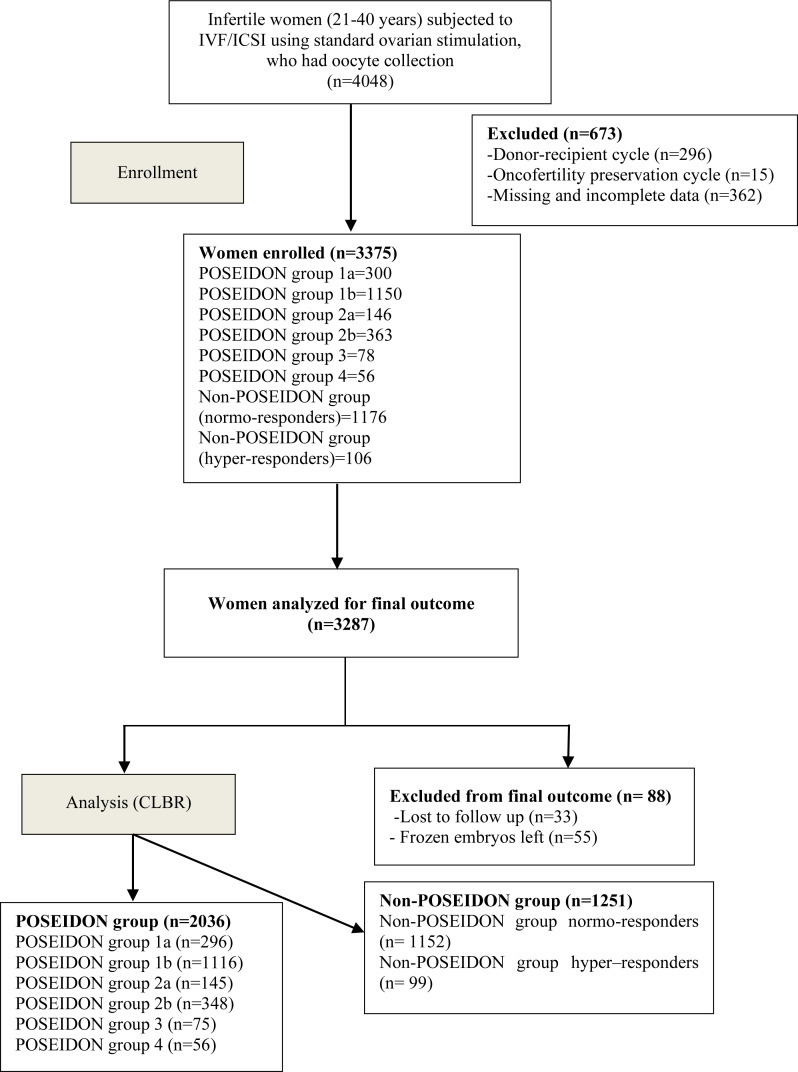
A total of 4048 ART cycles were done during the period of January 2011 and December 2020. Figure 1 presents the consort diagram of the study participants. Out of 3375 IVF cycles included in the study, 88 women were excluded from the final outcome evaluation due to lost to follow up (n=33) and those who had no pregnancy but frozen embryos left (n=55). Therefore, for final outcome evaluation, 3287 women were analyzed. The CLBR was calculated as per aspiration cycle in 3287 women. There was a total of 2929 fresh transfers and 1072 frozen transfers.
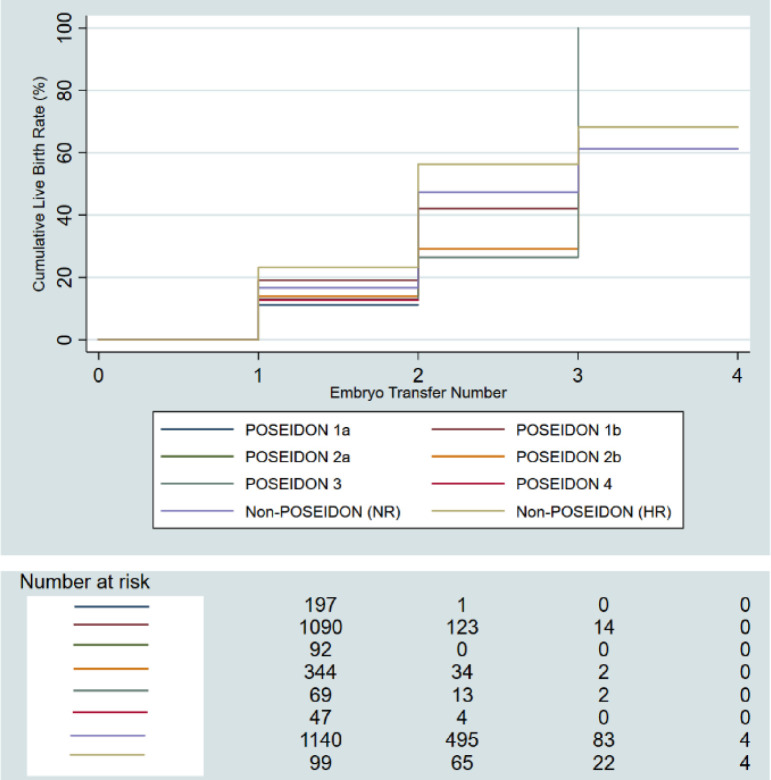
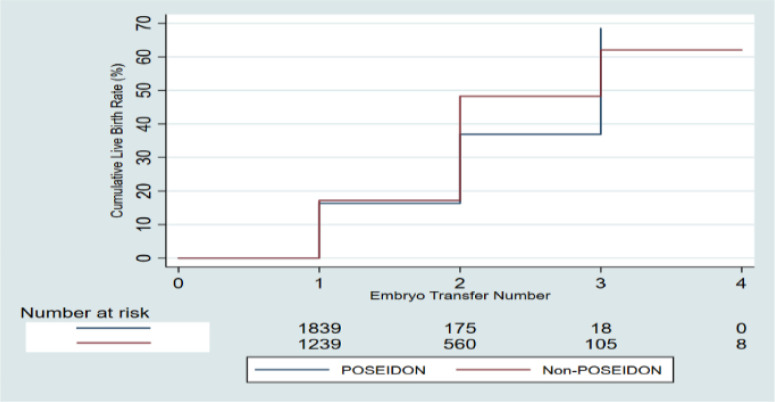
The CLBR was also calculated using the non-parametric Kaplan–Meier method and uncensored values (known final outcome). The “time” response in the model was the order of ETs; each patient was the unit of observation, whereas live birth delivery was the event. Time-to-event plots and their corresponding tables were generated using three approaches as follows:
![Figure 4. The Kaplan-Meier CLBR plot among POSEIDON and non-POSEIDON groups [Both grouped according to age: younger (<35 years) and older (≥ 35 years)]](/data/jri/fulltext/figures/PMC10402454/JRI-24-117-g004.jpg)
For Kaplan-Meier graphs, further 209 women were excluded where ET did not happen due to empty follicle syndrome, fertilization failure, and cleavage failure; therefore, 3028 cases were finally included and CLBR per ET was calculated.
Table 1 shows the baseline characteristics of the patient population. Ages of POSEIDON group 1 and 3 were comparable to non-POSEIDON groups while group 2 and 4 had significantly higher age than non-POSEIDON groups. Female factor was the most common cause of infertility among all the groups. Table 2 shows the baseline investigations of the study participants. Agonist was the most common stimulation protocol used in all POSEIDON and non–POSEIDON groups, except POSEIDON group 1a and group 4 where antagonist protocol was the most common protocol.
Table 1. Comparison of baseline characteristics of POSEIDON with non-POSEIDON group
| POSEIDON groups (n=2093) | Non-POSEIDON (normo-responder) group | Non-POSEIDON (hyper-responder) group | Comparison of POSEIDON groups with non-POSEIDON normo-responder group (p-value) | Comparison of POSEIDON groups with non-POSEIDON hyper-responder group (p-value) | ||||||||||||||||
|---|---|---|---|---|---|---|---|---|---|---|---|---|---|---|---|---|---|---|---|---|
|
| ||||||||||||||||||||
| Baseline characteristics | Group 1 (n=1450) | Group 2 (n=509) | Group 3 (n=78) | Group 4 (n=56) | ||||||||||||||||
|
| ||||||||||||||||||||
| 1a (n=300) | 1b (n=1150) | 2a (n=146) | 2b (n=363) | 3 (n=78) | 4 (n=56) | (n=1176) | (n=106) | 1a | 1b | 2a | 2b | 3 | 4 | 1a | 1b | 2a | 2b | 3 | 4 | |
| Age * (years) | 30.26±2.81 | 29.98±2.77 | 36.62±1.49 | 36.61±1.59 | 30.57±2.78 | 37.12±1.71 | 30.71±3.64 | 29.20±3.20 | 0.615 | <0.001 | <0.001 | <0.001 | 1.000 | <0.001 | 0.199 | 0.469 | <0.001 | <0.001 | 0.220 | <0.001 |
| BMI* (kg/m2) | 24.51±3.21 | 24.54±3.39 | 25.28±3.69 | 25.44±3.54 | 24.86±3.38 | 27.13±3.54 | 24.87±3.40 | 24.34±3.75 | 0.919 | 0.631 | 0.966 | 0.358 | 1.000 | 0.002 | 1.000 | 1.000 | 0.704 | 0.293 | 0.994 | 0.001 |
| Infertility n (%) $ | ||||||||||||||||||||
| Primary | 265 (88.33) | 1048 (91.13) | 127 (86.99) | 317 (87.33) | 74 (94.87) | 52 (92.86) | 967 (82.23) | 91 (85.85) | 0.011 | <0.001 | 0.164 | 0.024 | 0.003 | 0.042 | 0.495 | 0.081 | 0.853 | 0.743 | 0.053 | 0.212 |
| Secondary | 35 (11.67) | 102 (8.87) | 19 (13.01) | 46 (12.67) | 4 (5.13) | 4 (7.14) | 209 (17.77) | 15 (14.15) | ||||||||||||
| Cause of infertility n (%) $ | ||||||||||||||||||||
| Male | 53 (17.67) | 233 (20.26) | 19 (13.01) | 60 (16.53) | 16 (20.51) | 9 (16.07) | 207 (17.60) | 10 (9.43) | 0.042 | 0.424 | <0.001 | <0.001 | 0.758 | 0.816 | 0.001 | 0.003 | <0.001 | <0.001 | 0.028 | 0.360 |
| Female | 163 (54.33) | 682 (59.30) | 74 (50.68) | 189 (52.07) | 46 (58.97) | 38 (67.86) | 726 (61.73) | 81 (76.42) | ||||||||||||
| Unexplained | 67 (22.33) | 180 (15.65) | 45 (30.82) | 105 (28.93) | 14 (17.95) | 8 (14.29) | 188 (15.99) | 10 (9.43) | ||||||||||||
| Combined | 17 (5.67) | 55 (4.78) | 8 (5.48) | 9 (2.48) | 2 (2.56) | 1 (1.79) | 55 (4.68) | 5 (4.72) | ||||||||||||
| FSH* (mIU/ml) | 6.59±2.15 | 6.33±2.04 | 6.59±2.02 | 6.35±1.81 | 6.41±2.24 | 7.46±2.41 | 5.61±1.57 | 5.47±1.63 | <0.001 | <0.001 | <0.001 | <0.001 | 0.065 | <0.001 | <0.001 | 0.005 | 0.002 | 0.012 | 0.128 | <0.001 |
| LH# (mIU/ml) | 4.26 (3.00,5.72) | 4.11 (2.92,5.77) | 4.10 (2.91,5.78) | 4.00 (3,5.52) | 3.73 (2.81,4.71) | 4.14 (2.86,5.38) | 4.49 (3.10,6.09) | 5.10 (3.56,7.01) | 0.0799 | 0.0051 | 0.102 | 0.016 | 0.001 | 0.154 | <0.001 | <0.001 | <0.001 | <0.001 | <0.001 | <0.001 |
| AMH (ng/ml) | 3.11 (2.30,4.66) | 3.42 (2.46,4.92) | 2.71 (2,3.72) | 2.83 (2.12,4.32) | 1.01 (0.81,1.11) | 0.99 (0.70,1.09) | 4.30 (3.0,6.56) | 4.49 (3.19,8.61) | <0.001 | <0.001 | <0.001 | <0.001 | <0.001 | <0.001 | <0.001 | <0.001 | <0.001 | <0.001 | <0.001 | <0.001 |
| AFC# | 11 (8,15) | 12 (10,16) | 9(7,12) | 11(8,14) | 9(7,13) | 7(6,9) | 15(12,20) | 34(30,40) | <0.001 | <0.001 | <0.001 | <0.001 | <0.001 | <0.001 | <0.001 | <0.001 | <0.001 | <0.001 | <0.001 | <0.001 |
Mean±SD,
Median (p25, p75),
Bonferroni correction
p<0.004 is significant, rest p<0.05 is significant
Table 2. Comparison of ovarian stimulation characteristics and outcome of POSEIDON with non-POSEIDON group
| POSEIDON groups (n=2093) | Non-POSEIDON (normo-responder) group | Non-POSEIDON (hyper-responder) group | Comparison of POSEIDON groups with non-POSEIDON normo-responder group (P value) | Comparison of POSEIDON groups with non-POSEIDON hyper-responder group (P value) | ||||||||||||||||
|---|---|---|---|---|---|---|---|---|---|---|---|---|---|---|---|---|---|---|---|---|
|
| ||||||||||||||||||||
| Ovarian stimulation characteristics | Group 1 (n=1450) | Group 2 (n= 509) | Group 3 (n=78) | Group 4 (n=56) | ||||||||||||||||
|
| ||||||||||||||||||||
| 1a (n=300) | 1b (n=1150) | 2a (n=146) | 2b (n=363) | 3 (n=78) | 4 (n=56) | (n=1176) | (n=106) | 1a | 1b | 2a | 2b | 3 | 4 | 1a | 1b | 2a | 2b | 3 | 4 | |
| Stimulation protocol n (%) $ | ||||||||||||||||||||
| Antagonist | 143 (47.66) | 439 (38.17) | 55 (37.67) | 142 (39.11) | 27 (34.61) | 27 (48.21) | 474 (40.30) | 48 (45.28) | <0.001 | 0.003 | <0.001 | <0.001 | <0.001 | <0.001 | <0.001 | 0.080 | <0.001 | 0.001 | <0.001 | .001 |
| Agonist | 123 (41.00) | 676 (58.78) | 67 (45.89) | 188 (51.79) | 37 (47.43) | 22 (39.28) | 689 (58.58) | 58 (54.71) | ||||||||||||
| Microdose flare | 34 (11.33) | 35 (3.04) | 24 (16.43) | 33 (9.09) | 14 (17.94) | 7 (12.50) | 13 (1.10) | 0.00(0.00) | ||||||||||||
| Total rFSH* (IU) | 2673.77±1190.23 | 2823.10±1059.36 | 3096.53±1387.79 | 3135.57±1279.33 | 2970.30±1178.53 | 3365.89±1742.51 | 2655.89±977.67 | 2429.36±950.89 | 1.000 | 0.069 | 0.009 | <0.001 | 0.571 | 0.008 | 0.798 | 0.086 | 0.003 | <0.001 | 0.156 | 0.001 |
| Total HMG# (IU) | 675 (375,2625) | 600 (300,1725) | 2100 (450,3675) | 750 (375,2625) | 1087.5 (525,2700) | 1612.50 (675,3600) | 375 (300,900) | 337.5 (225,375) | <0.001 | <0.001 | <0.001 | <0.001 | <0.001 | <0.001 | <0.001 | <0.001 | <0.001 | <0.001 | <0.001 | <0.001 |
| E2# (pg/ml) | 1665 (900,2524) | 2792 (1958,4280) | 1219 (851,2274) | 2738 (1772,4361) | 2433 (1532,3560) | 1221 (766,2550) | 4448 (3138,4941) | 5085 (4256,7590) | <0.001 | <0.001 | <0.001 | <0.001 | <0.001 | <0.001 | <0.001 | <0.001 | <0.001 | <0.001 | <0.001 | <0.001 |
| P4# (ng/ml) | 1.14 (0.68,1.9) | 1.11 (0.76,1.61 | 1.02 (0.81,1.81) | 1.12 (0.78,1,71) | 1.04 (0.7,1.45) | 0.91 (0.48,1.32) | 1.30 (0.92,1.98) | 1.27 (1.06,1.73) | <0.001 | <0.001 | <0.001 | <0.001 | <0.001 | <0.001 | 0.022 | 0.001 | 0.011 | 0.012 | 0.002 | <0.001 |
| Total stimulation days # | 11 (9,12) | 11 (10,12) | 11 (9,12) | 11 (10,12) | 10 (10,11) | 10 (9,12) | 10 (10,11) | 10 (9,11) | 0.130 | 0.014 | 0.141 | 0.003 | 0.366 | 0.078 | 0.019 | 0.006 | 0.990 | 0.968 | 0.211 | 0.418 |
| ET on day of trigger (mm)* | 8.69±1.72 | 9.06±1.62 | 9.12±1.87 | 9.10±1.75 | 8.94±1.57 | 8.60±1.90 | 9.14±1.65 | 9.36±1.90 | 0.013 | 0.984 | 1.000 | 1.000 | 0.994 | 0.604 | 0.087 | 0.882 | 0.023 | 0.001 | 0.911 | 0.399 |
| FOI* | 0.20±0.16 | 0.56±0.25 | 0.26±0.18 | 0.58±0.23 | 0.69±0.37 | 0.52±0.28 | 0.91±0.42 | 0.75±0.12 | <0.001 | <0.001 | <0.001 | <0.001 | <0.001 | <0.001 | <0.001 | <0.001 | <0.001 | 0.002 | 0.981 | 0.011 |
| Oocyte retrieved # | 2 (1,3) | 7 (5,8) | 2 (1,3) | 6 (5,8) | 6 (4,10 | 4 (2,5) | 12 (11,15) | 24 (22,28) | <0.001 | <0.001 | <0.001 | <0.001 | <0.001 | <0.001 | <0.001 | <0.001 | <0.001 | <0.001 | <0.001 | <0.001 |
| MII # | 2 (0,2) | 5 (3,6) | 2 (0,2) | 4 (3,5) | 4 (3,7) | 2 (1,4) | 9 (7,10) | 17 (15,20) | <0.001 | <0.001 | <0.001 | <0.001 | <0.001 | <0.001 | <0.001 | <0.001 | <0.001 | <0.001 | <0.001 | <0.001 |
| Fertilization rate* | 90.29±29.19 | 98.26±12.02 | 84.01±36.30 | 97.58±14.13 | 94.57±22.48 | 92.30±26.90 | 95.14±14.22 | 92.35±16.38 | 0.013 | 0.007 | <0.001 | 0.577 | 1.000 | 0.986 | 0.988 | 0.113 | 0.058 | 0.358 | 0.998 | 1.000 |
| Cleavage rate# | 0 (0,100) | 100 (47,100) | 0 (0,0) | 100 (0,100) | 100 (83.33,100) | 87.50 (0,100) | 77.77 (62.50,100) | 87.50 (72.22,100) | <0.001 | <0.001 | <0.001 | 0.009 | <0.001 | 0.288 | <0.001 | 0.259 | <0.001 | 0.202 | 0.002 | 0.034 |
| Total Embryos# | 2 (0,2) | 4 (3,6) | 1 (0,2) | 4 (3,5) | 4 (2,6) | 2 (1,4) | 8 (6,10) | 15 (11,18) | <0.001 | <0.001 | <0.001 | <0.001 | <0.001 | <0.001 | <0.001 | <0.001 | <0.001 | <0.001 | <0.001 | <0.001 |
| Vitrified embryos n (%) $ | 11 (3.67) | 227 (19.74) | 5 (3.42) | 65 (17.91) | 15 (19.23) | 9 (16.07) | 649 (55.19) | 88 (83.02) | <0.001 | <0.001 | <0.001 | <0.001 | <0.001 | <0.001 | <0.001 | <0.001 | <0.001 | <0.001 | <0.001 | <0.001 |
| Day of embryo transfer# | 2 (2,3) | 3 (3,3) | 2 (2,3) | 3 (2,3) | 3 (2,3) | 3 (2,3) | 5 (3,5) | 5 (5,5) | <0.001 | <0.001 | <0.001 | <0.001 | <0.001 | <0.001 | <0.001 | <0.001 | <0.001 | <0.001 | <0.001 | <0.001 |
| EFS n (%) | 60 (20.00) | 6 (0.52) | 22 (15.06) | 0 (0.00) | 2 (2.56) | 4 (7.14) | 0 (0.00) | 0 (0.00) | ||||||||||||
| Fertilization Failure n (%) | 22 (7.33) | 14 (1.21) | 19 (13.01) | 4 (1.10) | 4 (5.12) | 4 (7.14) | 12 (1.02) | 0 (0.00) | ||||||||||||
| Cleavage failure n (%) | 17 (5.66) | 6 (0.52) | 12 (8.21 | 0 (0.00) | 0 (0.00) | 1 (1.78) | 0 (0.00) | 0 (0.00) | ||||||||||||
Mean±SD,
Median (p25, p75),
Bonferroni correction
P<0.004 is significant, rest P<0.05 is significant
As shown in table 2, oocytes retrieved and MII oocytes were significantly higher in non-POSEIDON groups as compared to POSEIDON groups (p<0.001). Follicle-to-oocyte index (FOI) was significantly higher in non-POSEIDON groups in comparison to all POSEIDON groups; however, the difference was not statistically significant in POSEIDON group 3 when compared to hyper-responders. The frequency of empty follicle syndrome (EFS) was the highest in group 1a among POSEIDON groups.
The main outcome, cumulative live birth rate (CLBR), was two-fold lower in POSEIDON group (combined) as compared to non-POSEIDON group (combined) (353/2036, 17.33%; 451/1251, 36.05%, p<0.001) (Table 3).
Table 3. Comparison of pregnancy outcomes of POSEIDON groups with non-POSEIDON group
| POSEIDON groups (n=2093) | Non-POSEIDON (normo-responder) group | Non-POSEIDON (hyper-responder) group | Comparison of POSEIDON groups with non-POSEIDON normo-responder group | Comparison of POSEIDON groups with non-POSEIDON hyper-responder group | ||||||||||||||||
|---|---|---|---|---|---|---|---|---|---|---|---|---|---|---|---|---|---|---|---|---|
|
| ||||||||||||||||||||
| Group 1 (n=1450) | Group 2 (n= 509) | Group 3 (n=78) | Group 4 (n=56) | |||||||||||||||||
|
| ||||||||||||||||||||
| 1a (n=300) | 1b (n=1150) | 2a (n=146) | 2b (n=363) | 3 (n=78) | 4 (n=56) | (n=1176) | (n=106) | P value | P value | |||||||||||
| Women were excluded due to lost to follow up and no pregnancy but frozen embryos left | n=4 | n=34 | n=1 | n=15 | n=3 | n=0 | n=24 | n=7 | 1a | 1b | 2a | 2b | 3 | 4 | 1a | 1b | 2a | 2b | 3 | 4 |
| Final women for analysis | n=296 | n=1116 | n=145 | n=348 | n=75 | n=56 | n=1152 | n=99 | ||||||||||||
| TPR/aspiration cycle | 29 (9.79) | 335 (30.01) | 10 (6.89) | 72 (20.68) | 16 (21.33) | 10 (17.85) | 487 (42.27) | 63 (63.63) | <0.001 | <0.001 | <0.001 | <0.001 | <0.001 | <0.001 | <0.001 | <0.001 | <0.001 | <0.001 | <0.001 | <0.001 |
| CPR/aspiration cycle | 28 (9.45) | 312 (27.95) | 10 (6.89) | 66 (18.96) | 16 (21.33) | 9 (16.07) | 466 (40.45) | 62 (62.62) | <0.001 | <0.001 | <0.001 | <0.001 | 0.001 | <0.001 | <0.001 | <0.001 | <0.001 | <0.001 | <0.001 | <0.001 |
| CLBR/aspiration cycle | 22 (7.43) | 249 (22.31) | 8 (5.51) | 55 (15.80) | 13 (17.33) | 6 (10.71) | 394 (34.20) | 57 (57.57) | <0.001 | <0.001 | <0.001 | <0.001 | 0.002 | <0.001 | <0.001 | <0.001 | <0.001 | <0.001 | <0.001 | <0.001 |
| CLBR/ET | 22/198 (11.1) | 249/1227 (20.3) | 8/92 (8.7) | 55/380 (14.5) | 13/84 (15.5) | 6/51 (11.8) | 394/1722(22.9) | 57/190 (30.0) | ||||||||||||
TPR = Total pregnancy rate, CPR= Clinical pregnancy rate, CLBR = Cumulative live birth rate
Logistic regression analysis: A regression analysis was done to see the relationship between women parameters like age, BMI, AFC, AMH, gonadotropin used, infertility factor, trigger, number of oocytes retrieved and cumulative live birth rate in POSEIDON and non-POSEIDON group. In non-POSEIDON group, gonadotropin dose, AFC, infertility factor, AMH, protocol, BMI, and trigger were dropped from the model suggesting no relation, whereas age and oocytes retrieved showed significant relationship with cumulative live birth rate. In POSEIDON group, gonadotropin dose, AFC, infertility factor, AMH, BMI, and trigger were dropped from the model, suggesting no association, whereas age, oocytes retrieved, and protocol had significant relationship with cumulative live birth rate.
For every one-year increase in the age, the odds of CLBR decreased by approximately 4% (OR 0.96, CI 0.93–0.99) in POSEIDON group and by 5% (OR 0.95, CI 0.92–0.98) in non-POSEIDON group, probably because of oocyte quality, whereas for every unit increase in oocytes retrieved, the odds of CLBR increased by 1.22 times (OR1.22, CI 1.16–1.28) in POSEIDON group and by 1.08 times (OR1.08, CI 1.05–1.11) in non-POSEIDON group. Increased number of oocytes leads to creation of supernumerary embryos which can be cryopreserved for later use and subsequent multiple embryo transfer, thereby the chance of live birth would be enhanced. In POSEIDON group, agonist protocol increases the odds of CLBR 1.30 times (Table 4).
Table 4. Univariate analysis of comparison of different POSEIDON groups with non-POSEIDON groups
| POSEIDON group | Non-POSEIDON group | |||
|---|---|---|---|---|
|
| ||||
| CLBR | Adjusted odds ratio (95% confidence interval) | Unadjusted odds ratio (95% confidence interval) | Adjusted odds ratio (95% confidence interval) | Unadjusted odds ratio (95% confidence interval) |
| Age | 0.96 (0.93–0.99) | 0.95 (0.92–0.97) | 0.95 (0.92–0.98) | 0.94 (0.91–0.97) |
| Oocytes retrieved | 1.22 (1.16–1.28) | 1.24 (1.18–1.30) | 1.08 (1.05–1.11) | 1.08 (1.06–1.12) |
| Stimulation protocol | ||||
| Antagonist | Reference | Reference | - | - |
| Agonist | 1.30 (1.01–1.67) | 1.46 (1.14–1.86) | - | - |
| Microdose flare up | 1.06 (0.60–1.84) | 0.77 (0.14–0.20) | - | - |
Considering only one ET was done, the probability of having live birth was maximum in POSEIDON group 1b (19%) followed by POSEIDON group 2b (14%), followed by POSEIDON group 3 (13%), followed by group 4 (13%), followed by group 1a (11%), and the chance was the lowest in POSEIDON group 2a (9%). Among non-POSEIDON groups, hyper-responder group had higher cumulative live birth rate as compared to normo-responders (23%, 17%) (Figure 2 and supplementary table 3).
When all POSEIDON groups were combined together and compared with combined non-POSEIDON group for CLBR, the probability of CLBR was higher in non-POSEIDON group than POSEIDON group (17%, 16%) when one ET was done (Figure 3 and supplementary table 4). But overall, CLBR was almost more than double the rate in POSEIDON group. This may be explained by a greater number of oocytes and embryos available in non-POSEIDON group, thus a greater number of total ETs and higher overall CLBR. This further explained the number of available oocytes as the independent factor affecting CLBR. When POSEIDON and non-POSEIDON groups were divided according to age, then younger non-POSEIDON cases had similar CLBR (18%) as younger POSEIDON women (18%) after undergoing at least one ET. In older group, non-POSEIDON women (14%) had better CLBR than POSEIDON women (13%) with at least one ET done (Figure 4 and supplementary table 5).
In comparison to non–POSEIDON group, the highest CLBR was detected in younger suboptimal response group 1b followed by younger poor reserve group 3, older suboptimal response group 2b, older low reserve group 4, younger poor response group 1a, and older poor response group 2a, respectively (Table 3). Table 5 presents the univariate analysis showing different POSEIDON groups and CLBR, taking non-POSEIDON group as the reference.
Table 5. Multivariable logistic regression analysis showing factors affecting CLBR in POSEIDON and non-POSEIDON groups
| CLBR | Unadjusted odds ratio (95% CI) | p-value |
|---|---|---|
| Non-POSEIDON group (normo-responders and hyper-responders) | Reference | |
| POSEIDON1a | 0.14 (0.09–0.22) | <0.001 |
| POSEIDON1b | 0.51 (0.42–0.61) | <0.001 |
| POSEIDON 2a | 0.10 (0.05–0.21) | <0.001 |
| POSEIDON 2b | 0.33 (0.24–0.45) | <0.001 |
| POSEIDON 3 | 0.37 (0.09–0.50) | 0.001 |
| POSEIDON 4 | 0.21 (0.50–0.63) | 0.002 |
Regarding sub-group analysis based on age of POSEIDON cohort, younger age group (group 1 and 3) had better outcome in terms of total oocytes retrieved, total MII oocytes, fertilization rate, day 3 cleavage rate, number of cryopreserved embryos, and cumulative live birth rate. Total administered human menopausal gonadotropin (hMG) was significantly higher in the older group (group 2 and 4) (Supplementary table 1).
On dividing the POSEIDON cohort according to ovarian reserve (good reserve group; group 1 and 2) versus (poor ovarian reserve; group 3 and 4), the total gonadotropin dose administered was greater in poor reserve group than good reserve group, whereas they were comparable in terms of total oocytes retrieved, total MII oocytes, fertilization rate, number of cryopreserved embryos, total pregnancy rate, clinical pregnancy rate, and cumulative live birth rate (Supplementary table 2).
The present research is the first study to evaluate IVF outcomes in terms of cumulative live birth rate among low prognosis Asian-Indian women undergoing IVF-ICSI cycles. According to the findings, CLBR in POSEIDON patients was almost half of that in non-POSEIDON women. The study showed that among both POSEIDON and non-POSEIDON population, female age and oocyte number are the most important predictors of cumulative live birth rate.
Previous studies done on POSEIDON stratification of women undergoing IVF/ICSI cycles have shown similar results concluding female age and oocyte number as the most important parameters affecting CLBR irrespective of the fact whether the woman belongs to POSEIDON or non-POSEIDON group (11–13).
The single most important parameter affecting oocyte yield and CLBR is the female age. Similar to previously reported studies (14, 15), the present study showed significantly higher pregnancy rate and CLBR among young POSEIDON (group 1 and 3) as compared to older POSEIDON (group 2 and 4) groups. When comparing group 2 and 3, it was revealed that although group 2 had higher number of oocytes and embryos, significantly higher CLBR was reported in group 3 than group 2 due to younger age with higher oocyte yield (16). In the present study, group 2 was further divided into poor (2a) and sub-optimal responders (2b). Therefore, slightly higher CLBR was reported in group 2b (14%) as compared to group 3 (13%). Group 2a demonstrated the lowest CLBR rates among all the POSEIDON groups. Advancing age affects the IVF outcomes by decreasing both oocyte quantity and quality, thus affecting implantation, aneuploidy, and miscarriage rates. Thus, POSEIDON stratification may be of help to the clinicians in counselling low prognosis women planning for IVF treatments.
Different researchers have categorized different groups as comparators to POSEIDON groups either according to both AFC and oocyte (16), or only number of oocytes. Esteves et al. have done the similar stratification and analysis although higher CLBR has been reported in all POSEIDON groups (34%) as compared to the present study (17.33%) (4). This may be due to different patient profiles, different protocols used, ethnic variations, and the effect of socio-demographic factors in different study populations. Indian women have been reported to age 5–6 years faster than western age-matched counterparts which may explain the comparatively lower CLBR in POSEIDON group. Also, in Esteves et al.’s study, all patients with >9 oocytes were considered as a single non-POSEIDON group. Yet, in the present study, non-POSEIDON group was divided into further two groups according to number of oocytes retrieved. Although the number of hyper-responders was comparatively less, this group had the highest CLBR in our study. This may be explained by CLBR as a function of number of oocytes, embryos, and supernumerary embryos available for frozen embryo transfer.
POSEIDON stratification may help to prognosticate women undergoing repeated IVF cycles after failed attempts. Interventions may vary depending upon POSEIDON stratification. In a study by Leijdekkers et al., CLBR rates were calculated among POSEIDON stratified women over repeated IVF cycles. Their CLBR rate was about 56% over 18 months which could be due to repeated IVF cycles (17). This will help to give realistic picture of success rate of repeated IVF cycles.
This is the first study from India assessing IVF outcomes in different POSEIDON groups among women undergoing IVF. CLBR as the primary outcome measure was calculated which is considered the most important and relevant parameter to assess ART success. In fact, large amounts of data were gathered during the 10 years. Our results might add to the existing literature on validation of POSEIDON criteria and help these DOR women in prognosticating and individualizing the treatment for better ART outcomes. Limitations include retrospective nature of the study and male factor was not excluded which could have affected the outcome.
POSEIDON stratification of low prognosis women undergoing IVF stands strong and is valid to prognosticate and counsel the women undergoing IVF. Non-POSEIDON women have almost 2-fold higher CLBR in comparison to POSEIDON group. With at least one embryo transfer done, young POSEIDON women have similar cumulative live birth rate (CLBR) as non-POSEIDON women. Similarly, with at least one embryo transfer done, women’s CLBR in POSEIDON suboptimal response group 1b and group 2b was nearer to normo-responders. This implies that the age and oocyte quantity are the independent factors affecting CLBR in both POSEIDON and non-POSEIDON groups. POSEIDON stratification of low prognosis women undergoing IVF may help the clinicians to individualize the treatment protocols, select the option of repeat IVF using self-oocyte, or refer the couple for IVF using donor oocyte. The same may be used in routine clinical practice to counsel the couples planning for IVF treatments. As most of the studies are retrospective on POSEIDON stratification and IVF outcomes, further prospective trials with larger sample size are warranted in different ethnic populations.
