
Infertility is characterized by the failure to establish a clinical pregnancy after 12 months of regular, unprotected sexual intercourse (1). According to the World Health Organization (WHO), approximately 15% of couples are infertile (2), with specific causes including ovulatory dysfunction (20%‒40%), tubal and peritoneal pathology (30%‒40%), male factors related to the quality or production of spermatozoa (30%‒40%), and some unknown factors (3). In such cases, many couples seek to overcome infertility through assisted reproductive technologies (ARTs). Among the available ARTs, intracytoplasmic sperm injection (ICSI) is widely implemented to address male factors, as the sperm is directly injected into the egg.
As ARTs require high-quality sperm, samples can first be subjected to sperm selection, which should ideally be a simple process with a short preparation time. Ultimately, such procedures should yield high-quality sperm following contaminant removal, such as debris and leukocytes (4). Although several sperm selection methods are currently available, density gradient centrifugation (DGC) is the most widely used protocol. However, the procedure also entails risks, as centrifugation can cause oxidative stress that damages the sperm. Specifically, centrifugation is a major iatrogenic cause of reactive oxygen species (ROS) production (5), and its excess during the selection process can lead to quality issues such as sperm DNA fragmentation (SDF) and apoptosis. In addition, low fertilization rates and poor embryo development can substantially hinder the success of ARTs (6–9); for example, high SDF is correlated with low pregnancy and high miscarriage rates (10–14).
The microfluidic method is an alternative approach to sort spermatozoa, in which the sperm flow is manipulated using small amounts of fluid, with the sperm moving in the flow direction. Either active or passive flow has been applied for sperm sorting in previous studies (4, 15–17). In this arrangement, sperm with high motility can quickly reach the end of the equipment. Moreover, the procedure takes less time than other methods and can recover sperm of high quality. Compared with that in DGC, ROS production is reduced in the microfluidic method, as centrifugation is not required and its sorting time is short (the entire process requires just 20‒30 min). Several studies have shown that sperm, using the microfluidic method, have lower oxidative stress and less DNA fragmentation than those obtained using DGC or swim-up techniques (4, 15–20). Furthermore, the microfluidic method is relatively inexpensive and does not require intensive labor.
In this study, a capillary flow-driven, chemical-free microfluidic device, designed and developed in-house, was tested. Specifically, the novel device uses barriers to create microchannels that allow the entry of sperm with high motility, normal morphology, and low DNA fragmentation following the introduction of fresh semen. The results obtained using the in-house microfluidic device were also compared with those obtained using DGC, which is currently the standard method used for sperm processing at our center.
Study design and participant selection: This experimental study was approved by the Institutional Ethics Committee of the Faculty of Medicine, Prince of Songkla University (REC.63-123-12-4). All procedures followed in the study were in accordance with the ethical standards of the responsible committee on human experimentation (institutional and national) and the tenets of the Helsinki Declaration of 1964 and its later amendments. The procedures were conducted at the Reproductive Medicine Unit of Songklanagarind Hospital, Thailand, between 1 September 2020 and 28 February 2021. Participants were healthy men aged between 18 and 40 years with normal semen profiles according to the WHO (Geneva) criteria (21). The exclusion criteria were as follows: sexual abstinence for less than 2 days or more than 7 days, semen collected via sexual intercourse or deposited in an inappropriate container, use of lubricant, and semen viscosity that was considered excessive. All participants were provided sufficient information regarding this study, and their signed informed consent forms were obtained before enrolment. Personal data of the participants were also recorded.
The required sample size was calculated from three dependent means for a pair-matched study using α=0.017, and Zα/2=2.12, with the power of at least 80%, and with β=0.2 and Zβ=0.84. The mean difference between groups was 0.7. The effect size (delta/standard deviation) was 0.7. Therefore, the required sample size for this study was 18.
Sample collection: Of the 27 initial participants recruited, 19 were enrolled in the study and provided semen samples. All samples were produced via masturbation, collected in sterile containers, and allowed to liquefy for 30 min at room temperature (approximately 25°C). Each sample was then aliquoted into three tubes.
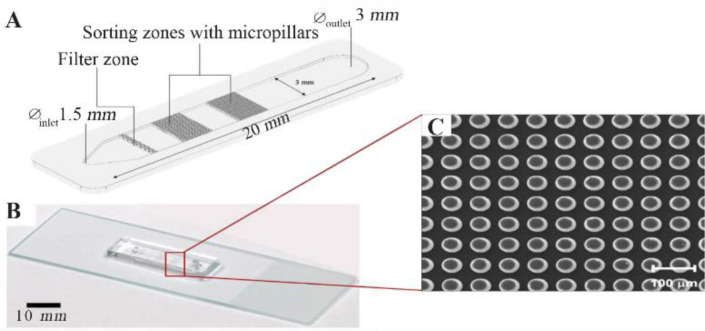
Device design: Our novel microfluidic device was constructed to feature micropillar arrays to mimic the natural filtering characteristics of the female reproductive tract (15, 22, 23). It was passive, non-invasive, and composed with a soft, flexible polymer called polydimethylsiloxane (PDMS). The design consisted of three zones inside the microchannel. The first zone was created to capture any blood cells or other pjri_articles that might be present in unprocessed semen. The remaining two zones, which featured pillar arrays, were designed to separate sperm with high motility and normal morphology. The channel dimensions of the microfluidic chip designed using NX software vs. 1953 (Siemens Digital Industries Software, USA) were as follows: 20 mm in length, 3 mm in width, and 50 μm in depth, with circular columns of 50 μm in diameter. There were three zones of micropillars with a gap in the middle, as illustrated in figure 1A. In the first zone, the micropillars were arranged in a staggered pattern to separate sperm from debris in raw semen before entering the next zone of the microchannel, whereas the micropillars in the second and third zones for sperm selection had an aligned arrangement, with 50–75 and 20–25-μm space between the micropillars, respectively. The mechanism of the device that allowed high motility sperm to move forward to the outlet was similar to the natural female genital tract. To account for sperm swimming behavior in pillar array geometries (15), the microchannels in the second and third zones contained multiple micropillars, which simulated the surface of the genital tract, featuring tiny pores and crypts that would trap sperm, thereby allowing sperm with high motility to move forward towards the outlet. Thus, highly progressive motile sperm with normal anatomy could reach the outlet faster than abnormal sperm. As this method does not involve centrifugation nor chemical substances, it should produce sperm with low SDF. Moreover, sperm with high motility and normal morphology should move through the microchannel toward the outlet. The diameter of the inlet was 1.5 mm, which fitted the tip of a micropipette to make it easier to inject the raw semen, and that of the outlet was 3 mm to allow for capillary flow, making it simple to collect sorted sperm. The actual image of the device is shown in figure 1B. The morphology of the micropillars observed using scanning electron microscopy is shown in figure 1C.
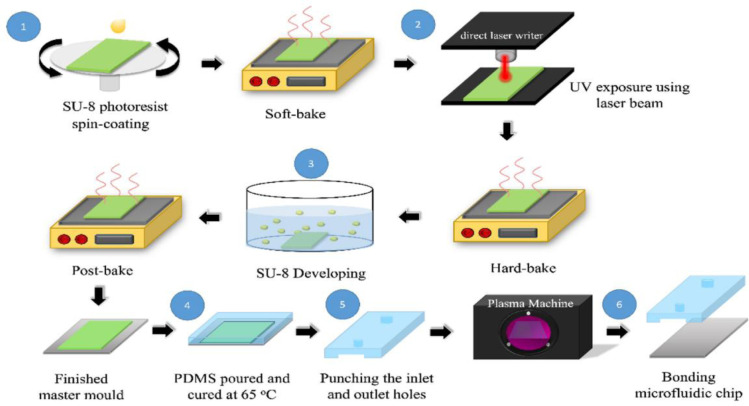
Device fabrication: The microfluidic chip was fabricated using photolithography and soft lithography. Polydimethylsiloxane (PDMS, Sylgard 184; Dow Corning Corp, USA) as a biocompatible material was used to fabricate the chip owing to its elasticity, transparency, gas permeability, nontoxicity, inexpensive material composition, easy disposability, and safety for use with reproductive cells. The device was fabricated using the following procedure:
Semen analysis: Sperm parameters were evaluated using a computer-assisted sperm analysis (CASA) system (IVOS II; Hamilton Thorne, USA) according to WHO guidelines (5th edition). Sperm motility was analyzed by placing 6 μl of sample on a slide and inserting it into the CASA system. Sperm morphology was analyzed by air-drying the sample on a glass slide, and then staining it with Diff-Quick stain. The CASA system was used to analyze the sample at a magnification of 40×. For comparative analysis, each fresh semen sample was aliquoted into three subsamples as follows:
Sperm preparation using DGC: DGC was performed with two layers—1 ml of 80% Sil-Select STOCK™ solution (Fertipro NV, Belgium) at the bottom and 1 ml of 40% Sil-Select STOCK™ solution on the top. A sample of 1 mm was then layered on top of the solution and centrifuged at 300× g for 15 min at room temperature (approximately 25°C). After removing the supernatant, the pellet was placed in a new conical tube with 4 ml of sperm washing medium (Gibco F-10 Nutrient Mixture; Gibco, USA) and then centrifuged at 300× g for 15 min at approximately 25°C. After removing the supernatant again, the pellet was washed with 4 ml of sperm culture medium and centrifuged at 400× g for 5 min at approximately 25°C. Finally, 0.5 ml of the suspended pellet was analyzed using the CASA system and subjected to DNA fragmentation assessment.
Sperm preparation using the microfluidic method: After manually filling the microfluidic device with sperm washing medium (Gibco F-10 Nutrient Mixture) using a micropipette, 2 μl of unprocessed semen was gently added into the inlet. The device was then placed in an incubator for 30 min at 37°C. Finally, the sperm were collected at the outlet and subjected to analysis using the CASA system and DNA fragmentation assessment.
Sperm DNA fragmentation analysis: DNA fragmentation was detected using the terminal deoxynucleotidyl transferase dUTP nick-end labeling (TUNEL) assay (Guava TUNEL Kit; Luminex, USA). Sperm were washed with cold phosphate-buffered saline, fixed with 4% paraformaldehyde, and then incubated for 1 hr at 4°C. Subsequently, ice-cold 70% ethanol was added, and then the samples were stored at −20°C for a minimum of 16 hr. The fixed samples were centrifuged at 300× g for 10 min. The supernatant was removed, and the pellets were washed with buffer and then centrifuged at 300× g for 10 min. After removing the supernatant, the DNA was labeled with a master mix of terminal deoxynucleotidyl transferase (TdT) enzyme reaction buffer, TdT enzyme, 5-bromo-2′-deoxyuridine 5′-triphosphate (BrdU), and sterile water, and incubated at 37°C for 1 hr. Rinsing buffer was added to the sample, which was then centrifuged at 300× g for 10 min. Next, a staining master mix of anti-BrdU containing anti-BrdU-TRIC and rinsing buffer was added to the sample; thereafter, the sample was incubated for 30 min in the dark at room temperature (approximately 25°C). Following incubation, rinsing buffer was added, and the sample was centrifuged at 300× g for 10 min. Fluorescent labeling was used to identify fragmented sperm DNA. The specimens were placed over a SuperFrost Plus glass slide, and 4′,6-diamidino-2-phenylindole (DAPI) counterstaining was used to identify other cells. In total, 200 sperm were counted from each specimen to calculate the DNA fragmentation index (DFI) under a fluorescence microscope.
Statistical analysis and data representation: Statistical analyses were performed using Stata software vs. 14.2 (StataCorp, USA), with baseline characteristics reported as mean±SD. Primary and secondary outcomes were analyzed using the mixed-effect Poisson regression for counted variables and mixed-effect linear regression for continuous variables. A concentration model was developed using log transformation. Statistical significance was determined at p<0.05. Figure 3 shows a flowchart outlining the study procedure.
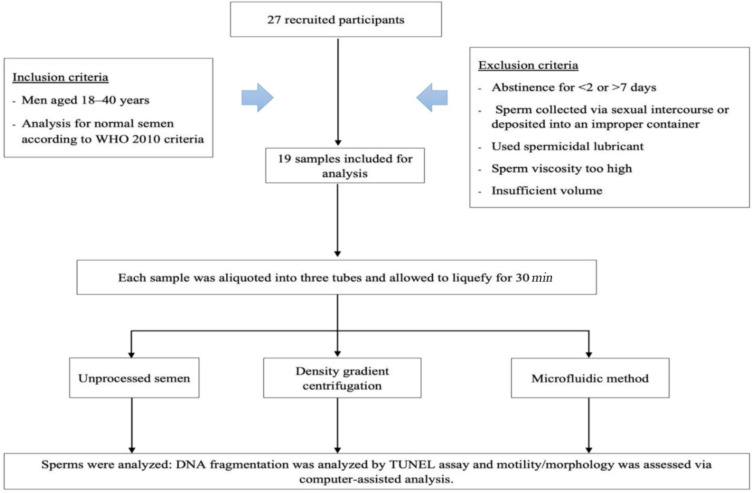
Participant characteristics and baseline semen analysis: After applying the exclusion criteria, 19 participants were enrolled in this study (mean age of 29±3 years). All 19 submitted semen samples were considered normal per the WHO criteria (21). Table 1 lists the basic demographic characteristics of the participants and initial semen analysis results.
Table 1. Baseline characteristics of the study population
| Parameter | Mean±SD (range) (n=19) |
|---|---|
| Age (years) | 29±3.0 (20‒40) |
| Sperm concentration (×106/ml) | 85.7±24.3 (40.6‒141) |
| Total motility (%) | 70.8±14.4 (41.6‒91.4) |
| Progressive motility (%) | 62.4±14.7 (34‒86) |
| Normal morphology (%) | 5.3±1.6 (4‒10) |
| Sperm DNA fragmentation (SDF) (%) | 4.9±3.6 (0.47‒16.5) |
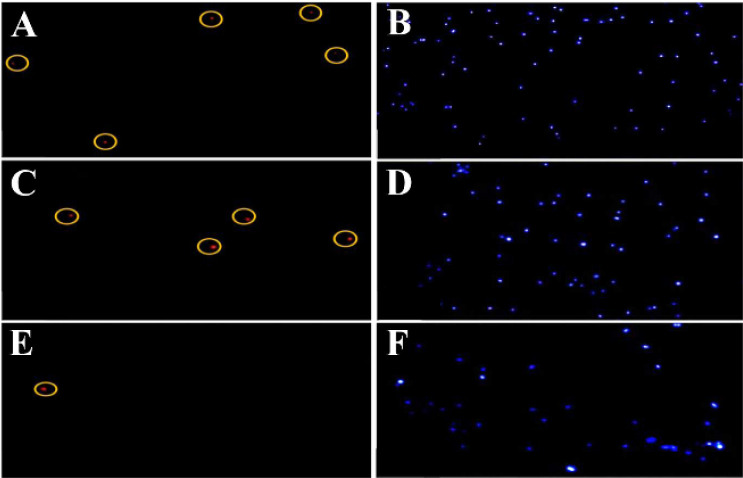
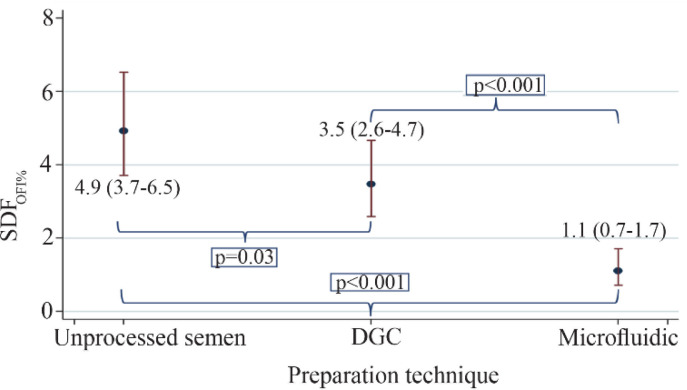
Sperm DNA fragmentation: After the TUNEL assay, DNA fragmentation was detected using fluorescence microscopy. Here, a minimum of 200 sperm from each sample were scored using light microscopy. As shown in figure 4, sperm stained with DAPI (blue) were first counted, followed by cells that emitted a red fluorescent signal (TUNEL-positive, highlighted with yellow circles). Figure 4A and 4B show sperm obtained from unprocessed semen, sperm obtained using density gradient centrifugation (Figure 4C, 4D), and sperm obtained using the microfluidic method (Figure 4E, 4F). The number of positive tests was assessed as the percentage of the total count. Sperm cells collected using the microfluidic method showed a significantly lower SDF than those collected using DGC and in the unprocessed semen, median SDF values were 1.1%, 3.5%, and 4.9%, respectively (Figure 5).
Sperm concentration, motility, and morphology: Both DGC and the microfluidic method yielded a lower sperm concentration than that in fresh semen. Although the microfluidic method yielded a significantly lower sperm concentration than DGC, there were no significant differences in total motility, progressive motility, curvilinear velocity, straight-line velocity, or normal morphology among the samples (Table 2).
Table 2. Semen parameters before and after density gradient centrifugation (DGC) and after using the microfluidic method
| Parameter | Before DGC | After DGC | After using the microfluidic method |
|---|---|---|---|
| Concentration (×106/ml) | 81.40 (56.83‒117.92) a | 19.30 (13.33‒27.67) b | 0.54 (0.37‒0.77) c |
| Total motility (%) | 70.78 (64.31‒77.26) a | 92.18 (89.80‒94.57) b | 91.52 (86.49‒96.55) b |
| Progressive motility (%) | 62.41 (55.82‒69.01) a | 89.22 (86.18‒92.23) b | 87.93 (82.64‒93.22) b |
| Curvilinear velocity (μm/s) | 70.65 (60.61‒81.14) a | 114.62 (104.13‒125.118) b | 118.14 (107.64‒128.63) b |
| Straight-line velocity (μm/s) | 32.82 (27.91‒37.74) a | 63.51 (58.60‒68.43) b | 64.73 (59.82‒69.65) b |
| Normal morphology (%) | 5.33 (4.59‒6.06) a | 10.45 (7.84‒13.06) b | 11.03 (7.58‒14.47) b |
| Sperm DNA fragmentation (SDF) (%) | 4.9 (3.7‒6.5) a | 3.5 (2.6‒4.7) b | 1.1 (0.7‒1.7) c |
Notes: Data are presented as mean (95% confidence interval).
Superscript letters (a–c) indicate significant differences between subgroups
In this study, a microfluidic device, designed and fabricated in-house, was successfully developed that yielded sperm with considerably lower SDF values in comparison to sperm obtained from un-processed semen or those obtained using DGC. This finding reinforces the efficacy of microfluidic devices in sperm selection, consistent with the findings of previous studies (15, 18–20), which used microfluidic devices and reported lower SDF values in comparison to those in which sperm were obtained using the swim-up technique involving centrifugation. Moreover, this finding highlights the efficacy of our device’s unique mechanism, which guides activated sperm towards the outlet zone using microchannel geometries. Our microfluidic device worked by leveraging sperm-swimming behavior and competition-based motility for sperm selection. Hence, sperm with abnormal morphology and low motility were unable to reach the outlet in the microchannel, whereas highly motile sperm could reach the outlet.
Our device had a simple fabrication process which was designed in-house; moreover, it was easier to use than devices currently commercially available. Notably, the microfluidic method used in this study produced sperm with motility similar to that of sperm obtained using DGC (18, 19). Thus, similar percentages of motile sperm were recovered using microfluidic and DGC methods, demonstrating comparability with widely implemented standardized techniques. Following the Kruger’s strict criteria, the in-house microfluidic chip also produced sperm with normal morphology at a rate of approximately 10%, which is equivalent to that achieved with DGC. Owing to the passive-dependent mechanism and short sorting time of sperm, less DNA damage from the sperm preparation process could be expected. This method caused only 1.1% of median SDF in the sperm. A similar finding was reported in a previous study that used a microfluidic device containing micropillars; the results demonstrated better outcomes than the swim-up method, leading to low SDF and greater number of sperm with high motility and normal morphology (15). Another study also demonstrated a higher number of sperm with low SDF and good motility which were recovered after sorting using a microfluidic device based on motility and thigmotaxis (24).
The in-house microfluidic device constitutes an ideal sperm selection method for use in ARTs. As demonstrated in this study, it is simple to use, requires less time, does not entail intensive labor, and consistently selects sperm with low SDF, high motility, and normal morphology. Currently, DGC and swim-up are the most commonly used methods of sperm preparation before application in in vitro fertilization and intracytoplasmic sperm injection. However, the DNA integrity of motile sperm recovered through these methods may be compromised (25). A recent study showed that 20–50% of viable sperm obtained using the DGC and swim-up methods exhibited SDF (26). In contrast, the microfluidic method produced considerably less SDF, with values ranging between 4–15% in a previous study (15). Notably, the in-house microfluidic chip used in the present study showed an SDF value of only 1.1% after complete sperm sorting. This finding is important in the context of clinical practice, as DNA damage in sperm cannot be detected before insemination. Several studies have shown that SDF adversely affects ART outcomes, resulting in low fertilization rates (8, 27), poor blastocyst development (28, 29), low implantation rates (8, 30), and high miscarriage rates (10, 11, 13, 30, 31). In contrast, accumulating evidence indicates that the microfluidic method can be used to isolate sperm with low SDF rates (15, 19, 20), resulting in improved ART outcomes.
The in-house microfluidic device described herein can successfully isolate sperm with considerably less SDF than those with DGC, with comparable motility and normal morphology rates between the samples. Regarding other important aspects, the device is not complicated to operate, labor-intensive, nor time-consuming, and is cost-effective owing to its unique in-house design and massive-scale fabrication process. However, the current design is limited by its microscale qualities, which result in a low number of recovered sperm. Consequently, the device is more suited to intracytoplasmic sperm injection. In the future, the design may be improved to select a higher number of sperm for use in either in vitro fertilization or intrauterine insemination.
We acknowledge the support of Infertility Unit team and Alan Frederick Geater, Ph.D., from the Epidemiology Unit, Prince of Songkla University, Hat Yai, Songkhla, Thailand. This study was supported by the Faculty of Medicine, Prince of Songkla University, Thailand [grant number 63-3-007]. The funding source had no role in the study design, in the collection, analysis, and interpretation of data or in the writing of the manuscript.
